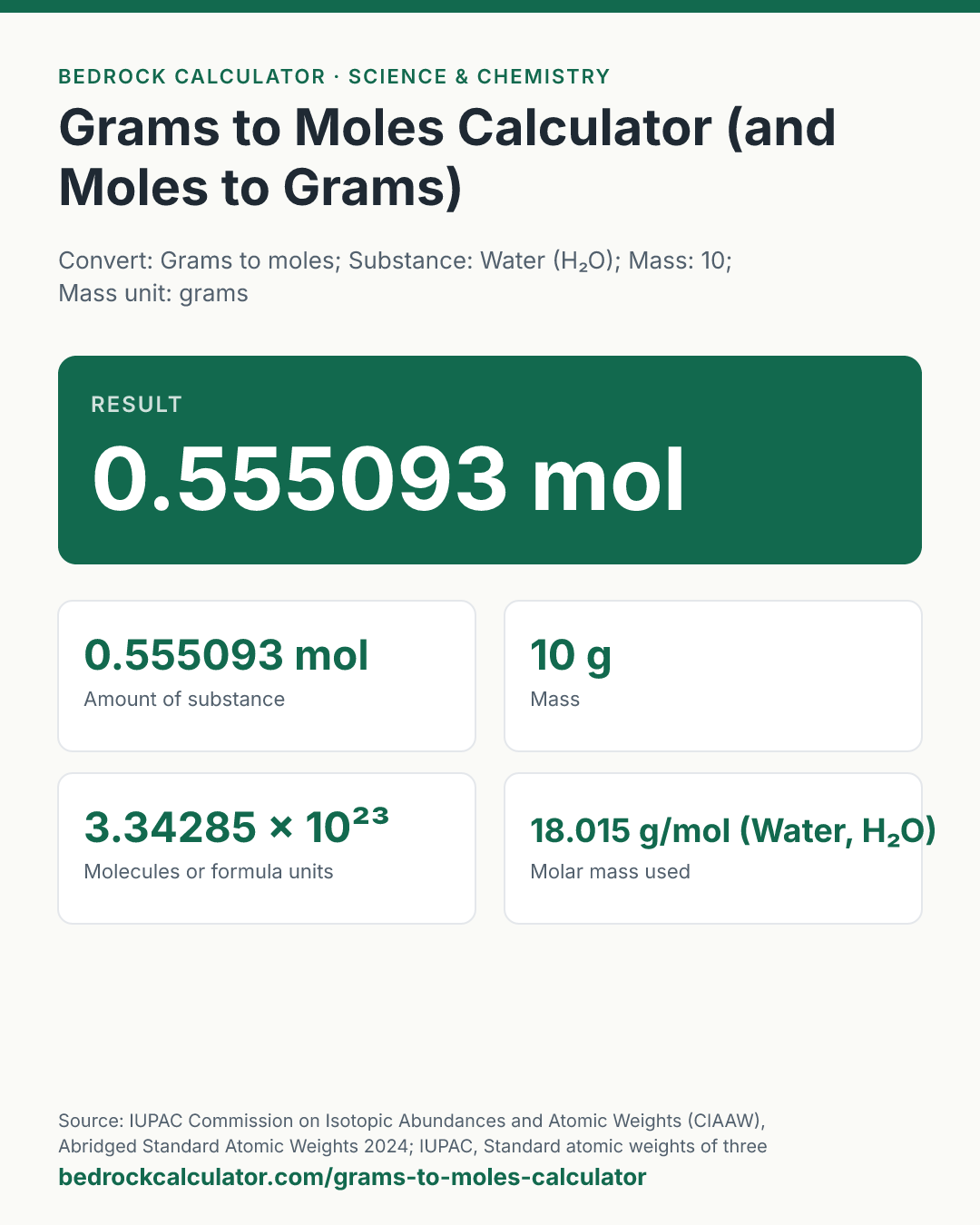
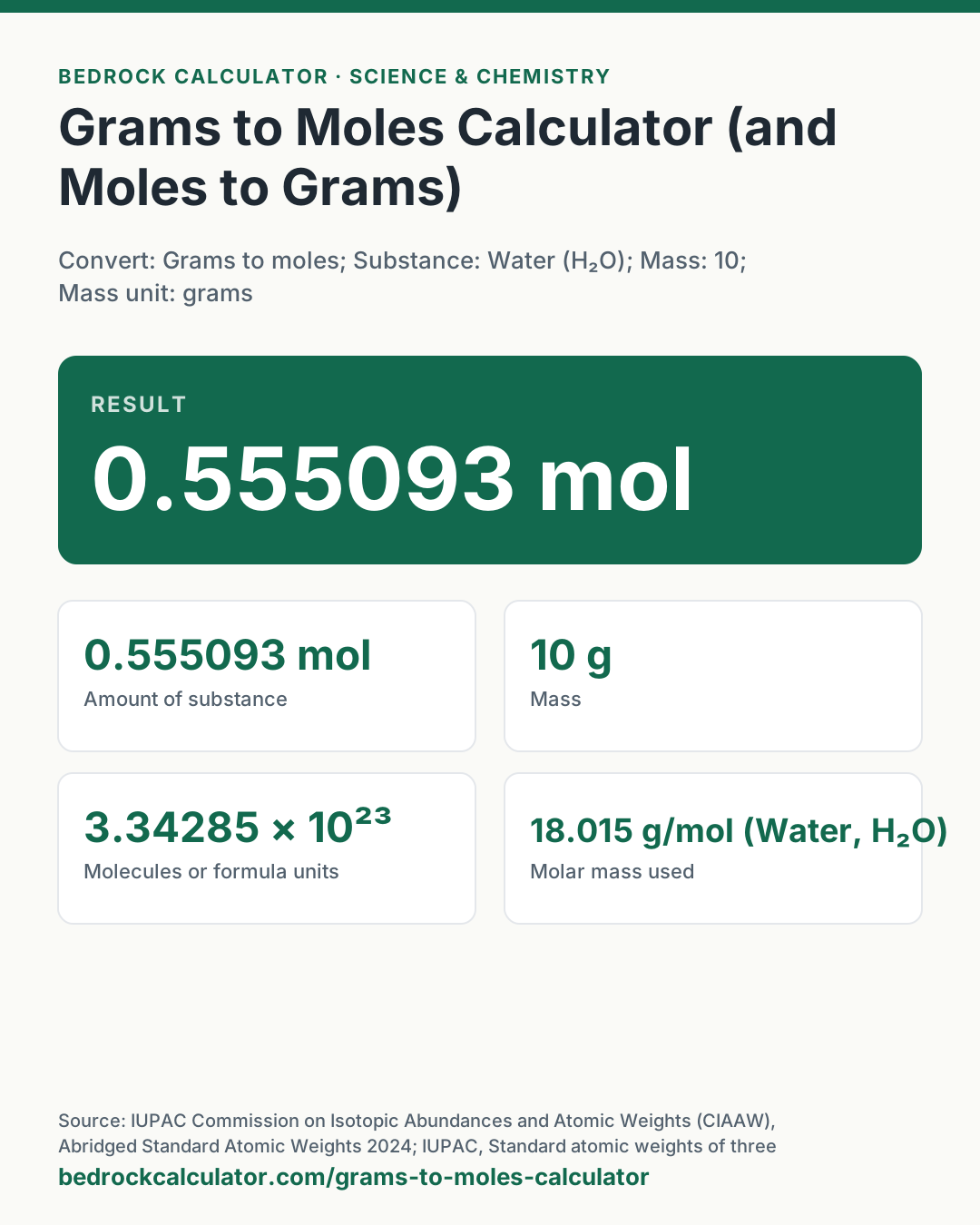
Quick Answer: 10 g of water is 0.555093 mol, because water's molar mass is 18.015 g/mol and moles equal grams divided by molar mass. That is 3.34285 × 10²³ water molecules.
What does this calculator do?
This grams to moles calculator converts a mass of a substance into the amount in moles, converts moles back into grams, and turns a count of molecules or atoms into moles. Alongside each answer it gives the number of molecules (or formula units) and the total number of atoms, so you can see what a mole means in particles.
The link between grams and moles is the molar mass, the mass of one mole of the substance in grams. For the thirty or so common substances in the list (water, salt, carbon dioxide, glucose, sulfuric acid, iron, gold and more), the calculator works out the molar mass itself. It multiplies each element's standard atomic weight by the number of atoms in the formula and adds them up. The atomic weights are the IUPAC abridged standard atomic weights, 2024 edition, published by the Commission on Isotopic Abundances and Atomic Weights: hydrogen 1.0080, carbon 12.011, nitrogen 14.007, oxygen 15.999, sodium 22.990, chlorine 35.45, and so on. For any other substance, choose Custom and enter its molar mass.
The link between moles and particles is the Avogadro constant, N_A = 6.02214076 × 10²³ per mole. Since the 2019 revision of the SI it is an exact number: the mole is defined as exactly that many entities. NIST lists it in the CODATA tables with no uncertainty.
Using the Grams to Moles Calculator
- Choose the conversion: grams to moles, moles to grams, or number of particles to moles.
- Pick the substance from the list, or choose Custom and type its molar mass in g/mol.
- Enter the mass (in grams, milligrams, kilograms, pounds or ounces), the number of moles, or the number of particles. Large counts can be typed as 1e24.
- Read the result at the top. The cards give the amount in moles, the mass in grams, the number of molecules or formula units, the number of atoms and the molar mass used.
How is this calculated?
- Find the molar mass. For a listed substance, each element's standard atomic weight is multiplied by its count in the formula and the products are added. Water is 2 × 1.0080 + 15.999 = 18.015 g/mol.
M = ∑_i nᵢ Aᵣ(i)
- Convert the mass to grams. A mass in milligrams, kilograms, pounds or ounces is converted to grams with exact factors (1 lb is 453.59237 g).
- Grams to moles, and back. Divide the mass by the molar mass, or multiply moles by the molar mass:
n = m/M; m = nM
- Particles. Moles times the Avogadro constant give the number of molecules or formula units; particles divided by it give moles. For a listed substance, the number of atoms is the number of formula units times the atoms in one formula unit (3 for H₂O, 45 for sucrose).
N = nN_A; N_A = 6.02214076 × 10²³ mol⁻¹
- Round for display. Results are rounded half up to six significant figures, and very large numbers are written in scientific notation.
Worked Example
The default inputs convert 10 g of water:
- Molar mass: 2 × 1.0080 + 15.999 = 18.015 g/mol.
- Moles: 10 ÷ 18.015 = 0.555093 mol.
- Molecules: 0.555093 × 6.02214076 × 10²³ = 3.34285 × 10²³.
- Atoms: three per molecule, 1.00285 × 10²⁴.
The reverse direction: 2 mol of sodium chloride (58.44 g/mol) weighs 2 × 58.44 = 116.88 g.
Carbon shows what a mole is. 12.011 g of carbon is exactly 1 mol, which is 6.02214 × 10²³ atoms.
From a count of particles, 10²⁴ molecules of carbon dioxide is 10²⁴ ÷ N_A = 1.66054 mol, which at 44.009 g/mol weighs 73.0787 g.
How Many Moles Are in a Gram?
It depends entirely on the substance. One gram is 1 ÷ M moles, so a light molecule gives many moles per gram and a heavy one few. The reference table on this page runs the calculator on 100 g of every listed substance: 100 g of water is 5.55093 mol, while 100 g of sodium chloride is only 1.71116 mol.
How to Calculate Grams to Moles by Hand
Write down the formula, look up each element's atomic weight, multiply by how many atoms of it there are, and add. That is the molar mass in g/mol. Then divide your mass in grams by it. The calculator does exactly that for listed substances and shows the molar mass it used, so you can check your own sum.
What does this calculator not account for?
- Purity and water of crystallisation. The mass is taken as the pure substance. A hydrate has its own formula and molar mass; copper(II) sulfate pentahydrate is listed separately for that reason.
- Isotopically altered material. Standard atomic weights describe normal terrestrial material. Enriched or depleted samples, and some commercial lithium and boron, differ.
- Variable elements. For some elements, including hydrogen, carbon and chlorine, IUPAC gives an interval because natural samples vary. The abridged table gives one value for ordinary use, and that is what the calculator uses.
- Elements with no standard atomic weight. Radioactive elements such as technetium and radon have no standard atomic weight and are not in the table. Use Custom with the mass of the isotope you have.
- Formula entry. The calculator does not parse a typed formula. For a compound not in the list, add up the molar mass yourself and use Custom.
What mistakes do people make with this?
- Using atomic number for atomic weight. Carbon's atomic number is 6; its atomic weight is 12.011.
- Forgetting subscripts. H₂O has two hydrogens. Leaving one out drops a whole hydrogen's worth from the molar mass, and every answer after it is wrong.
- Treating diatomic gases as atoms. Oxygen gas is O₂, so its molar mass is twice oxygen's atomic weight of 15.999.
- Mixing up molecules and atoms. One mole of water has N_A molecules but three times as many atoms.
- Over-rounding the molar mass. Rounding 58.44 to 58 changes results by 0.75%.
Frequently Asked Questions
How do I convert grams to moles?
How do I convert moles to grams?
How many molecules are in a mole?
Where do the atomic weights come from?
How do I find the number of atoms in a sample?
Why do different textbooks give slightly different molar masses?
Sources
- IUPAC Commission on Isotopic Abundances and Atomic Weights (CIAAW), Abridged Standard Atomic Weights 2024. ciaaw.org/abridged-atomic-weights.htm
- IUPAC, Standard atomic weights of three technology critical elements revised (2024). iupac.org/standard-atomic-weights-of-three-technology-critical-elements-revised
- Prohaska et al., Standard atomic weights of the elements 2021 (IUPAC Technical Report), Pure and Applied Chemistry 94 (2022) 573. doi.org/10.1515/pac-2019-0603
- NIST, CODATA Value: Avogadro constant, N_A = 6.02214076 × 10²³ mol⁻¹ (exact). physics.nist.gov/cgi-bin/cuu/Value