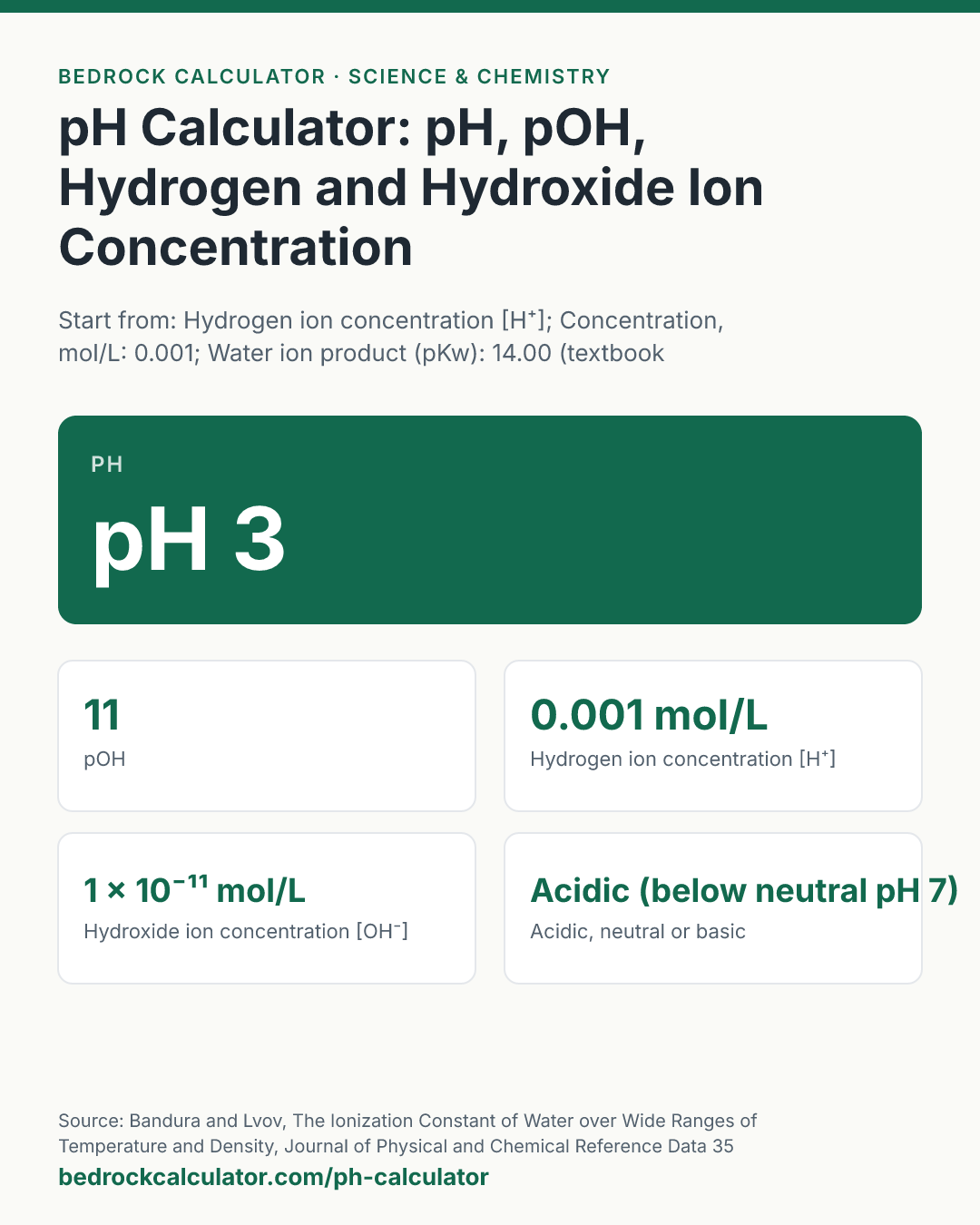
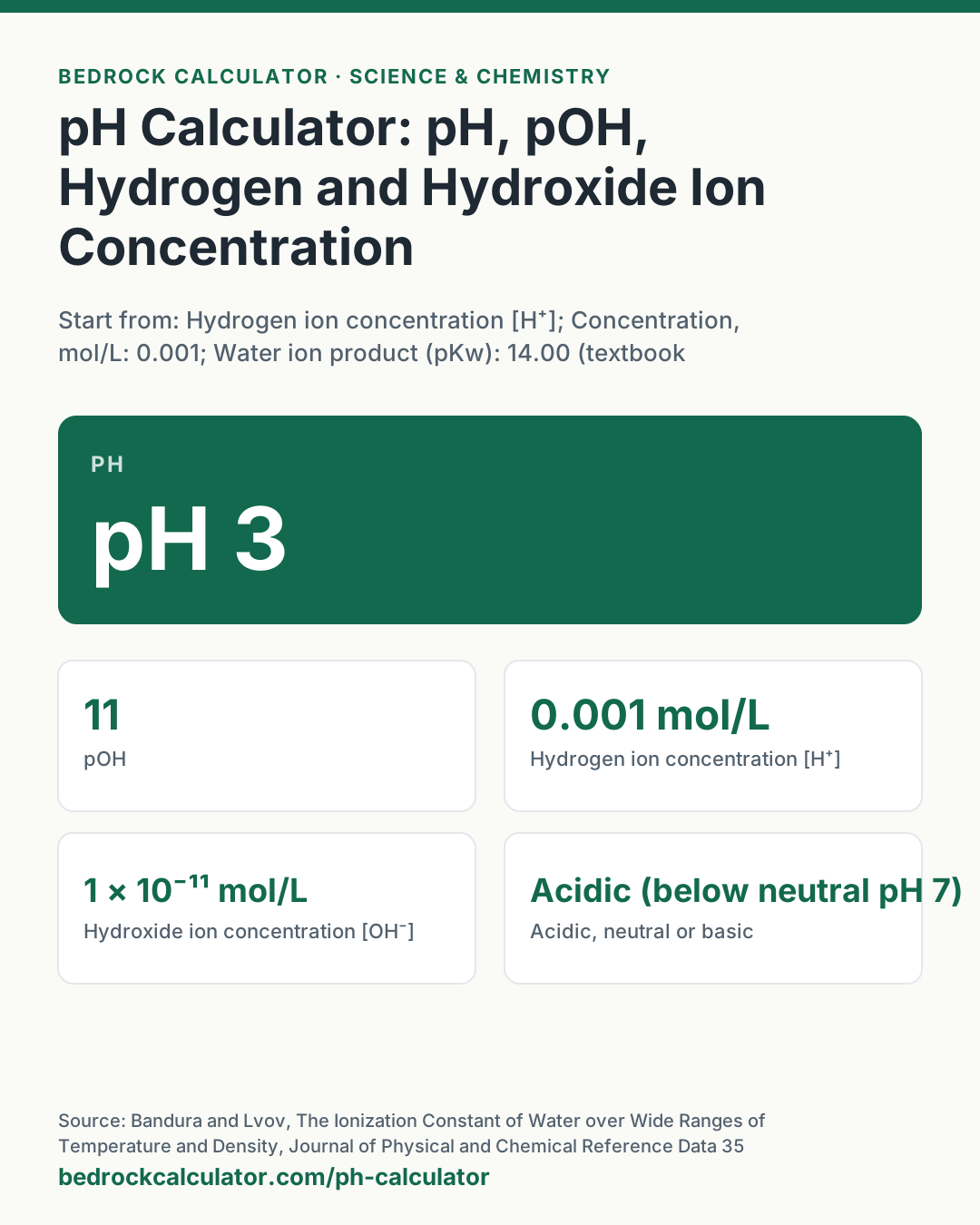
Quick Answer: A solution with a hydrogen ion concentration of 0.001 mol/L has pH 3, because pH is the negative base 10 logarithm of [H⁺]. Its pOH is 11, so it is acidic.
What does this calculator do?
This pH calculator converts between the four ways of describing how acidic or basic a water solution is: pH, pOH, the hydrogen ion concentration [H⁺] and the hydroxide ion concentration [OH⁻]. Enter any one of them and it gives the other three, and says whether the solution is acidic, neutral or basic.
pH is a logarithmic scale. Each step of one pH unit is a tenfold change in hydrogen ion concentration, so a solution at pH 3 has ten times the [H⁺] of one at pH 4 and a thousand times that of one at pH 6. The calculator shows concentrations in scientific notation where they get small, so you can see that directly.
pH and pOH are tied together by the ion product of water: pH + pOH = pKw. Most courses use pKw = 14.00, and that is the default here. But pKw changes with temperature, so the calculator also offers measured values for pure water from 0 to 100 °C, taken from the formulation of Bandura and Lvov published in the Journal of Physical and Chemical Reference Data. At 25 °C that table gives 13.99; at 50 °C, 13.26. The neutral point moves with it: warm pure water is neutral below pH 7.
Using the pH Calculator
- Choose what you are starting from: [H⁺], [OH⁻], pH or pOH.
- Enter the concentration in moles per litre, or the pH or pOH value. Very small concentrations can be typed as 1e-9.
- Choose pKw: the 14.00 convention, or a measured value for the temperature of your water.
- Read the pH at the top, and pOH, [H⁺], [OH⁻] and the acidic, neutral or basic verdict below.
For a strong acid that releases one hydrogen ion per molecule, such as hydrochloric or nitric acid, [H⁺] is the acid's molarity. For a strong base with one hydroxide, such as sodium hydroxide, [OH⁻] is its molarity.
How is this calculated?
- Start from a concentration or a p-value. A concentration is turned into its p-value with a base 10 logarithm:
pH = −log ₁₀[ H⁺]; pOH = −log ₁₀[ OH⁻]
- Use pKw to get the other p-value. pH and pOH always add to pKw, so either is pKw minus the other:
pH + pOH = p K_w
- Turn p-values back into concentrations. Each concentration is 10 to the minus p:
[ H⁺] = 10^(−pH); [ OH⁻] = 10^(−pOH)
- Classify. Neutral water has equal [H⁺] and [OH⁻], so its pH is half of pKw (7 at the textbook value). Below that the solution is acidic, above it basic. The comparison uses the pH rounded to three decimals.
- Round for display. pH and pOH are shown to three decimal places and concentrations to four significant figures. A concentration of zero or less is refused, since its logarithm does not exist.
Worked Example
The default input is [H⁺] = 0.001 mol/L, for example 0.001 M hydrochloric acid:
- pH = −log₁₀(0.001) = 3.
- pOH = 14 − 3 = 11.
- [OH⁻] = 10⁻¹¹ = 1 × 10⁻¹¹ mol/L.
- 3 is below 7, so the solution is acidic.
A 0.01 M sodium hydroxide solution has [OH⁻] = 0.01, so pOH = 2 and pH 12.
From a meter reading of pH 4.5: [H⁺] = 10⁻⁴·⁵ = 3.162 × 10⁻⁵ mol/L, and pOH is 9.5.
Pure water at 50 °C has pKw = 13.26, so it is neutral at pH 6.63, with [H⁺] = [OH⁻] = 2.344 × 10⁻⁷ mol/L. That water is not acidic, even though its pH is below 7.
How to Calculate pH from Concentration
Take the logarithm of the hydrogen ion concentration and change its sign. With a calculator, enter the concentration, press log, and negate. For [H⁺] = 2.5 × 10⁻⁴ mol/L that is pH 3.602. If you have the hydroxide concentration instead, find pOH the same way and subtract it from 14.
The pH Scale and Ion Concentrations
The reference table on this page runs the calculator at every whole pH from 0 to 14 with pKw = 14. It shows the symmetry of the scale: at pH 7 both concentrations are 1 × 10⁻⁷ mol/L, and each step away from 7 multiplies one by ten and divides the other by ten.
What does this calculator not account for?
- Activity. Strictly, pH is defined from the activity of hydrogen ions, not their concentration. In dilute solutions the two are close; in concentrated or salty solutions they are not, and measured pH differs from −log[H⁺].
- Weak acids and bases. Acetic acid, ammonia and other weak electrolytes only partly dissociate, so [H⁺] is much lower than the acid's molarity. Finding it needs the acid dissociation constant, which this calculator does not use.
- Polyprotic acids. Sulfuric acid can release two hydrogen ions. Enter the [H⁺] you have worked out rather than the acid molarity.
- Very dilute acids. At 10⁻⁸ M acid, water's own ions dominate and the true pH is just under 7, not 8. The calculator treats the number you enter as the total [H⁺].
- Pressure. The pKw values are for 0.1 MPa (and saturation pressure at 100 °C).
- Temperatures between the rows. The values are used exactly as Table 4 prints them, to two decimals, and only at 0, 25, 50, 75 and 100 °C. The calculator does not interpolate; for 37 °C, pick the nearer row or work out pKw from the paper's equation.
What mistakes do people make with this?
- Forgetting the minus sign. log₁₀(0.001) is −3; pH is +3.
- Assuming neutral means 7 at every temperature. It is pKw/2, which is 7 only at the 14.00 convention.
- Using a weak acid's molarity as [H⁺]. That overstates acidity, often by more than a pH unit.
- Reading pH as linear. pH 3 is not twice as acidic as pH 6; it has a thousand times the hydrogen ion concentration.
- Typing the concentration in mmol/L. Convert to mol/L first: 1 mmol/L is 0.001 mol/L.
Frequently Asked Questions
How do you calculate pH?
How do I find [H⁺] from pH?
What is pOH?
Can pH be negative or above 14?
Why is pKw not exactly 14?
Is pH 7 always neutral?
Sources
- Bandura and Lvov, The Ionization Constant of Water over Wide Ranges of Temperature and Density, Journal of Physical and Chemical Reference Data 35 (2006) 15, Table 4. srd.nist.gov/JPCRD/jpcrd696.pdf
- Buck et al., Measurement of pH: Definition, Standards, and Procedures (IUPAC Recommendations 2002), Pure and Applied Chemistry 74 (2002) 2169. doi.org/10.1351/pac200274112169
- BIPM, The International System of Units (SI Brochure, 9th edition): the mole and amount concentration. bipm.org/en/publications/si-brochure