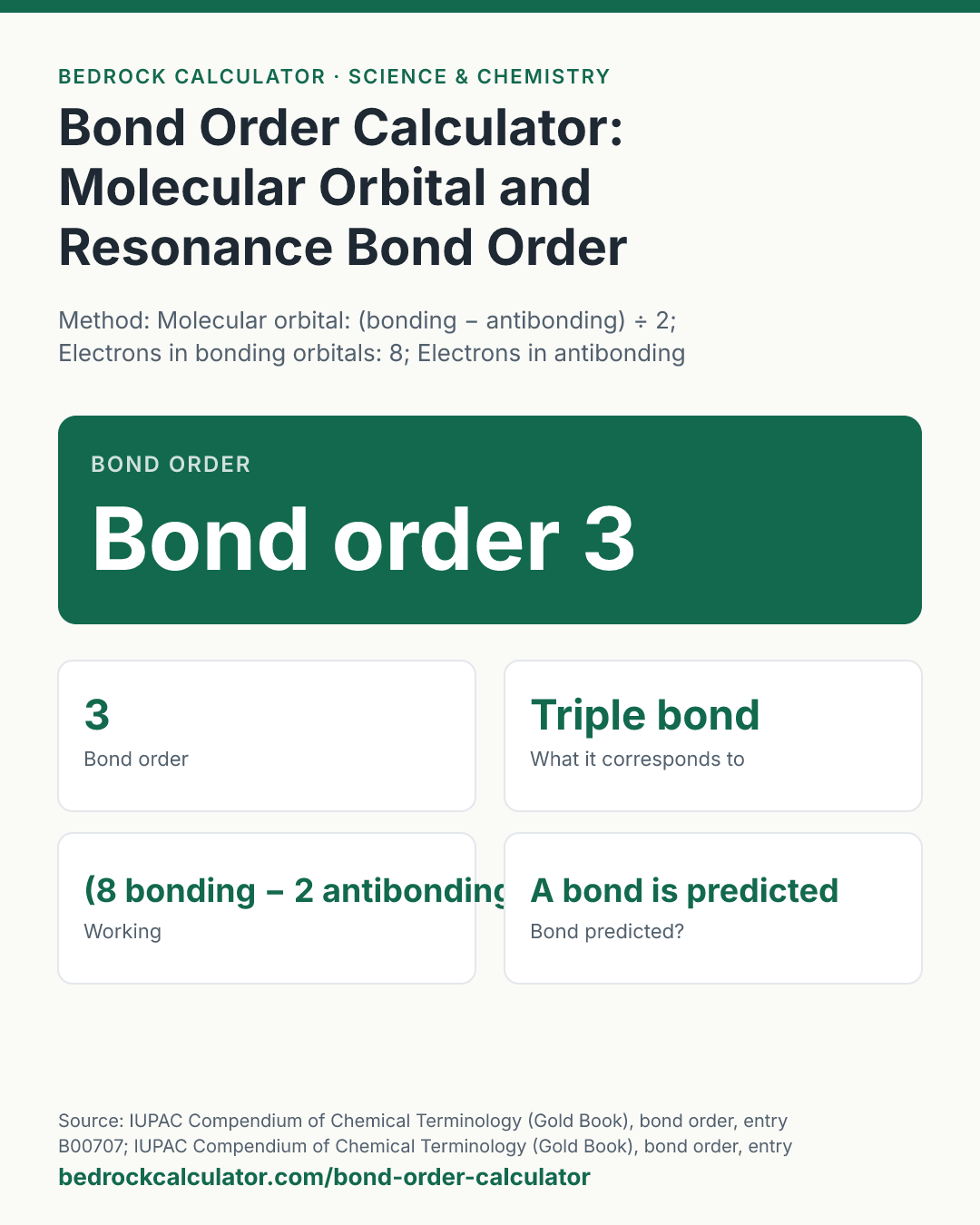

Quick Answer: Nitrogen, N₂, with 8 bonding and 2 antibonding valence electrons has a bond order of 3, a triple bond, because bond order equals bonding electrons minus antibonding electrons, divided by 2.
What does this calculator do?
This bond order calculator works out the bond order of a molecule or ion by the two methods taught in general chemistry. In molecular orbital (MO) theory, bond order is half the difference between the electrons in bonding orbitals and the electrons in antibonding orbitals.
In Lewis structures with resonance, it is the average number of shared electron pairs per bond across the equivalent bonds.
Both methods need counts that you read from a diagram. The calculator does not draw an MO diagram or a Lewis structure; you count the electrons or the bonds, and it does the arithmetic and tells you what the result means: a single, double or triple bond, something in between, or no net bond at all.
Bond order is a useful single number. Higher bond order means a shorter and stronger bond, so N₂ with a triple bond is far harder to break apart than F₂ with a single one. A bond order of zero predicts that the molecule should not exist as a stable species, which is the MO explanation for why helium stays as single atoms.
IUPAC notes that bond order has several definitions, depending on how electron density is shared out between atoms. This page uses the two counting definitions found in textbooks, not the quantum chemical bond indices computed by modelling software.
Using the Bond Order Calculator
- Choose the method: molecular orbital or resonance average.
- For the MO method, fill the MO diagram for your species and count the electrons in bonding orbitals (σ, π) and in antibonding orbitals (σ, π). Count valence electrons only, or all electrons, but use the same choice for both counts.
- For the resonance method, draw one Lewis structure, add up the shared pairs in the set of equivalent bonds (a double bond counts 2), and count how many of those bond positions there are.
- Read the bond order at the top and what it corresponds to below.
How is this calculated?
- Molecular orbital bond order. Each electron in a bonding orbital adds half a bond and each electron in an antibonding orbital takes half a bond away:
bond order = (N_bonding − N_antibonding)/2
- Resonance bond order. The shared pairs in the equivalent bonds are spread evenly over their positions:
bond order = (shared pairs in the equivalent bonds)/(number of bond positions)
- Describe the result. Whole numbers 1, 2 and 3 are single, double and triple bonds. Values between them are described as between the two, and zero or less means no net bonding, so no bond is predicted.
- Round for display. The bond order is shown to four decimal places, so a third reads as 1.3333. Counts are whole numbers; negative counts and zero bond positions are refused.
Worked Example
The default inputs are the valence electrons of N₂. Its MO diagram has two electrons in σ2s, two in σ*2s, four in the two π2p orbitals and two in σ2p:
- Bonding: 2 + 4 + 2 = 8. Antibonding: 2.
- Bond order = (8 − 2) ÷ 2 = 3, a triple bond.
O₂ has two more electrons, and both go into antibonding π orbitals: (8 − 4) ÷ 2 = 2, a double bond. The two unpaired π electrons are also why liquid oxygen is drawn to a magnet.
He₂ has two electrons in σ1s and two in σ1s: (2 − 2) ÷ 2 = 0*. No bond is predicted, and helium does not form a stable diatomic molecule.
For resonance, ozone has one single and one double bond in any one Lewis structure, 3 shared pairs over 2 oxygen to oxygen bonds: 3 ÷ 2 = 1.5. Carbonate has 4 pairs over 3 carbon to oxygen bonds: 1.3333.
How to Calculate Bond Order from an MO Diagram
Fill the molecular orbitals in order of energy, two electrons per orbital, then count. For the second-period diatomics up to N₂ the order is σ2s, σ2s, π2p (two orbitals), σ2p, π2p (two orbitals), σ*2p. From O₂ on, σ2p drops below π2p, but the counts of bonding and antibonding electrons, and so the bond order, come out the same either way. The reference table on this page runs the calculator on the counts that occur along that series.
Bond Orders of Common Diatomics
Using valence electron counts from the standard MO diagrams:
| Species | Bonding | Antibonding | Bond order |
|---|---|---|---|
| H₂ | 2 | 0 | 1 |
| He₂ | 2 | 2 | 0 |
| B₂ | 4 | 2 | 1 |
| C₂ | 6 | 2 | 2 |
| N₂, CO | 8 | 2 | 3 |
| O₂⁺, NO | 8 | 3 | 2.5 |
| O₂ | 8 | 4 | 2 |
| O₂⁻ | 8 | 5 | 1.5 |
| F₂, O₂²⁻ | 8 | 6 | 1 |
| Ne₂ | 8 | 8 | 0 |
Each bond order in the table is the calculator's result for that pair of counts.
What does this calculator not account for?
- Filling the diagram. The calculator takes your counts. A miscounted MO diagram gives a wrong bond order with no warning.
- Polyatomic molecules in MO theory. The MO method here is for a single bond between two atoms. Larger molecules have delocalised orbitals spread over many atoms.
- Bond strength and length. Bond order predicts the trend, not the numbers. Bond energies and lengths come from measurement.
- Other definitions. Computational chemistry defines bond orders from electron density (Mulliken, Wiberg and others), which give non-integer values even for simple molecules.
- Unequal resonance contributors. The resonance average assumes the structures contribute equally, which is true for ozone and carbonate but not for every ion.
What mistakes do people make with this?
- Mixing valence and total electrons. Counting core electrons on one side only shifts the answer. Core σ1s and σ*1s cancel, so either count works if you are consistent.
- Forgetting the charge. A cation has fewer electrons and an anion more. O₂⁻ has one more than O₂.
- Counting both π orbitals as one. There are two π2p bonding orbitals, holding up to four electrons.
- Dividing by the number of resonance structures. In the resonance method, divide by the number of equivalent bond positions, not by how many structures you drew.
- Treating zero as a weak bond. A bond order of zero means no net bond.
Frequently Asked Questions
What is bond order?
How do you calculate bond order?
What does a bond order of 0 mean?
Can bond order be a fraction?
Does higher bond order mean a stronger bond?
Why does O₂ have unpaired electrons?
Sources
- IUPAC Compendium of Chemical Terminology (Gold Book), bond order, entry B00707. goldbook.iupac.org/terms/view/B00707
- IUPAC Compendium of Chemical Terminology (Gold Book), bond order, entry BT07005 (electron population definitions and resonance averages). goldbook.iupac.org/terms/view/BT07005