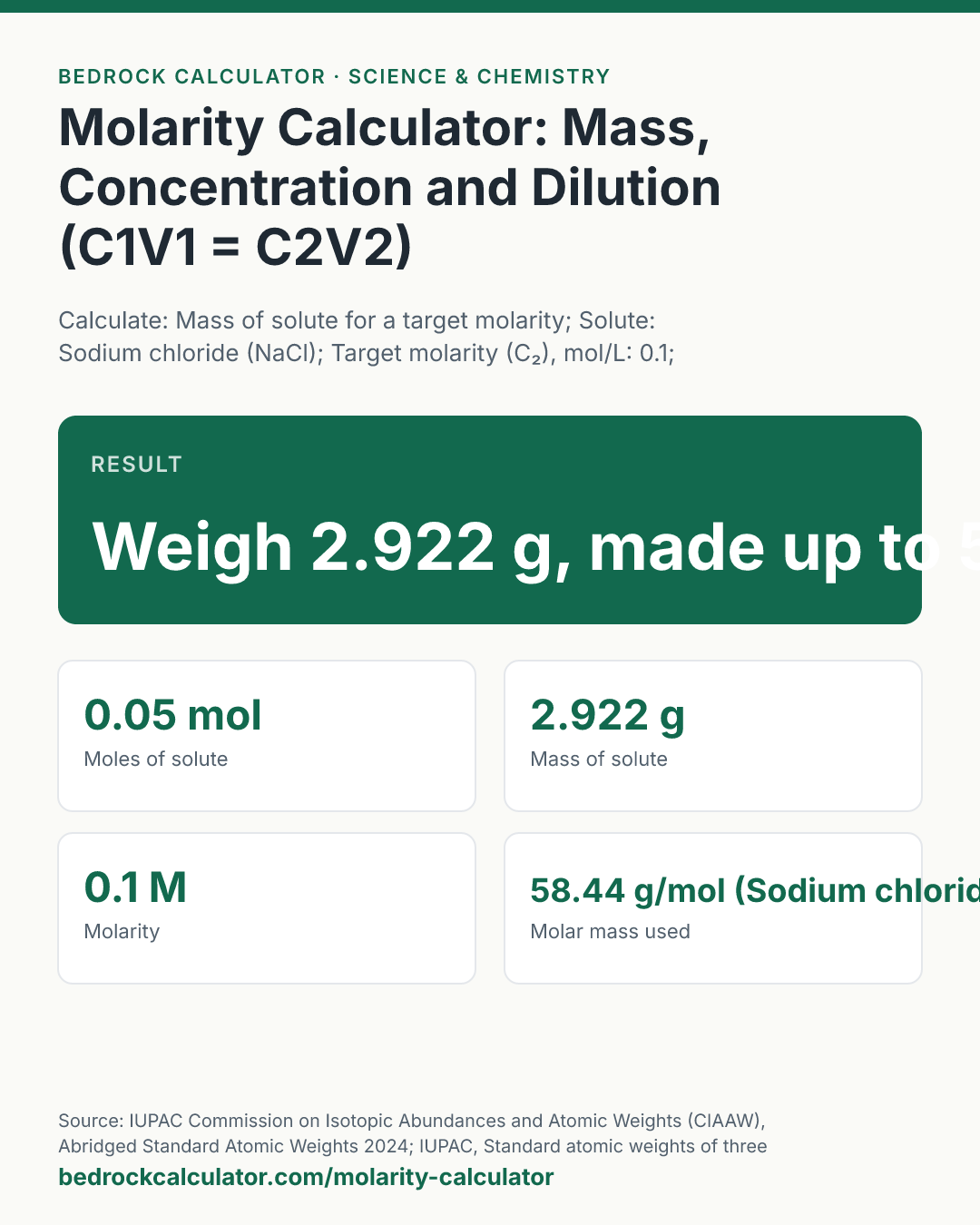
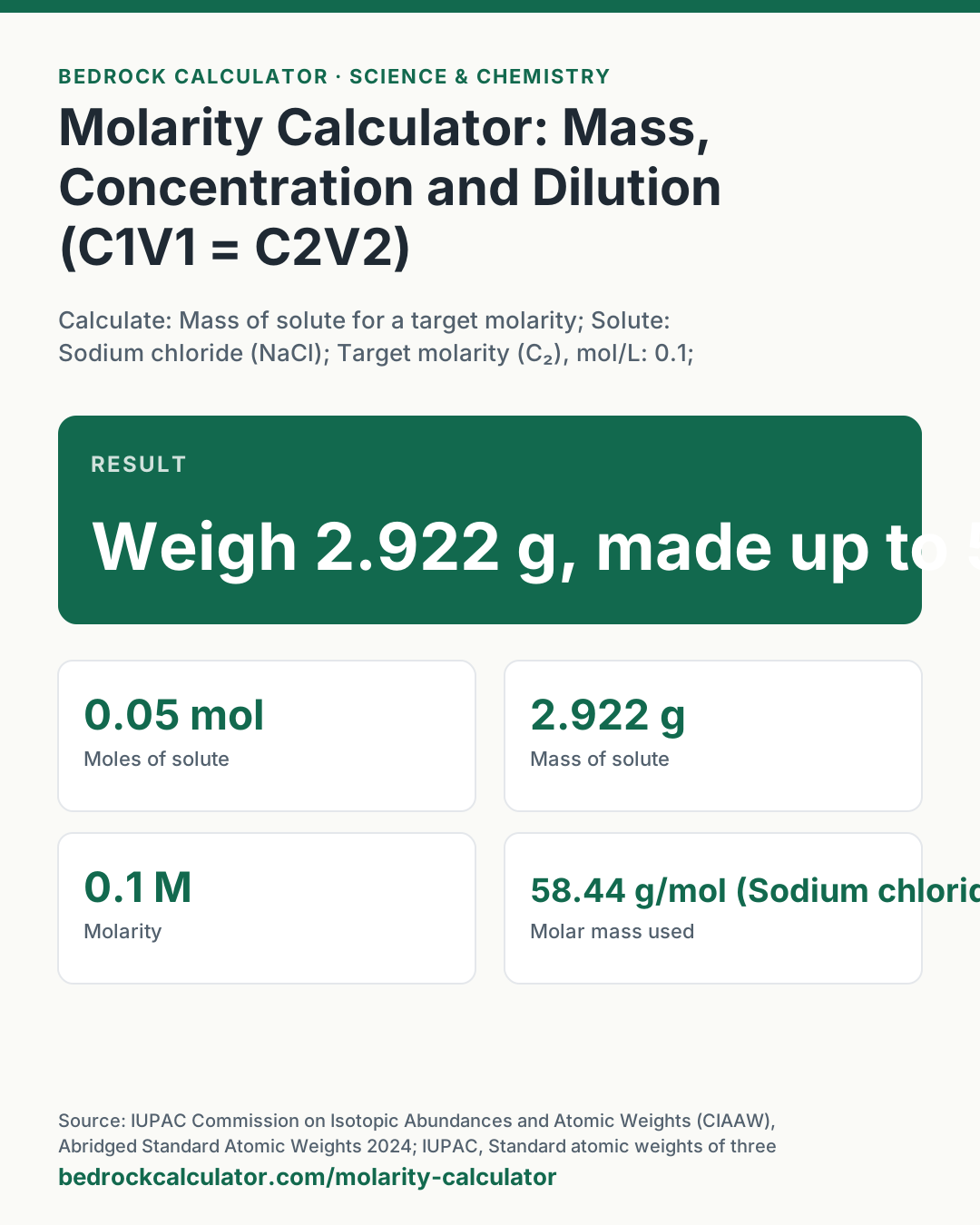
Quick Answer: To make 500 mL of a 0.1 M sodium chloride solution, weigh out 2.922 g of NaCl and add water up to 500 mL. That is 0.05 mol of salt at 58.44 g/mol.
What does this calculator do?
This molarity calculator handles the three jobs that come up at the bench. It tells you how many grams of a solid to weigh out for a solution of a given molarity and volume. It works out the molarity of a solution you have already made from the mass dissolved and the final volume.
And it works as a dilution calculator, giving the volume of a stock solution to measure out and the volume of solvent to make it up to, using C₁V₁ = C₂V₂.
Molarity, written M, is moles of solute per litre of solution. Two things in that definition trip people up. The volume is of the finished solution, not of the water you start with, and the amount is in moles, so you need the molar mass of the solute to turn it into grams.
For molar masses, the calculator lists common laboratory compounds (sodium chloride, sodium hydroxide, sulfuric acid, glucose, copper sulfate pentahydrate and others). Each one is summed atom by atom from the IUPAC abridged standard atomic weights, the 2024 table published by the Commission on Isotopic Abundances and Atomic Weights: hydrogen 1.0080, carbon 12.011, oxygen 15.999, sodium 22.990, chlorine 35.45 and so on. For anything not listed, choose Custom and type the molar mass.
Using the Molarity Calculator
- Choose what to calculate: the mass to weigh out, the molarity of a solution, or a dilution.
- Pick the solute from the list, or choose Custom and enter its molar mass in g/mol. A dilution does not need it.
- Enter the final volume of solution in millilitres, litres or microlitres.
- For the mass mode, enter the target molarity. For the molarity mode, enter the mass you dissolved. For a dilution, enter the stock concentration and the target concentration.
- Read the result at the top and the moles, mass, molarity and molar mass on the cards below.
How is this calculated?
- Find the molar mass. For a listed compound, the molar mass is the sum of each element's standard atomic weight times the number of its atoms. For NaCl that is 22.990 + 35.45 = 58.44 g/mol.
M = ∑_i nᵢ Aᵣ(i)
- Convert the volume to litres. Molarity is per litre, so 500 mL becomes 0.5 L.
- Mass mode. Moles needed are the molarity times the volume; grams are moles times molar mass.
n = cV; m = nM
- Molarity mode. The mass is converted to grams and divided by the molar mass to get moles, which are divided by the volume.
n = m/M; c = n/V
- Dilution mode. The moles of solute do not change when you add solvent, so the stock concentration times the stock volume equals the final concentration times the final volume. Solved for the stock volume:
C₁V₁ = C₂V₂ ⇒ V₁ = C₂V₂/C₁
The solvent volume shown is V₂ − V₁. A target stronger than the stock is refused, because adding solvent can only lower a concentration.
- Round for display. Results are rounded half up to six significant figures.
Worked Example
The default inputs make 500 mL of 0.1 M sodium chloride:
- Molar mass: 22.990 + 35.45 = 58.44 g/mol.
- Volume: 500 mL = 0.5 L.
- Moles: 0.1 × 0.5 = 0.05 mol.
- Mass: 0.05 × 58.44 = 2.922 g.
Dissolve the salt in less than 500 mL of water, then add water up to the 500 mL mark.
For a sodium hydroxide stock, 1 L of 2 M needs 2 mol at 39.997 g/mol, which is 79.994 g.
Going the other way, 9 g of glucose (180.156 g/mol) dissolved and made up to 250 mL is 0.0499567 mol in 0.25 L, a molarity of 0.199827 M.
Dilution Calculator: C1V1 = C2V2
To make 500 mL of 0.1 M from a 1 M stock:
- V₁ = 0.1 × 500 ÷ 1 = 50 mL of stock.
- Make it up to 500 mL with about 450 mL of solvent.
That is a tenfold dilution: the concentration drops by the same factor that the volume grows. The units only need to match on each side; C₁ and C₂ in the same unit, V₁ and V₂ in the same unit. The calculator takes concentrations in mol/L and returns volumes in the unit you used for V₂.
Grams of Common Solutes for a 1 M Solution
The reference table on this page runs the calculator for 1 litre of a 1 M solution of thirteen common compounds, so the grams needed equal the molar mass. Scale it to any other molarity and volume by multiplying: half a litre of 0.2 M needs a tenth of the table figure.
What does this calculator not account for?
- Purity and hydrates. The mass assumes a pure solute. A reagent that is 99% pure, or a salt that has picked up water, needs more. Use the hydrate's own molar mass when the label gives one, as with copper(II) sulfate pentahydrate.
- Volumes that do not add. Mixing a stock with solvent can give slightly less or more than V₁ + V₂ − V₁ suggests, especially for concentrated acids and alcohols. That is why the solvent card is marked approximate: make up to the final volume instead.
- Temperature. Volumes change with temperature, so molarity does too. Molality (moles per kilogram of solvent) does not, and is not calculated here.
- Dissociation. 0.1 M NaCl gives about 0.2 M of ions. The calculator reports the formula unit concentration, not ion concentrations or activity.
- Safety. Diluting strong acids and bases releases heat. Always add acid to water, follow your lab's procedures, and treat this page as arithmetic only.
What mistakes do people make with this?
- Using the water volume instead of the solution volume. Dissolve, then make up to the final volume.
- Leaving millilitres as litres. 500 mL is 0.5 L. The calculator converts if you set the unit.
- Using an anhydrous molar mass for a hydrate. CuSO₄·5H₂O is 249.677 g/mol, much more than the anhydrous salt.
- Inverting the dilution. V₁ is the stock volume and is the smaller one. If your answer is larger than V₂, the concentrations are the wrong way round.
- Rounding the molar mass early. Using 58 for NaCl instead of 58.44 is a 0.75% error before you start.
Frequently Asked Questions
What is molarity?
How do I calculate molarity from grams?
How do I use C1V1 = C2V2?
Where do the molar masses come from?
Is molarity the same as molality?
Can I convert grams to moles here?
Sources
- IUPAC Commission on Isotopic Abundances and Atomic Weights (CIAAW), Abridged Standard Atomic Weights 2024. ciaaw.org/abridged-atomic-weights.htm
- IUPAC, Standard atomic weights of three technology critical elements revised (gadolinium, lutetium, zirconium, 2024). iupac.org/standard-atomic-weights-of-three-technology-critical-elements-revised
- Prohaska et al., Standard atomic weights of the elements 2021 (IUPAC Technical Report), Pure and Applied Chemistry 94 (2022) 573. doi.org/10.1515/pac-2019-0603
- BIPM, The International System of Units (SI Brochure, 9th edition): the mole and the litre. bipm.org/en/publications/si-brochure