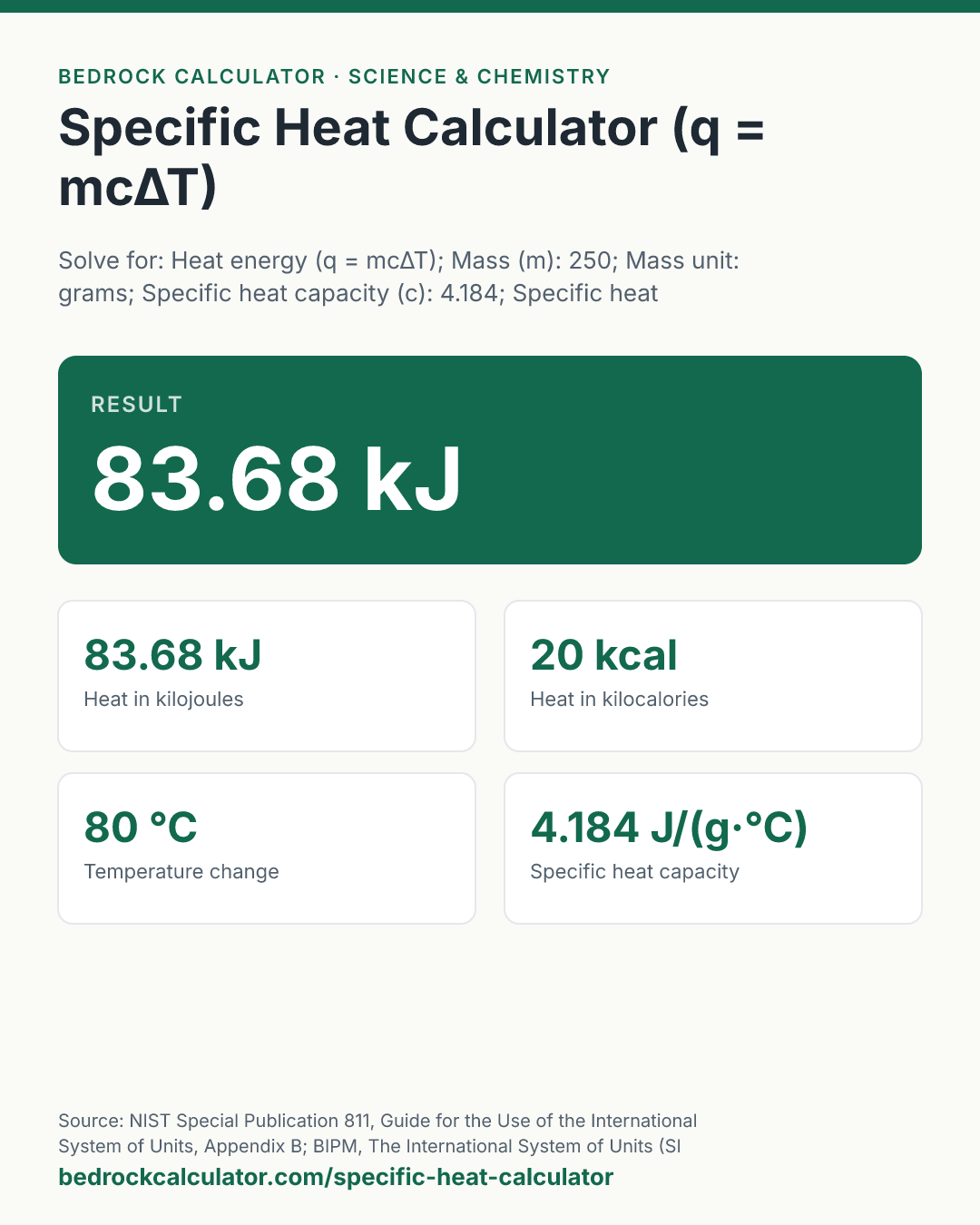
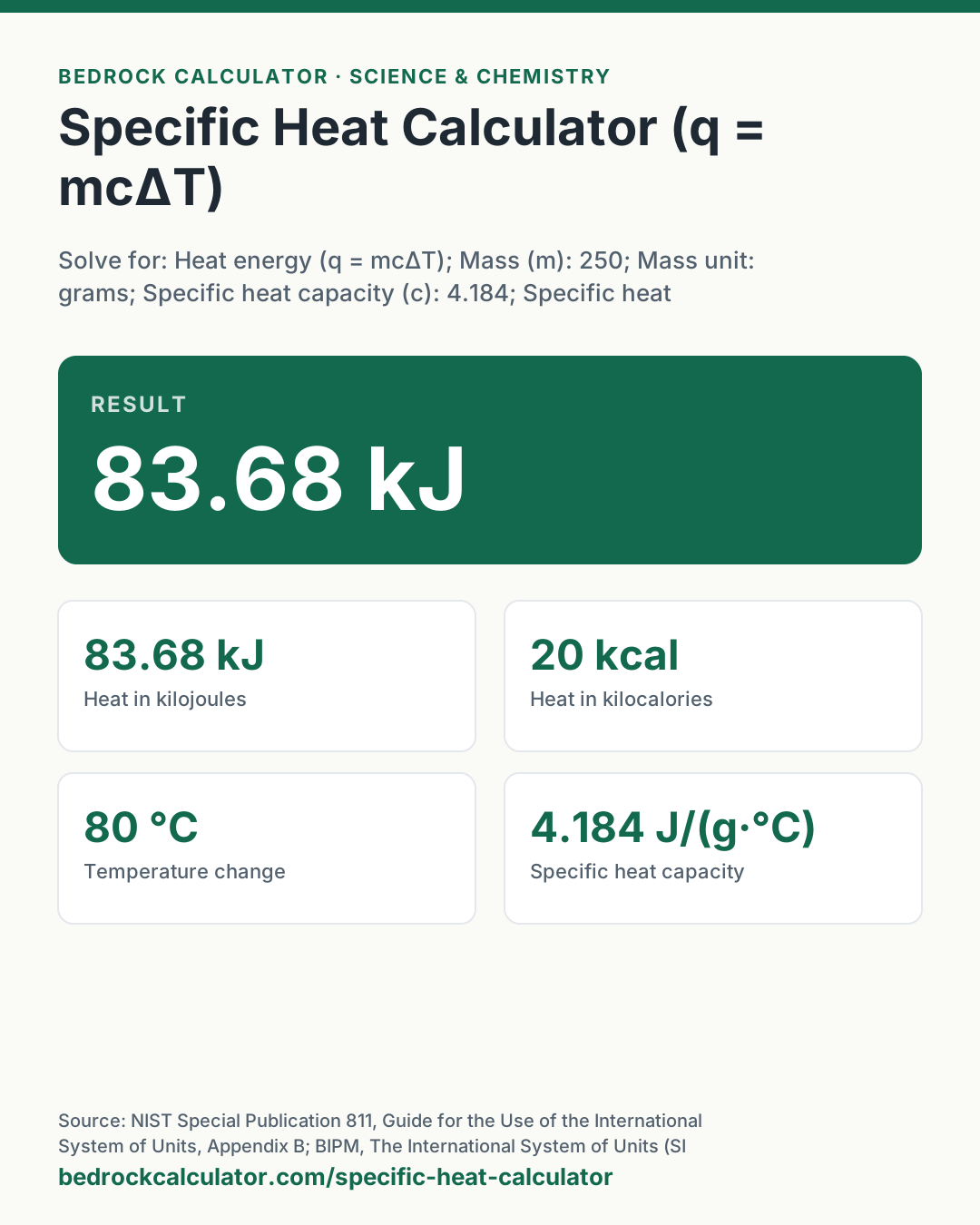
Quick Answer: Heating 250 g of water from 20 °C to 100 °C takes 83.68 kJ, from q = mcΔT with c = 4.184 J/(g·°C) and a rise of 80 °C. That is 20 kcal.
What does this calculator do?
This specific heat calculator works the equation q = mcΔT, which links the heat energy that goes into or out of a substance with its mass, its specific heat capacity and its change in temperature.
It solves for any one of the four: the heat needed, the specific heat capacity of a sample from a measurement, the mass that a given amount of heat can warm, or how far the temperature moves when heat is added or removed.
Specific heat capacity, c, is the energy needed to raise one gram of a substance by one degree. Water's is unusually high, which is why it takes so long to boil a pan and why coastal climates are mild. The default here is 4.184 J/(g·°C). That number has a precise origin: it is one thermochemical calorie per gram per degree, and the thermochemical calorie is defined as exactly 4.184 J (NIST Special Publication 811). Measured values for liquid water at room temperature are within a fraction of a percent of it, so it is the figure most courses use. For any other material, enter its specific heat from your textbook or a data table.
Mass can be in grams, kilograms or pounds, specific heat in J/(g·K), J/(kg·K), cal/(g·°C) or Btu/(lb·°F), temperatures in Celsius, kelvins or Fahrenheit, and energy in joules, kilojoules, calories, kilocalories or British thermal units. The calculator converts to grams, J/(g·K), kelvins and joules before solving.
Using the Specific Heat Calculator
- Choose what to solve for: heat, specific heat capacity, mass or temperature change.
- Enter the mass and its unit, and the specific heat capacity and its unit.
- Enter the initial and final temperatures. When solving for the temperature change, only the initial temperature is read and the final one is worked out.
- When solving for c, mass or temperature change, enter the heat energy and its unit. A negative heat means heat taken away.
- Read the result at the top, and the heat in four units, c, the mass, the temperature change and the final temperature below.
How is this calculated?
- Convert to working units. Mass to grams, specific heat to J/(g·K), temperatures to kelvins and heat to joules. A kelvin and a degree Celsius are the same size, so J/(g·K) and J/(g·°C) are the same unit. The Btu per pound per degree Fahrenheit is exactly 4.1868 J/(g·K), by the definition of the International Table Btu.
- Find the temperature change. ΔT is the final temperature minus the initial one, in kelvins:
ΔT = T₂ − T₁
- Solve the chosen arrangement of q = mcΔT:
q = mcΔT; c = q/mΔT; m = q/cΔT; ΔT = q/mc
When solving for the temperature change, the final temperature is the initial one plus ΔT.
- Check the inputs. Temperatures below absolute zero are refused, as is any arrangement that would divide by zero (no temperature change when solving for c or mass, no mass or c when solving for ΔT), and removing so much heat that the result would go below absolute zero.
- Convert back and round. Heat is shown in joules, kilojoules, kilocalories (4,184 J) and Btu (1,055.05585262 J), the temperature change in your temperature unit, and every figure to six significant figures.
Worked Example
The default inputs warm 250 g of water from 20 °C to 100 °C:
- ΔT = 100 − 20 = 80 °C.
- q = 250 × 4.184 × 80 = 83,680 J, or 83.68 kJ.
- In other units: 20 kcal, or 79.3133 Btu.
Measuring a specific heat: a 50 g metal sample warmed from 20 °C to 50 °C by 1.35 kJ has c = 1,350 ÷ (50 × 30) = 0.9 J/(g·°C).
Finding a temperature change: 10 kJ added to 1 kg of water raises it by 10,000 ÷ (1,000 × 4.184) = 2.39006 °C, from 20 °C to 22.3901 °C.
Cooling gives a negative heat: 2 kg of water going from 60 °C to 20 °C gives off 334.72 kJ, shown as −334.72 kJ.
In customary units, 1 lb of water heated from 68 °F to 212 °F with c = 1 Btu/(lb·°F) takes exactly 144 Btu.
How to Calculate Specific Heat
Measure how much heat you put in, the mass of the sample and how much its temperature rose, then divide: c = q ÷ (m × ΔT). In a school lab the heat usually comes from an electric heater (power times time) or from a known mass of hot water in a calorimeter. Choose the specific heat mode, enter the three measured values, and the calculator does the division and converts the units.
The Specific Heat Capacity Equation and Water
The specific heat capacity equation, q = mcΔT, makes water a convenient yardstick. With c = 4.184 J/(g·°C), every kilogram of water needs 4.184 kJ for each degree it warms. The reference table on this page lists the heat to take 1 kg of water from 20 °C to temperatures up to 100 °C: 41.84 kJ to reach 30 °C and 334.72 kJ to reach boiling. Those are energies to warm the water only; boiling it away takes far more.
What does this calculator not account for?
- Phase changes. Melting ice or boiling water absorbs latent heat with no temperature change. q = mcΔT does not cover it; add the latent heat separately, and do not run a calculation across 0 °C or 100 °C for water as if the phase stayed the same.
- Specific heat that varies with temperature. c is treated as constant over the range. For water between 0 °C and 100 °C it changes by under 1%, but for some materials, and over large ranges, it changes more.
- Heat losses. In a real pan or calorimeter some heat warms the container and the air. The calculator assumes all of q goes into the substance.
- Constant pressure versus constant volume. For gases the two specific heats differ noticeably. Use the one your problem specifies.
- Material data. The calculator does not hold a table of specific heats. Enter the value for your material from a reliable source.
What mistakes do people make with this?
- Mixing J/(g·°C) with kilograms. 4.184 J/(g·°C) is 4,184 J/(kg·°C). Set the unit to match the number you type.
- Using absolute temperatures where a difference is meant. Only the change matters, and it is the same in °C and K. A change in °F is 1.8 times larger.
- Losing the sign. Heat released is negative. If a cooling calculation gives a positive q, the temperatures are swapped.
- Confusing kcal and cal. A food Calorie is a kilocalorie, 1,000 calories.
- Assuming 4.184 for every liquid. Oils, alcohols and salt water all have different specific heats.
Frequently Asked Questions
What is the specific heat formula?
How do I figure out specific heat from an experiment?
What is the specific heat of water?
What is the difference between heat capacity and specific heat capacity?
Why is the answer negative?
Can I work in Btu and Fahrenheit?
Sources
- NIST Special Publication 811, Guide for the Use of the International System of Units, Appendix B: the thermochemical calorie (4.184 J exactly), the International Table calorie and Btu, and units of specific heat capacity. nist.gov/pml/special-publication-811
- BIPM, The International System of Units (SI Brochure, 9th edition): the joule, the kelvin and the degree Celsius. bipm.org/en/publications/si-brochure
- NIST Chemistry WebBook, SRD 69: Water, condensed phase thermochemistry data. webbook.nist.gov/cgi/cbook.cgi