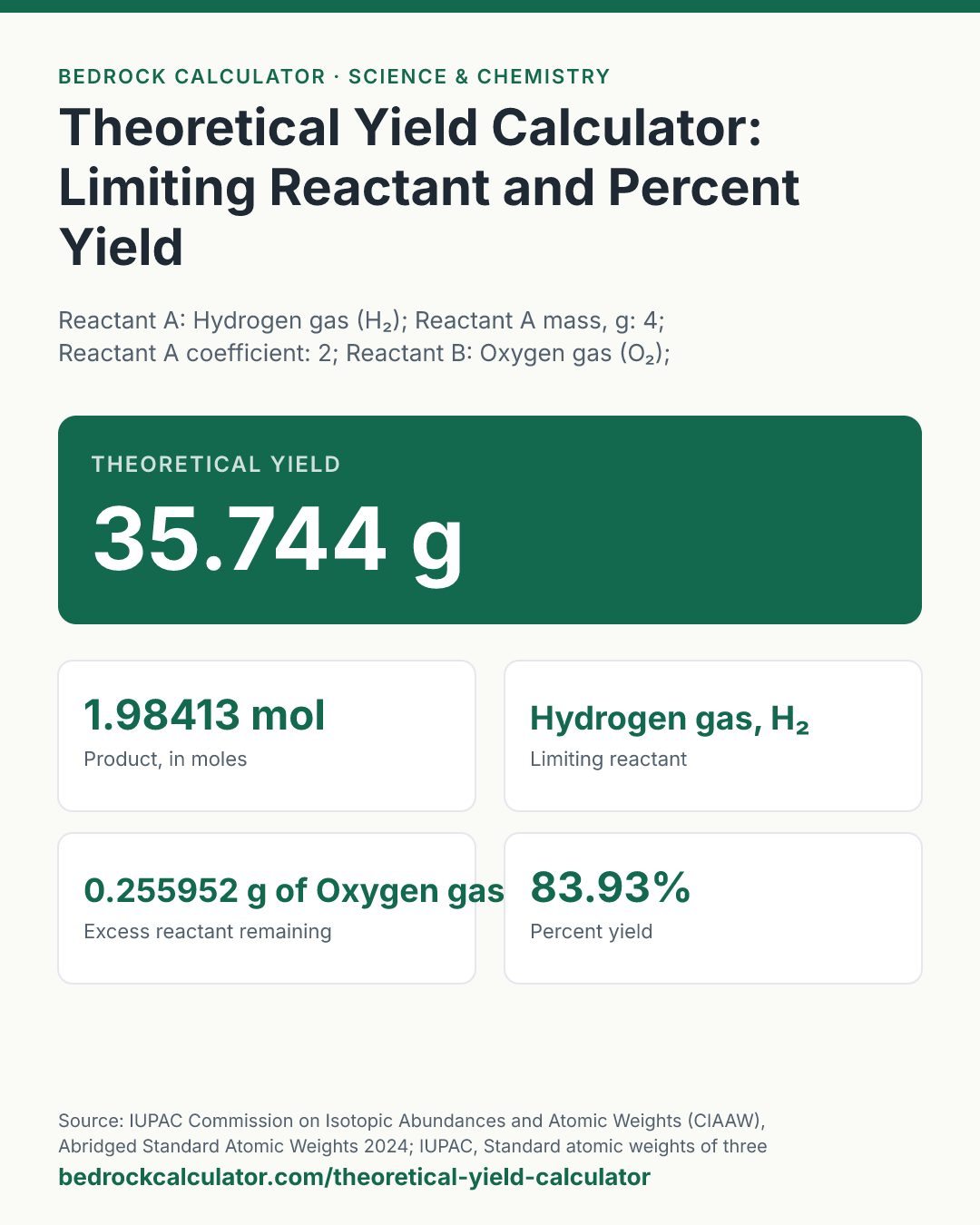
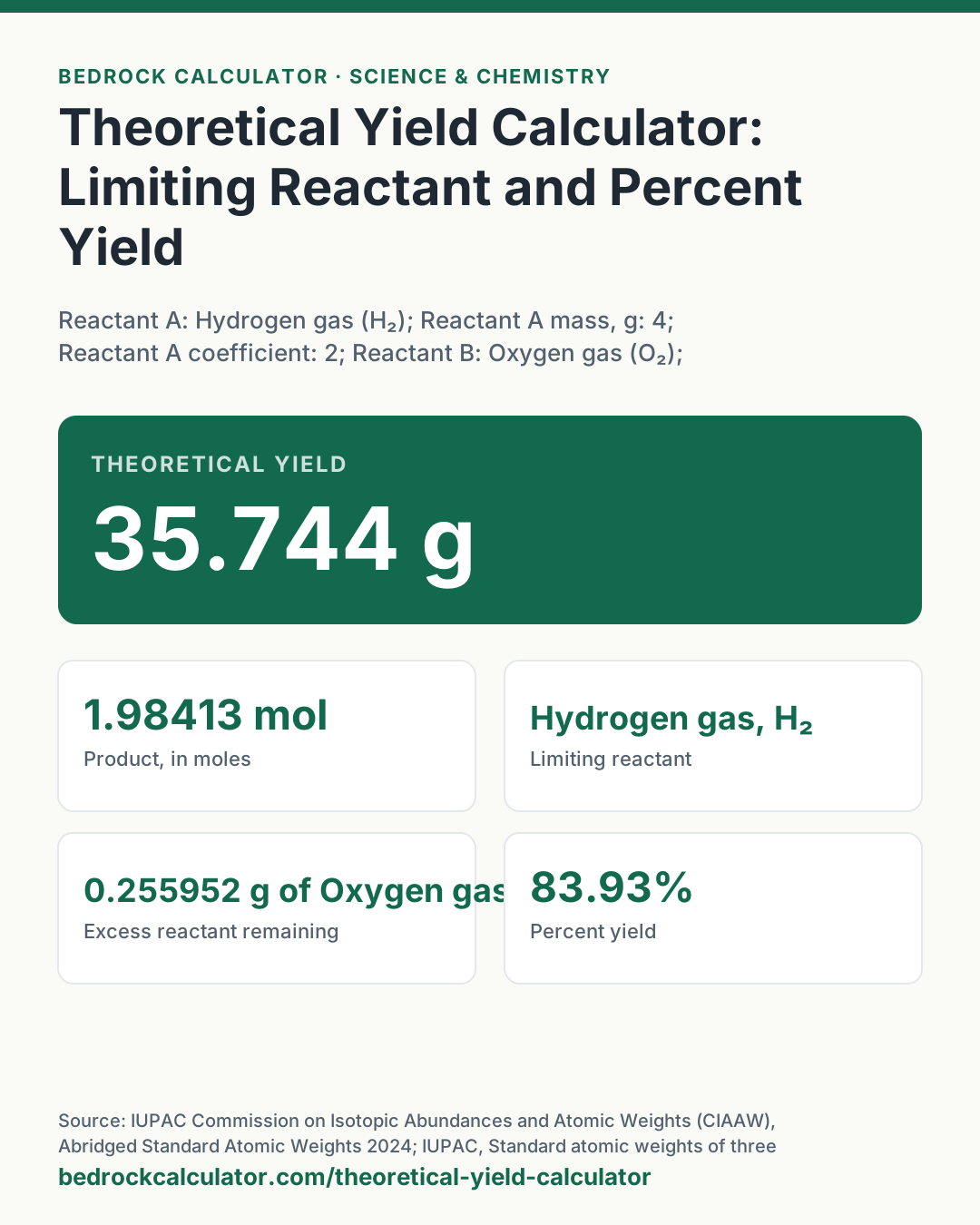
Quick Answer: Burning 4 g of hydrogen with 32 g of oxygen (2H₂ + O₂ → 2H₂O) can make at most 35.744 g of water. Hydrogen runs out first, so it is the limiting reactant, and collecting 30 g would be a percent yield of 83.93%.
What does this calculator do?
This theoretical yield calculator works out the most product a reaction can make from the reactants you start with. You give it the balanced equation's coefficients, the masses of one or two reactants and the substances involved, and it finds the limiting reactant and the mass and moles of product.
It also shows how much of the other reactant is left over, and, if you enter what you actually collected, the percent yield.
The theoretical yield is a ceiling. Real reactions lose product to side reactions, incomplete conversion and handling, so the actual yield is almost always lower, and the percent yield measures how close you came.
Molar masses for the listed compounds (hydrogen, oxygen, water, ammonia, calcium carbonate, sodium hydroxide, glucose and others) are summed from the IUPAC abridged standard atomic weights, 2024 edition: hydrogen 1.0080, carbon 12.011, nitrogen 14.007, oxygen 15.999 and so on. Any substance not in the list can be entered as Custom with its molar mass.
Using the Theoretical Yield Calculator
- Balance the equation first. The calculator needs the coefficients, not the unbalanced formula.
- Choose reactant A, enter its mass in grams and its coefficient.
- For a second reactant, choose B and enter its mass and coefficient. Enter 0 for B's mass if it is in excess or there is only one reactant.
- Choose the product and its coefficient.
- Optionally, enter the mass of product you actually collected.
- Read the theoretical yield at the top, and the moles of product, the limiting reactant, the leftover reactant, the percent yield and the molar masses below.
How is this calculated?
- Molar masses. Each listed compound's molar mass is the sum of its atoms' standard atomic weights. Water is 2 × 1.0080 + 15.999 = 18.015 g/mol.
- Moles of each reactant. Mass divided by molar mass:
n = m/M
- Find the limiting reactant. Each reactant's moles are divided by its coefficient in the balanced equation. The smallest result belongs to the reactant that runs out first, and it sets how far the reaction can go:
ξ = min(n_A/a, n_B/b)
- Product. The moles of product are that extent times the product's coefficient, and the theoretical yield is those moles times the product's molar mass:
n_P = p ξ; m_P = n_PM_P
- Leftover reactant. The other reactant uses its coefficient times the extent, in moles; what remains is its starting mass minus that amount times its molar mass.
- Percent yield. The actual mass collected divided by the theoretical yield:
percent yield = actual/theoretical × 100
- Round for display. Masses and moles are rounded half up to six significant figures, and percent yield to two decimals.
Worked Example
The default inputs are 2H₂ + O₂ → 2H₂O with 4 g of hydrogen and 32 g of oxygen:
- Molar masses: H₂ 2.016 g/mol, O₂ 31.998 g/mol, H₂O 18.015 g/mol.
- Moles: 4 ÷ 2.016 = 1.984127 mol of H₂; 32 ÷ 31.998 = 1.000063 mol of O₂.
- Divide by coefficients: H₂ 1.984127 ÷ 2 = 0.992063; O₂ 1.000063 ÷ 1 = 1.000063. Hydrogen is smaller, so it is limiting.
- Water: 0.992063 × 2 = 1.98413 mol, × 18.015 = 35.744 g.
- Oxygen left over: 0.255952 g.
- If 30 g of water were collected: 30 ÷ 35.744 × 100 = 83.93%.
With only one reactant, heating 50 g of calcium carbonate (CaCO₃ → CaO + CO₂) gives at most 28.0144 g of calcium oxide. Collecting 26 g is a 92.81% yield.
For ammonia (N₂ + 3H₂ → 2NH₃) from 28 g of nitrogen and 10 g of hydrogen, nitrogen is limiting and the theoretical yield is 34.045 g, with 3.95502 g of hydrogen left over.
How to Find the Limiting Reactant
Convert every reactant to moles, then divide each by its coefficient in the balanced equation. The smallest number marks the limiting reactant. Comparing raw masses, or raw moles, is the common mistake: in the water example there is eight times as much oxygen by mass, yet hydrogen still runs out first. The reference table on this page shows the switch: with 32 g of oxygen, hydrogen limits up to 4 g, and from 5 g of hydrogen on, oxygen limits and the yield stops at 36.0323 g.
What does this calculator not account for?
- Balancing. The calculator trusts your coefficients. An unbalanced equation gives a wrong answer with no warning.
- More than two reactants. Only two reactants can be entered. For a third, check it separately against the same extent.
- Side reactions and equilibrium. Theoretical yield assumes the reaction goes completely to the stated product. Reversible reactions, such as ammonia synthesis, stop well short of it in practice.
- Purity and water content. Masses are taken as pure. A wet or impure product can show a percent yield above 100%, which signals a measurement problem, not extra product.
- One product at a time. For reactions with several products, run the calculator once per product.
What mistakes do people make with this?
- Skipping the coefficients. Dividing moles by the coefficient is what makes the comparison fair.
- Using atoms instead of molecules. Hydrogen and oxygen gases are H₂ and O₂. Choose the diatomic entries.
- Comparing masses instead of moles. The reactant with less mass is not necessarily limiting.
- Rounding molar masses early. Rounding 18.015 to 18 shifts the yield before you start.
- Percent yield over 100%. That points to an impure or damp product, not to a better than perfect reaction.
Frequently Asked Questions
How do you calculate theoretical yield?
What is a limiting reactant?
How do I calculate percent yield?
Can I use it with only one reactant?
Why is my theoretical yield different from my textbook's?
What if a substance is not in the list?
Sources
- IUPAC Commission on Isotopic Abundances and Atomic Weights (CIAAW), Abridged Standard Atomic Weights 2024. ciaaw.org/abridged-atomic-weights.htm
- IUPAC, Standard atomic weights of three technology critical elements revised (2024). iupac.org/standard-atomic-weights-of-three-technology-critical-elements-revised
- Prohaska et al., Standard atomic weights of the elements 2021 (IUPAC Technical Report), Pure and Applied Chemistry 94 (2022) 573. doi.org/10.1515/pac-2019-0603
- BIPM, The International System of Units (SI Brochure, 9th edition): the mole and amount of substance. bipm.org/en/publications/si-brochure