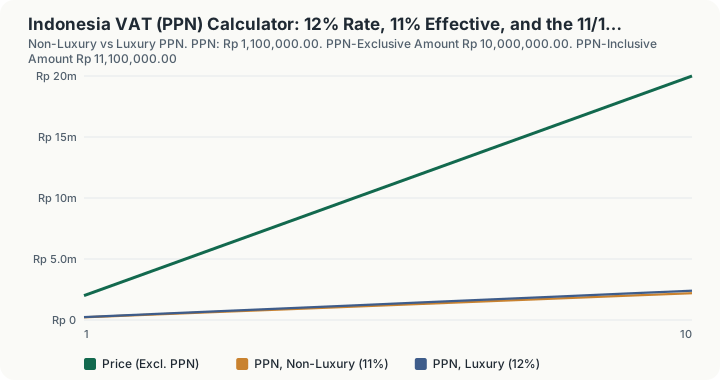
Quick Answer: An Rp 10,000,000 price with PPN added carries Rp 1,100,000 of PPN, for an Rp 11,100,000 total. That is an effective 11%, even though the statutory rate is 12%. Indonesia gets there by taxing 12% of a reduced base equal to 11/12 of the selling price, not by charging a lower rate. Goods subject to PPnBM are taxed at 12% of the full price instead, so they bear Rp 1,200,000 on the same Rp 10,000,000.
What does this calculator do?
Indonesia's VAT is the tax most often quoted wrongly, because the number that appears on an invoice does not match the number in the statute. UU 7/2021, the Harmonisasi Peraturan Perpajakan law, raised the PPN rate to 12% with effect from 1 January 2025. The rise was then almost entirely neutralised for ordinary goods and services by PMK 131/2024, which kept the 12% rate but changed what the 12% is applied to.
The mechanism is a "DPP nilai lain", an alternative tax base. For supplies that are not subject to PPnBM, the taxable base is set at 11/12 of the selling price rather than the whole of it. Twelve percent of eleven twelfths is exactly eleven percent, so the price bears 11% even though no 11% rate exists anywhere in the law. For goods that are subject to PPnBM, which is to say luxury vehicles, luxury housing, aircraft and yachts, the full selling price remains the base and the effective rate really is 12%.
This calculator is built for Indonesian businesses, PKP registrants and finance teams who need to add PPN to a price, work backward from a PPN-inclusive figure, or work out where they sit against the Rp 4.8 billion registration threshold. It shows the statutory rate and the effective rate separately, and it shows the DPP that the 12% was actually applied to, because on a faktur pajak that reduced base is a number you have to report rather than a piece of background theory.
The distinction is not academic. A business that treats the effective 11% as though it were the statutory rate will report the wrong DPP on its SPT Masa PPN even when the rupiah of tax happens to come out right.
How is this calculated?
The calculator first works out the share of the selling price that forms the tax base. For non-luxury supplies that share is 11/12; for PPnBM-liable supplies it is the whole price.
Effective Rate = 12% × Base Share
For a non-luxury supply that gives $12\% \times \frac{11}{12} = 11\%$. For a luxury supply the base share is 1, so the effective rate is the statutory 12%.
Adding PPN to a PPN-exclusive price:
PPN = Exclusive Price × Effective Rate
Inclusive Price = Exclusive Price + PPN
Removing PPN from a PPN-inclusive price. This uses a fraction, not a deduction. If the effective rate is $e$, the PPN contained in an inclusive price is:
PPN = Inclusive Price × e/(1 + e)
At an 11% effective rate that fraction is 11/111, or about 9.91% of the inclusive price. Deducting a flat 11% instead would overstate the tax.
PPnBM, where you supply a rate, is charged on the exclusive price and added alongside the PPN:
PPnBM = Exclusive Price × PPnBM Rate
The registration test compares gross annual turnover against the Rp 4,800,000,000 pengusaha kecil threshold. Reaching it makes PKP registration compulsory.
The net position applies the same effective rate to sales and to purchases and takes the difference, which is the figure reported on the SPT Masa PPN.
Net PPN = (Sales × e) − (Purchases × e)
Worked Example
A Jakarta trading company sells Rp 10,000,000 of ordinary, non-luxury goods.
Step 1: Establish the tax base share. The goods are not subject to PPnBM, so the DPP nilai lain applies at eleven twelfths.
Base share = 11/12, or 91.6667% of the selling price
Step 2: Apply that share to the selling price to get the DPP.
Rp 10,000,000 × 11/12 = Rp 9,166,666.67
DPP = Rp 9,166,666.67
Step 3: Apply the statutory 12% rate to that DPP.
Rp 9,166,666.67 × 12% = Rp 1,100,000
PPN = Rp 1,100,000
Step 4: Add the PPN to the selling price.
Rp 10,000,000 + Rp 1,100,000 = Rp 11,100,000
Total invoice = Rp 11,100,000
Step 5: Confirm the effective rate.
(Rp 1,100,000)/(Rp 10,000,000) = 11%
Effective rate = 11%, against a statutory rate of 12%
Now take the same goods sold as a PPnBM-liable luxury item. The base share becomes 1, so the DPP is the full Rp 10,000,000 and the PPN is Rp 1,200,000. The gap of Rp 100,000 comes entirely from the base, not from the rate. Both supplies were taxed at 12%.
Finally, work backward. A supplier quotes Rp 11,100,000 all inclusive for the non-luxury goods.
Step 6: Apply the extraction fraction, not the rate.
Rp 11,100,000 × 11/111 = Rp 1,100,000
PPN contained in the quote = Rp 1,100,000
Step 7: Subtract to recover the base price.
Rp 11,100,000 − Rp 1,100,000 = Rp 10,000,000
Exclusive price = Rp 10,000,000
What does this calculator not account for?
- PPnBM rate lookup. PPnBM runs from 10% to 200% and is set item by item by Menteri Keuangan regulation. This calculator charges whatever rate you enter and defaults to zero. It does not know which rate applies to your goods, and it does not verify that your goods are PPnBM-liable at all. You must confirm the rate from the applicable PMK.
- Which category your goods fall into. The luxury and non-luxury selection is yours. The calculator does not classify goods.
- Exempt and non-taxable supplies. Goods and services outside the scope of PPN, and supplies specifically exempted, are not modelled. Selecting a category always produces tax.
- Zero-rated exports. Exports of goods and of certain services are subject to PPN at 0% with input tax still recoverable. That case is not offered here.
- PPN over imports. Import PPN uses an import value base built from customs value plus duty, which is not the selling price used here.
- PPN PMSE on foreign digital services, and PPN collected by appointed government collectors (pemungut PPN or WAPU), both of which shift who remits the tax.
- Faktur pajak validity. The net position assumes every rupiah of input PPN you enter is creditable. In practice input PPN is only creditable against a valid, correctly reported faktur pajak, and credit is denied outright for some categories of expenditure.
- PPN DTP and sector incentives. Government-borne PPN schemes, which have applied to housing and vehicles in recent years, are not modelled.
- Special nilai lain cases. PMK sets particular alternative bases for certain transactions. This calculator applies the general 11/12 base for non-luxury supplies only.
- Confirmation that PMK 131/2024 is unamended. The 12% statutory rate is verified against UU HPP itself. The 11/12 nilai lain base is verified against the Directorate General of Taxes' own published description of PMK 131/2024, not against the text of the regulation, which could not be retrieved from jdih.kemenkeu.go.id or peraturan.bpk.go.id on 31 August 2026. Whether that base share is still in force for your filing period is not something this page can confirm. Check the current PMK before relying on it.
What mistakes do people make with this?
- Deducting 11% from an inclusive price. The PPN inside an inclusive figure is 11/111 of it, roughly 9.91%, not 11%. On Rp 11,100,000 the correct answer is Rp 1,100,000; deducting 11% gives Rp 1,221,000 and leaves a base price that is short by Rp 121,000.
- Reporting the selling price as the DPP. For non-luxury supplies the DPP is 11/12 of the price. Reporting the full price as the base, then reporting the correct rupiah of tax, produces a faktur that does not reconcile.
- Assuming the rate fell to 11%. It did not. The rate is 12%. Only the base changed, and only for non-PPnBM supplies. Anything written on the assumption that Indonesia has an 11% VAT rate will misstate the luxury case.
- Treating the threshold as a test on profit. The Rp 4.8 billion test looks at gross turnover, not margin or profit.
- Forgetting that the threshold cuts both ways. Registering voluntarily below the threshold lets you credit input PPN, but it also brings the full faktur pajak and monthly filing burden.
- Assuming this is settled law. The 12% rate and the nilai lain base arrived together at the start of 2025 and the arrangement has been revisited publicly since. Check the current PMK before relying on the base share for a filing period.
Frequently Asked Questions
Is Indonesia's VAT rate 11% or 12%?
What is a DPP nilai lain?
How do I remove PPN from a price that already includes it?
When do I have to register as a PKP?
Does this calculator work out PPnBM for me?
Why does my invoice show a base that is not the price I charged?
Sources
- Direktorat Jenderal Pajak, "PMK 131/2024: Tarif PPN Sebelas-Dua Belas", pajak.go.id/en/node/113453 (read 31 August 2026). Source for the 12% statutory rate, the 11/12 DPP nilai lain for non-luxury supplies, the 12% effective rate on PPnBM-liable goods, and the grounding of the nilai lain power in the VAT Law.
- Direktorat Jenderal Pajak, "Batasan Omzet Pengusaha Kena Pajak", pajak.go.id/index.php/en/node/64443 (read 31 August 2026). Source for the Rp 4,800,000,000 pengusaha kecil threshold under PMK 197/PMK.03/2013.
Also consulted: Undang-Undang Nomor 7 Tahun 2021 tentang Harmonisasi Peraturan Perpajakan (UU HPP), which set the 12% PPN rate; Peraturan Menteri Keuangan Nomor 131 Tahun 2024, which established the DPP nilai lain of 11/12 for supplies not subject to PPnBM.