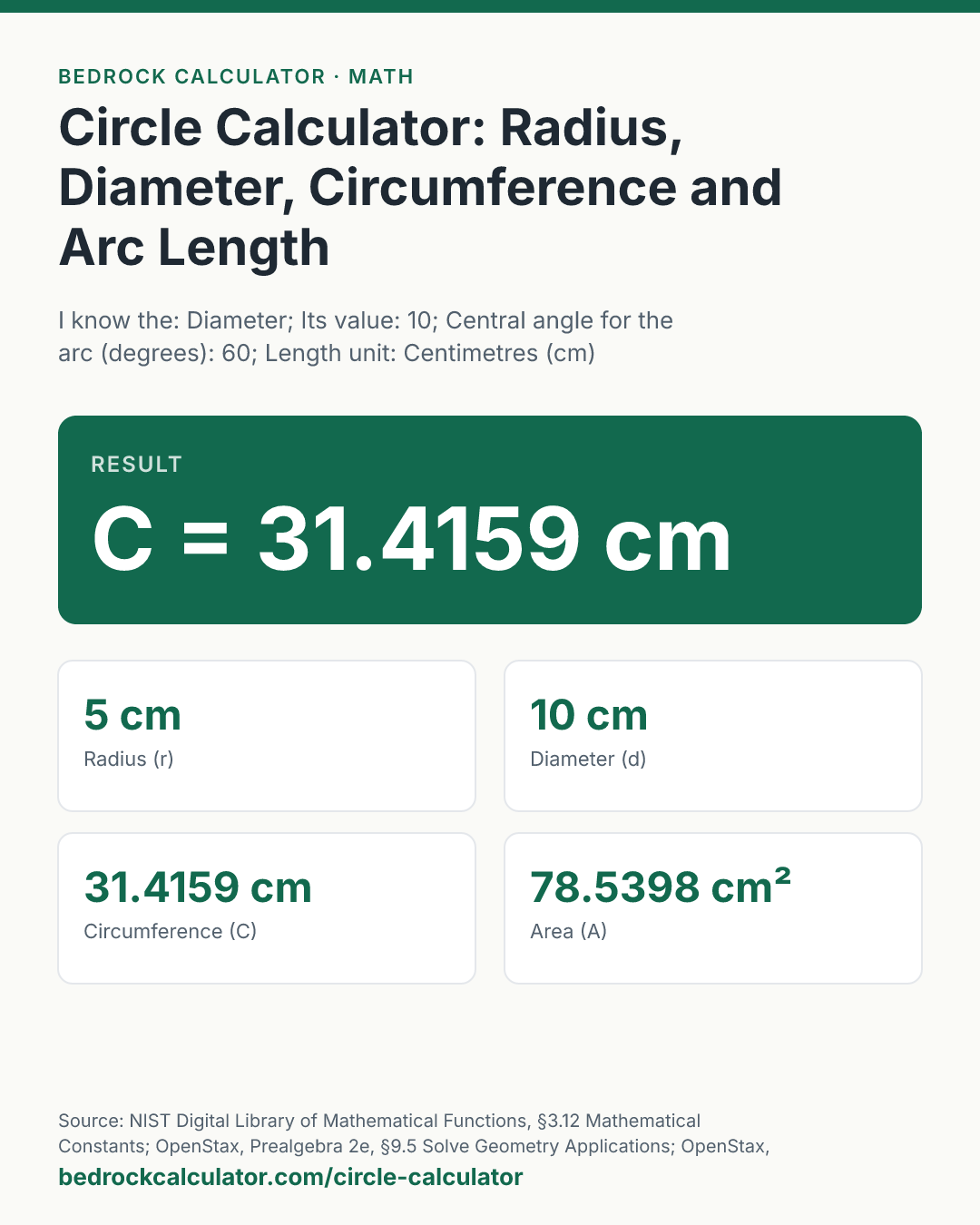

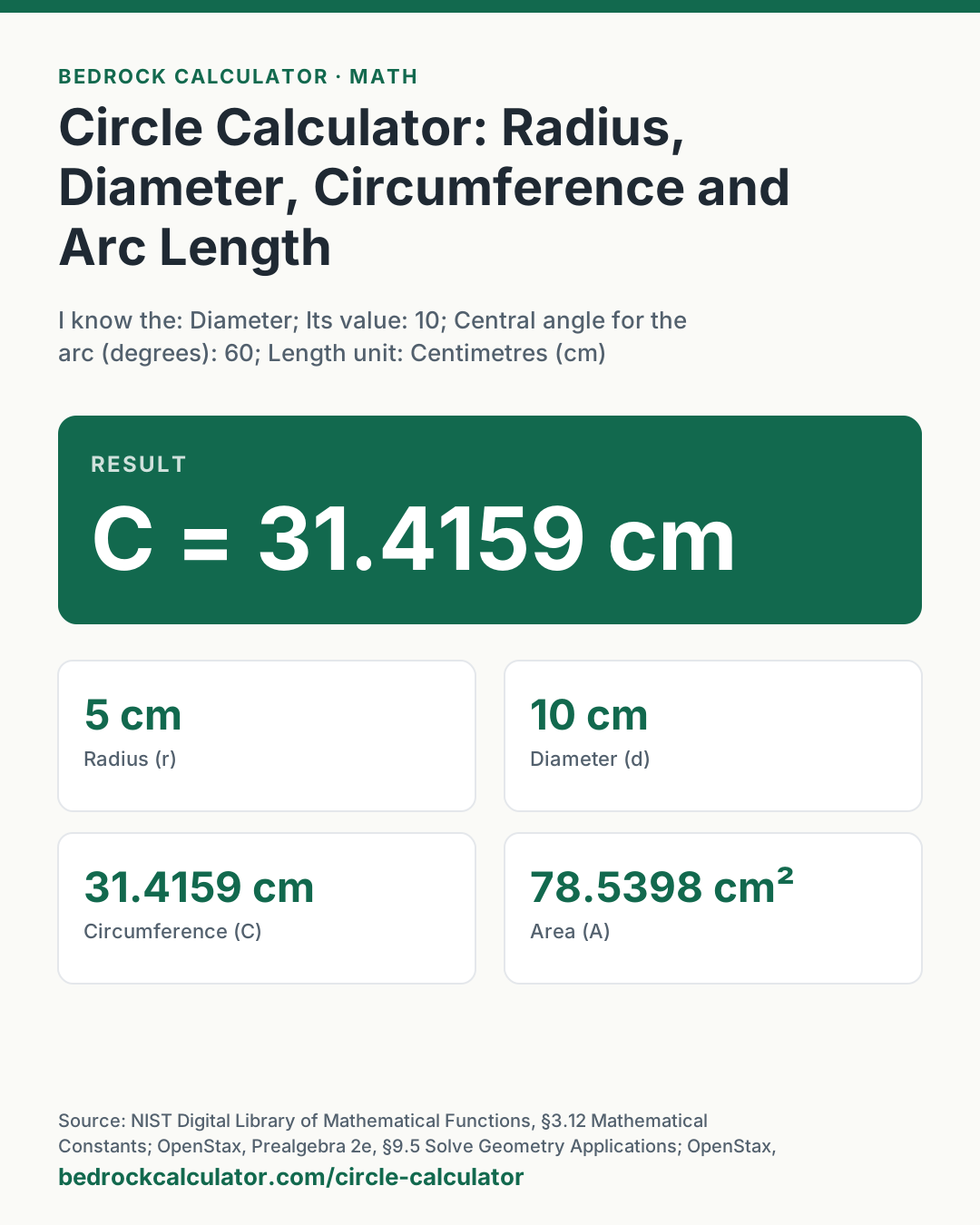
Quick Answer: A circle with a diameter of 10 cm has a circumference of 31.4159 cm: the circumference is pi times the diameter. Going the other way, a 100 cm circumference is a diameter of 31.831 cm, found by dividing by pi.
What does this calculator do?
This circle calculator takes whichever one measurement you have, the radius, the diameter, the circumference or the area, and works out the other three. It also gives the arc length and the sector area for any central angle you enter.
So it answers both "how long is the edge of this circle" and "how long is this curved piece of it".
The four measurements are tied together by two facts. The diameter is twice the radius. And the circumference is pi times the diameter, which is what pi means: it is the ratio of the distance around any circle to the distance across it. The area then follows from the radius. Once you know one of the four, you know all of them.
Lengths can be in any unit. The calculator treats the unit as a label and does not convert it, so a circumference in inches gives a diameter in inches and an area in square inches. Pi is carried to 34 significant digits and the results are rounded to four decimal places only when shown.
Using the Circle Calculator
- Choose the measurement you know: radius, diameter, circumference or area.
- Type its value. For an area, enter it in square units of the length unit you pick.
- If you want an arc, enter the angle at the centre in degrees. A quarter of the circle is 90 degrees; the whole circle is 360.
- Pick your length unit, or "No unit" for plain numbers.
The result at the top answers the usual question. Give a radius or diameter and it shows the circumference; give a circumference or area and it shows the diameter. The cards beneath list all four measurements, the arc length and the sector area. The presets load a 100 cm circumference, a 50 m² area and a 45 degree arc on a circle of radius 6 inches.
How is this calculated?
- Recover the radius. Every result is built from the radius, r, so the first step turns your measurement into one. A diameter is halved. A circumference is divided by two pi. An area is divided by pi and square rooted.
r = d/2; r = C/2π; r = √(A/π)
- Rebuild the circle. From the radius come the diameter, the circumference and the area.
d = 2r; C = 2πr = πd; A = πr²
- Arc and sector. The central angle in degrees is converted to radians, theta = angle times pi over 180. The arc length is the radius times theta, and the sector area is the radius squared times theta over two. If the angle is not above 0 and at most 360, only these two results are left blank.
s = rθ; A_sector = r²θ/2
- Round for display. The working carries 34 digits of precision. Each figure is rounded half up to four decimal places when shown.
Worked Example
The default input is a diameter of 10 cm with a 60 degree angle.
- Radius: 10 ÷ 2 = 5 cm.
- Circumference: pi × 10, shown as 31.4159 cm.
- Area: pi × 5², which is 25 pi, shown as 78.5398 cm².
- Arc for 60 degrees, one sixth of the way round: 5.236 cm, and the sector it encloses is 13.09 cm².
Now a tape measured around a tree trunk reads 100 cm. Choose circumference and enter 100. The diameter is 100 ÷ pi, 31.831 cm, so the trunk is a little under 32 cm thick. The radius is 15.9155 cm and the cross-section area is 795.7747 cm².
From an area of 50 m², the radius is the square root of 50 ÷ pi, 3.9894 m, the diameter is 7.9788 m and the circumference is 25.0663 m. That is how big a round patio of 50 square metres would be.
For an arc of 45 degrees on a circle of radius 6 inches, the arc is an eighth of the 37.6991 in circumference: 4.7124 in. The wedge it encloses has an area of 14.1372 in².
What Is the Arc Length Equation?
The arc length is the radius times the central angle in radians, s = r theta. In degrees, the same equation reads s = (angle ÷ 360) × 2 pi r: the arc is the same share of the circumference as the angle is of a full turn.
The table below the calculator lists arcs on a circle of radius 1, where the arc length equals the angle in radians. An angle of 57.2958 degrees gives an arc of 1, which is the definition of one radian: the angle whose arc is as long as the radius.
How Do You Find the Diameter from the Circumference?
Divide the circumference by pi. A circumference of 100 gives a diameter of 31.831, and a circumference of 36 gives 11.4592. To turn circumference into radius, divide by two pi instead, or halve the diameter. The table below the calculator lists diameters and radii for common circumferences.
How Do You Find the Circumference from the Diameter?
Multiply the diameter by pi. That is the whole circle perimeter formula, C = pi d, and it is the same as C = 2 pi r because the diameter is two radii. A 12 inch circle is 37.6991 inches around.
How Do You Find the Radius of a Circle?
Halve the diameter if you have it. If you only have the distance around, divide the circumference by two pi. If you have the area, divide it by pi and take the square root: an area of 50 gives a radius of 3.9894. The radius of a cylinder works the same way, since its ends are circles.
Measure around the cylinder, enter that as the circumference, and the radius card is the cylinder's radius.
What does this calculator not account for?
- Unit conversion. Enter every length in one unit. The answer comes back in that unit and is not converted.
- Angles in radians. The central angle is entered in degrees. To use radians, multiply by 180 and divide by pi first.
- Chords and segments. The straight line across an arc, and the area between it and the arc, are not shown here. The area of a circle calculator on this site gives the chord of a sector.
- Out-of-round objects. A pipe or trunk that is slightly oval has no single diameter. Measuring around it and dividing by pi gives the diameter of a circle with the same perimeter, which is a fair average but not the widest or narrowest width.
- Measurement error. Four decimal places are shown, but the answer is only as precise as the tape. Round it to match.
What mistakes do people make with this?
- Mixing up radius and diameter. Entering a diameter as the radius doubles every length and quadruples the area.
- Dividing by 2 pi when you want the diameter. Circumference ÷ pi is the diameter; circumference ÷ 2 pi is the radius.
- Using a sagging tape. For the circumference, pull the tape snug and level all the way round. A slack or tilted tape reads long.
- Forgetting the area is squared. If the radius is in metres, the area is in square metres. Enter an area in the square of the unit you choose.
- Rounding pi to 3.14 early. 3.14 is slightly less than pi, so every circumference comes out a little short, and the shortfall grows with the size of the circle. The calculator keeps 34 digits.
Frequently Asked Questions
What is the formula for the circumference of a circle?
How do I find the diameter of a circle from its area?
How do I measure the circumference of a round object?
What is the perimeter of a half circle?
Is the circumference the same as the perimeter?
Why is pi the same for every circle?
Sources
- NIST Digital Library of Mathematical Functions, §3.12 Mathematical Constants: pi as the ratio of the circumference of a circle to its diameter. dlmf.nist.gov/3.12
- OpenStax, Prealgebra 2e, §9.5 Solve Geometry Applications: Circles and Irregular Figures (d = 2r, C = pi d, A = pi r²). openstax.org/books/prealgebra-2e/pages/9-5-solve-geometry-applications-circles-and-irregular-figures
- OpenStax, Algebra and Trigonometry 2e, §7.1 Angles: the radian, arc length s = r theta and the area of a sector. openstax.org/books/algebra-and-trigonometry-2e/pages/7-1-angles