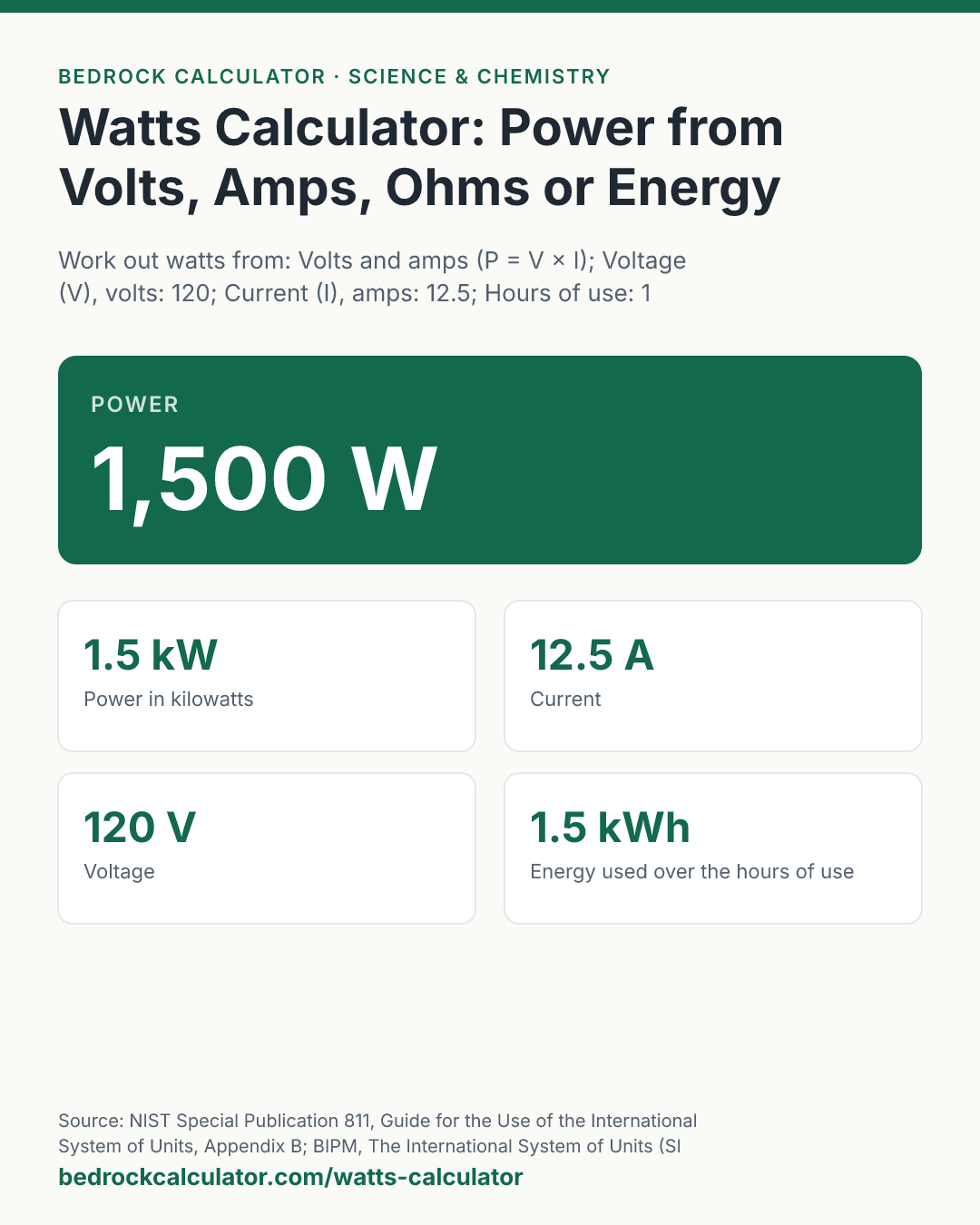

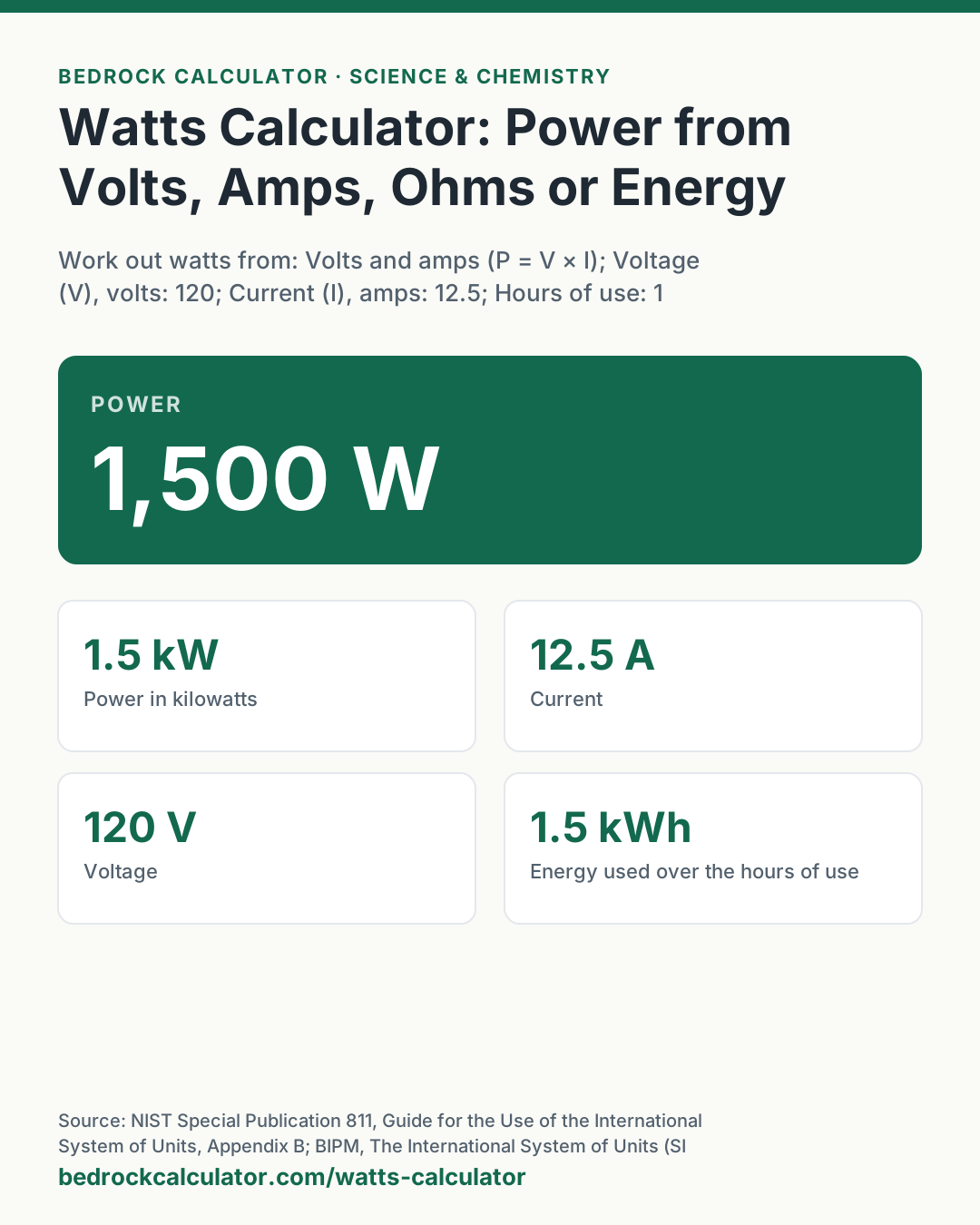
Quick Answer: A heater on 120 volts drawing 12.5 amps uses 1,500 W (1.5 kW), because watts equal volts times amps. Running it for one hour uses 1.5 kWh of energy.
What does this calculator do?
This watts calculator answers the question "how many watts?" from whatever you know about a circuit or a device. Give it volts and amps, amps and ohms, volts and ohms, or an amount of energy and the time it took, and it returns the power in watts, kilowatts, horsepower and Btu per hour.
The current and voltage are filled in too, where the inputs allow.
A watt is one joule of energy per second. Power tells you how fast energy is used or delivered, which is why appliances are rated in watts while electricity bills charge for kilowatt hours, the energy a 1,000 W load uses in an hour. The calculator links the two: set the hours of use and the last card shows the energy in kilowatt hours.
The horsepower here is mechanical horsepower, 550 foot-pounds-force per second, which is 745.69987 W. The Btu is the International Table Btu used on heater and air conditioner ratings. Both factors come from NIST Special Publication 811.
Using the Watts Calculator
- Choose what you know: volts and amps, amps and ohms, volts and ohms, or energy and time.
- Fill in those boxes. Only the boxes that mode uses are shown.
- Set the hours of use if you want the energy figure.
- Read the power at the top and the conversions, current, voltage and energy below.
The presets load a 120 V space heater, a 230 V kettle boiling for three minutes, a 12 V supply across a 4 Ω resistor, and a meter reading of 1.5 kWh over an hour.
How is this calculated?
- Pick the formula for the mode. Each is a form of the same two laws: power is voltage times current, and Ohm’s law relates voltage, current and resistance (V = IR).
P = VI; P = I²R; P = V²/R; P = E/t
- Fill in the missing electrical quantity. In amps and ohms mode the voltage is V = IR. In volts and ohms mode the current is I = V/R. In volts and amps mode both are the values you typed. Energy and time mode has no circuit, so neither is shown.
- Convert energy and time to SI for P = E/t. The energy is converted to joules and the time to seconds, so the quotient is in watts. A kilowatt hour is 3,600,000 J.
- Energy used. The power is multiplied by the hours of use, converted to seconds, and the result in joules is expressed in kilowatt hours.
E = P t
- Convert and round. Watts are converted to kilowatts, horsepower (745.69987158227022 W each) and Btu per hour (about 0.29307 W each), and every figure is rounded half up to six significant figures.
Worked Example
The default inputs are a space heater on a 120 V outlet drawing 12.5 A:
- Power: P = 120 × 12.5 = 1,500 W, or 1.5 kW.
- In other units: 2.01153 hp, or 5,118.21 Btu/h.
- Energy over 1 hour of use: 1,500 W × 1 h = 1.5 kWh.
A 230 V kettle drawing 10 A runs at 2,300 W. Boiling for three minutes, entered as 0.05 hours, uses 0.115 kWh.
For a resistor, 12 V across 4 Ω dissipates 12² ÷ 4 = 36 W, and the current is 12 ÷ 4 = 3 A. Checking with P = I²R gives 3² × 4, the same 36 W.
From an energy meter, 1.5 kWh used in one hour is an average of 1,500 W.
The Watts Formula
The watts formula you need depends on which two quantities you have. With voltage and current, use P = V × I. With current and resistance, use P = I² × R. With voltage and resistance, use P = V² ÷ R. Without any circuit values, divide energy by time: P = E ÷ t. All four give the same answer for the same circuit, as the resistor example shows.
How Many Watts Does a Circuit Carry?
The reference table on this page runs the calculator at 120 V for currents from 1 to 30 A. A 15 A household circuit at 120 V carries up to 1,800 W, and a 20 A circuit up to 2,400 W. Those are the arithmetic limits of P = VI.
Electrical codes set the continuous load lower than the breaker rating, which is a safety rule this page does not apply.
What does this calculator not account for?
- AC power factor. For alternating current, P = VI is exact only for resistive loads such as heaters, kettles and incandescent bulbs. Motors, compressors and many power supplies draw current out of step with the voltage, so their real power is V × I × power factor, which is lower. The calculator assumes a power factor of one.
- Three-phase supplies. Three-phase power uses √3 × V × I × power factor and is not modelled.
- Efficiency. A 1,500 W heater turns all of its input into heat, but a 1,500 W motor delivers less than 1,500 W of mechanical power. The horsepower card converts units; it does not estimate a motor’s output.
- Changing loads. Energy used assumes the power is steady over the hours you enter. A fridge that cycles on and off uses much less than its rating times 24 hours.
- Resistance that changes with temperature. A bulb filament’s resistance rises as it heats, so P = V²/R with a cold resistance overstates its running power.
What mistakes do people make with this?
- Confusing watts and watt hours. Watts are a rate; watt hours are an amount. A 1,500 W heater does not use 1,500 W per hour; it uses 1.5 kWh in an hour.
- Forgetting to square. In P = I²R and P = V²/R the current or voltage is squared. Doubling the voltage across a resistor quadruples its power.
- Using the breaker rating as the load. A 15 A breaker limits current; it does not tell you what a device draws.
- Mixing milliamps and amps. 500 mA is 0.5 A. Enter amps.
- Reading kVA as kW. Generators and UPS units are often rated in volt-amperes. Watts equal VA only at a power factor of one.
Frequently Asked Questions
How many watts is 120 volts at 15 amps?
How do I convert amps to watts?
How do I convert watts to kilowatt hours?
What is a watt in terms of other units?
Why does my device's label show a different wattage?
Is horsepower the same everywhere?
Sources
- NIST Special Publication 811, Guide for the Use of the International System of Units, Appendix B: horsepower (550 ft·lbf/s), the International Table Btu and the watt hour. nist.gov/pml/special-publication-811
- BIPM, The International System of Units (SI Brochure, 9th edition): the watt, joule, volt, ampere and ohm. bipm.org/en/publications/si-brochure
- US Department of Energy, Estimating Appliance and Home Electronic Energy Use: wattage times hours of use to kilowatt hours. energy.gov/energysaver/articles/estimating-appliance-and-home-electronic-energy-use