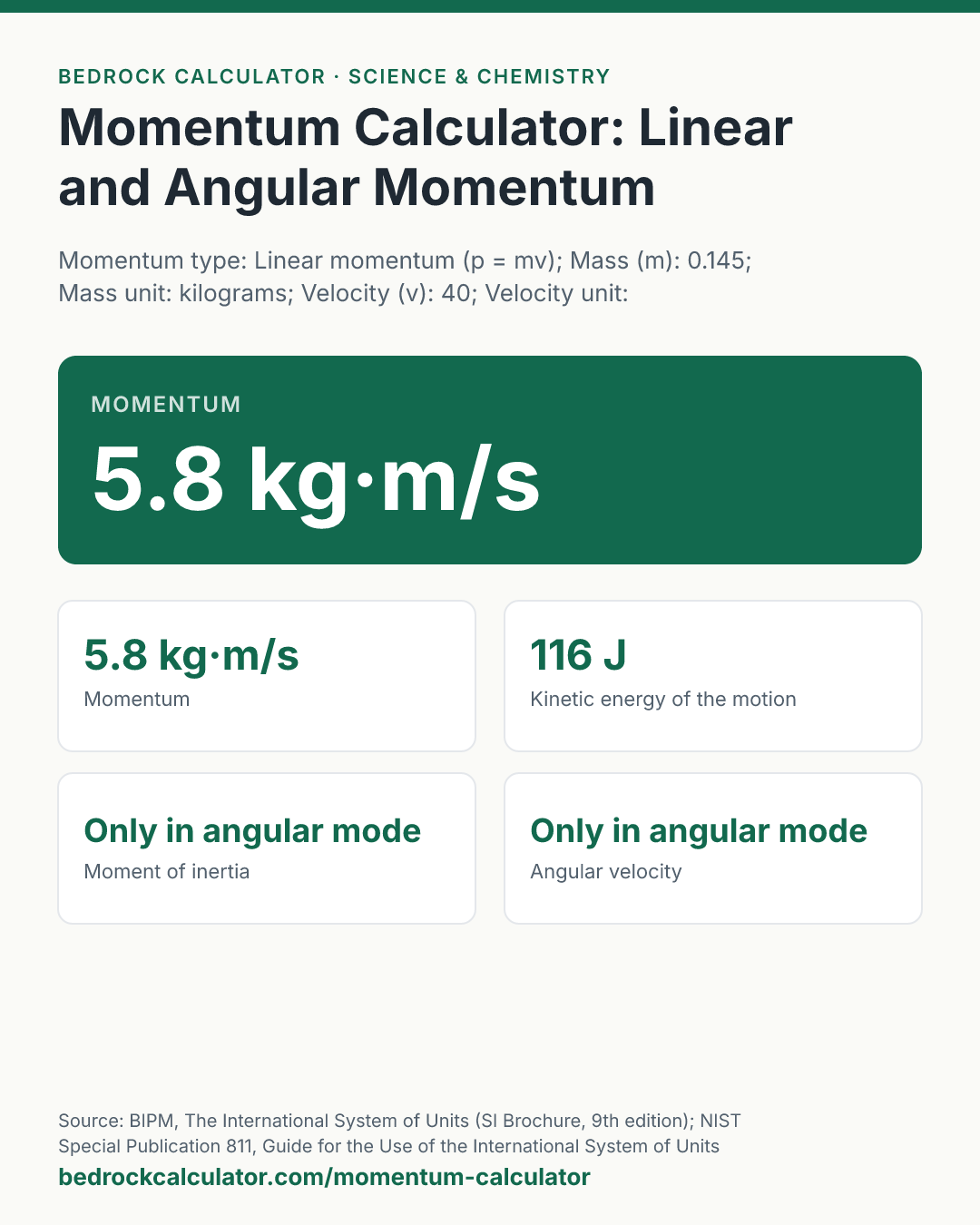

Quick Answer: A 0.145 kg baseball thrown at 40 m/s has a momentum of 5.8 kg·m/s, from p = mv. For spinning objects, angular momentum is L = Iω, the moment of inertia times the angular velocity.
What does this calculator do?
This momentum calculator handles both kinds of momentum met in a physics course. Linear momentum belongs to anything moving in a straight line and is mass times velocity. Angular momentum belongs to anything spinning and is the moment of inertia times the angular velocity.
The calculator does the second one properly: rather than asking you for a moment of inertia, it works it out from the mass, the size and the shape, using the standard formulas for a point mass, a hoop, a solid disc, a solid sphere, a hollow sphere and a thin rod.
Each mode also gives the kinetic energy that goes with the motion, so you can see how momentum and energy differ. Momentum grows in step with speed; kinetic energy grows with its square.
Inputs are converted to SI units before any formula runs: mass to kilograms, velocity to metres per second, radius to metres and rotation speed from revolutions per minute to radians per second. Results are in kilogram metres per second for linear momentum and kilogram square metres per second for angular momentum.
Using the Momentum Calculator
- Choose linear or angular momentum.
- Enter the mass and choose its unit.
- For linear momentum, enter the velocity and its unit. A negative velocity means motion in the opposite direction.
- For angular momentum, pick the shape, enter the radius (or, for a rod, its full length) and the rotation speed in rpm.
- Read the momentum at the top. The cards give the kinetic energy, the moment of inertia, the angular velocity and the working.
How is this calculated?
- Convert to SI. Mass goes to kilograms, velocity to metres per second, the radius to metres. The rotation speed becomes an angular velocity in radians per second, because one revolution is 2π radians:
ω = (2π × rpm)/60
- Linear momentum. Mass times velocity, keeping the sign of the velocity:
p = mv
- Kinetic energy from momentum. The energy of the same motion, written in terms of momentum:
KE = p²/2m
- Moment of inertia. The mass times the square of the radius, scaled by a factor set by the shape. For a rod, r is the length.
| Shape and axis | Factor k in I = k m r² |
|---|---|
| Point mass at radius r, thin hoop about its axis | 1 |
| Solid disc or cylinder about its axis | 1/2 |
| Solid sphere about a diameter | 2/5 |
| Thin hollow sphere about a diameter | 2/3 |
| Thin rod about its centre | 1/12 |
| Thin rod about one end | 1/3 |
- Angular momentum and rotational energy. The moment of inertia times the angular velocity, and the rotational kinetic energy from the same two figures:
L = Iω; KE_rot = 1/2Iω²
- Round for display. Results are rounded half up to six significant figures, with trailing zeros dropped.
Worked Example
The default inputs are a baseball of 0.145 kg pitched at 40 m/s:
- Momentum: p = 0.145 × 40 = 5.8 kg·m/s.
- Kinetic energy: 5.8² ÷ (2 × 0.145) = 116 J.
A 1,500 kg car at 50 km/h moves at 13.8889 m/s, so its momentum is 20,833.3 kg·m/s and its kinetic energy 144,676 J. Compare the two ratios to the baseball and they do not match: the car's lead in energy is a different multiple from its lead in momentum, because energy depends on speed squared and momentum on speed alone.
For rotation, take a solid 2 kg disc with a radius of 0.5 m turning at 60 rpm:
- Moment of inertia: ½ × 2 × 0.5² = 0.25 kg·m².
- Angular velocity: 60 rpm is 6.28319 rad/s.
- Angular momentum: 0.25 × 6.28319 = 1.5708 kg·m²/s.
- Rotational energy: 4.9348 J.
Angular Momentum Formulas
There are two angular momentum formulas in common use, and they describe the same quantity. For a rigid body, L = Iω. For a single small mass moving at speed v on a circle of radius r, L = mvr, which is what Iω becomes when I = mr² and v = ωr. The point mass option in the calculator is that second case.
The shape matters a great deal. The reference table runs the same 2 kg mass, 0.5 m size and 60 rpm through every shape. A hoop, with all of its mass at the rim, has 3.14159 kg·m²/s, twice the 1.5708 kg·m²/s of a solid disc. A rod spun about its centre has only 0.261799 kg·m²/s.
How Do You Calculate Momentum?
Multiply the mass in kilograms by the velocity in metres per second. The answer is in kilogram metres per second, sometimes written as newton seconds, since one is the same as the other.
Keep the sign: two objects of equal mass moving towards each other at the same speed have a total momentum of zero, which is why such a collision can bring both to a stop.
What does this calculator not account for?
- Collisions. The calculator gives the momentum of one object. To solve a collision, add the momenta before and after; total momentum is conserved when no outside force acts.
- Direction in two or three dimensions. Velocities are along one line, and angular momentum is given as a magnitude about one axis. Vector problems need the components handled separately.
- Composite shapes. Each shape is uniform and ideal. A bicycle wheel is somewhere between a hoop and a disc; a real flywheel needs its own moment of inertia.
- Axes other than those listed. The factors are for the stated axis. A disc spun about a diameter, or a sphere about a point on its surface, has a different moment of inertia.
- Relativistic speeds. p = mv is the low-speed form.
What mistakes do people make with this?
- Using rpm as an angular velocity. ω must be in radians per second. 60 rpm is 6.28319 rad/s, not 60 and not 1.
- Using diameter for radius. I depends on the square of the radius, so a diameter makes it four times too big.
- Entering a rod's half length. For the rod options, enter the full length; the factors 1/12 and 1/3 already account for where the mass sits.
- Confusing momentum with kinetic energy. Doubling speed doubles momentum but quadruples energy.
- Forgetting kilograms. A 145 g ball is 0.145 kg. Set the unit to grams if you type 145.
Frequently Asked Questions
What is the formula for angular momentum?
Is angular momentum conserved?
What units is momentum measured in?
How do I convert angular frequency to frequency?
Can momentum be negative?
Why does the calculator give kinetic energy as well?
Sources
- BIPM, The International System of Units (SI Brochure, 9th edition): the radian, the kilogram and derived units such as kg·m/s. bipm.org/en/publications/si-brochure
- NIST Special Publication 811, Guide for the Use of the International System of Units: units of momentum, moment of inertia and angular momentum, and the conversion factors for mass and velocity. nist.gov/pml/special-publication-811