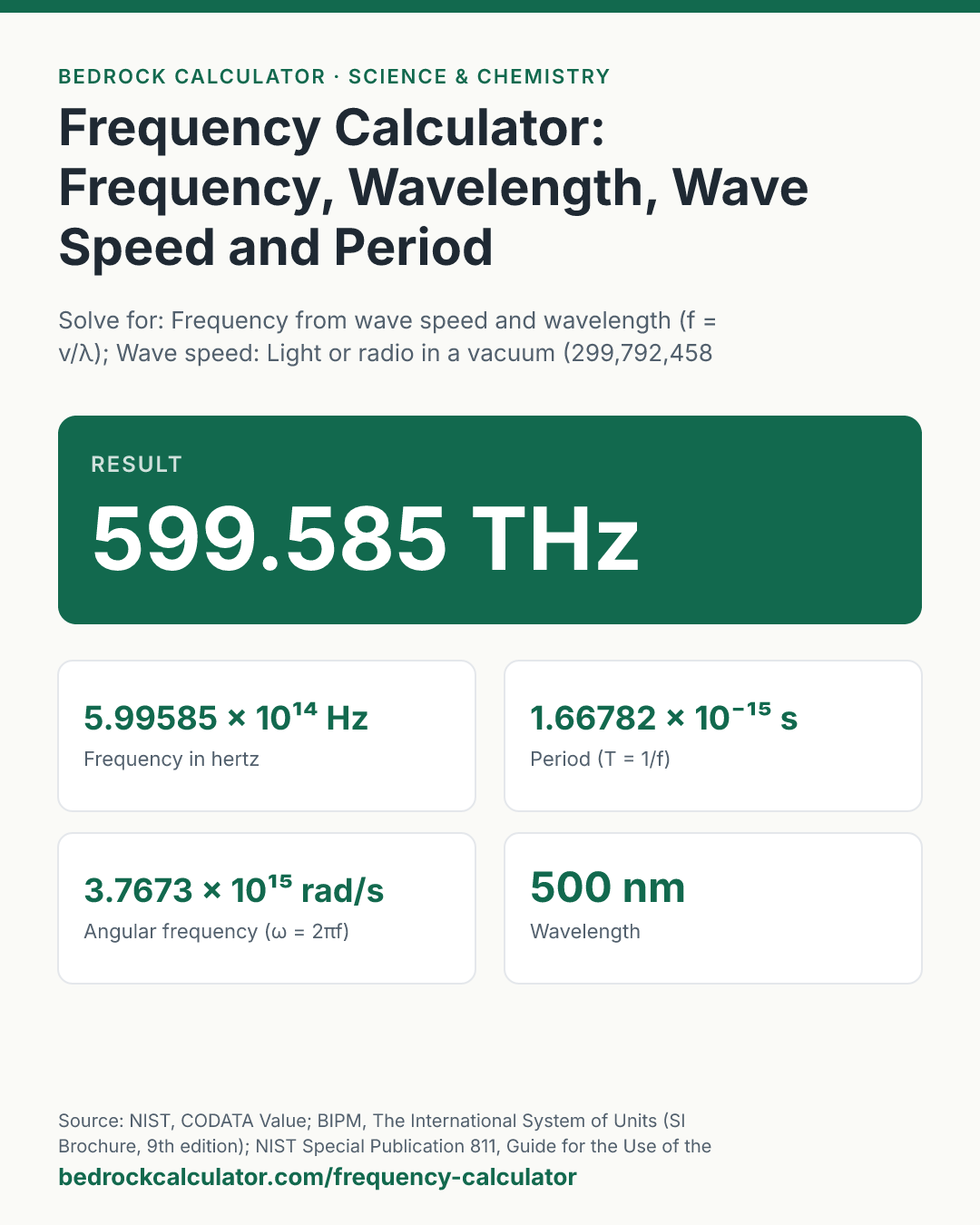
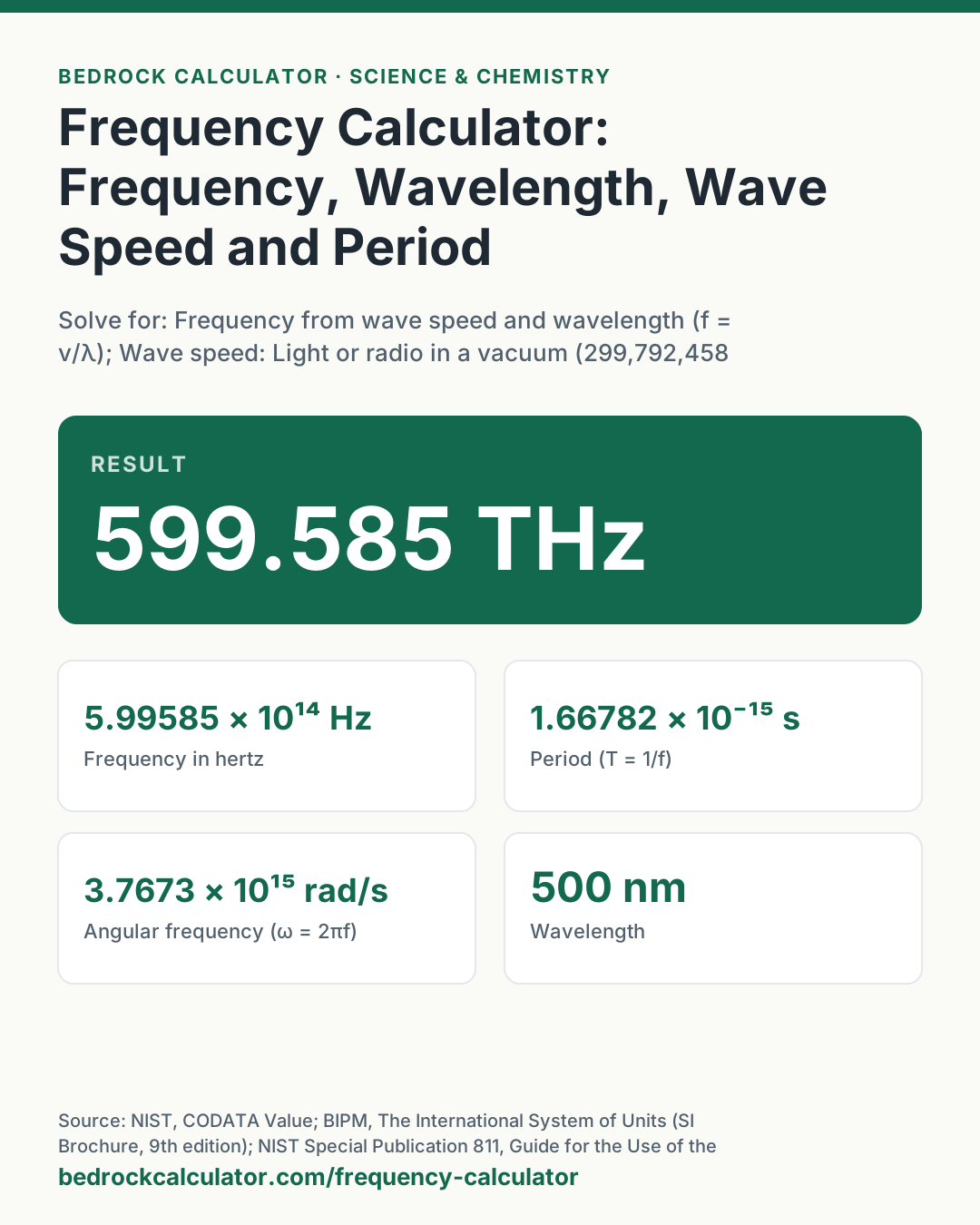
Quick Answer: Green light with a wavelength of 500 nm has a frequency of 599.585 THz, from f = v/λ with the speed of light, 299,792,458 m/s. Its period is 1.66782 × 10⁻¹⁵ s.
What does this calculator do?
This frequency calculator works the relations that tie together every kind of wave and oscillation: frequency, wavelength, wave speed, period and angular frequency. Give it any two that determine the rest and it fills in the others, so one page answers questions about light, radio, sound, strings and mains electricity alike.
Three formulas carry it. The wave equation, v = fλ, says the speed of a wave is its frequency times its wavelength. The period is the time for one cycle, the reciprocal of the frequency, T = 1/f. The angular frequency, ω = 2πf, is the same rate counted in radians per second, which is how oscillations are usually written in physics.
For light and radio waves in a vacuum, the calculator uses the speed of light, c = 299,792,458 m/s. That figure is exact: since 1983 the metre has been defined from it, and NIST lists it in the CODATA tables with no uncertainty. For any other wave, such as sound or a wave on a string, you type its speed. Wavelengths can be entered from nanometres to kilometres, frequencies from hertz to terahertz and periods from nanoseconds to seconds; everything is converted to metres, hertz and seconds before the formulas run.
Using the Frequency Calculator
- Choose what to solve for: frequency from wavelength, wavelength from frequency, wave speed, frequency from a period, or frequency from an angular frequency.
- Choose the wave speed: light or radio in a vacuum, or another wave whose speed you enter in metres per second.
- Fill in the boxes the mode uses and pick their units.
- Read the result at the top. The cards give the frequency in hertz and with a prefix, the period, the angular frequency, the wavelength and the wave speed.
How is this calculated?
- Convert to SI. Wavelengths go to metres, frequencies to hertz and periods to seconds, using exact SI prefixes (1 nm is 10⁻⁹ m, 1 GHz is 10⁹ Hz, 1 ms is 10⁻³ s).
- Solve the chosen relation. The wave equation, rearranged for whichever quantity you asked for:
f = v/λ; λ = v/f; v = fλ
- Period and angular modes. A period is turned into a frequency by taking its reciprocal; an angular frequency is divided by 2π:
f = 1/T; f = ω/2π
- Fill in the rest. From the frequency, the calculator works out the period and the angular frequency. In period and angular modes it also gives the wavelength the wave would have at the wave speed you chose.
T = 1/f; ω = 2πf
- Choose a readable unit and round. Frequencies are shown in hertz and again with the largest prefix that keeps the number at 1 or more (kHz, MHz, GHz or THz). Wavelengths are shown in nanometres, micrometres, millimetres, metres or kilometres in the same way. Everything is rounded half up to six significant figures, except the wave speed, which is shown to nine so that the speed of light appears in full. Very large and very small numbers are written in scientific notation.
Worked Example
The default inputs are green light, wavelength 500 nm, in a vacuum:
- Wavelength in metres: 500 nm = 5 × 10⁻⁷ m.
- Frequency: f = 299,792,458 ÷ (5 × 10⁻⁷) = 5.99585 × 10¹⁴ Hz, or 599.585 THz.
- Period: T = 1/f = 1.66782 × 10⁻¹⁵ s.
- Angular frequency: ω = 2πf = 3.7673 × 10¹⁵ rad/s.
Going the other way, a Wi-Fi signal at 2.4 GHz has a wavelength of 299,792,458 ÷ (2.4 × 10⁹) = 124.914 mm, which is why the antennas inside routers are a few centimetres long.
For a wave on a string or in air, enter its speed. A pattern with a frequency of 440 Hz and a wavelength of 0.78 m moves at 440 × 0.78 = 343.2 m/s.
Finally, a waveform that repeats every 20 ms has a frequency of 1 ÷ 0.02 = 50 Hz, the mains frequency in Europe, and an angular frequency of 314.159 rad/s.
The Frequency Formula
The frequency formula depends on what you know. From a period, f = 1/T: a cycle that takes 20 ms repeats 50 times a second. From a wave's speed and wavelength, f = v/λ. From an angular frequency, f = ω/2π. And if you simply count cycles, frequency is the number of cycles divided by the time you counted them for, which is the same thing as 1/T. All of these give a frequency in hertz, one cycle per second.
Wave Speed Formula
The wave speed formula is v = fλ: frequency times wavelength. It holds for every kind of wave, and it is the reason a higher frequency means a shorter wavelength when the speed is fixed. Light in a vacuum always travels at 299,792,458 m/s, so its colour is set by either its frequency or its wavelength; the reference table on this page runs the visible range from 788.928 THz at 380 nm to 399.723 THz at 750 nm.
What does this calculator not account for?
- Light in a material. Light slows down in glass, water or air, so its wavelength shortens while its frequency stays the same. The light option is for a vacuum. In air the difference is under 0.03%, but in glass it is about a third; enter the slower speed with the "Other wave" option for those cases.
- The speed of sound. Sound speed depends on the medium and its temperature, so the calculator does not assume one. Enter the speed you have from your course or from a measurement.
- Dispersion. In some media, waves of different frequencies travel at different speeds. The calculator treats the speed as a single number.
- Doppler shifts. A moving source or observer changes the observed frequency. That needs the Doppler formula, which is not part of this page.
- Non-sinusoidal signals. A square wave or a musical note contains many frequencies. The calculator handles one frequency at a time.
What mistakes do people make with this?
- Mixing nanometres and metres. f = v/λ needs λ in metres for an answer in hertz. 500 entered as metres instead of nanometres gives a frequency a billion times too small.
- Confusing ω and f. Angular frequency is 2π times the ordinary frequency. Mains at 50 Hz has ω = 314.159 rad/s, not 50.
- Using the speed of light for sound. The light option is for electromagnetic waves only. Sound in air is roughly a million times slower.
- Reading THz as Hz. Visible light frequencies are hundreds of terahertz, or hundreds of millions of millions of hertz. Check the prefix on the result card.
- Expecting frequency to change in a new medium. When a wave crosses into a new material, its speed and wavelength change; its frequency does not.
Frequently Asked Questions
How do you find frequency?
How do you calculate the speed of a wave?
How do I convert angular frequency to frequency?
What is the wavelength of 2.4 GHz Wi-Fi?
What units is frequency measured in?
Is the speed of light exactly 299,792,458 m/s?
Sources
- NIST, CODATA Value: speed of light in vacuum, c = 299,792,458 m/s (exact). physics.nist.gov/cgi-bin/cuu/Value
- BIPM, The International System of Units (SI Brochure, 9th edition): the definition of the metre from c, the hertz and SI prefixes. bipm.org/en/publications/si-brochure
- NIST Special Publication 811, Guide for the Use of the International System of Units: the hertz, the radian per second and SI prefixes. nist.gov/pml/special-publication-811