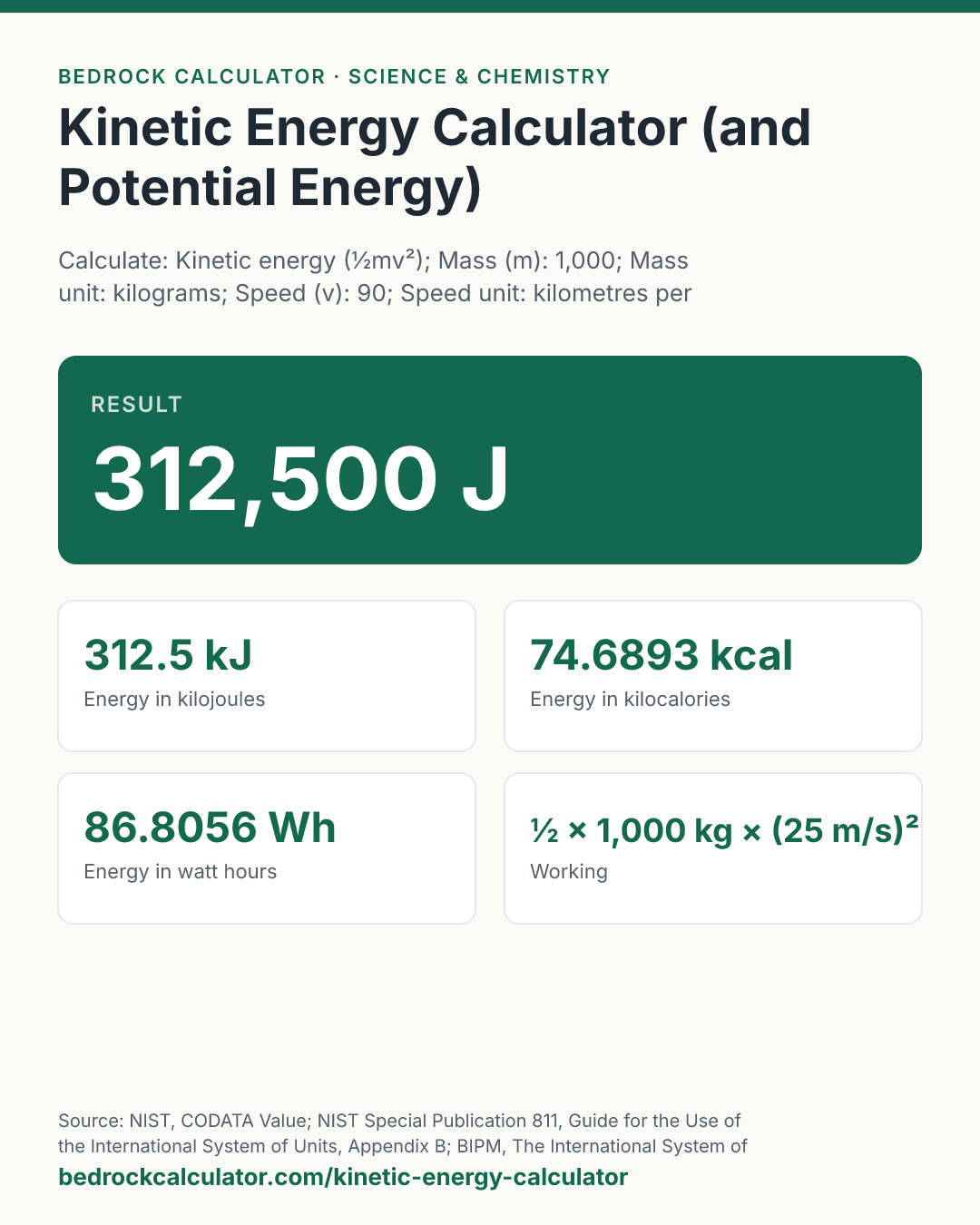

Quick Answer: A 1,000 kg car moving at 90 km/h has 312,500 J of kinetic energy, from KE = ½mv² with the speed in metres per second (25 m/s). That is 312.5 kJ, or 86.8056 Wh.
What does this calculator do?
This kinetic energy calculator works out the energy of a moving object from its mass and speed, and it handles three related questions as well: the gravitational potential energy of a raised object, the speed that a given amount of kinetic energy corresponds to, and the rotational kinetic energy of a spinning wheel.
Kinetic energy depends on the square of speed. That one fact explains most of what surprises people about it: a car at 120 km/h carries four times the energy of the same car at 60 km/h, not twice, and it needs roughly four times the braking distance to shed it. The reference table on this page shows the pattern for a 1,000 kg car from 10 to 130 km/h.
Every input is converted to SI units first: kilograms, metres per second and metres. The answer is then given in joules, kilojoules, kilocalories, watt hours and foot-pounds. The kilocalorie is the thermochemical one, 4,184 J exactly, and potential energy uses standard gravity, 9.80665 m/s², the exact value NIST lists in the CODATA tables.
Using the Kinetic Energy Calculator
- Choose what to calculate: kinetic energy, potential energy, speed from kinetic energy, or rotational kinetic energy.
- Enter the mass and pick its unit (kilograms, grams, pounds or tonnes).
- For kinetic energy, enter the speed in m/s, km/h, mph or ft/s. For potential energy, enter the height in metres, centimetres or feet. For speed, enter the energy and its unit. For rotation, enter the moment of inertia and the speed in revolutions per minute.
- Read the result at the top. The cards below give the energy in five units and the working line.
How is this calculated?
- Convert to SI. Mass is converted to kilograms, speed to metres per second, height to metres and any typed energy to joules, using exact definitions (1 lb is 0.45359237 kg, 1 km/h is 1/3.6 m/s, 1 kWh is 3,600,000 J).
- Kinetic energy. Half the mass times the square of the speed:
KE = 1/2mv²
- Potential energy. Mass times standard gravity times height. The height is measured from whatever level you choose as zero, so a negative height gives a negative energy relative to that level.
PE = mgh; g = 9.80665 m/s²
- Speed from kinetic energy. The kinetic energy formula rearranged for speed. The answer is shown in the speed unit you chose.
v = √((2 KE)/m)
- Rotational kinetic energy. The rotation speed in revolutions per minute is turned into radians per second, then half the moment of inertia is multiplied by its square.
ω = (2π × rpm)/60; KE_rot = 1/2Iω²
- Convert and round. The energy in joules is converted to kilojoules, kilocalories (4,184 J), watt hours (3,600 J) and foot-pounds (1.3558179483314004 J), and every figure is rounded half up to six significant figures.
Worked Example
The default inputs describe a 1,000 kg car travelling at 90 km/h:
- Speed in SI: 90 ÷ 3.6 = 25 m/s.
- Kinetic energy: ½ × 1,000 × 25² = ½ × 1,000 × 625 = 312,500 J.
- Other units: 312.5 kJ, 74.6893 kcal, 86.8056 Wh, or 230,488 ft·lbf.
Two smaller cases from the presets:
- A 145 g baseball at 40 m/s: ½ × 0.145 × 40² = 116 J.
- A 2 kg bag lifted 10 m: 2 × 9.80665 × 10 = 196.133 J of potential energy.
Working backwards, a 1,000 kg mass holding 312,500 J of kinetic energy is moving at √(2 × 312,500 ÷ 1,000) = 25 m/s, which the calculator shows as 90 km/h.
A flywheel with a moment of inertia of 0.5 kg·m² spinning at 3,000 rpm turns at 314.159 rad/s and stores 24,674 J.
How Do You Calculate Potential Energy?
Multiply the mass in kilograms by the acceleration of gravity and by the height in metres: PE = mgh. The answer is in joules. A 2 kg bag lifted 10 m gains 196.133 J, and that is also the most kinetic energy it can have when it falls back the same 10 m, if no energy goes into air resistance.
Only the change in height matters; the zero level is yours to choose, so pick the floor, the ground or the bottom of the swing, whichever makes the problem easier.
Why Doubling Speed Quadruples the Energy
Because speed is squared, energy scales with its square. In the table, 60 km/h gives 138.889 kJ and 120 km/h gives 555.556 kJ, exactly four times as much. The same rule is why a crash at 30 km/h, 34.7222 kJ, is a quarter as violent as one at 60 km/h. Brakes turn kinetic energy into heat, so stopping distance at a given braking force rises with the square of speed too.
What does this calculator not account for?
- Relativistic speeds. ½mv² is the low-speed form. Near the speed of light, kinetic energy grows faster than this formula predicts. Everyday objects never get close enough for it to matter.
- Rotation of a rolling object. A rolling wheel or ball has both kinetic energy of motion and rotational energy. Kinetic mode counts only the first; add the rotational mode result for the second.
- Losses. Converting potential energy to kinetic energy assumes nothing is lost to friction or air. Real falls and slides lose some energy to both.
- Local gravity. Potential energy uses standard gravity. Measured gravity is a few parts in a thousand different depending on where you are.
- Food labels. The kilocalorie here is the thermochemical one. Nutrition labels use a calorie that is the same within rounding, but this page is about mechanics, not diet.
What mistakes do people make with this?
- Using km/h directly. Putting 90 into ½mv² as if it were m/s makes the answer too big by a factor of 3.6², or 12.96. Convert to m/s first, or set the speed unit and let the calculator convert.
- Using grams. A 145 g ball is 0.145 kg. The calculator accepts grams if you set the unit; the formula needs kilograms.
- Forgetting the half. mv² alone is twice the kinetic energy.
- Mixing up rpm and rad/s. One revolution is 2π radians, so 3,000 rpm is 314.159 rad/s, not 3,000 or 50.
- Treating potential energy as absolute. It depends on where you set zero; only differences between two heights carry meaning.
Frequently Asked Questions
What is the formula for kinetic energy?
How do I solve for potential energy?
How do I find speed from kinetic energy?
What is rotational kinetic energy?
Why is the answer also shown in watt hours?
Can kinetic energy be negative?
Sources
- NIST, CODATA Value: standard acceleration of gravity, g_n = 9.80665 m/s² (exact). physics.nist.gov/cgi-bin/cuu/Value
- NIST Special Publication 811, Guide for the Use of the International System of Units, Appendix B: the thermochemical calorie (4.184 J), the watt hour and the foot-pound-force. nist.gov/pml/special-publication-811
- BIPM, The International System of Units (SI Brochure, 9th edition): the joule and the radian. bipm.org/en/publications/si-brochure