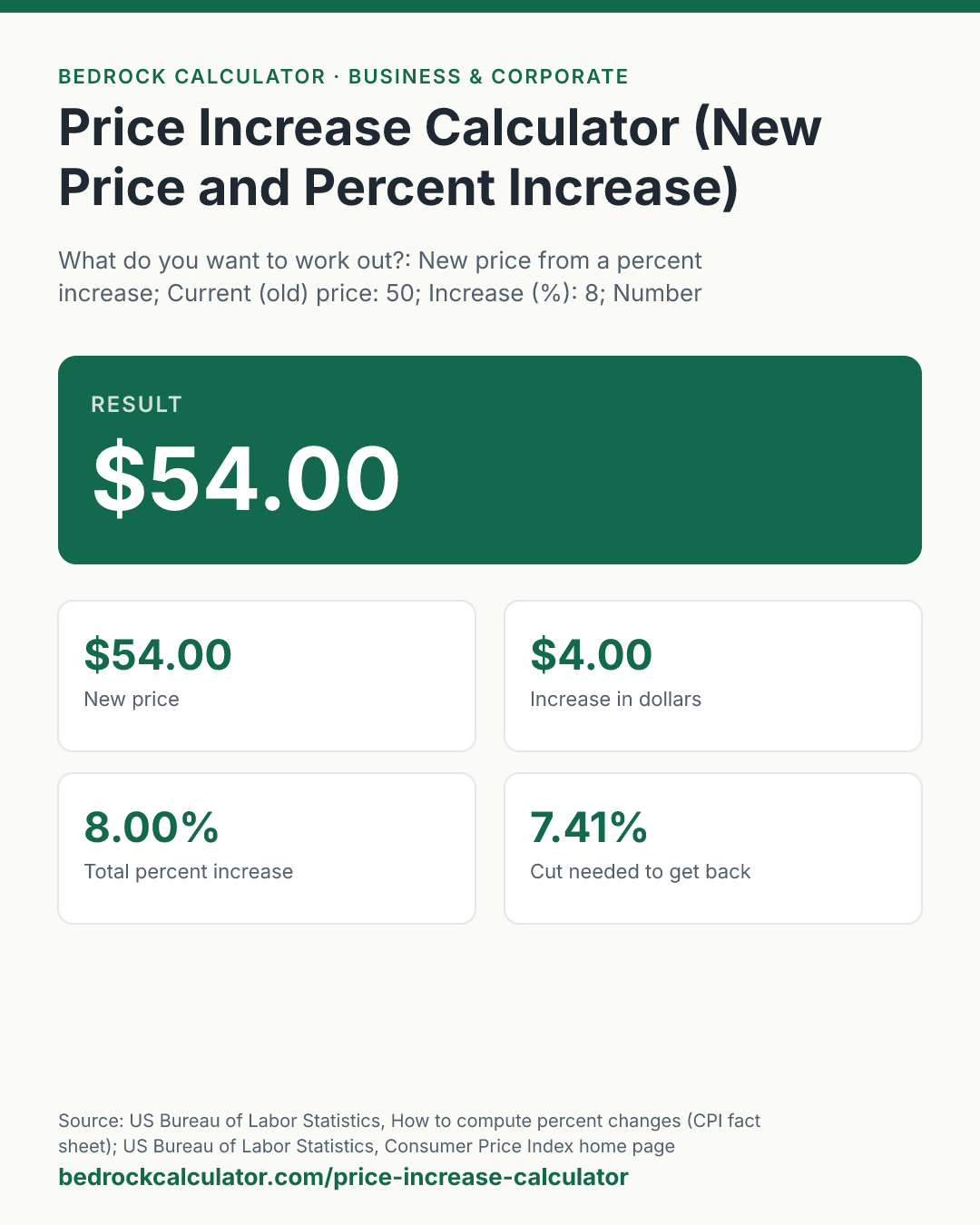
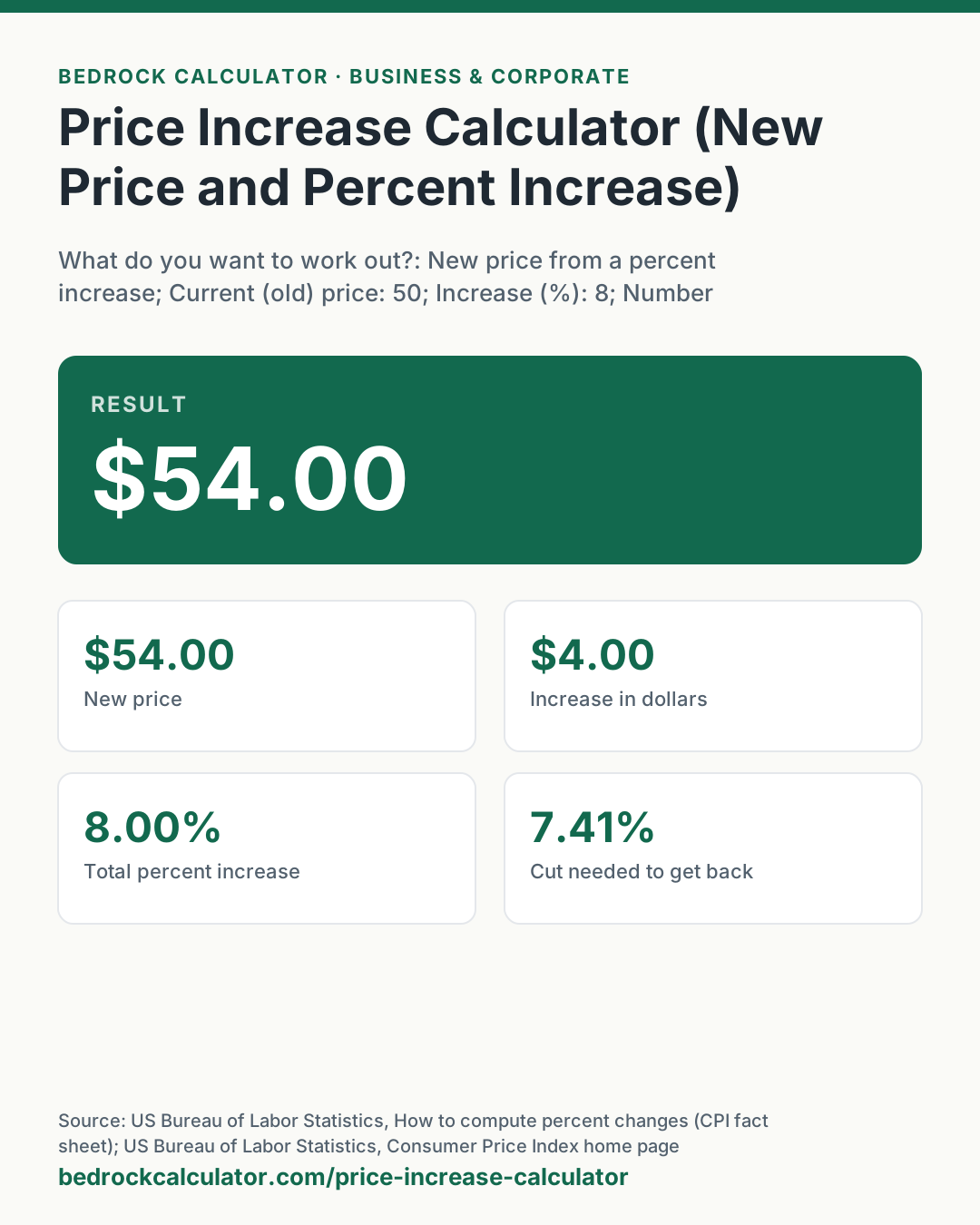
Quick Answer: A $50 price raised by 8% becomes $54.00, an increase of $4.00. Multiply the old price by one plus the increase written as a decimal.
What does this calculator do?
This price increase calculator works in both directions. Enter a current price and a percentage, and it returns the new price and the increase in dollars. Enter an old price and a new one, and it returns the percentage increase between them. Either way it also shows the cut that would take the new price back to the old one, which is always smaller than the rise, and it can apply the same increase several times in a row, such as a yearly price rise over a number of years.
Sellers use it to set a new price list after their costs go up. Buyers use it to see how much a subscription, a grocery item or a rent has really gone up by. The arithmetic is the same: percentage change is the difference between the two prices divided by the old price, the method the Bureau of Labor Statistics publishes for working out changes in the Consumer Price Index.
Money is worked at full precision and rounded to the cent only for display, and percentages to two decimal places.
Using the Price Increase Calculator
To find a new price:
- Leave the mode on "New price from a percent increase".
- Enter the current price and the increase in percent.
- To repeat the increase, set the number of increases. Three yearly rises of 5% means 3.
To find a percent increase:
- Switch the mode to "Percent increase from two prices".
- Enter the old price and the new price.
- Read the percent increase at the top. A new price lower than the old one shows as a negative increase, which is a decrease.
The presets cover a $80 price going up 10%, $100 rising 5% a year for three years, a shelf price that moved from $3.49 to $3.99, and a $40 price raised 25%.
How is this calculated?
- Raise the price. An increase of p percent multiplies the price by (100 + p) / 100.
new price = old price × (100 + p)/100
- Repeat if asked. With more than one increase, each one is applied to the price left by the one before, so n increases of p percent multiply the price by that factor n times.
price after n = old price × ((100 + p)/100)ⁿ
- Measure the change. The increase in dollars is the new price minus the old. The total percent increase is that difference divided by the old price, times 100. In the second mode this step runs directly on the two prices you enter.
percent increase = (new − old)/old × 100
- Work out the cut that undoes it. After a rise of r percent, a cut of r / (100 + r) × 100 percent brings the new price back to the old one.
cut to get back = r/(100 + r) × 100
- Round for display. Prices are rounded to the cent and percentages to two decimal places only when shown.
Worked Example
With the default inputs, $50 raised by 8%:
- New price: $50 × 1.08 = $54.00.
- Increase: $54 − $50 = $4.00.
- Cut needed to get back: 8 ÷ 108 × 100 = 7.41%. Taking 7.41% off $54 returns it to $50.
$100 rising 5% a year for three years:
- After one year: $100 × 1.05 = $105.00.
- After two: $105 × 1.05 = $110.25.
- After three: $110.25 × 1.05 = $115.76.
- The total increase is 15.76%, more than three times 5%, because each rise is on a higher price.
A shelf price that went from $3.49 to $3.99: the increase is $0.50, and $0.50 ÷ $3.49 = 14.33%.
How Do You Calculate a Price Increase Percentage?
Subtract the old price from the new price, divide by the old price, and multiply by 100. The order matters: always divide by the old, starting price. Dividing by the new price instead gives the smaller figure that describes the same move as a cut from the new price, which is a different question.
For example, $40 going to $50 is a $10 rise. Divided by the old $40, that is a 25% increase. The same $10 divided by $50 is 20%, which is the cut needed to go from $50 back to $40. Both numbers are correct; they answer different questions.
Why a Rise and a Cut Do Not Cancel
A 10% rise followed by a 10% cut does not return to the starting price. The $80 preset shows it: up 10% is $88.00, and the cut needed to get back to $80 is only 9.09%. A full 10% off $88 would land below $80. The table below the calculator lists the cut that undoes each common increase on a $100 price; a 50% rise, for instance, takes a 33.33% cut to reverse, and doubling a price takes a 50% cut.
What does this calculator not account for?
- Inflation. The calculator compares two prices as they are. It does not say whether an increase was more or less than general inflation over the same period. For that, compare the result with the change in the Consumer Price Index.
- Shrinkflation. If the package got smaller while the price stayed the same or rose, the real increase is bigger. Compare unit prices instead.
- Taxes and fees. Sales tax, delivery charges and service fees are not included unless they are part of the prices you enter.
- Different increases each year. Repeated increases all use the same percentage. For a different rise each year, apply them one at a time, entering each new price as the next old price.
- Margins and markups. The calculator measures the change in a price, not the profit in it. Raising a price by 8% does not raise your margin by 8 percentage points.
What mistakes do people make with this?
- Dividing by the new price. The percent increase is always measured from the old price.
- Adding yearly increases. Five years of 5% is not 25%. The table shows 27.63% after five rises, because each one compounds on the last.
- Expecting the same percentage to reverse a rise. After a 25% rise, a 20% cut brings the price back, as the $40 preset shows.
- Confusing percent with percentage points. When the thing that rises is itself a percentage, such as a fee rate, a rise of one percentage point is a much larger percent increase in the rate. Say which one you mean.
- Rounding before compounding. Round the final price, not each year's price, or small errors build up.
Frequently Asked Questions
How do I increase a price by a percentage?
How do I work out the percentage increase between two prices?
What is a 10% increase on $80?
How much will a price be after several years of increases?
How do I reverse a price increase?
Is a price increase the same as a markup?
Sources
- US Bureau of Labor Statistics, How to compute percent changes (CPI fact sheet): subtract the earlier value from the later one, divide by the earlier value and multiply by 100. bls.gov/cpi/factsheets/calculating-percent-changes.htm
- US Bureau of Labor Statistics, Consumer Price Index home page: official measures of the change in prices paid by urban consumers. bls.gov/cpi