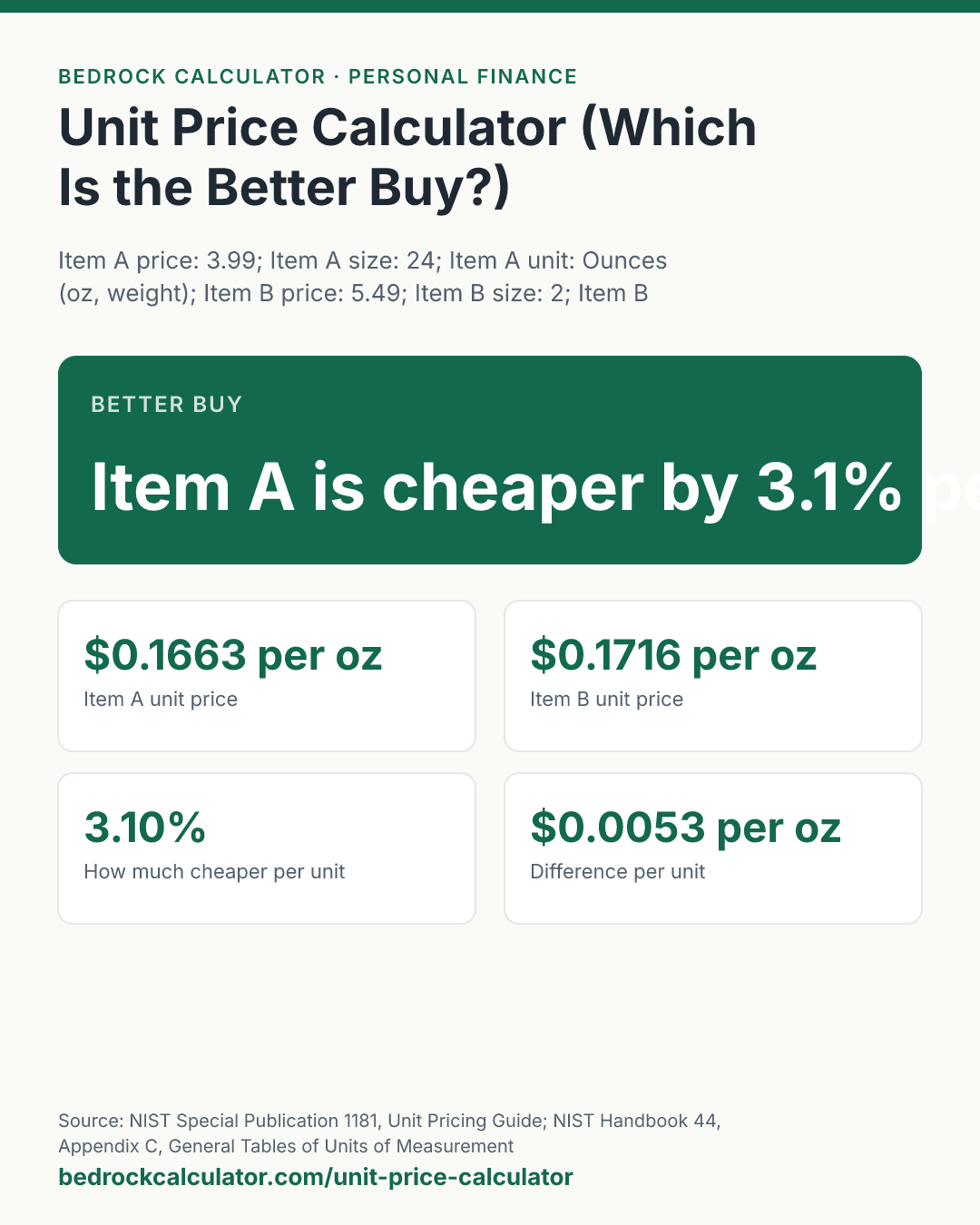
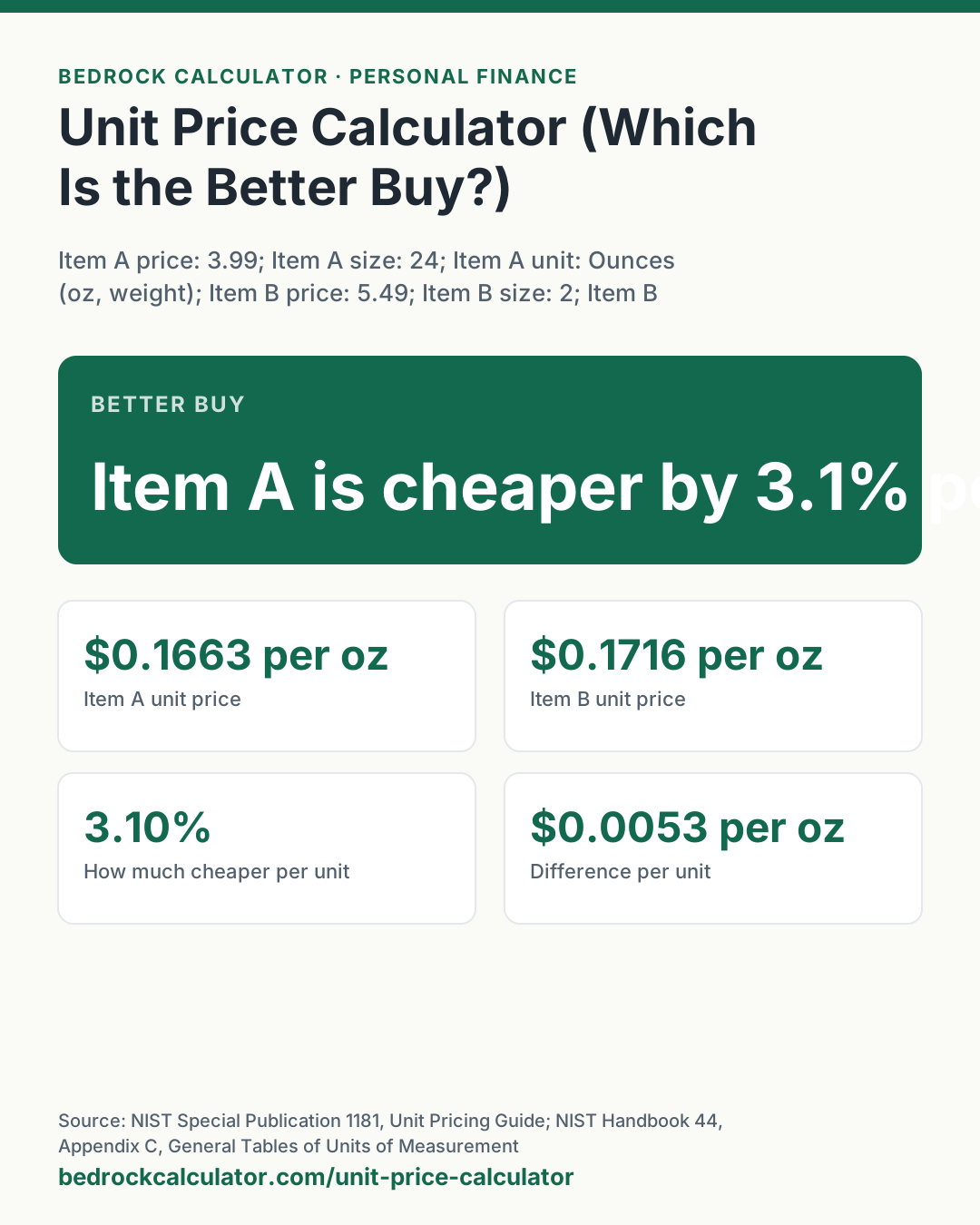
Quick Answer: A 24 oz jar at $3.99 costs $0.1663 per oz, and a 2 lb jar at $5.49 costs $0.1716 per oz, so Item A is cheaper by 3.1% per oz. Divide each price by its size in the same unit, then compare.
What does this calculator do?
This unit price calculator compares two packages of the same product and tells you which is the better buy. Enter each item's price and size, in ounces, pounds, grams, kilograms, fluid ounces, millilitres, litres, gallons or a simple count, and choose the unit to compare them in. It converts both sizes to that unit, divides each price by its size, and shows the two unit prices side by side with the percentage difference.
The conversion step is the part that matters. Stores often unit price different sizes in different units, so a jar priced per ounce sits next to a tub priced per pound. The National Institute of Standards and Technology's guide to unit pricing says every size of a product should be unit priced in the same unit of measure so shoppers can compare value; this calculator does that for you, using exact conversion factors (16 ounces to the pound, 1,000 grams to the kilogram).
Unit prices are shown to four decimal places of a dollar. Shelf labels usually round to the nearest cent, which on a per-ounce price can make two different products look identical.
How to Use the Unit Price Calculator
- Enter item A's price, its size and the unit the size is in, as printed on the package.
- Do the same for item B.
- Choose the unit to compare per. It must measure the same kind of thing as the items: weight with weight, liquid volume with liquid volume, or count with count.
- Read which item is cheaper per unit, by how much, and both unit prices.
The presets compare pasta in 500 g and 1 kg packs, juice in a 64 fl oz bottle and a gallon jug, and paper towels in packs of 24 and 36 rolls. The table below the calculator shows how the price per ounce of a $4.99 product falls as the package gets bigger.
How is this calculated?
- Check the units match. A weight cannot be compared with a volume or a count without knowing the product's density or the size of each piece, so the calculator compares only items measured the same way. If they differ, it shows each unit price in its own unit and says they are not comparable.
- Convert both sizes to the comparison unit. Each size is multiplied by the exact factor between its unit and the comparison unit: a pound is 16 ounces, a kilogram 1,000 grams, a US gallon 128 fluid ounces.
- Divide price by size. The unit price is the price divided by the size in the comparison unit.
unit price = price/(size in comparison units)
- Compare. The item with the lower unit price is the better buy. The percentage shown is the difference between the two unit prices divided by the higher one.
percent cheaper = (higher unit price − lower unit price)/(higher unit price) × 100
- Round for display. Unit prices are shown to four decimal places of a dollar and the percentage to two decimal places.
Worked Example
With the default inputs, a 24 oz jar at $3.99 and a 2 lb jar at $5.49, compared per ounce:
- Item A: $3.99 ÷ 24 oz = $0.1663 per oz.
- Item B: 2 lb is 32 oz, so $5.49 ÷ 32 oz = $0.1716 per oz.
- The difference is $0.0053 per oz, so item A is cheaper by 3.1% per ounce, even though the bigger jar is item B.
Pasta, 500 g for $1.79 against 1 kg for $2.99, per kilogram: 500 g is half a kilogram, so item A costs $3.58 per kg against $2.99 per kg for item B. The kilogram pack is 16.48% cheaper.
Paper towels, 24 rolls for $21.99 against 36 rolls for $29.99, per roll: $0.9163 against $0.8331 per roll. The 36-roll pack is 9.08% cheaper per roll, though only if the rolls are the same size.
Which Is the Better Buy?
The one with the lower unit price, all else being equal. Bigger packages are often cheaper per unit, as the table of a $4.99 product at different sizes shows: the same price over a 64 oz package works out to $0.078 per oz against $0.3119 for 16 oz. But the default example shows that bigger is not always cheaper. The 2 lb jar costs more per ounce than the 24 oz jar.
"All else being equal" carries weight. A cheaper unit price is only a saving if you use the extra before it goes off, if the quality is the same, and if the bigger outlay fits your budget this week.
How Do You Calculate a Unit Price?
Divide the price by the quantity. For a fair comparison, express every quantity in the same unit first. If one cereal is 18 oz and another is 1.5 lb, turn the pounds into ounces (24 oz) before dividing. For items sold by count, such as rolls, loads or tablets, divide the price by the count.
What does this calculator not account for?
- Weight against volume. A product sold by weight cannot be compared with one sold by fluid ounces without its density. Fluid ounces and weight ounces are different units.
- Different-sized pieces. A count compares items, not their size. A "double roll" of paper towels holds more than a regular roll, so check sheets per roll or square feet if the package lists them.
- Concentration. A concentrated detergent does more loads per ounce. Compare per load where the package says.
- Waste. A bigger size is only cheaper if you use it all.
- Coupons and multi-buy offers. Enter the price you will actually pay for each item, after any deal.
- Imperial units. Fluid ounces and gallons here are US customary. UK pints and fluid ounces are different sizes and are not offered.
What mistakes do people make with this?
- Trusting the shelf label's units. A store may unit price one size per ounce and another per pound. Convert to one unit, as the calculator does.
- Mixing ounces and fluid ounces. An "oz" on a can of beans is weight; a "fl oz" on a bottle is volume.
- Assuming the big pack is cheaper. Check: the default example shows it can cost more per unit.
- Rounding too early. Two products whose unit prices differ by a fraction of a cent can round to the same figure on a label. Keep at least four decimal places of a dollar.
- Comparing different products. A store brand and a name brand at different unit prices are not necessarily the same value. Unit price compares cost, not quality.
Frequently Asked Questions
How do I calculate the price per unit?
Which is the better buy, 24 oz for $3.99 or 2 lb for $5.49?
How do I compare a price per ounce with a price per pound?
Is a gallon cheaper than two half gallons?
What is a unit pricing label?
Can I compare price per load or per sheet?
Sources
- NIST Special Publication 1181, Unit Pricing Guide: A Best Practice Approach to Unit Pricing (2015): unit pricing every size in the same unit of measure, and the units used for weight, volume and count. doi.org/10.6028/NIST.SP.1181
- NIST Handbook 44, Appendix C, General Tables of Units of Measurement: the avoirdupois pound and ounce and the US gallon and fluid ounce. nist.gov/pml/owm/nist-handbook-44-current-edition