How much house can you afford in Canada under the stress test?
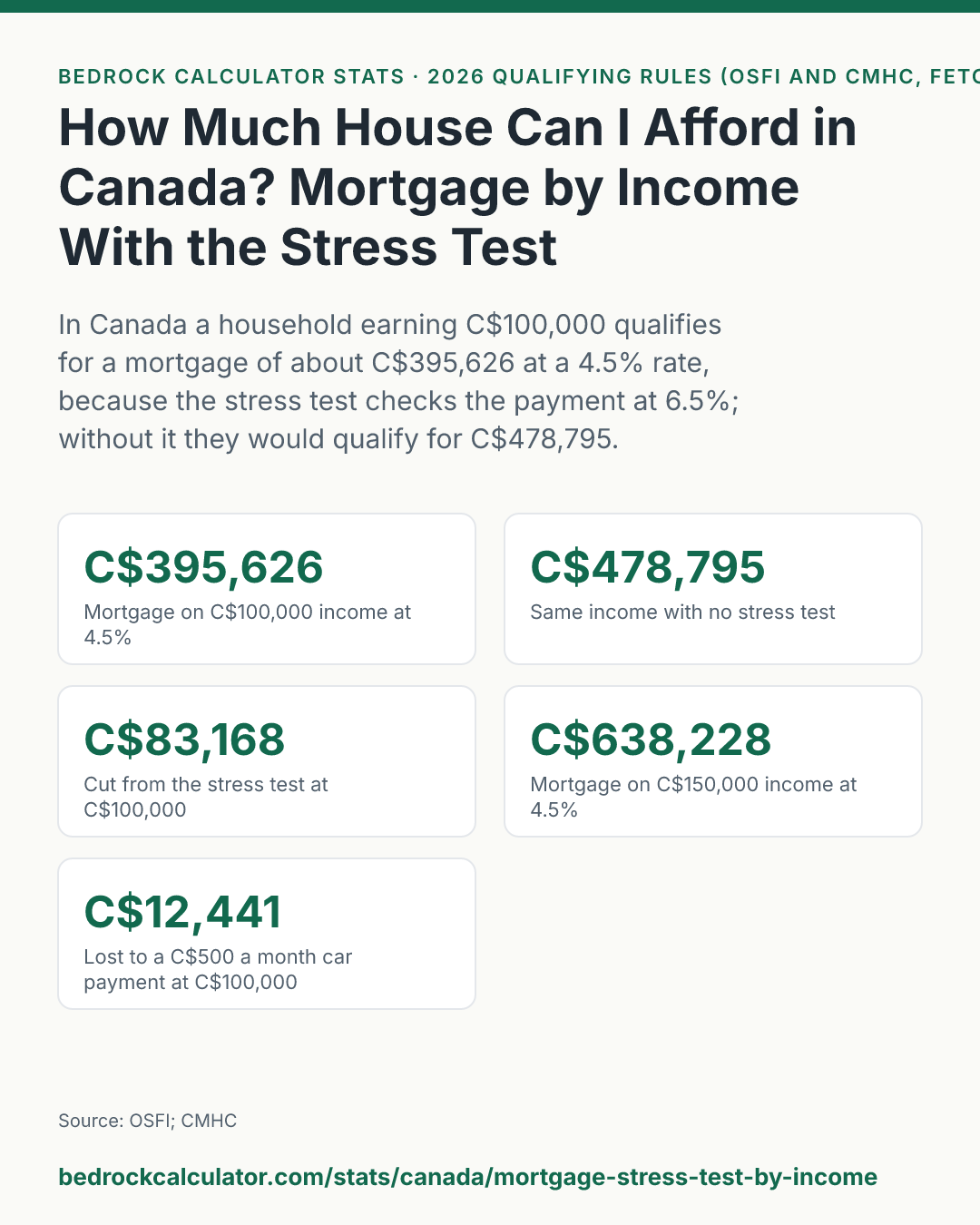
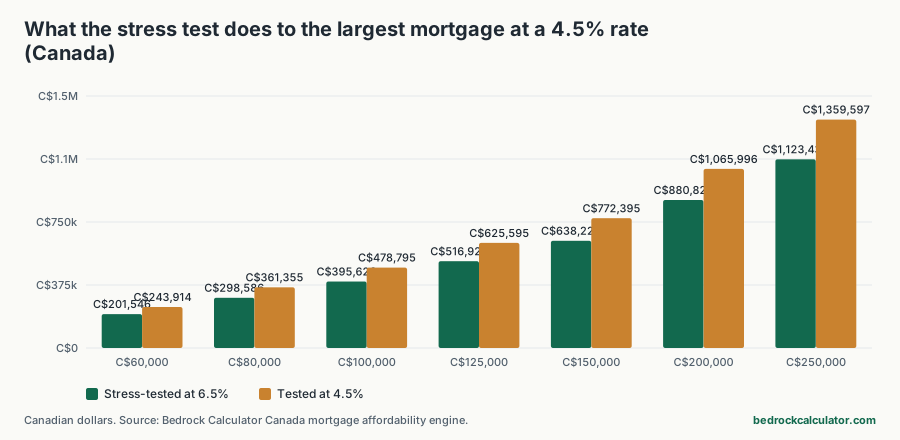
In Canada you don't qualify for a mortgage at the rate you'll actually pay. Lenders test you at a higher rate, and that test, not your income alone, usually sets the ceiling. A household earning C$100,000 a year that's offered 4.5% has to qualify at 6.5%, which caps its mortgage at about C$395,626.
Tested at the contract rate instead, the same household would qualify for C$478,795.
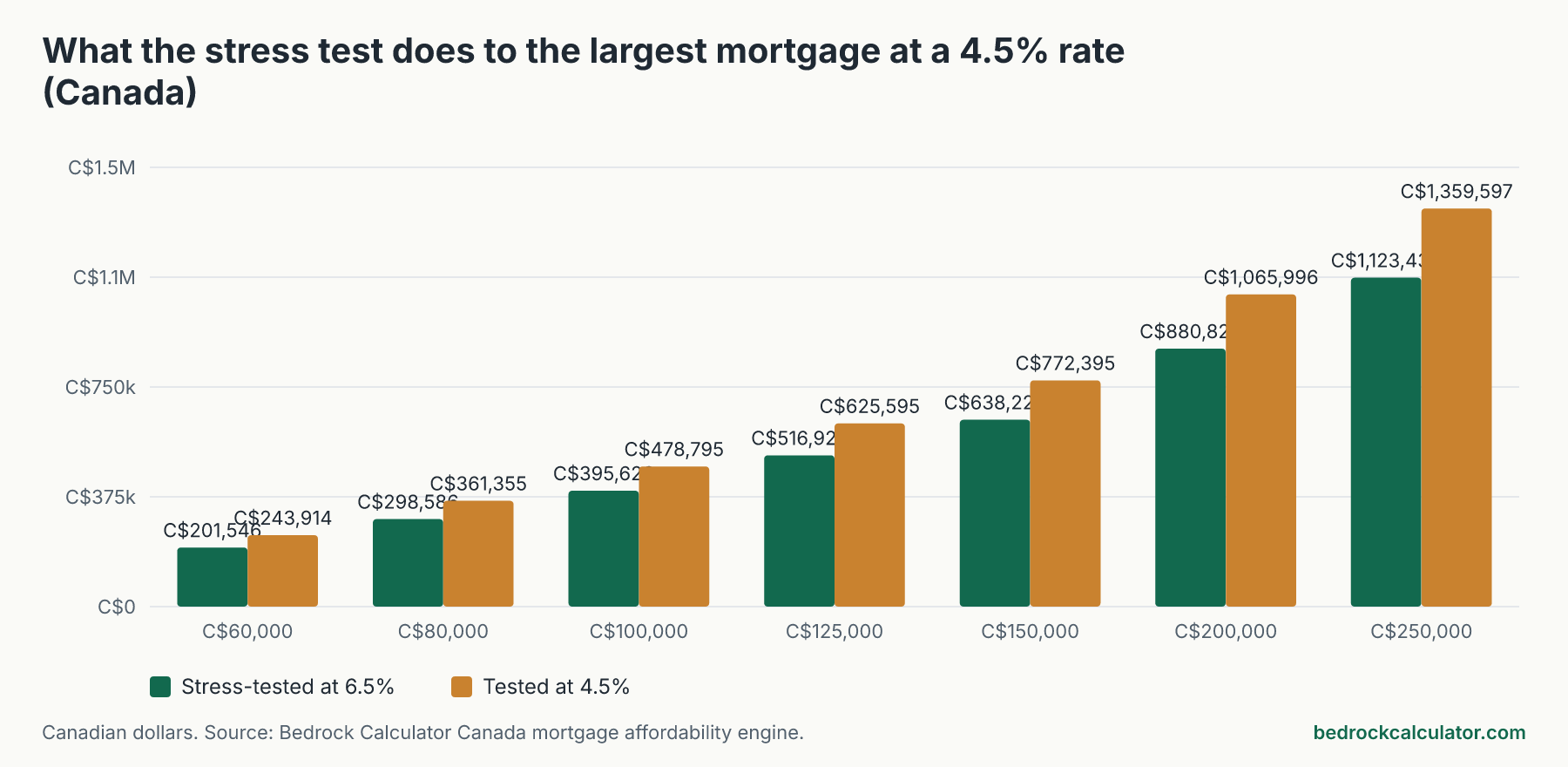
So the stress test takes C$83,168 off what that household can borrow, a cut of 17.4%. The cut is about the same share at every income, but it grows in dollars as income rises.
How we worked out these numbers
We ran the Canada mortgage affordability calculator on this site at seven household incomes from C$60,000 to C$250,000, at three contract rates. It finds the largest mortgage whose payment at the qualifying rate fits inside two limits on gross income:
- Gross debt service (GDS): the mortgage payment, property tax, heat and half of any condo fee can't be more than 39% of gross income.
- Total debt service (TDS): all of that plus your other debt payments can't be more than 44%.
Those are the limits CMHC publishes for insured mortgages, and they're the calculator's defaults. We set the qualifying rate using the rule OSFI publishes for uninsured mortgages, which CMHC also applies to insured ones: the greater of your contract rate plus 2% and 5.25%.
Everything else is held fixed so that income is the only thing changing. Each run uses the calculator's default C$5,400 a year of property tax and C$150 a month for heat, no condo fee, no other debts and a 25-year amortization. The payment is worked out the Canadian way, with interest compounded twice a year as the Interest Act requires.
The largest mortgage at every income
Click any column heading to sort. The price column adds a C$100,000 down payment to the 4.5% mortgage, as an example only.
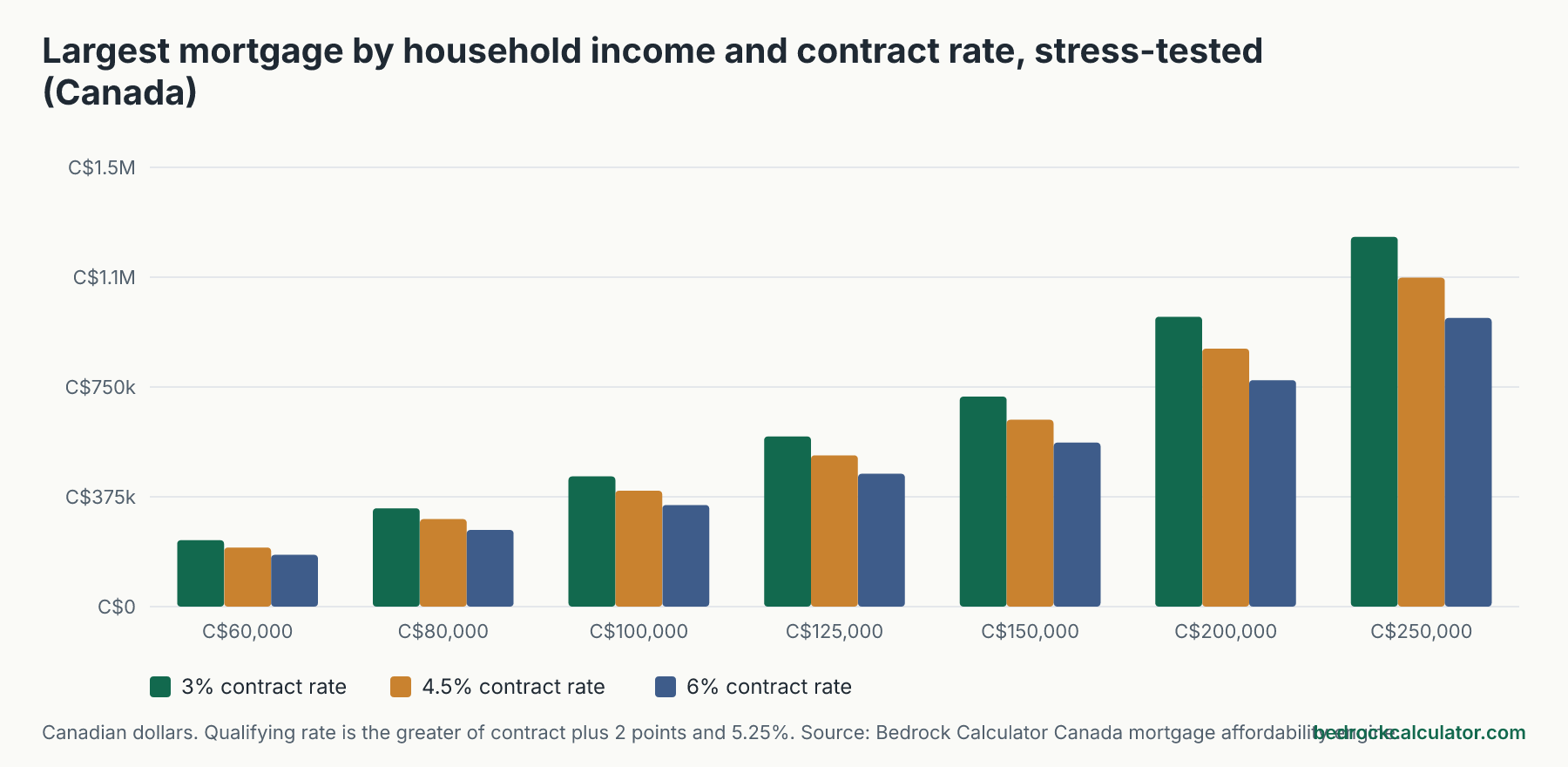
Largest mortgage a Canadian household qualifies for, by income and contract rate (Canadian dollars)
Download CSVStress-tested at the greater of the contract rate plus 2% and 5.25%. GDS 39%, TDS 44%, 25-year amortization, C$5,400 a year property tax, C$150 a month heat, no other debt. Price adds a C$100,000 down payment.
| C$60,000 | C$226,541 | C$201,546 | C$176,884 | C$243,914 | 17.4% | C$301,546 |
| C$80,000 | C$335,617 | C$298,586 | C$262,050 | C$361,355 | 17.4% | C$398,586 |
| C$100,000 | C$444,692 | C$395,626 | C$347,216 | C$478,795 | 17.4% | C$495,626 |
| C$125,000 | C$581,036 | C$516,927 | C$453,674 | C$625,595 | 17.4% | C$616,927 |
| C$150,000 | C$717,381 | C$638,228 | C$560,132 | C$772,395 | 17.4% | C$738,228 |
| C$200,000 | C$990,069 | C$880,829 | C$773,047 | C$1,065,996 | 17.4% | C$980,829 |
| C$250,000 | C$1,262,758 | C$1,123,430 | C$985,963 | C$1,359,597 | 17.4% | C$1,223,430 |
Read across a row and you can see how much the rate matters. At C$100,000 of income, the largest mortgage is C$444,692 at a 3% rate, C$395,626 at 4.5% and C$347,216 at 6%. Read down a column and you can see income doing most of the work: at 4.5%, the ceiling rises from C$201,546 on C$60,000 to C$638,228 on C$150,000 and C$1,123,430 on C$250,000.
How the stress test rate is set
The rule has two parts, and whichever gives the higher rate wins.
- If your contract rate is low, the 5.25% floor applies. At 3%, contract plus 2% would be lower than the floor, so you're tested at 5.25%.
- Once your contract rate is above the floor minus 2%, you're tested at contract plus 2%. At 4.5% that's 6.5%, and at 6% it's 8%.
That's why the gap between the 3% and 4.5% columns is smaller than you might expect. Both households are being tested at rates that are not far apart.
What the stress test costs you, and what it buys
At a 4.5% contract rate the test lowers the largest mortgage by 17.4% at every income in our table, because the qualifying payment and the income limits both scale with income. In dollars, that's C$83,168 at C$100,000 and C$134,168 at C$150,000.
The other side of it is a cushion. At C$100,000 the qualifying payment on the largest mortgage is C$2,650 a month, but at the rate you'd actually pay it's C$2,189.69. The C$460.31 difference is room to absorb a higher rate when your term renews.
Your other debts matter too
In all these runs the GDS limit is the one that binds, because we assumed no other debt. Add a C$500 monthly car payment at C$100,000 of income and the TDS limit takes over. The largest mortgage drops from C$395,626 to C$383,186, which is C$12,441 less. Paying off a car loan or a line of credit before you apply can raise what you qualify for. Paying it down when GDS is the binding limit won't.
What these figures leave out
The calculator works out the largest mortgage the ratios allow, and not much else. It doesn't:
- Apply lender judgment. Credit score, how stable your job is and how much of your income is bonus or commission all change real approvals.
- Add the mortgage insurance premium. With under 20% down, insurance is required and its premium is added to the loan. The calculator flags that and stops there.
- Check the minimum down payment, which rises in steps with the price.
- Tie property tax to the price. It uses one property tax figure, so a pricier home with a bigger tax bill would qualify for a little less than shown.
- Include closing costs, land transfer tax, maintenance or home insurance.
- Cover credit unions in every case. The qualifying rate rule binds federally regulated lenders. Provincially regulated lenders such as many credit unions set their own policies.
- Hold a rate for 25 years. Most Canadian mortgages renew every few years at whatever rate applies then.
Run your own numbers
Put your own income, property tax, condo fees and debts into the Canada mortgage affordability calculator, with the qualifying rate set by the rule above. If you're buying your first home, the first-time home buyer calculator shows how an FHSA and the Home Buyers' Plan add to your down payment. In Ontario, add the land transfer tax calculator to see the cash you'll need on closing.