How much do the FHSA and the Home Buyers' Plan add to a down payment?
First-time buyers in Canada can use two federal programs for the same home: the First Home Savings Account (FHSA) and the RRSP Home Buyers' Plan (HBP). Stacked together they make a large down payment.
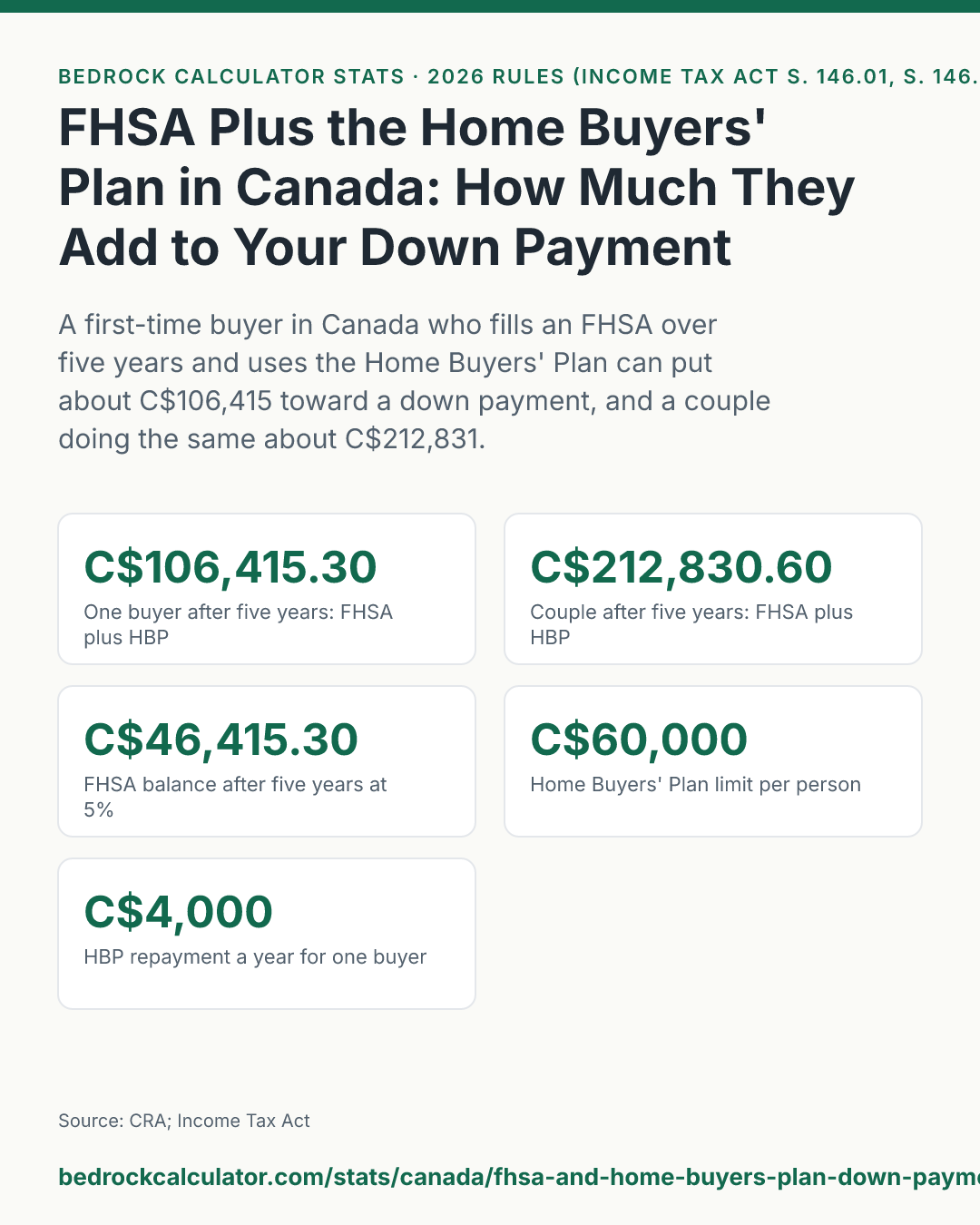
A buyer who puts the maximum into an FHSA for five years, earns 5% a year on it and has C$60,000 in an RRSP to draw on can bring about C$106,415.30 to the purchase. A couple who both do the same can bring about C$212,830.60. The FHSA part never has to be paid back. The HBP part does, over 15 years.
How we worked out these numbers
We used two calculators on this site, one feeding the other.
First, the FHSA calculator builds the account. It assumes you open it, put in C$8,000 a year until you reach the C$40,000 lifetime limit, and buy five or ten years after opening. We used a 5% yearly return and a combined federal and provincial marginal rate of 30.5% for the tax deduction. It reports the balance at purchase, the growth and the tax refunds the deductions produced along the way.
Second, the first-time home buyer calculator stacks that FHSA balance with a Home Buyers' Plan withdrawal capped at C$60,000 per person under the Income Tax Act, and adds the first-time home buyers' tax credit. We assumed each buyer already has at least C$60,000 in an RRSP and no other savings, so the totals show what the two programs alone provide.
For a couple we treated each partner as doing exactly what the single buyer does. The couple's FHSA balance is two single balances, and the calculator doubles the HBP limit because each eligible person has their own.
What the two programs add up to
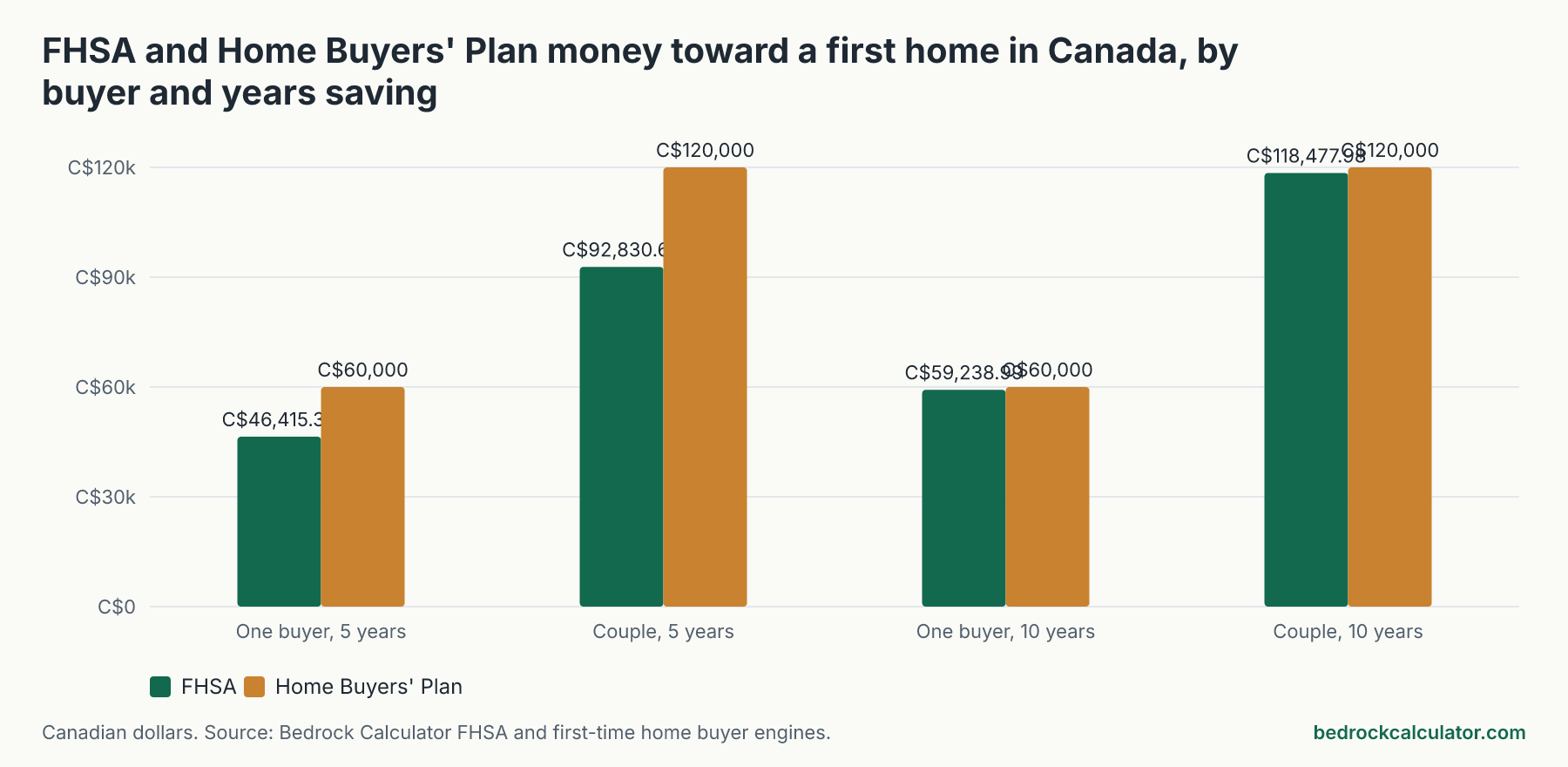
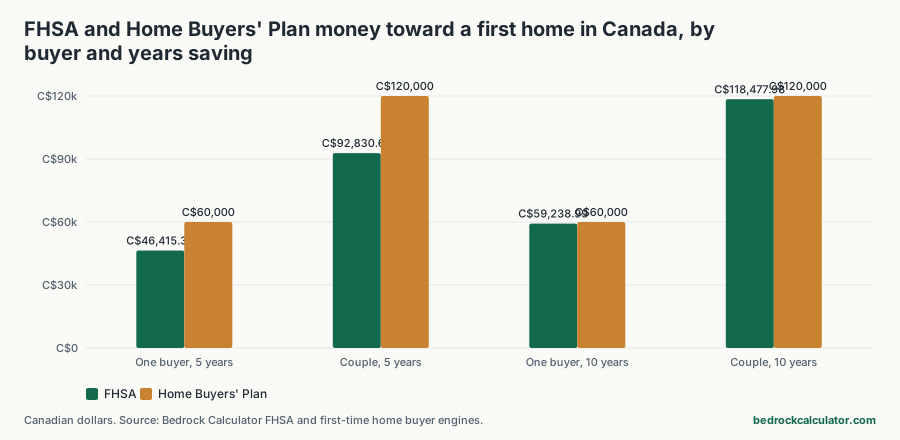
FHSA plus Home Buyers' Plan: down payment a first-time buyer in Canada can assemble (Canadian dollars)
Download CSVFHSA filled at C$8,000 a year to the C$40,000 lifetime limit, growing 5% a year, with the deduction at a 30.5% combined rate. Home Buyers' Plan at its C$60,000 per-person limit. A couple is two buyers who each do the same.
| Couple, 10 years | C$118,477.98 | C$120,000 | C$238,477.98 | C$24,400 | C$8,000 |
| Couple, 5 years | C$92,830.60 | C$120,000 | C$212,830.60 | C$24,400 | C$8,000 |
| One buyer, 10 years | C$59,238.99 | C$60,000 | C$119,238.99 | C$12,200 | C$4,000 |
| One buyer, 5 years | C$46,415.30 | C$60,000 | C$106,415.30 | C$12,200 | C$4,000 |
After five years one buyer has C$46,415.30 in the FHSA, of which C$6,415.30 is growth. Waiting ten years doesn't let you put more in, because contributions stop at C$40,000, but the money keeps growing tax-free, so the balance reaches C$59,238.99. Add the HBP and one buyer has C$119,238.99 after ten years, a couple C$238,477.98.
The FHSA also pays you along the way. Each contribution is deductible like an RRSP contribution, so at a 30.5% rate the deductions cut your tax by C$12,200 in total. That money isn't in the table's down payment figure. If you saved it too, your down payment would be bigger.
FHSA money is yours, HBP money is a loan
The two programs feel similar at the closing table, but they work very differently afterward.
A qualifying FHSA withdrawal is tax-free and final. You never repay it, and it never counts as income.
An HBP withdrawal is a loan from your RRSP to yourself. You repay it over 15 years, so taking the full C$60,000 means putting C$4,000 a year back into your RRSP. For a couple who both take the maximum, that's C$8,000 a year between you. CRA's current rules delay the start of repayments for first withdrawals made from 2026 to 2028, but the calculator doesn't model when repayment starts, only the yearly amount. Miss a repayment and it's added to your taxable income for that year.
How much of the price that covers
For one buyer after five years, FHSA plus HBP covers 21.3% of a C$500,000 home, 16.4% of a C$650,000 home and 10.6% of a C$1,000,000 home. For a couple the shares double: 42.6%, 32.7% and 21.3%. A couple buying at C$650,000 would need a mortgage of about C$437,169.40.
The buyer can also claim the first-time home buyers' tax credit of C$1,400 per home. It's a non-refundable credit, so it only helps if you owe at least that much federal tax, and a couple shares one credit rather than getting two.
What the return does
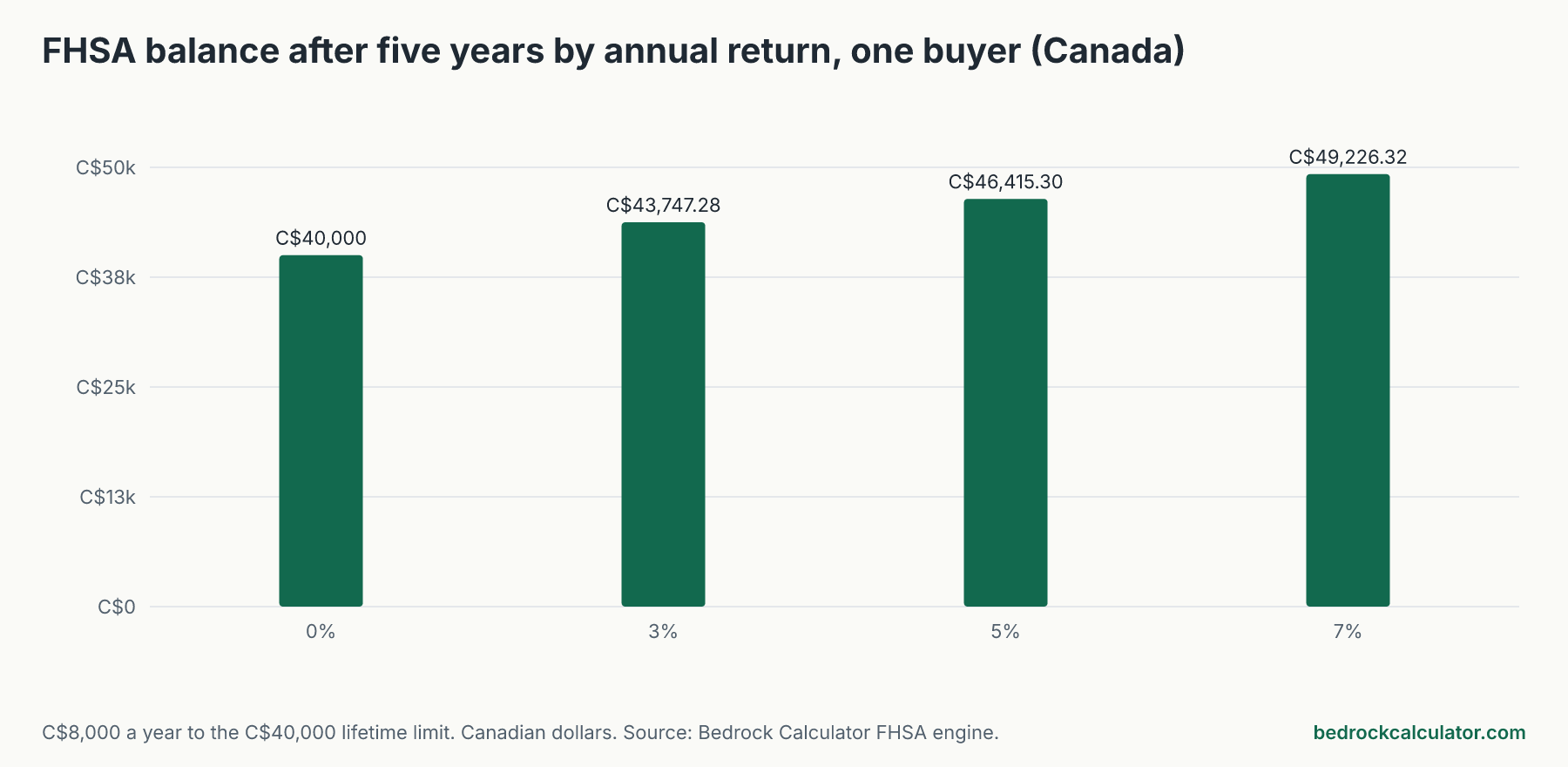
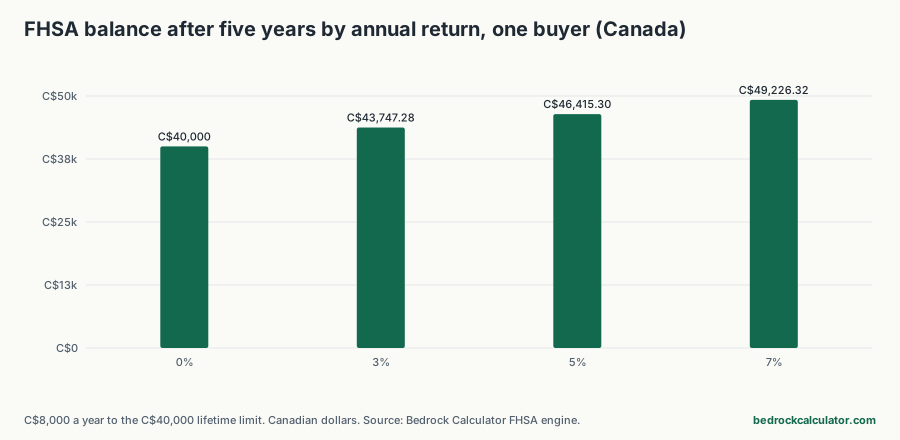
The FHSA's growth matters less than you might think over five years. With no growth at all, five years of maximum contributions leaves C$40,000. At 5% it's C$46,415.30, and at 7% it's C$49,226.32. The tax refunds of C$12,200 are the same whatever the return, and over a short saving period they're worth more than the growth. Because the horizon is short, many first-time buyers keep FHSA money in something with less risk than stocks.
What these figures leave out
These are planning figures. The calculators don't check:
- Whether you qualify as a first-time buyer. Broadly, you can't have lived in a home you or your spouse owned in the current year or the four years before. Each program has its own version of the test.
- The withdrawal conditions, such as a written agreement to buy a qualifying home and timing rules. A withdrawal that fails them can be fully taxable.
- The RRSP 90-day rule. Money put into an RRSP less than 90 days before an HBP withdrawal may not be deductible, so topping up an RRSP just to withdraw it can backfire.
- Your real marginal rate. We used one rate for every FHSA deduction. You can also carry an FHSA deduction forward to a higher-income year.
- Provincial programs, land transfer tax rebates and the GST or HST new housing rebate. The first-time buyer rebates page covers Ontario, Toronto and BC.
- Closing costs, legal fees and the minimum down payment rules.
Run your own numbers
Start with the FHSA calculator using your own contributions, years and rate. Put the result into the first-time home buyer calculator with your actual RRSP balance and savings. Then check what mortgage your income supports with the Canada mortgage affordability calculator, and see how an RRSP contribution today changes your tax with the RRSP calculator.