Should you take CPP at 60, 65 or 70?
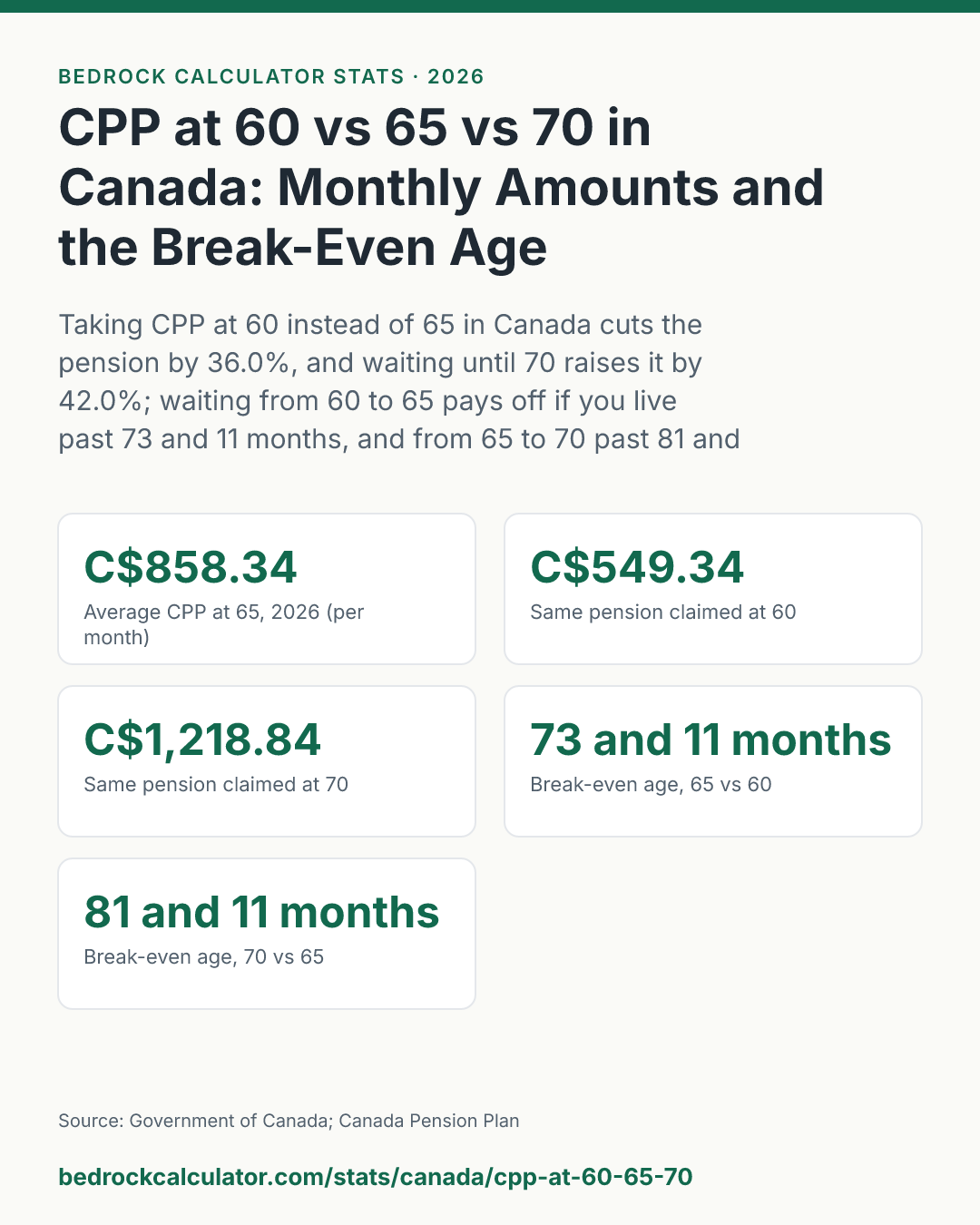
You can start your Canada Pension Plan retirement pension any time between 60 and 70, and the choice is permanent. Start at 60 and every cheque is 36.0% smaller than at 65. Wait until 70 and every cheque is 42.0% bigger.
Whether waiting is worth it comes down to how long you live. Comparing 60 with 65, the later start catches up in total dollars at about age 73 and 11 months. Comparing 65 with 70, it catches up at about 81 and 11 months. Live past those ages and waiting paid off; die before them and the earlier start would have paid more.
How we worked out these numbers
We ran the CPP and OAS calculator on this site at every claiming age from 60 to 70, for two starting points from the site's 2026 CPP table:
- The average pension at 65 that the Government of Canada reports for July 2026, C$858.34 a month
- The maximum age-65 pension in 2026, C$1,507.65 a month
The calculator applies CPP's adjustment for when you start: a reduction of 7.2% for each year before 65 and an increase of 8.4% for each year after, worked out month by month. To find the break-even ages, we added up what each choice pays, month after month, until the later start had paid at least as much in total.
Those totals are in today's dollars. CPP is indexed to inflation every January once it's being paid, so leaving inflation out doesn't change the comparison much. If anything it slightly understates waiting, because the pension you haven't started yet is also tied to wage growth until you claim. What we have left out matters more: income tax on the pension, any return you could earn by investing early payments, the survivor's pension, the post-retirement benefit for people who keep working while collecting, and the effect of a smaller or larger CPP on income-tested benefits like the Guaranteed Income Supplement. We've also kept OAS at 65 throughout so the comparison is CPP alone.
Every claiming age, side by side
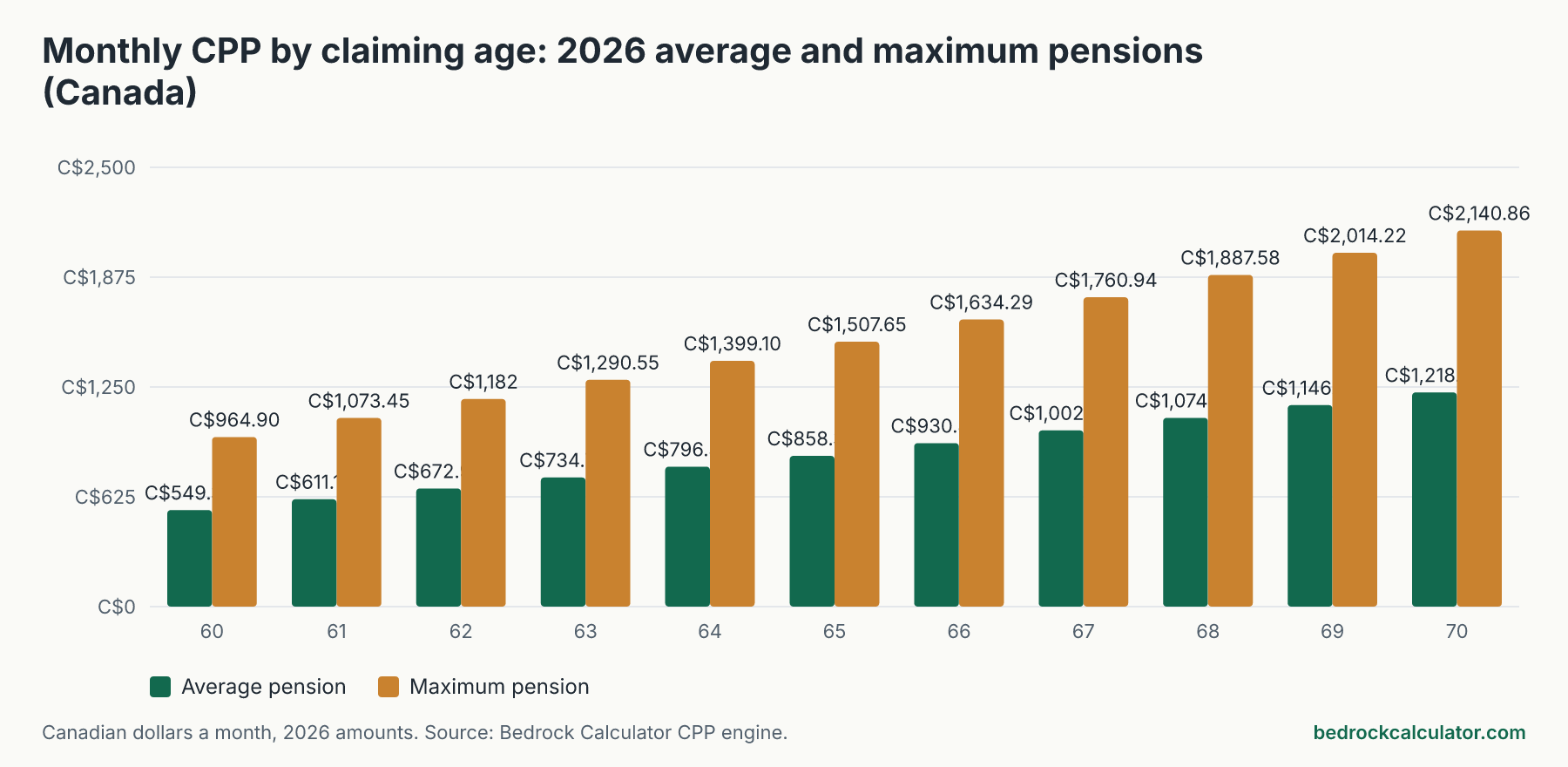
CPP retirement pension by claiming age, Canada 2026 (Canadian dollars a month)
Download CSVAverage and maximum age-65 pensions for 2026, adjusted for early or late claiming. Break-even is the age at which claiming later has paid the same in total as claiming at that age (or at 65, for ages after 65), in today's dollars.
| 60 | 64.0% | C$549.34 | C$964.90 | 73 and 11 months |
| 61 | 71.2% | C$611.14 | C$1,073.45 | 74 and 11 months |
| 62 | 78.4% | C$672.94 | C$1,182 | 75 and 11 months |
| 63 | 85.6% | C$734.74 | C$1,290.55 | 76 and 11 months |
| 64 | 92.8% | C$796.54 | C$1,399.10 | 77 and 11 months |
| 65 | 100.0% | C$858.34 | C$1,507.65 | n/a |
| 66 | 108.4% | C$930.44 | C$1,634.29 | 77 and 11 months |
| 67 | 116.8% | C$1,002.54 | C$1,760.94 | 78 and 11 months |
| 68 | 125.2% | C$1,074.64 | C$1,887.58 | 79 and 11 months |
| 69 | 133.6% | C$1,146.74 | C$2,014.22 | 80 and 11 months |
| 70 | 142.0% | C$1,218.84 | C$2,140.86 | 81 and 11 months |
On the average 2026 pension, starting at 60 gives C$549.34 a month and waiting until 70 gives C$1,218.84. That's C$8,034 a year more for life by waiting the full ten years. For someone entitled to the maximum, the range is C$964.90 to C$2,140.86.
Why the break-even ages don't depend on your pension
Here's a useful shortcut. The break-even age is the same whether your pension is tiny or the maximum, because both the early and late amounts are a fixed share of your age-65 pension. Only the ratio matters. That's why we can give one answer, about 73 and 11 months for 60 vs 65, without knowing your contribution history.
The break-even for other ages follows the same pattern. Starting at 62 rather than 65 breaks even around 75 and 11 months. Waiting from 65 to 67 breaks even around 78 and 11 months. And skipping straight from 60 to 70 breaks even around 78 and 3 months.
Lifetime totals at different ages
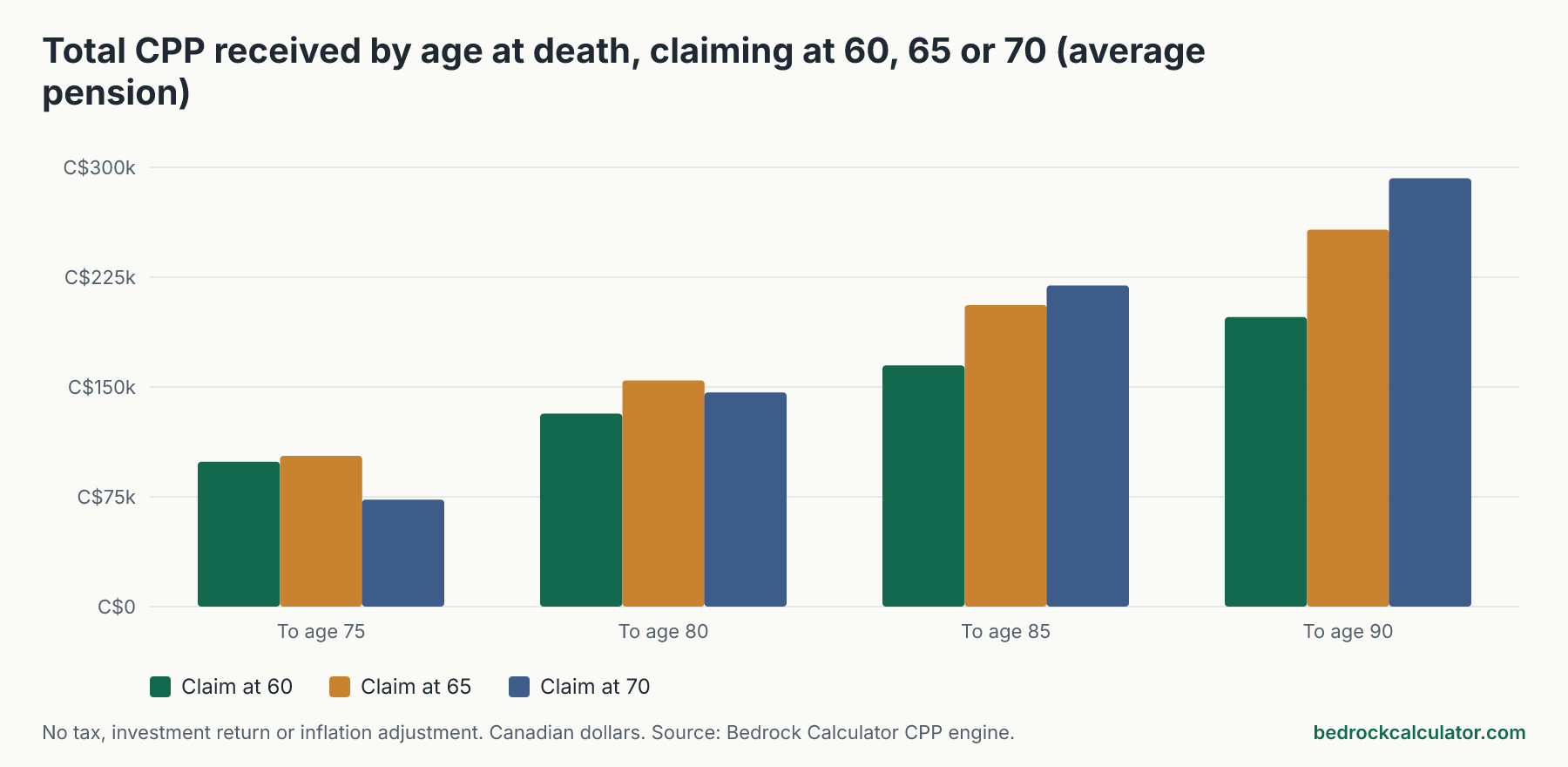
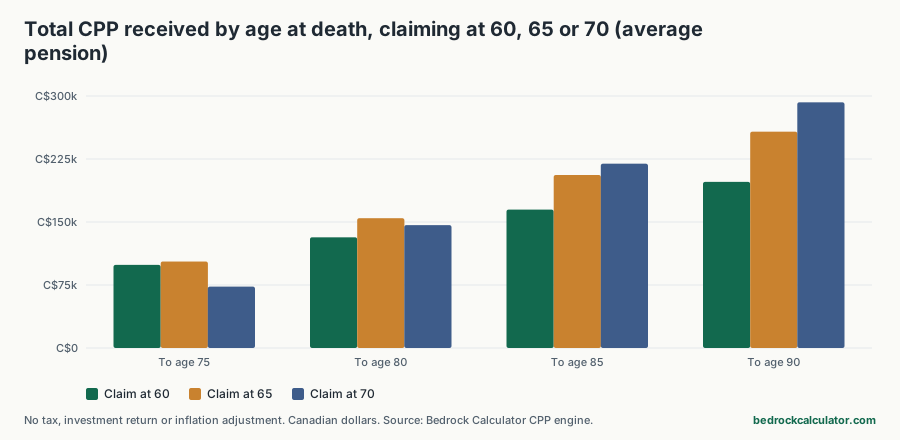
Break-even ages are easier to feel as totals. Here's what the average 2026 pension adds up to, in today's dollars, depending on when you start and how long you live.
If you die at 75, claiming at 60 has paid C$98,881 against C$73,130 for someone who waited until 70. Early wins comfortably. At 80, starting at 65 is ahead with C$154,501, against C$131,842 at 60 and C$146,261 at 70. By 90, waiting until 70 has paid C$292,522, which is C$94,759 more than starting at 60.
A Canadian who reaches 65 has a good chance of living well into their 80s, which is why many planners lean toward delaying. But averages don't decide individual cases.
When taking CPP early makes sense
- Health. If you have a condition that shortens life expectancy, the early start is likely to pay more in total.
- You need the income now. If the alternative is high-interest debt, or drawing down savings at a bad time, an earlier pension can be the better trade.
- Little else to live on between 60 and 65. Starting CPP early can bridge the years before OAS begins at 65.
When waiting makes sense
- Good health and long-lived parents. The longer you expect to live, the more delaying pays.
- Other savings to bridge the gap. Drawing on an RRSP in your 60s while you wait for a larger CPP also shrinks the RRIF you'll have to draw from later, which can help with taxes and the OAS clawback.
- Protection against outliving your money. A bigger, inflation-indexed pension for life is valuable insurance if you reach your 90s.
What to do next
Your own pension depends on your contribution record, so start with your estimate from My Service Canada Account. Then put it into the CPP and OAS calculator at different claiming ages to see the monthly amounts, and check how your combined income sits against the OAS clawback calculator before you decide.