How much of $500 sent abroad from the US actually arrives?
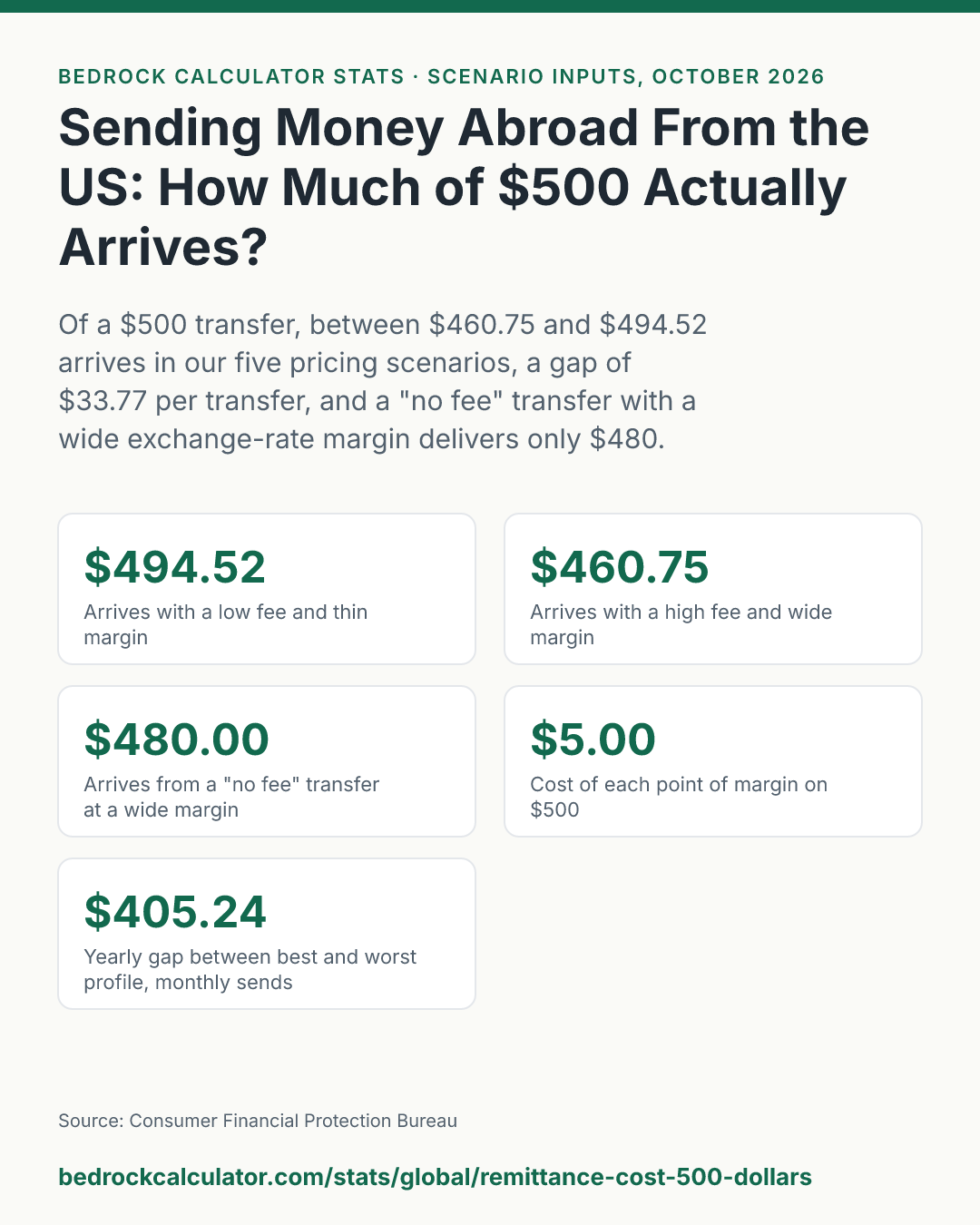
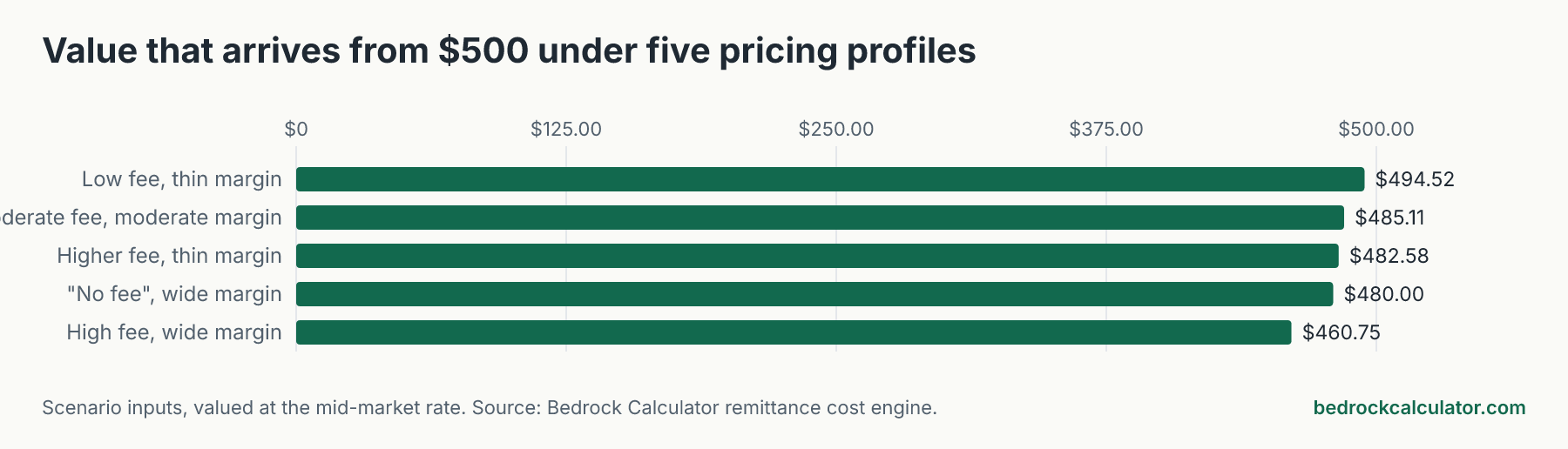
Send $500 abroad and the person on the other end never gets all of it. In the five pricing profiles we tested, the value that arrives ranges from $460.75 to $494.52. That's a $33.77 difference on a single transfer, and $405.24 a year if you send money home every month.
The fee you see isn't the whole story. A transfer advertised with no fee but a 4% exchange-rate margin delivers $480.00, less than a provider charging $14.99 up front with a thin margin.
How we worked out these numbers
Every figure comes from the remittance cost calculator on this site. We ran it on a $500 transfer at a grid of upfront fees from $0 to $25.00 and exchange-rate margins from nothing up to 5%, and recorded what it returned.
There are two costs in any international money transfer:
- The upfront fee, charged in dollars and shown on the receipt.
- The exchange-rate margin, the gap between the rate you're given and the mid-market rate, the one you'd see on a currency site. This one doesn't appear on any receipt. You only see it by comparing the two rates yourself.
The calculator takes the fee off first, converts what's left at the provider's rate, and prices the shortfall against the mid-market rate in dollars. Because both costs are worked out in the sending currency, the result is the same whichever currency your recipient gets. We've shown the arriving amount as its dollar value at the mid-market rate, so you can read it as "how much of my $500 got there".
These fees and margins are inputs we picked to show the range, not quotes from named companies. Real pricing varies by corridor, by how you pay, how the money is collected and how much you send.
Some things the calculator leaves out. It treats the mid-market rate as fixed at the moment of conversion, so it doesn't capture rate moves while a transfer is in flight. Intermediary bank charges on wires, cash pickup fees and card funding surcharges aren't included unless you enter them. And it applies one fee and one margin, whereas many providers change both with the amount sent.
Five ways to price a $500 transfer
Five pricing profiles on a $500 transfer
Download CSVScenario inputs, not quotes from named providers. Yearly cost assumes 12 transfers of $500.
| Low fee, thin margin | $2.99 | 0.5% | $2.49 | $5.48 | 1.10% | $494.52 | $65.76 |
| Moderate fee, moderate margin | $4.99 | 2.0% | $9.90 | $14.89 | 2.98% | $485.11 | $178.68 |
| Higher fee, thin margin | $14.99 | 0.5% | $2.43 | $17.42 | 3.48% | $482.58 | $209.04 |
| "No fee", wide margin | $0.00 | 4.0% | $20.00 | $20.00 | 4.00% | $480.00 | $240.00 |
| High fee, wide margin | $25.00 | 3.0% | $14.25 | $39.25 | 7.85% | $460.75 | $471.00 |
The best result comes from the profile with a low fee and a thin margin: $2.99 up front and a 0.5% margin, for a total cost of $5.48, or 1.10% of the amount sent. The worst pairs a $25.00 fee with a 3% margin. That costs $39.25, or 7.85%.
In the middle sits the kind of pricing you'll often see: a $4.99 fee and a 2% margin. Of its $14.89 total cost, the visible fee is $4.99. The other $9.90 is in the rate.
Are no-fee money transfers really free?
No. In our "no fee" profile, the provider takes nothing up front and recovers its cost through a 4% margin instead. On $500 that margin costs $20.00, and the recipient gets $480.00 in value.
Compare that with the provider charging $14.99 up front but with a 0.5% margin. Its total cost is $17.42 and the recipient gets $482.58. The transfer that looks more expensive at checkout actually delivers more.
Sent monthly, the "free" option costs $240.00 a year.
How much a hidden exchange-rate markup costs
On $500, each percentage point of margin costs $5.00. That sounds small until you multiply it out: $60.00 a year across 12 monthly transfers, for every single point.
The full grid below shows the value that arrives at every combination of fee and margin. At the top left, with no fee and the mid-market rate, all $500.00 arrives. At the bottom right, with a $25.00 fee and a 5% margin, only $451.25 does, a cost of 9.75%.
Dollar value that arrives from $500, by fee and exchange-rate margin
Download CSVEach cell is $500 minus the upfront fee and the exchange-rate margin, valued at the mid-market rate. Holds for any receiving currency. No recipient-side fees.
| 0.5% margin | $497.50 | $494.52 | $492.53 | $487.56 | $482.58 | $472.63 |
| 0% margin | $500.00 | $497.01 | $495.01 | $490.01 | $485.01 | $475.00 |
| 1% margin | $495.00 | $492.04 | $490.06 | $485.11 | $480.16 | $470.25 |
| 2% margin | $490.00 | $487.07 | $485.11 | $480.21 | $475.31 | $465.50 |
| 3% margin | $485.00 | $482.10 | $480.16 | $475.31 | $470.46 | $460.75 |
| 4% margin | $480.00 | $477.13 | $475.21 | $470.41 | $465.61 | $456.00 |
| 5% margin | $475.00 | $472.16 | $470.26 | $465.51 | $460.76 | $451.25 |
Read along a row and you see the fee's effect. Read down a column and you see the margin's.
Why small transfers cost more
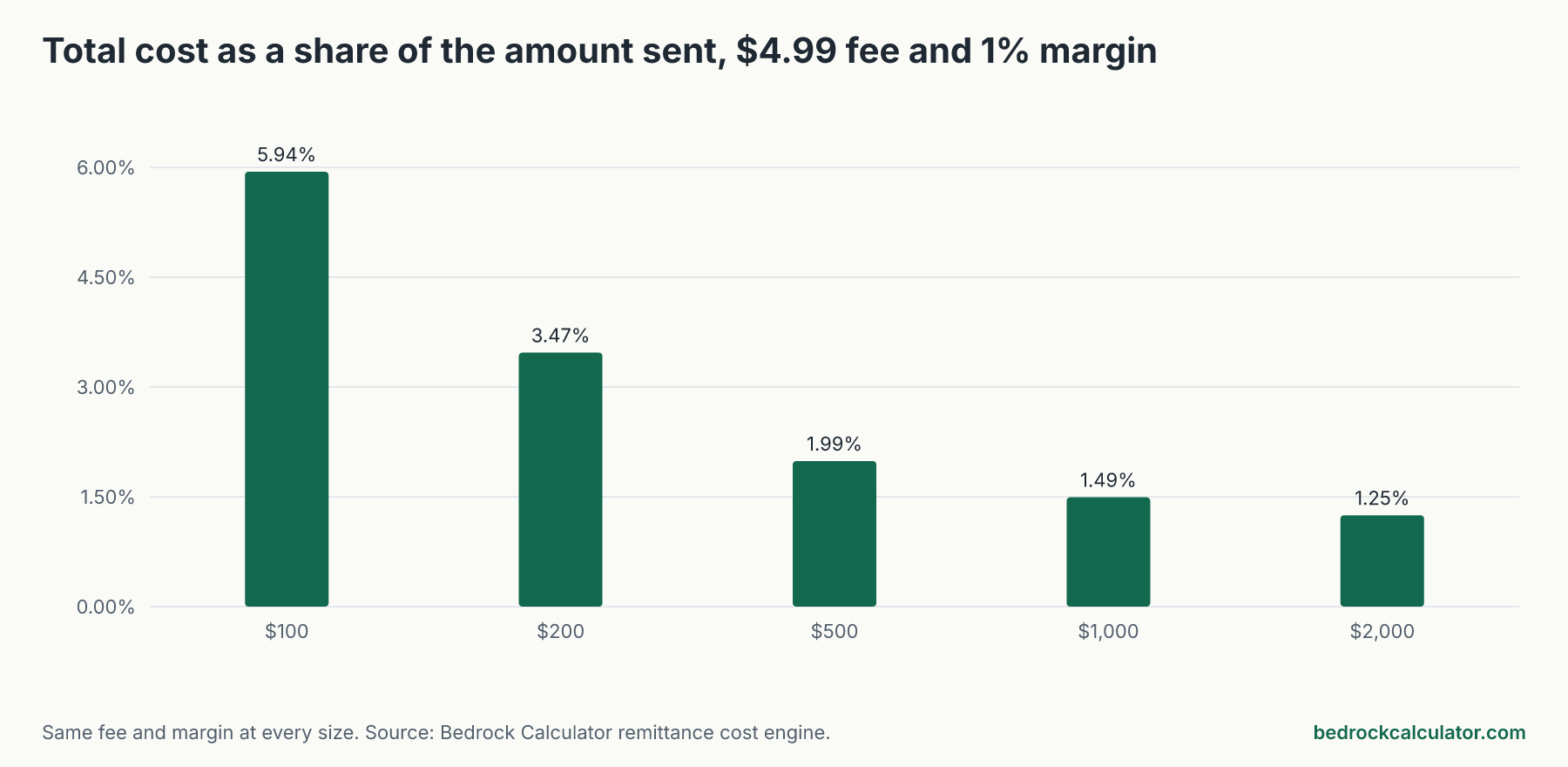
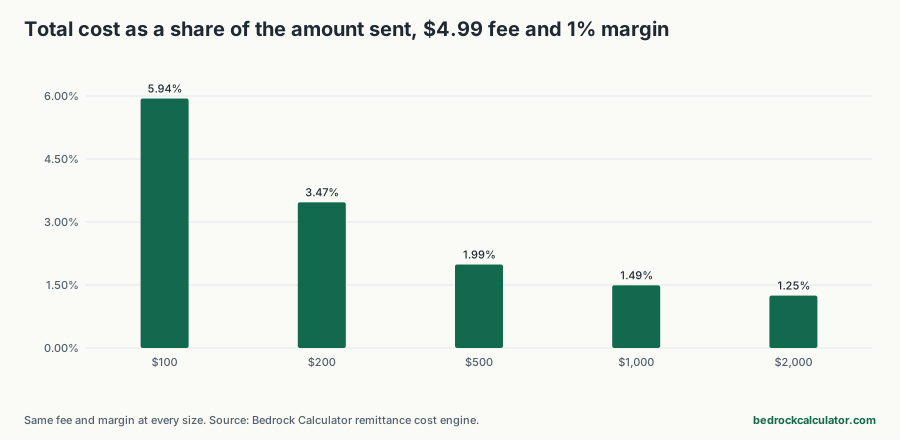
A fixed fee is the same whether you send $100 or $2,000, so it eats a bigger share of a small transfer. The margin, on the other hand, is always the same percentage.
With a $4.99 fee and a 1% margin, the total cost is $5.94 on $100, which is 5.94% of the amount. On $2,000 it's $24.94, just 1.25%. If you can combine several small transfers into one larger one, you'll usually keep more of the money, though only if the fee really is flat for your corridor.
How to find the cheapest way to send money internationally
The number to compare is the one the recipient gets. In the US, providers have to disclose the exchange rate and the amount to be received before you pay, under the Consumer Financial Protection Bureau's remittance rules. Get that figure from two or three providers for the same amount and pick the highest.
To see where the money is going on your own transfer, look up the mid-market rate at the moment you're sending, then enter it in the remittance cost calculator along with the fee and the rate you were quoted. It splits the cost into fee and margin and compares two alternatives side by side. The currency conversion calculator shows the effect of a dealer spread on a straight exchange, and the cross rate calculator helps when your currency pair isn't quoted directly.