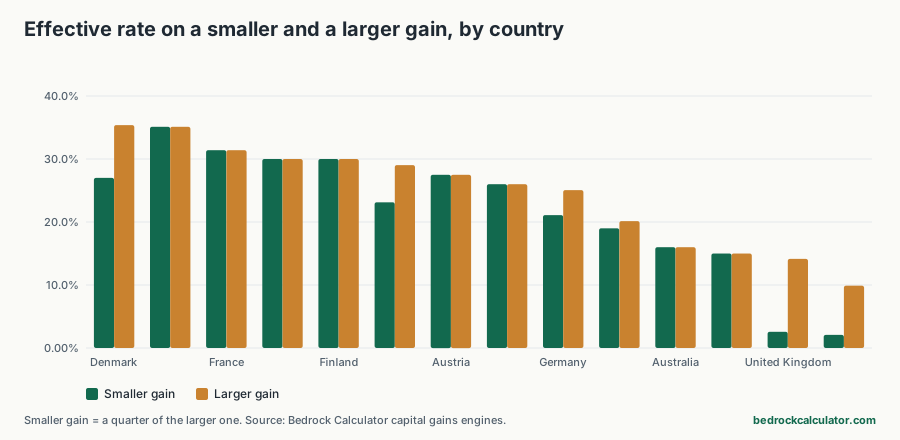
How much capital gains tax is due on the same share gain in each country?
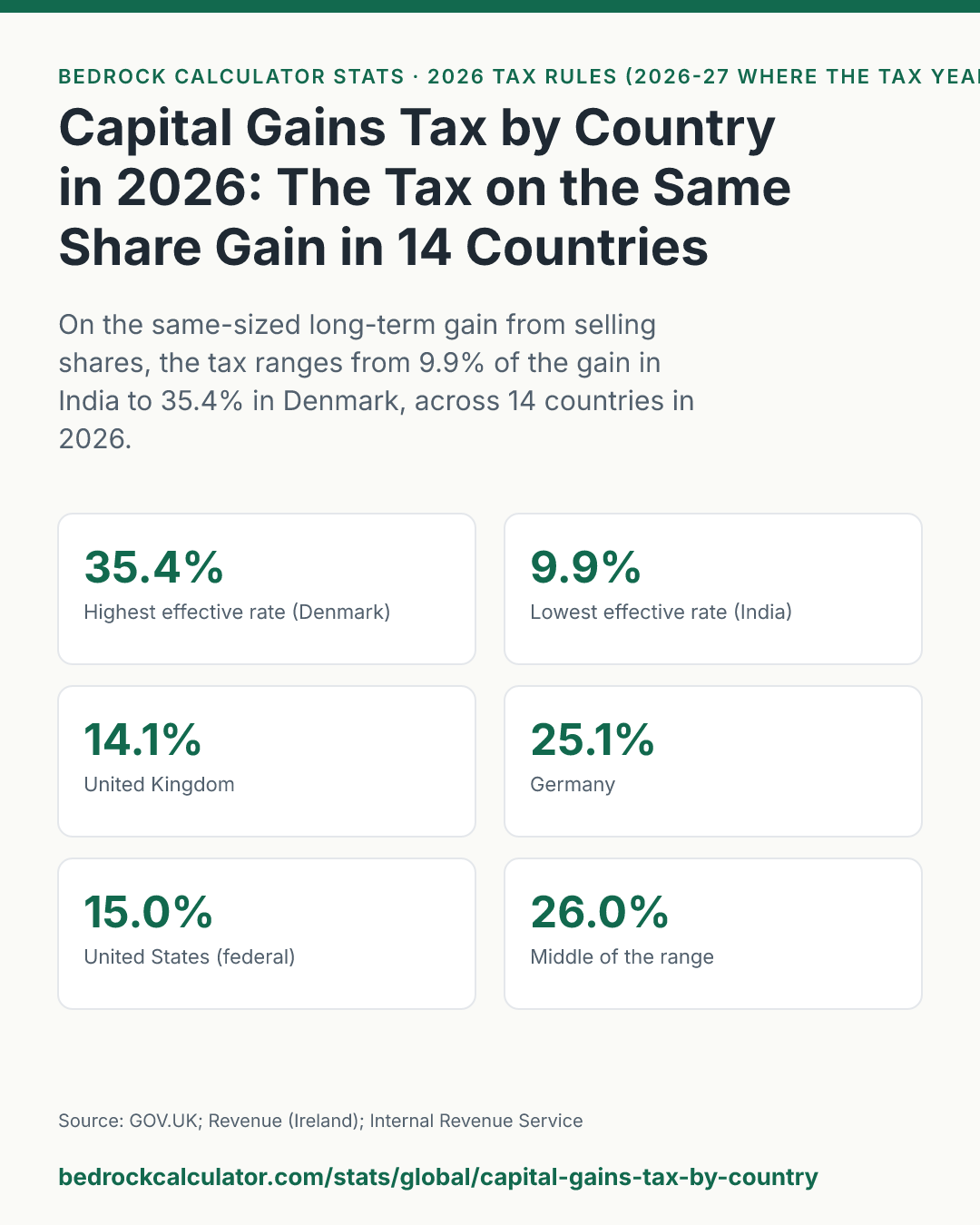
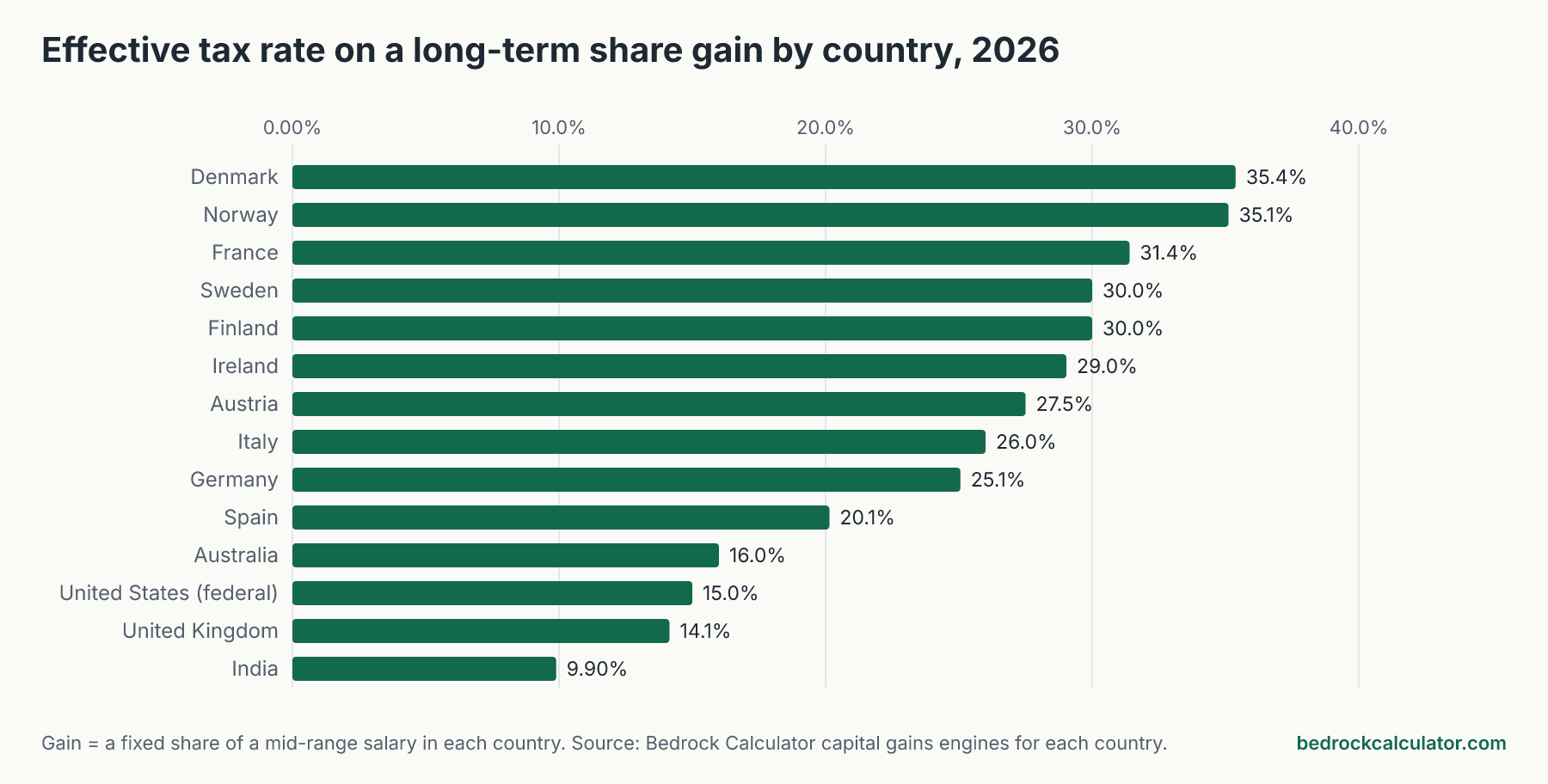
Sell shares at a profit and the tax you owe depends heavily on where you live. On a same-sized long-term gain, Denmark takes 35.4% of it in tax, the most of the 14 countries we compared. India takes the least, 9.9%.
The middle of the range is around 26.0%, which is roughly where Italy, Austria and Germany sit with their flat rates. The UK (14.1%), the US at the federal level (15.0%) and Australia (16.0%) all come in well below that.
How we worked out these numbers
Every figure comes from the capital gains tax calculator this site has for each country. We ran each one on the same kind of sale and recorded the tax.
The scenario is the same everywhere:
- A resident, single individual selling listed shares
- Shares held for more than a year (three years where the calculator asks), bought for twice the size of the gain and sold for three times it
- An ordinary taxable account, not a tax-free wrapper such as an ISA, a Swedish ISK or a Danish share savings account
- No losses to offset, no church tax
Comparing gains across currencies is tricky. A gain of 20,000 means something very different in euros, Swedish kronor and rupees. So instead of converting anything, we sized each country's gain to its own economy: the gain is 40% of a mid-range salary in that country, the same salaries we used in our take-home pay comparison where we have one. Where a calculator needs your other income to set your tax band, we used that salary. Each country's gain and tax stay in its own currency, and what we compare is the effective rate: the tax divided by the gain.
Capital gains tax on shares, country by country
Click any column heading to sort. Gains and tax are in the currency on each row.
Tax on a long-term share gain in 14 countries, 2026
Download CSVGains and tax in each country's own currency (see Currency); nothing is converted. Each gain is a fixed share of a mid-range salary in that country. Resident single individual, listed shares held over a year, ordinary account, no losses.
| Denmark | DKK | 450,000 | 180,000 | 63,690 | 35.4% | 27.0% | Share income: lower rate up to a threshold, higher rate above |
| Norway | NOK | 600,000 | 240,000 | 84,277.25 | 35.1% | 35.1% | Shareholder model: gain grossed up, then taxed, after one year of shielding deduction |
| France | EUR | 40,000 | 16,000 | 5,024 | 31.4% | 31.4% | Flat tax (PFU) including social levies |
| Sweden | SEK | 480,000 | 192,000 | 57,600 | 30.0% | 30.0% | Flat capital income tax on an ordinary account (not ISK) |
| Finland | EUR | 42,000 | 16,800 | 5,040 | 30.0% | 30.0% | Capital income tax: lower rate up to a threshold, higher rate above |
| Ireland | EUR | 50,000 | 20,000 | 5,806.3 | 29.0% | 23.1% | Flat CGT rate for disposals from 7 October 2026, after the annual exemption |
| Austria | EUR | 49,000 | 19,600 | 5,390 | 27.5% | 27.5% | Flat KESt on shares bought since 2011 |
| Italy | EUR | 35,000 | 14,000 | 3,640 | 26.0% | 26.0% | Flat substitute tax on securities |
| Germany | EUR | 50,000 | 20,000 | 5,011.25 | 25.1% | 21.1% | Flat Abgeltungsteuer plus solidarity surcharge, after the saver allowance |
| Spain | EUR | 35,000 | 14,000 | 2,820 | 20.1% | 19.0% | Progressive savings income scale |
| Australia | AUD | 95,000 | 38,000 | 6,080 | 16.0% | 16.0% | Half the gain added to income at marginal rates, plus Medicare levy |
| United States (federal) | USD | 75,000 | 30,000 | 4,500 | 15.0% | 15.0% | Federal long-term rates stacked on other taxable income; no state tax |
| United Kingdom | GBP | 35,000 | 14,000 | 1,980 | 14.1% | 2.6% | 18% and 24% bands after the annual exempt amount |
| India | INR | 1,500,000 | 600,000 | 59,375 | 9.9% | 2.1% | Listed equity long-term rate above the annual exemption, before cess |
Why Denmark and Norway charge the most
Denmark taxes share gains as share income, with a lower rate up to a threshold and a higher rate above it. Our gain of DKK 180,000 crosses that threshold, so the tax is DKK 63,690, or 35.4%.
Norway's shareholder model gets to a similar place differently. The gain is grossed up before tax, to line it up with the tax a company already paid on its profits, and then taxed at the ordinary rate. A shielding deduction, based on the cost of the shares and a risk-free return, takes a little off. On NOK 240,000 the tax is NOK 84,277, or 35.1%.
France (31.4%), Sweden (30.0%) and Finland (30.0%) are next. France's flat tax includes social levies on top of income tax, which is why it's higher than the rate many people quote.
Flat rates in much of Europe
Many European countries tax share gains at one flat rate, whatever your other income. Italy charges 26.0% and Austria 27.5%. Germany's flat rate plus solidarity surcharge works out at 25.1% on our EUR 20,000 gain, a little under the headline because of the annual saver allowance.
Ireland also uses a flat rate, cut in Budget 2027 for disposals from 7 October 2026, which is the rate used here. On EUR 20,000 the tax is EUR 5,806, or 29.0% after the small annual exemption.
Spain is the exception in the euro group: it taxes savings income on a progressive scale, so our EUR 14,000 gain is taxed at 20.1% overall.
Why the UK, US and Australia look lower
United Kingdom. The UK has an annual exempt amount, then taxes gains at a lower rate within the basic rate band and a higher rate above it. With a GBP 35,000 salary, our GBP 14,000 gain is taxed GBP 1,980, or 14.1%.
United States. Federal long-term rates depend on your total taxable income. A single filer with USD 75,000 of other taxable income pays 15.0% on a USD 30,000 gain. That's federal tax only. Most states tax gains as ordinary income on top, and the net investment income tax adds more at higher incomes.
Australia. If you've held an asset for more than a year, only half the gain is added to your income. With a AUD 95,000 salary that half is taxed at the marginal rate plus the Medicare levy, which works out at 16.0% of the whole gain.
India. Long-term gains on listed shares above an annual exemption are taxed at a flat rate. On INR 600,000, the tax is INR 59,375, or 9.9%. That figure is before the health and education cess.
Small gains are taxed very differently
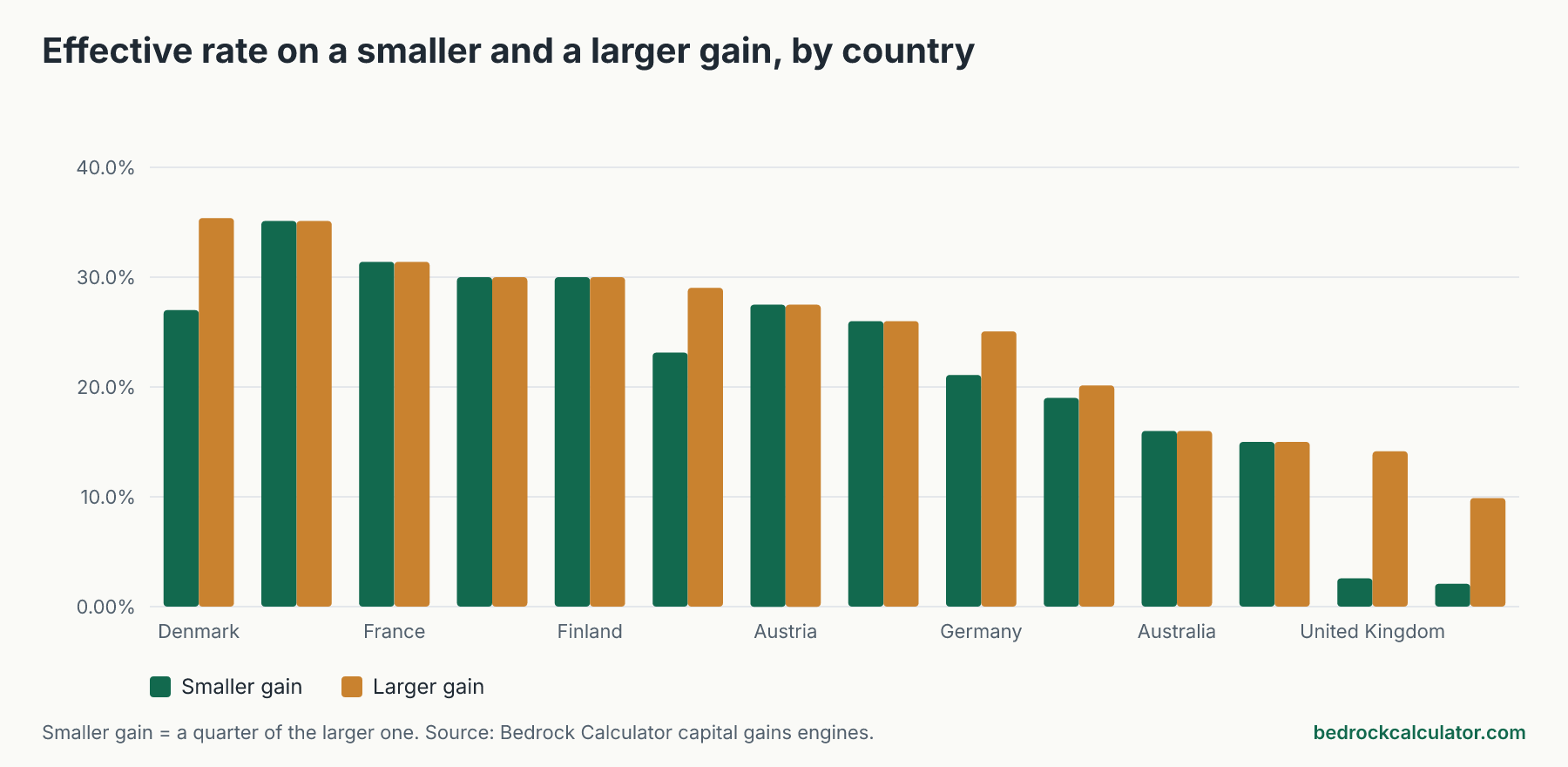
Allowances matter more than the headline rate when the gain is small. We also ran every calculator on a gain a quarter of the size, 10% of the salary. In the UK the effective rate on GBP 3,500 is just 2.6%, because most of it falls within the annual exempt amount. India drops to 2.1% on INR 150,000, and Denmark to 27.0% because the whole gain stays under its threshold.
8 of the 14 countries charge exactly the same rate on both sizes of gain: France, Italy, Austria, Sweden, Norway, Finland, Australia, United States (federal). In those, the size of the gain makes no difference to the rate.
What these figures leave out
These are single sales by one person in an ordinary account. Real tax bills move with things we haven't modelled:
- Tax-free accounts. ISAs in the UK, ISKs in Sweden, share savings accounts in Denmark and retirement accounts in the US can shelter gains entirely or tax them a different way.
- Losses. Most countries let you set losses against gains, and some let you carry them forward.
- State and local taxes. The US figure is federal only. Germany's church tax applies to members.
- Surcharges and cess. India's cess and surcharge on high incomes aren't included.
- Other assets. Property, crypto and business assets often follow different rules. Several of the calculators linked here handle those too.
Work out your own capital gains tax
To run your own sale, use the calculator for your country, such as the UK capital gains tax calculator, the Germany capital gains tax calculator, the France capital gains tax calculator, the Australia capital gains tax calculator, the India equity LTCG and STCG calculator or the US capital gains tax calculator. Our guide on how capital gains tax works explains the US rules in more depth.