How much state tax is due on a $100,000 capital gain in each US state?
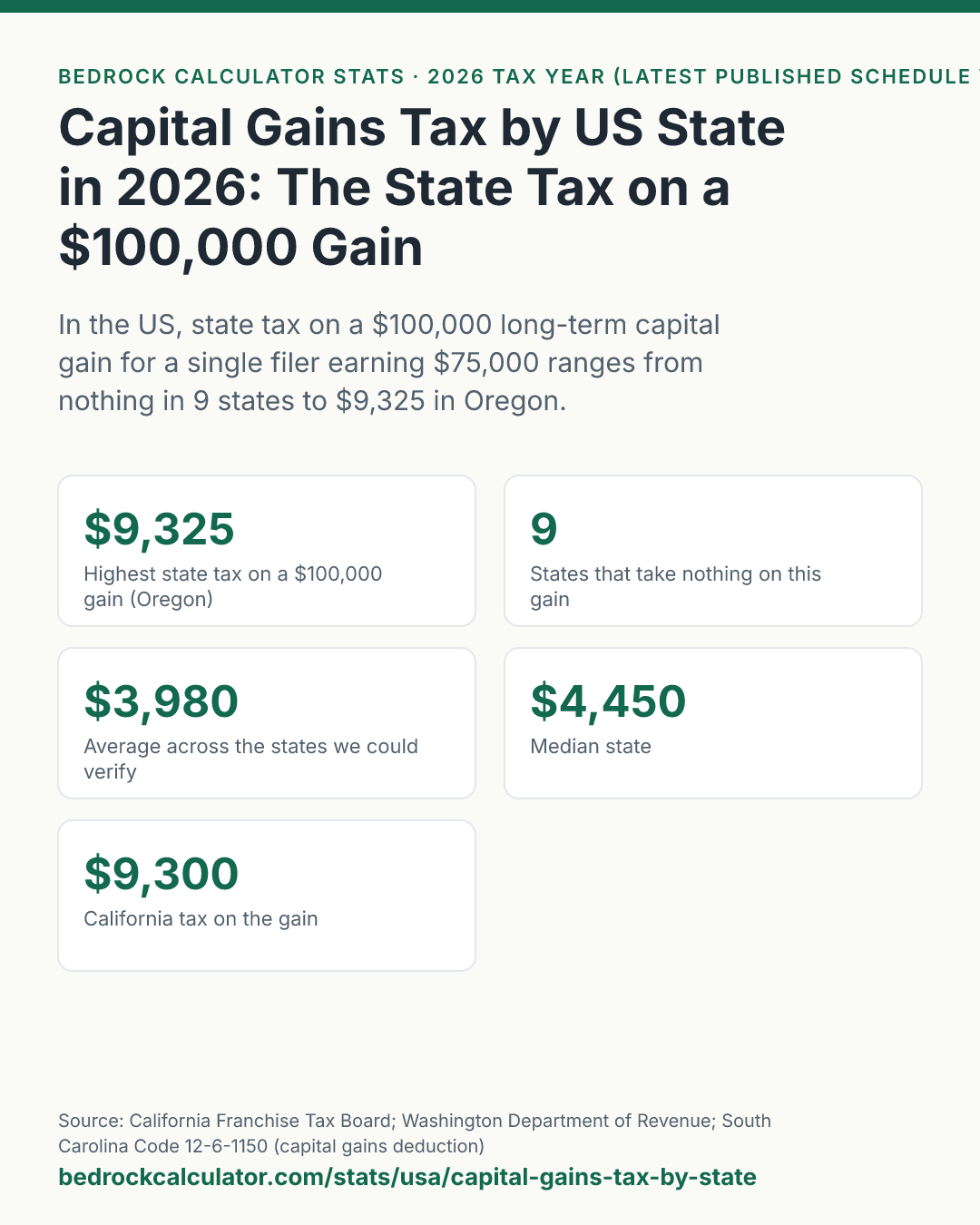
Sell stock, a rental or a business at a profit and the IRS takes its share. Then, in most of the US, your state takes another. For a single filer with $75,000 of other income and a $100,000 long-term gain, the state bill ranges from nothing in 9 states to $9,325 in Oregon.
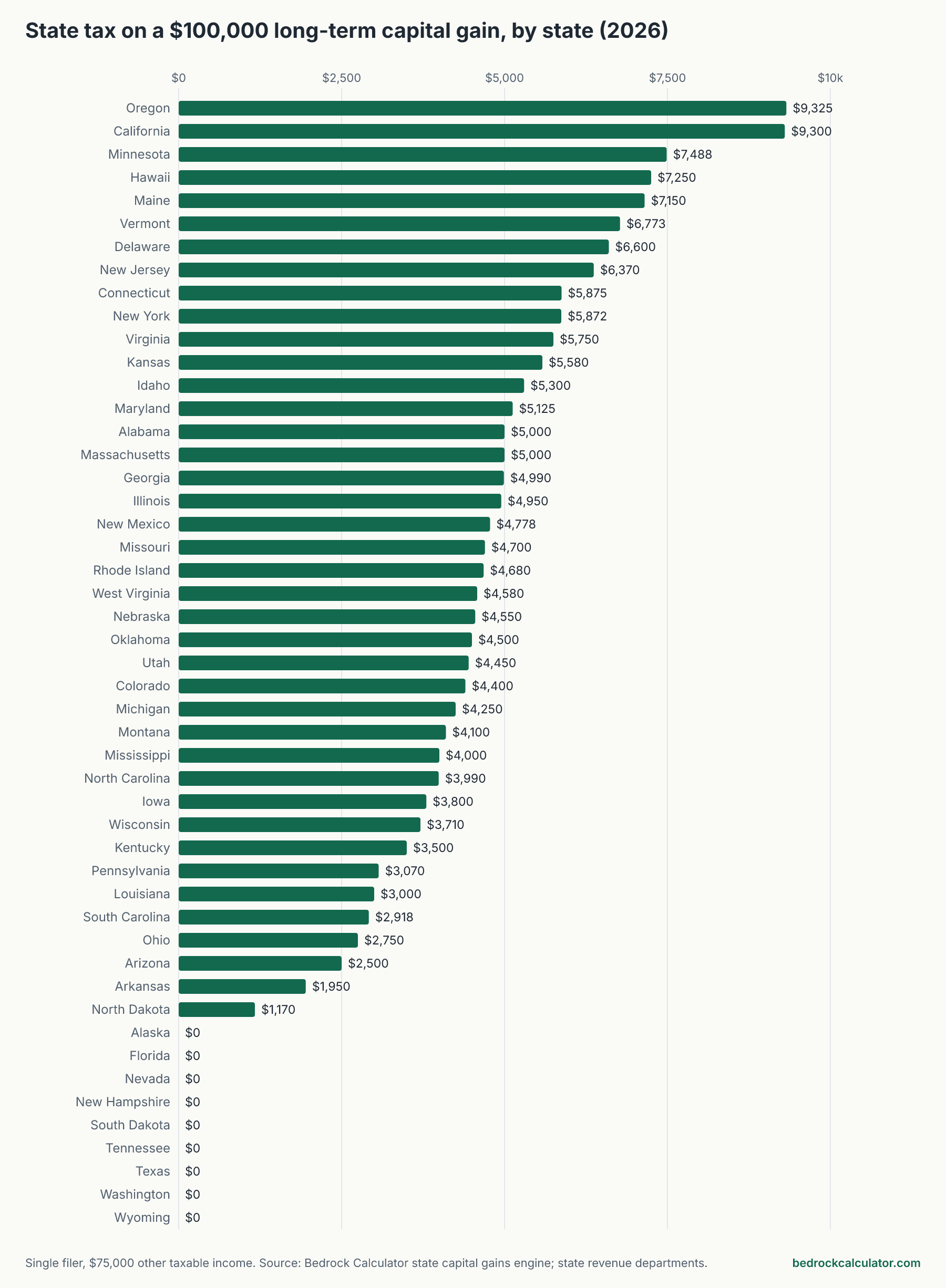
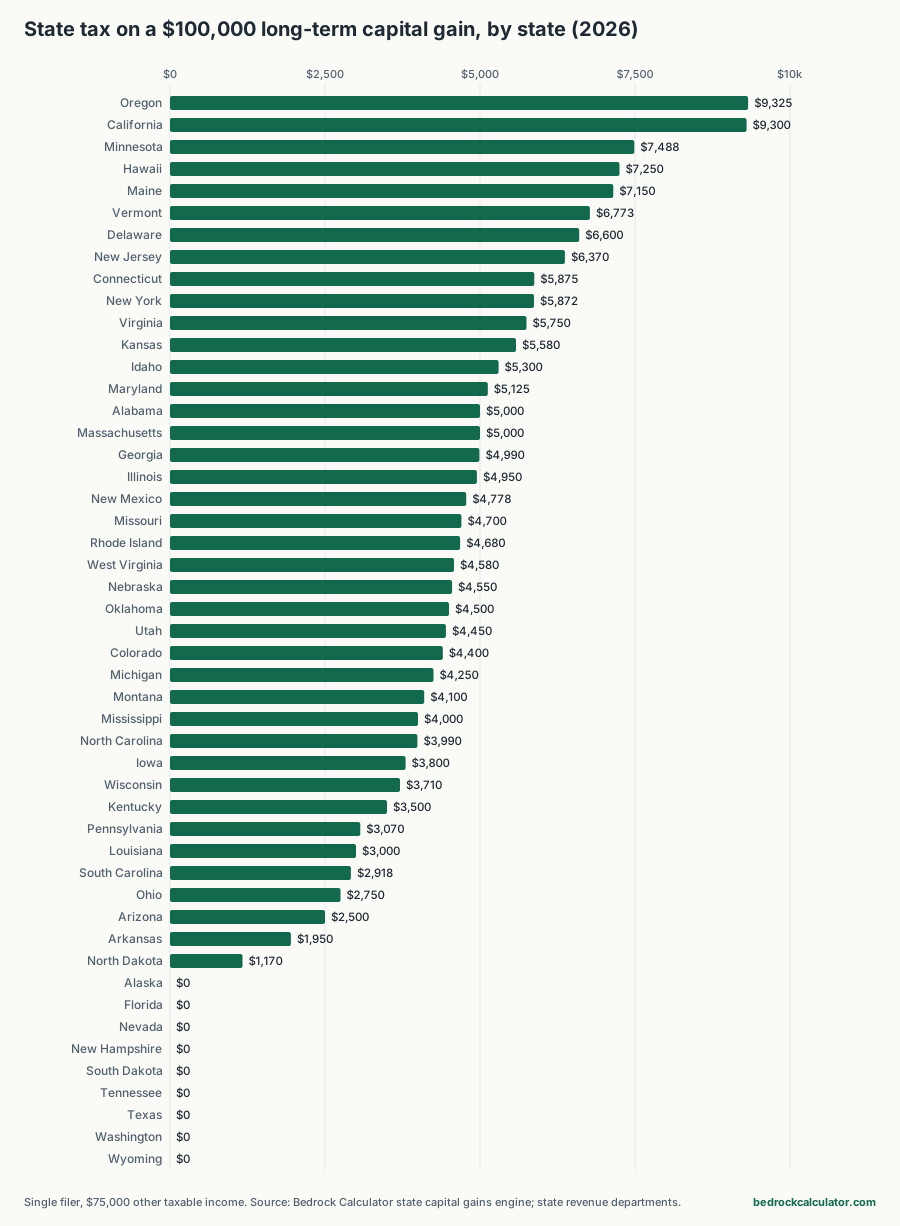
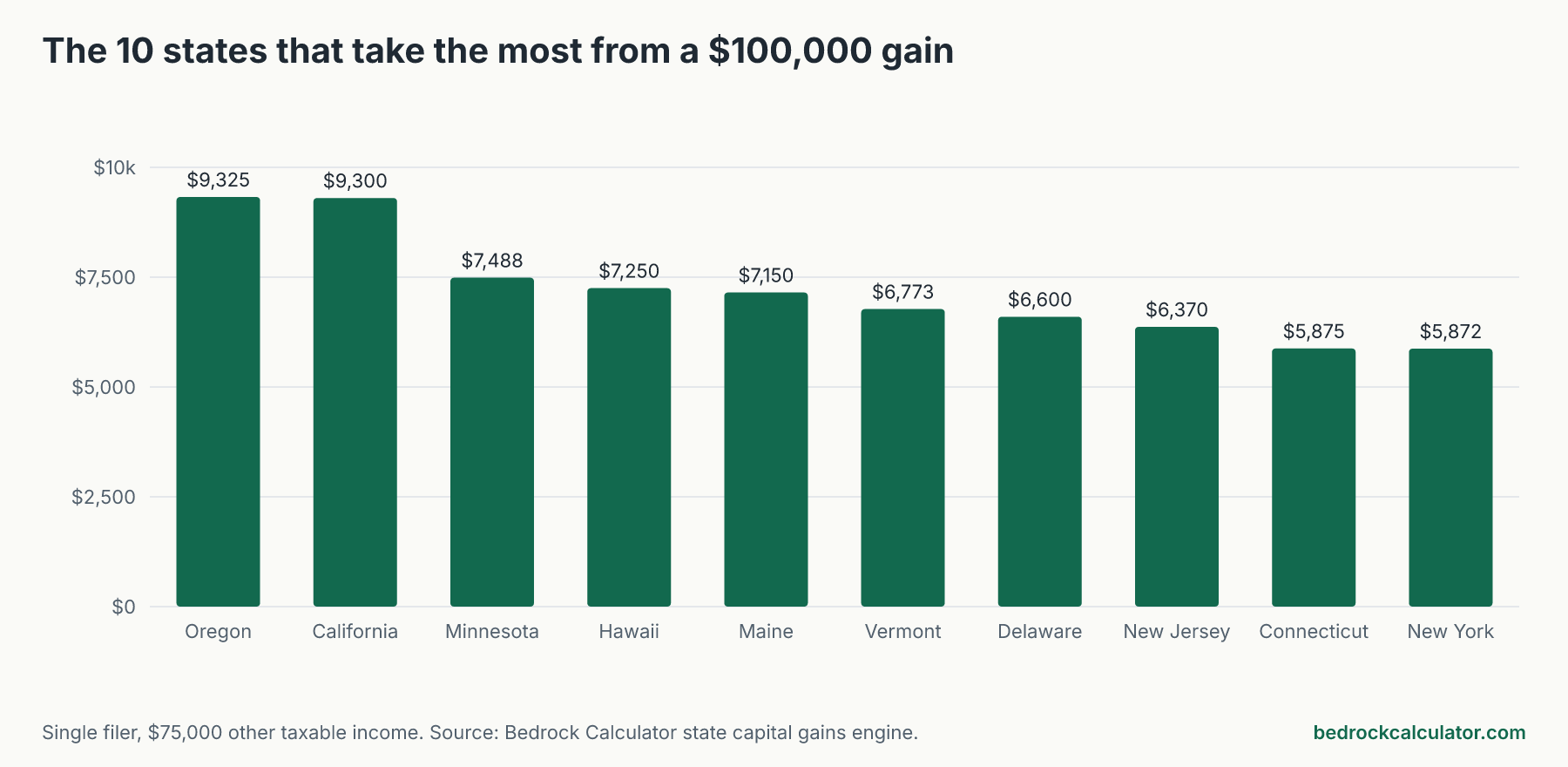
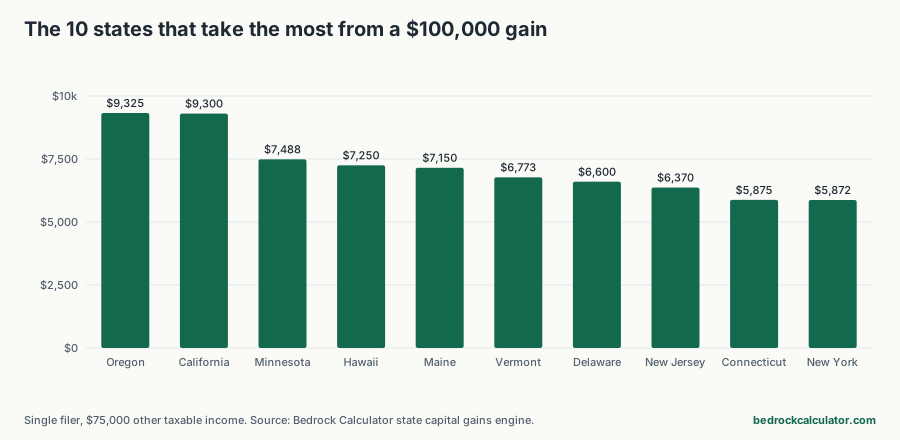
Across the 49 states we could verify, the average state tax on that gain is $3,980, and the middle state charges $4,450. The five highest are Oregon ($9,325), California ($9,300), Minnesota ($7,488), Hawaii ($7,250), Maine ($7,150).
How we worked out these numbers
Every state has its own capital gains calculator on this site, and we ran each one with the same inputs: a $100,000 long-term gain, $75,000 of other taxable income, single filer. Those happen to be the default inputs on every state page, so if you open, say, the California capital gains tax calculator, you'll see the same number we report here.
The calculator stacks the gain on top of your other income and runs it through the state's rate schedule, so in a graduated state the gain is taxed at your top rates, not your bottom ones. Where a state gives long-term gains a break, the calculator applies it: a percentage or dollar exclusion in Arkansas, Montana, New Mexico, North Dakota, South Carolina, Vermont, Wisconsin, with Montana using its own lower capital gains rates instead.
There are limits worth knowing about:
- "Other income" means state taxable income. The calculator doesn't apply state standard deductions, exemptions or credits, so treat $75,000 as income after those.
- Only state tax. Federal long-term capital gains tax and the net investment income tax for higher earners come on top, and so do local income taxes in places like New York City.
- Long-term gains only. Short-term gains get none of the state breaks above.
- Some schedules are a year behind. Where a state hadn't published its 2026 schedule when our engine was last verified, it uses the latest published year. That applies to Arkansas, California, Connecticut, Idaho, Vermont, Washington. Colorado's rate can also be cut for a year when the state has a revenue surplus.
- Indiana shows as n/a. Our engine stores a rate for it that hasn't yet been confirmed against the state's own published source, so we'd rather leave the cell blank than print an unconfirmed figure.
State tax on a $100,000 capital gain, state by state
Click any column heading to sort. "Share of the gain" is the state tax divided by the gain. "Top rate reached" is the state rate on the last dollar of the gain.
State tax on a $100,000 long-term capital gain, by US state (single filer, $75,000 other income)
Download CSVOther income treated as state taxable income. State tax only; federal tax, the 3.8% net investment income tax and local income taxes are not included.
| Oregon | $9,325 | 9.32% | 9.90% | Graduated, taxed as income |
| California | $9,300 | 9.30% | 9.30% | Graduated, taxed as income |
| Minnesota | $7,488 | 7.49% | 7.85% | Graduated, taxed as income |
| Hawaii | $7,250 | 7.25% | 7.25% | Graduated, taxed as income |
| Maine | $7,150 | 7.15% | 7.15% | Graduated, taxed as income |
| Vermont | $6,773 | 6.77% | 7.60% | Excludes $5,000 of the gain |
| Delaware | $6,600 | 6.60% | 6.60% | Graduated, taxed as income |
| New Jersey | $6,370 | 6.37% | 6.37% | Graduated, taxed as income |
| Connecticut | $5,875 | 5.88% | 6.00% | Graduated, taxed as income |
| New York | $5,872 | 5.87% | 5.90% | Graduated, taxed as income |
| Virginia | $5,750 | 5.75% | 5.75% | Graduated, taxed as income |
| Kansas | $5,580 | 5.58% | 5.58% | Graduated, taxed as income |
| Idaho | $5,300 | 5.30% | 5.30% | Flat rate, taxed as income |
| Maryland | $5,125 | 5.13% | 5.50% | Graduated, taxed as income |
| Alabama | $5,000 | 5.00% | 5.00% | Graduated, taxed as income |
| Massachusetts | $5,000 | 5.00% | 5.00% | Graduated, taxed as income |
| Georgia | $4,990 | 4.99% | 4.99% | Flat rate, taxed as income |
| Illinois | $4,950 | 4.95% | 4.95% | Flat rate, taxed as income |
| New Mexico | $4,778 | 4.78% | 4.90% | Excludes $2,500 of the gain |
| Missouri | $4,700 | 4.70% | 4.70% | Graduated, taxed as income |
| Rhode Island | $4,680 | 4.68% | 4.75% | Graduated, taxed as income |
| West Virginia | $4,580 | 4.58% | 4.58% | Graduated, taxed as income |
| Nebraska | $4,550 | 4.55% | 4.55% | Graduated, taxed as income |
| Oklahoma | $4,500 | 4.50% | 4.50% | Graduated, taxed as income |
| Utah | $4,450 | 4.45% | 4.45% | Flat rate, taxed as income |
| Colorado | $4,400 | 4.40% | 4.40% | Flat rate, taxed as income |
| Michigan | $4,250 | 4.25% | 4.25% | Flat rate, taxed as income |
| Montana | $4,100 | 4.10% | 4.10% | Lower capital gains rates |
| Mississippi | $4,000 | 4.00% | 4.00% | Graduated, taxed as income |
| North Carolina | $3,990 | 3.99% | 3.99% | Flat rate, taxed as income |
| Iowa | $3,800 | 3.80% | 3.80% | Flat rate, taxed as income |
| Wisconsin | $3,710 | 3.71% | 5.30% | Excludes $30,000 of the gain |
| Kentucky | $3,500 | 3.50% | 3.50% | Flat rate, taxed as income |
| Pennsylvania | $3,070 | 3.07% | 3.07% | Flat rate, taxed as income |
| Louisiana | $3,000 | 3.00% | 3.00% | Flat rate, taxed as income |
| South Carolina | $2,918 | 2.92% | 5.21% | Excludes $44,000 of the gain |
| Ohio | $2,750 | 2.75% | 2.75% | Graduated, taxed as income |
| Arizona | $2,500 | 2.50% | 2.50% | Flat rate, taxed as income |
| Arkansas | $1,950 | 1.95% | 3.90% | Excludes $50,000 of the gain |
| North Dakota | $1,170 | 1.17% | 1.95% | Excludes $40,000 of the gain |
| Alaska | $0 | 0.00% | 0.00% | No tax on capital gains |
| Florida | $0 | 0.00% | 0.00% | No tax on capital gains |
| Nevada | $0 | 0.00% | 0.00% | No tax on capital gains |
| New Hampshire | $0 | 0.00% | 0.00% | No tax on capital gains |
| South Dakota | $0 | 0.00% | 0.00% | No tax on capital gains |
| Tennessee | $0 | 0.00% | 0.00% | No tax on capital gains |
| Texas | $0 | 0.00% | 0.00% | No tax on capital gains |
| Washington | $0 | 0.00% | 0.00% | Separate capital gains tax |
| Wyoming | $0 | 0.00% | 0.00% | No tax on capital gains |
| Indiana | n/a | n/a | n/a | Rate not yet verified |
n/a means the state rate is not yet verified, as the treatment column says.
The states that take the most
Oregon tops the list at $9,325, 9.32% of the gain, because its brackets climb steeply and the gain pushes this filer into the top rate. California is a hair behind at $9,300. It taxes capital gains exactly like wages, and this gain reaches the 9.30% bracket. Higher gains would reach higher California rates still.
New York comes to $5,872 for this filer, before any New York City tax. Of the five highest, only Hawaii treats long-term gains differently, capping them at a rate below its top wage brackets. The rest simply add the gain to your income.
The states that take nothing
Alaska, Florida, Nevada, New Hampshire, South Dakota, Tennessee, Texas, Wyoming don't tax this gain because they don't tax personal income of this kind. (New Hampshire's old tax on interest and dividends never reached capital gains and has since been repealed.)
Washington is the odd one out. It has no income tax, but it does tax long-term capital gains above $278,000 a year. Our $100,000 gain is under that line, so it owes $0. A much larger sale would owe Washington's capital gains tax, and the Washington capital gains tax calculator shows how much.
States that go easier on long-term gains
A handful of states tax long-term gains less heavily than wages. The breaks are bigger than they look:
- North Dakota excludes a share of the gain and has low rates, so it charges the least of any state that taxes this gain: $1,170.
- Arkansas leaves $50,000 of the gain untaxed, for a bill of $1,950.
- South Carolina leaves $44,000 untaxed and charges $2,918.
- Montana taxes capital gains on its own lower rate schedule, for $4,100.
- Wisconsin, Vermont and New Mexico offer smaller exclusions.
What this means if you're planning a sale
State tax follows where you live when you sell, so the same gain can cost thousands more or less depending on your address. People sometimes time a large sale around a move, but states watch for that: a move has to be genuine, and some states tax gains on property located there no matter where you live. Talk to a tax professional before relying on a move to save tax.
For your own figure, start with the capital gains tax calculator for the federal side, then open your state's page, such as the New York capital gains tax calculator or the Texas capital gains tax calculator, to add the state tax.