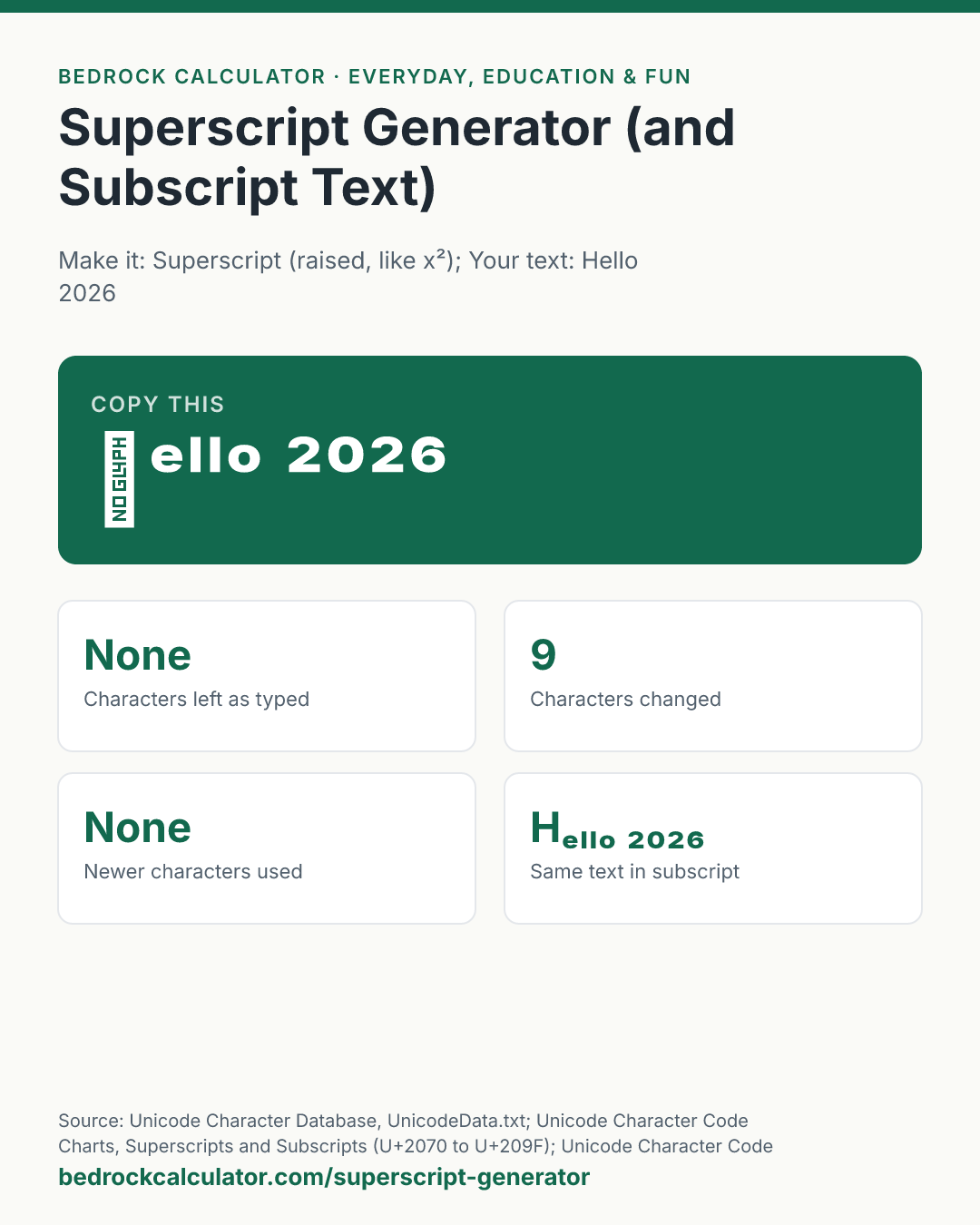

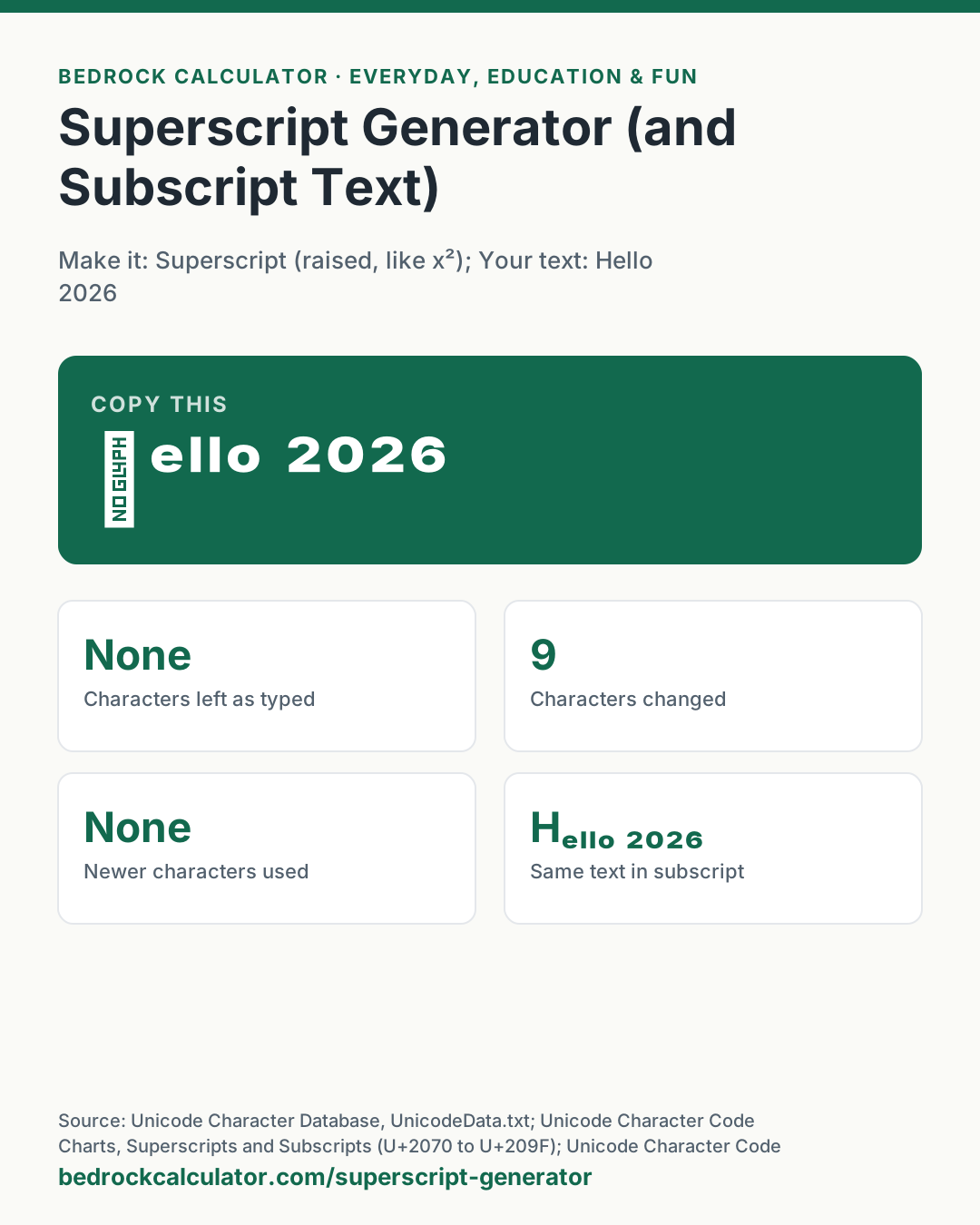
Quick Answer: The superscript generator turns "Hello 2026" into ᴴᵉˡˡᵒ ²⁰²⁶ using real Unicode characters you can paste anywhere. Capital S, X, Y and Z have no superscript form, so they stay as typed.
What does this calculator do?
This superscript generator converts ordinary text into raised characters, like the ² in x² or the ᵗʰ in 4ᵗʰ, and it can also produce subscript, lowered characters like the ₂ in H₂O.
The output is plain text made of Unicode characters, so it can be pasted into a social media bio, a chat message, a spreadsheet cell or a file name where you cannot use formatting.
That is the difference from the superscript button in a word processor. A word processor keeps the ordinary letter and draws it smaller and higher; the formatting is lost the moment you paste into a plain text box. The characters here are separate characters with their own code points, so they keep their shape wherever they go, as long as the reader's font includes them.
Unicode does not have a raised or lowered version of every character. Every digit has both, but the alphabet is patchy: there is no superscript capital S, X, Y or Z, and subscript has only 17 lowercase letters and no capitals at all. Rather than substitute a lookalike, the generator leaves those characters as you typed them and lists them, so you know exactly what did not convert.
Using the Superscript Generator
- Choose Superscript or Subscript.
- Type or paste your text in Your text.
- Copy the result at the top.
- Check Characters left as typed for anything Unicode could not raise or lower, and Newer characters used for characters that older fonts may not show.
To raise only part of a line, such as the "th" in 5th, convert just that part and paste it in after the 5. The code point card lists each character of the result so you can check exactly what you are pasting. The chart further down shows every letter, digit and sign in both forms.
How is this calculated?
- Look up each character. The text is read one character at a time, and each one is looked up in a table.
- The superscript table. It contains exactly the characters that Unicode's character database marks as a superscript form of a single basic character: the database lists, for example, U+1D43 MODIFIER LETTER SMALL A with the decomposition "superscript of a". That gives every digit, plus, equals and both parentheses, all 26 lowercase letters, and 22 capitals. Where two forms exist for a and o, the modifier letter is used rather than the ordinal indicator ª or º, which many fonts underline.
- The subscript table. Built the same way from the "subscript of" decompositions: the digits, the same signs, and the lowercase letters a, e, h, i, j, k, l, m, n, o, p, r, s, t, u, v and x.
- Minus signs. The superscript and subscript minus, U+207B and U+208B, are listed in the database as forms of the true minus sign, U+2212. The hyphen on your keyboard is mapped to them as well, since that is what people type.
- Everything else is kept. A character not in the table is copied unchanged and added once to the list of characters left as typed. Spaces are kept and never listed.
Worked Example
Hello 2026, superscript, the default:
- H becomes U+1D34 MODIFIER LETTER CAPITAL H.
- e, l, l and o become the modifier small letters U+1D49, U+02E1, U+02E1 and U+1D52.
- The space is kept.
- 2, 0, 2 and 6 become U+00B2, U+2070, U+00B2 and U+2076. The superscript 1, 2 and 3 sit in an older block of Unicode than the other digits, which is why their code points are out of sequence.
- The result is ᴴᵉˡˡᵒ ²⁰²⁶, with 9 characters changed and nothing left as typed.
The same text in subscript is Hₑₗₗₒ ₂₀₂₆: Unicode has no subscript capital H, so the H stays as typed.
Which Letters Have No Superscript?
Among the capitals, S, X, Y and Z. Every lowercase letter has a superscript form, though q only arrived in Unicode 14.0 in 2021, alongside capital C, F and Q, and fonts released before then do not draw them.
If your result shows an empty box or a question mark in place of one of those four, the reader's font is the reason, not the text.
How Do You Write H₂O?
Switch to Subscript and type H2O. The 2 becomes ₂, U+2082, while H and O, which have no subscript forms, are left as typed. That is exactly what chemical formulas need.
What does this calculator not account for?
- Fonts. A character only displays if the font on the reader's screen includes it. Modifier letters come from phonetic alphabets and are well covered on modern phones and computers, but the Unicode 14.0 additions are not everywhere yet.
- Partial conversion. The whole input is converted. To raise one part of a line, convert that part alone.
- Lookalike substitutes. Some generators fill gaps with characters that only look similar, such as a small capital or a letter from another script. This one does not, because those characters change meaning for screen readers and search.
- Accessibility. Screen readers may read modifier letters by their names rather than as words. Avoid putting important text, such as a name or a link, only in superscript.
- Characters beyond basic Latin. Accented letters, Greek and other scripts are kept as typed.
What mistakes do people make with this?
- Expecting formatting to survive a paste. Superscript made with a word processor's button disappears in plain text. These characters do not, because they are different characters.
- Searching for converted text. Search engines and the find function in most apps treat ᴴᵉˡˡᵒ as different from Hello, so text in superscript can be harder to find.
- Mixing up the ordinal indicators. The º often used in "1º" is the masculine ordinal indicator, not a superscript o. The generator uses the modifier letter instead.
- Converting capitals in subscript. Unicode has no subscript capitals, so a subscript capital will never appear, whatever you try.
- Pasting into fields with strict character rules. Some forms and usernames accept only basic letters and digits and will reject or strip these characters.
Frequently Asked Questions
How do I type a superscript 2?
Can I make the trademark or degree sign here?
Why did some letters not change?
Will superscript text show on Instagram or TikTok?
What is the difference between superscript and subscript?
Is this the same as small caps?
Sources
- Unicode Character Database, UnicodeData.txt: each character's name and its compatibility decomposition, including the superscript and subscript mappings used here. unicode.org/Public/UCD/latest/ucd/UnicodeData.txt
- Unicode Character Code Charts, Superscripts and Subscripts (U+2070 to U+209F). unicode.org/charts/PDF/U2070.pdf
- Unicode Character Code Charts, Phonetic Extensions (U+1D00 to U+1D7F): the modifier letters used for most superscript letters. unicode.org/charts/PDF/U1D00.pdf
- Unicode Standard Annex #44, Unicode Character Database: the meaning of the decomposition field and its super and sub tags. unicode.org/reports/tr44