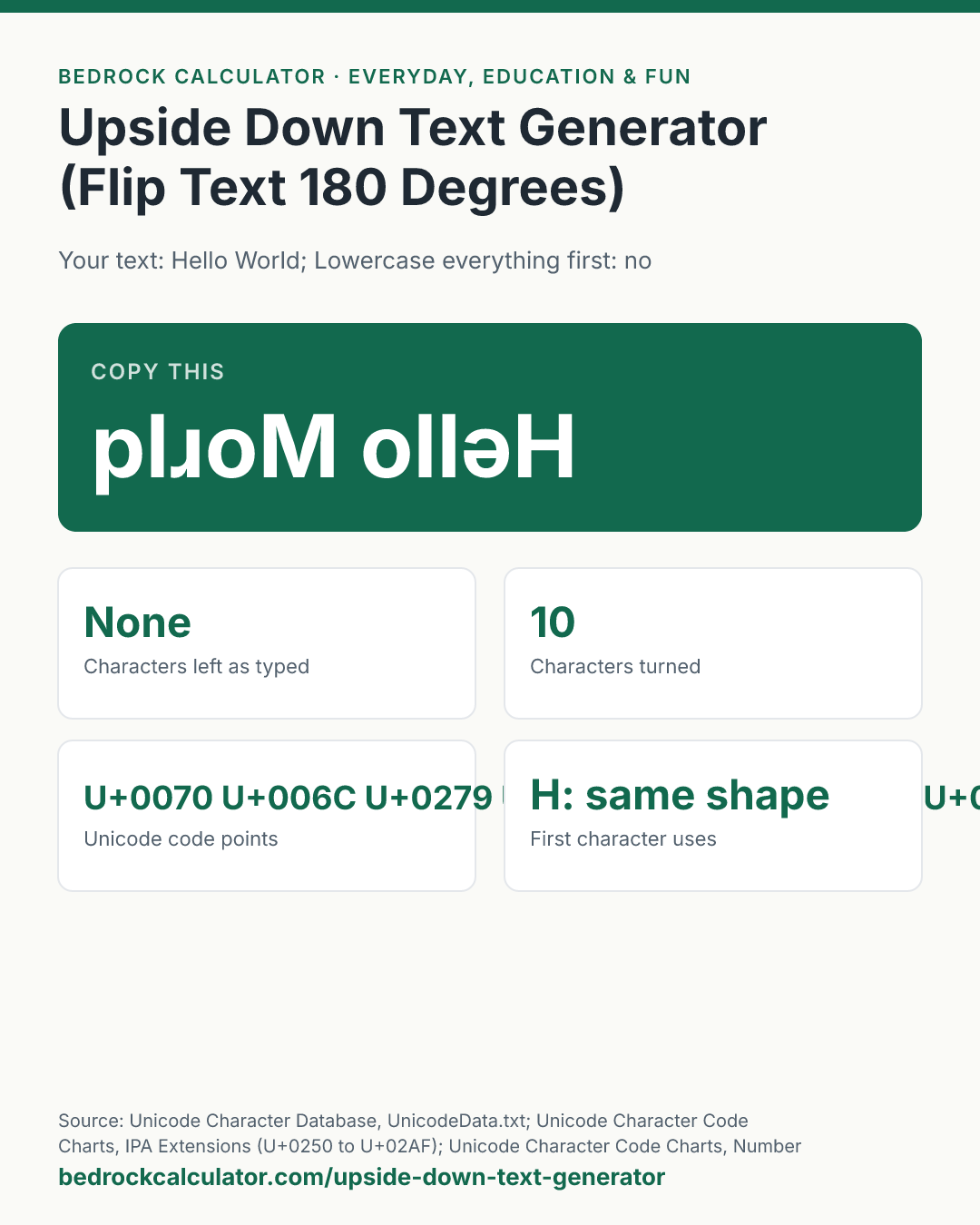

Quick Answer: The upside down text generator turns "Hello World" into plɹoM ollǝH: each character is swapped for one that looks turned over, and the order is reversed so it reads correctly with the screen upside down.
What does this calculator do?
This upside down text generator flips text through 180 degrees using real Unicode characters, so the result can be pasted into a message, a bio, a comment or a game name. Turn your phone over and the text reads normally.
There is no "upside down" setting in Unicode. The effect is built from characters that happen to look like rotated letters. Some are exact: Unicode has a character called LATIN SMALL LETTER TURNED A (ɐ), designed for phonetic writing, which is precisely an a turned over. Some letters are simply other letters turned round: a b upside down is a q, an n is a u, and a 6 is a 9. Some shapes are the same both ways up, such as o, s, x and z. And a few letters have no turned form at all, so the nearest lookalike is used: an upside-down c is shown as the open o, ɔ.
Capital B, D, J, P, Q, R and U, and the digits 4, 5 and 7, have no good equivalent. The generator leaves them as typed and lists them, rather than quietly substituting a character from another alphabet. If you want every letter to turn, switch on "Lowercase everything first": every lowercase letter has an equivalent.
Using the Upside Down Text Generator
- Type or paste your text into Your text.
- Switch on Lowercase everything first if you want capitals without a turned form to turn too.
- Copy the result at the top.
- Check Characters left as typed for anything that could not be turned.
The code point card lists every character in the result, so you can see exactly what you are pasting, and the chart below shows each letter, digit and common sign with the kind of mapping it uses.
How is this calculated?
- Optionally lowercase. With the option on, the text is converted to lowercase first.
- Look up each character. Each character is looked up in a fixed table with three kinds of entry. First, a Unicode character named TURNED, or INVERTED for the question and exclamation marks: this covers a, e, h, i, k, m, r, t, v, w and y, capital A, F, G, K, L, T, V and Y, the digits 2 and 3, the ampersand and the semicolon. Second, another ordinary character that is the rotated shape, or the same character when the shape is symmetric: b and q, d and p, n and u, M and W, 6 and 9, and the brackets, which swap. Third, the nearest lookalike where Unicode has no turned form: c, f, g, j, capital C and E, the digit 1, the full stop, the underscore and the double quote.
- Keep the rest. A character not in the table is copied unchanged and added once to the list of characters left as typed.
- Reverse the order. The characters are put in reverse order, so the last letter you typed comes first. Turned upside down, the first letter is then back on the left.
Worked Example
Hello World, the default:
- H is the same shape both ways up. e becomes ǝ, LATIN SMALL LETTER TURNED E (U+01DD). l and o are unchanged.
- W becomes M, o stays, r becomes ɹ, LATIN SMALL LETTER TURNED R (U+0279), l stays, and d becomes p.
- That gives Hǝllo Moɹlp, with 10 characters looked up and nothing left over.
- Reversed, it is plɹoM ollǝH.
Bob shows a gap: capital B has no turned form, so the result is qoB with B listed. With "Lowercase everything first" on, it becomes qoq, with every letter turned.
How Do You Type Upside Down?
Type normally into the box above and copy the result. There is no keyboard layout for upside-down text, because it is made of characters from several parts of Unicode, mostly the International Phonetic Alphabet. Pasting is the practical way.
What Is the Upside Down Question Mark?
It is ¿, INVERTED QUESTION MARK (U+00BF), the mark Spanish uses to open a question. The generator uses it for ? and uses ¡, INVERTED EXCLAMATION MARK, for !. Typing "what time is it?" gives ¿ʇᴉ sᴉ ǝɯᴉʇ ʇɐɥʍ.
What does this calculator not account for?
- Fonts. A character only displays if the reader's font has it. The phonetic letters are widely supported, but a few capitals, such as TURNED CAPITAL L (U+A780) and TURNED K (U+A7B0), come from newer blocks that some older fonts lack.
- Exact rotation. Lookalikes are approximations. An ɔ is close to an upside-down c, but it is a different letter. The chart says which kind of mapping each character uses.
- Accented letters and other scripts. These are kept as typed. Accents in particular cannot be turned.
- Accessibility and search. Screen readers read these characters by their own names, not as the words you typed, and search engines treat them as different text. Do not use upside-down text for anything people need to find or hear.
- Mirror writing. Turning text upside down is not the same as mirroring it left to right. This page only does the 180-degree turn.
What mistakes do people make with this?
- Forgetting the reversal. Swapping characters without reversing the order gives text that reads backwards once turned. The generator reverses for you.
- Turning it twice. Running upside-down text through again does not always give the original back, because lookalikes such as ɔ are not in the table as inputs. Keep your original text.
- Capitals that do not turn. B, D, J, P, Q, R and U stay upright. Lowercase first if that looks odd.
- Pasting where special characters are blocked. Some usernames and forms accept only basic letters and digits.
- Expecting digits 4, 5 and 7 to flip. There are no good upside-down forms for them, so they are left as typed.
Frequently Asked Questions
How do I flip text upside down?
Why are some letters not upside down?
What is an upside down e?
Does upside down text work on Instagram and Discord?
What does an upside down 6 look like?
Is upside down text the same as mirror text?
Sources
- Unicode Character Database, UnicodeData.txt: the names of the TURNED and INVERTED characters used here, such as U+0250 LATIN SMALL LETTER TURNED A and U+2132 TURNED CAPITAL F. unicode.org/Public/UCD/latest/ucd/UnicodeData.txt
- Unicode Character Code Charts, IPA Extensions (U+0250 to U+02AF): the turned small letters. unicode.org/charts/PDF/U0250.pdf
- Unicode Character Code Charts, Number Forms (U+2150 to U+218F): TURNED DIGIT TWO and TURNED DIGIT THREE. unicode.org/charts/PDF/U2150.pdf
- Unicode Character Code Charts, Letterlike Symbols (U+2100 to U+214F): TURNED CAPITAL F, TURNED SANS-SERIF CAPITAL G and Y, and TURNED AMPERSAND. unicode.org/charts/PDF/U2100.pdf