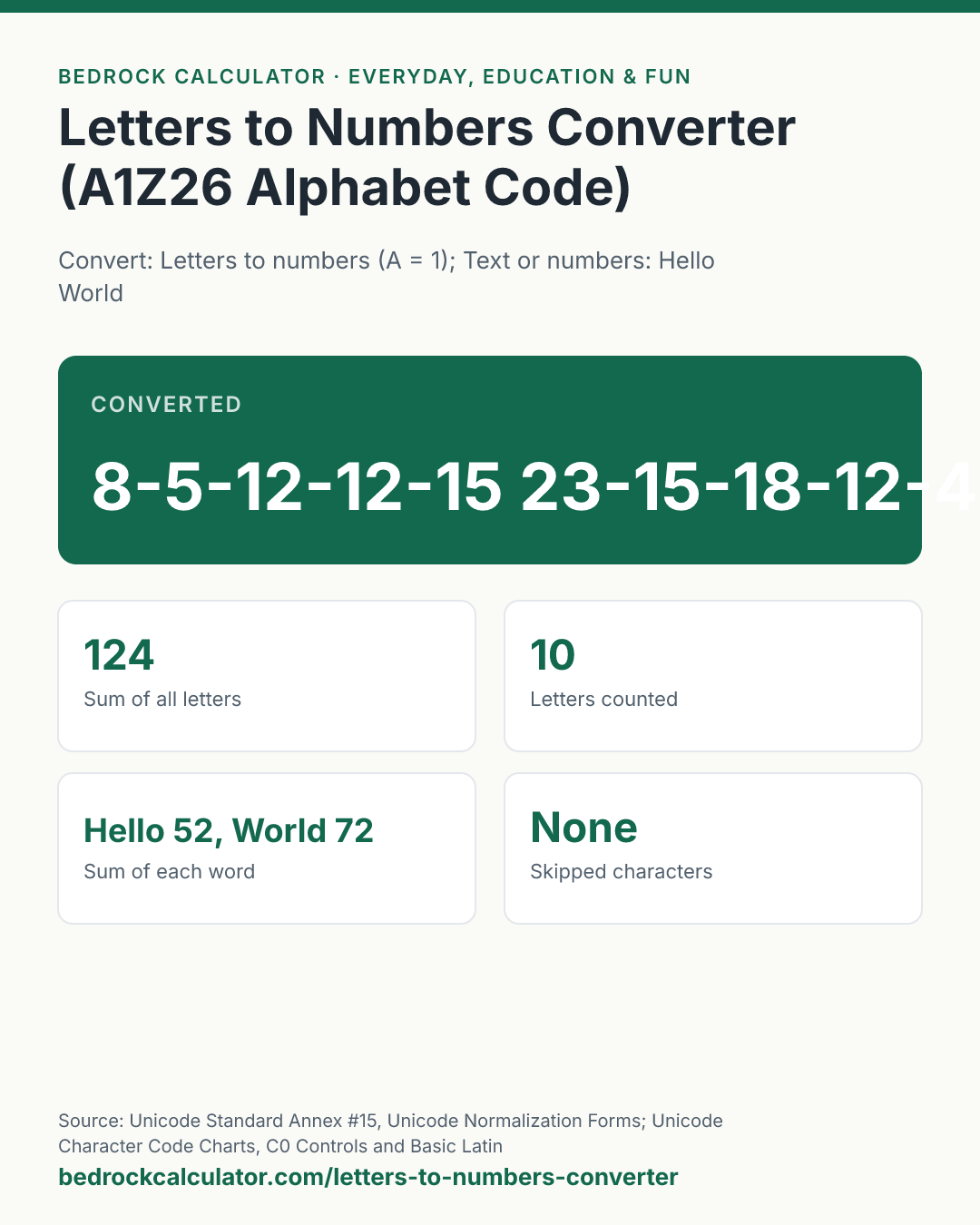
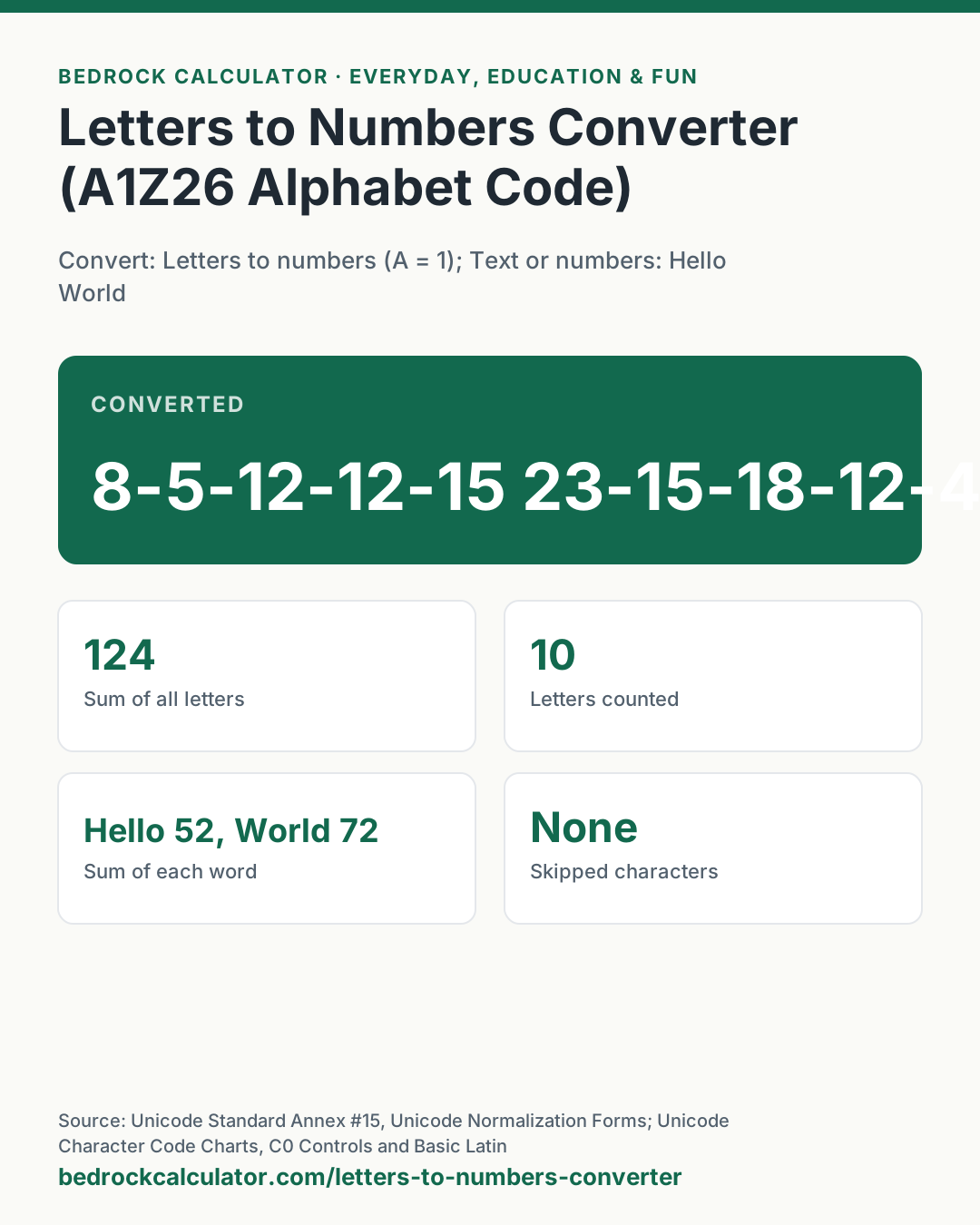
Quick Answer: In the A1Z26 code, A is 1 and Z is 26, so "Hello World" becomes 8-5-12-12-15 23-15-18-12-4, and its letters add up to 124.
What does this calculator do?
This letters to numbers converter turns text into the position of each letter in the English alphabet, A = 1, B = 2 and so on up to Z = 26, and turns a string of such numbers back into letters.
It also adds the numbers up, for the whole text and for each word, which is what most word puzzles, escape rooms and number games ask for.
The code is often called A1Z26, after its first and last pairs. It is not a secret cipher: anyone who knows the alphabet can read it. It turns up in puzzle hunts, geocaching clues, classroom activities and games where a word's "value" is the sum of its letters.
Upper and lower case give the same numbers. Accented letters count as their plain letter, so é is 5, the same as e. Spaces separate words. Anything else, such as digits, punctuation or a letter like ß that has no plain English equivalent, is skipped and listed so you can see exactly what was left out.
Using the Letters to Numbers Converter
- Choose Letters to numbers to encode text, or Numbers to letters to decode.
- Type or paste the text or the numbers.
- Read the result at the top. The cards show the sum of all letters, how many letters were counted, the sum of each word, and any characters that were skipped.
When decoding, separate the numbers of one word with hyphens, commas or dots, and separate words with spaces: 9 12-15-22-5 25-15-21. The presets load an encode, the full alphabet, a decode and a phrase with accents.
How is this calculated?
- Strip accents. The text is put through Unicode canonical decomposition, which splits a letter like é into a plain e followed by a separate accent mark, and the accent marks are removed. Letters with no such decomposition, such as ß, æ and ø, are not changed, so they are skipped later.
- Split into words. Any run of whitespace starts a new word.
- Number each letter. Within a word, each letter from A to Z, in either case, gets its position in the alphabet. Any other character is skipped and added once to the skipped list.
number = position of the letter in A to Z; A = 1, B = 2, …, Z = 26
- Add up. Each word's numbers are added for the word sums, and all of them together give the total.
- Decoding. In numbers-to-letters mode the input is split into words at spaces and into numbers at any other non-digit. Each whole number from 1 to 26 becomes its capital letter; any other number becomes a question mark and is listed. The decoded letters are then added up the same way.
Worked Example
Hello World, letters to numbers:
- No accents to strip, and two words.
- H is 8, E is 5, L is 12, L is 12, O is 15: 8-5-12-12-15, which adds to 52.
- W is 23, O is 15, R is 18, L is 12, D is 4: 23-15-18-12-4, which adds to 72.
- Together that is 124 across 10 letters.
Decoding 9 12-15-22-5 25-15-21 gives I LOVE YOU, with word sums of 9, 54 and 61. The whole alphabet from A to Z adds to 351.
How Do You Turn the Alphabet Into Numbers?
Count along the alphabet: A is 1, B is 2, C is 3, and so on to Z at 26. The chart below lists every letter. A quick way to find a letter in the middle is to remember a few landmarks: E is 5, J is 10, O is 15, T is 20 and Y is 25.
What Is the Value of a Word?
In letter-sum puzzles, a word's value is the total of its letters' numbers. "Hello" is worth 52 and "World" 72. Two different words can share a value, so a sum does not tell you which word it came from.
What does this calculator not account for?
- Other alphabets. Only the 26 letters of the basic Latin alphabet are numbered. Greek, Cyrillic, Hebrew, Arabic and other scripts are skipped.
- Letters beyond A to Z. Letters such as ß, æ, ø and þ are skipped, because Unicode does not decompose them into a plain letter. Spanish ñ, by contrast, decomposes to n and counts as 14.
- Other number codes. Some puzzles start at A = 0, or reverse the alphabet so that A = 26. Neither is offered here; for A = 0, subtract one from each number.
- Gematria and other traditional letter values. Systems that give letters values such as 1 to 9, then tens, then hundreds are not included. This page only does the plain alphabet position code.
- Formatting of the output. Numbers are joined with hyphens within a word and spaces between words. If your puzzle expects commas or slashes, replace them after copying.
What mistakes do people make with this?
- Losing word breaks when decoding. 8-9-20-8-5-18-5 is one word, HITHERE. Write 8-9 20-8-5-18-5 to get HI THERE.
- Running numbers together. 1 and 2 and 12 cannot be told apart in 112. Always separate the numbers when encoding by hand.
- Expecting digits to be encoded. A digit in the text is not a letter, so it is skipped and listed, not converted.
- Counting accents as different letters. Café and Cafe give the same numbers, 3-1-6-5, here. If your puzzle treats é as its own symbol, this converter is not the right tool for it.
- Off by one. If a puzzle's numbers seem one too high or too low throughout, it probably starts at A = 0 rather than A = 1.
Frequently Asked Questions
What number is each letter of the alphabet?
How do I convert numbers back to letters?
What is the A1Z26 cipher?
What does the alphabet add up to?
Is there a Hebrew gematria calculator here?
Does case matter?
Sources
- Unicode Standard Annex #15, Unicode Normalization Forms: canonical decomposition (NFD), used to reduce accented letters to their base letter. unicode.org/reports/tr15
- Unicode Character Code Charts, C0 Controls and Basic Latin: the 26 capital letters A to Z (U+0041 to U+005A) and small letters a to z (U+0061 to U+007A). unicode.org/charts/PDF/U0000.pdf