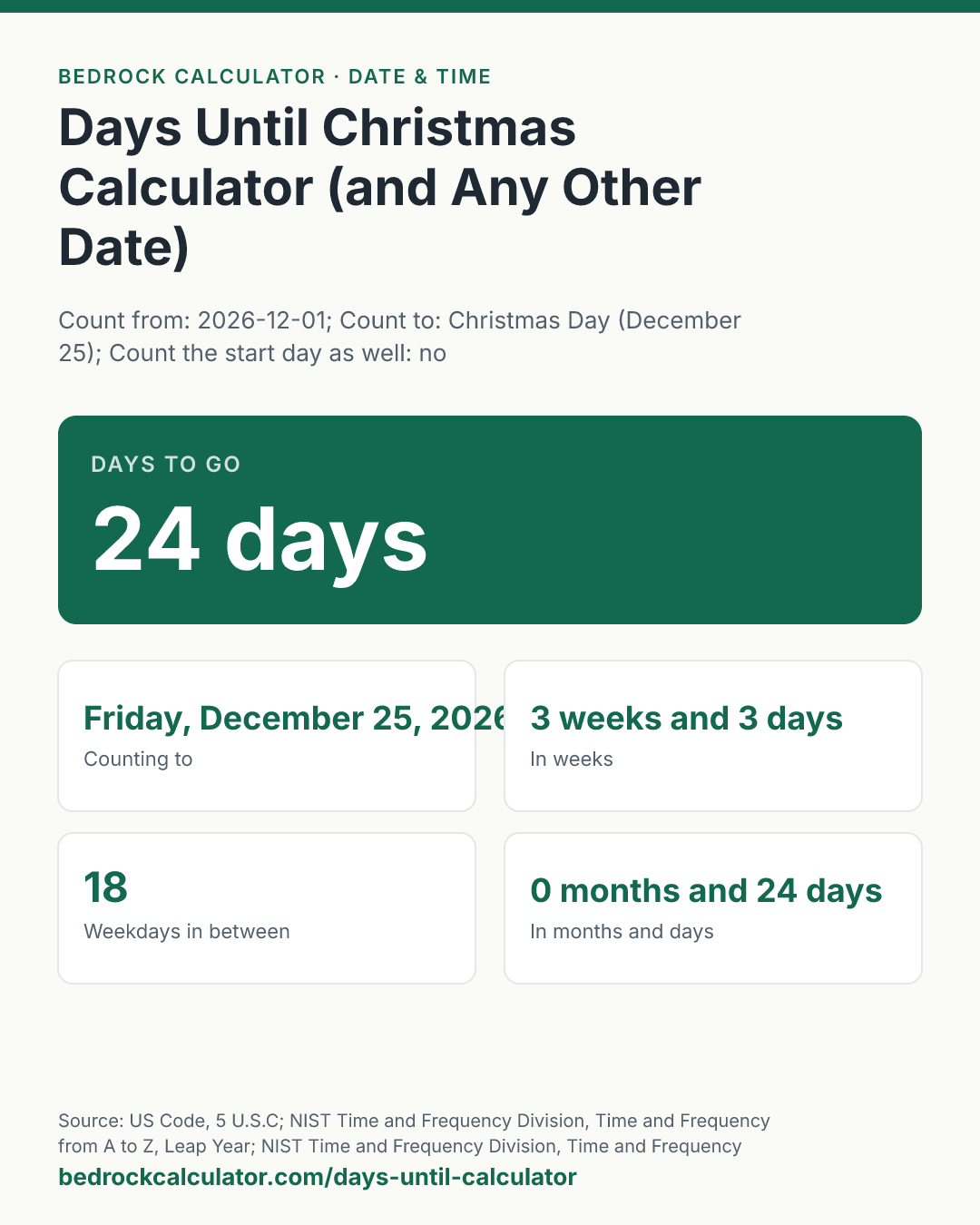

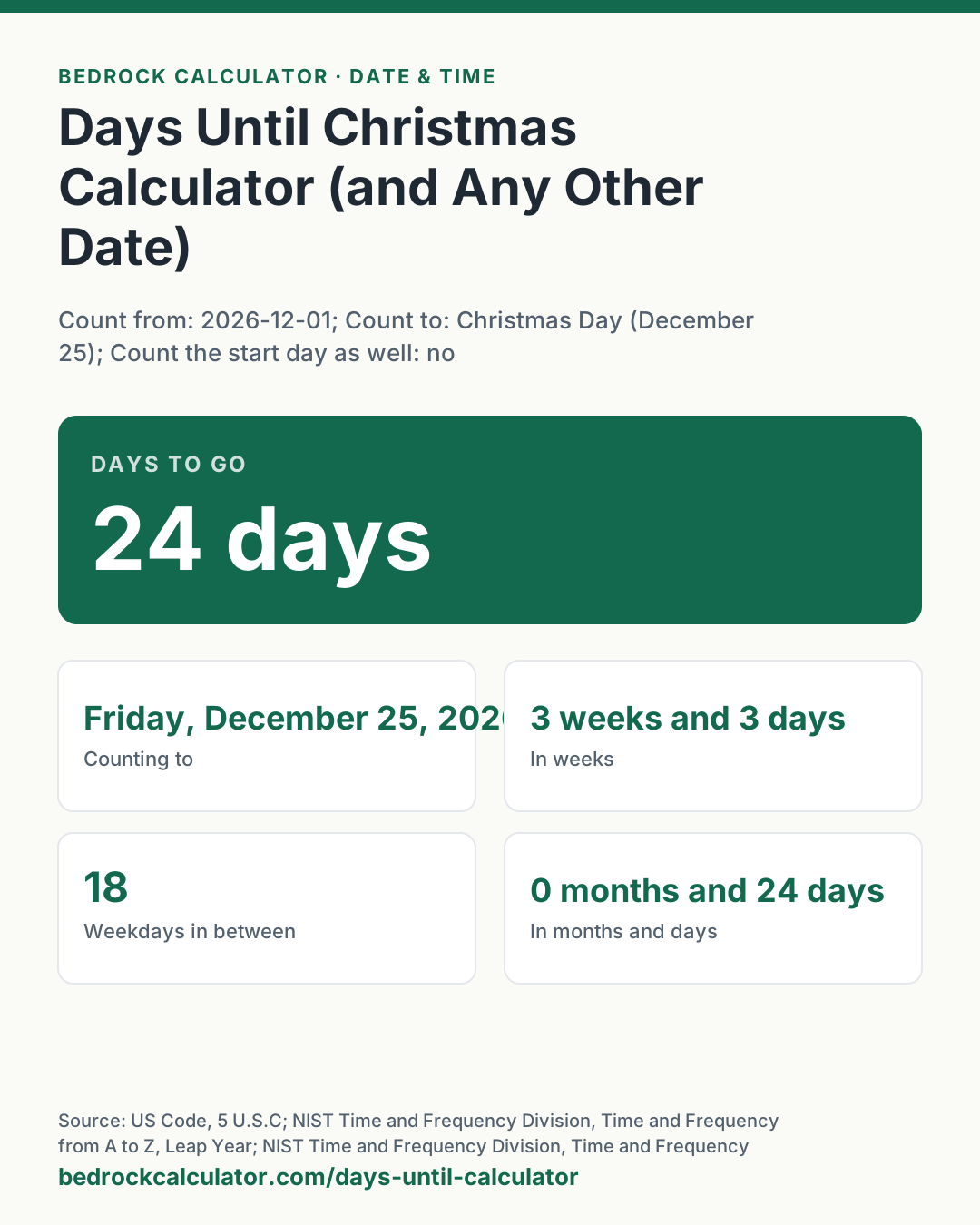
Quick Answer: Taking a fixed example date, counting from Tuesday, December 1, 2026, there are 24 days until Christmas Day on Friday, December 25, 2026. The calculator itself counts from today's date on your own device when you open it.
What does this calculator do?
This days until Christmas calculator tells you how many days are left before December 25, and it does the same for New Year's Day, Valentine's Day, Halloween, US Thanksgiving or any date you type in.
Next to the count it shows the date you are counting to and its weekday, the same span in weeks and days, in calendar months and days, the number of weekdays in between, and the span in hours.
The page counts from today. That sounds obvious, but this site is built ahead of time and served as a static page, so the server cannot know what today is when you read it. The count therefore runs in your browser: when the page loads, the "Count from" box is set to the date your phone or computer shows, and the result is worked out from that. The example figures in this article use a fixed start, December 1, 2026, so that they stay true whenever you read them, and every result names the start date it counted from.
A count of days is only useful if you know how it was counted. Here the start day is not counted and the target day is. On December 24, Christmas is 1 day away, and on Christmas Day itself the answer is 0. If you want to count both ends, for example to number the days of an event, switch on "Count the start day as well" and the count goes up by one.
Using the Days Until Christmas Calculator
- Leave Count from as it is to count from today, or pick another date. The "Use today" link puts today's date back.
- Choose what to count to in Count to: Christmas Day, New Year's Day, Valentine's Day, Halloween, US Thanksgiving, or "A date I choose".
- If you chose your own date, set it in Your date. A date earlier than the start is counted backwards and shown as days ago.
- Read the count at the top. The cards below give the target's weekday, weeks and days, months and days, weekdays and hours.
The preset buttons load five examples, all with fixed dates so you can check them: Christmas from December 1, New Year's Day from Christmas, Valentine's Day from January 1, January 30 from December 1, and Thanksgiving from October 17. Each one replaces the start date, so press "Use today" afterwards to count from today again.
How is this calculated?
- Read the start date. In the browser the start date is today's date from your device clock, in your own time zone. A date is handled as a calendar day only: there is no time of day attached, so a daylight saving change or a time zone difference can never move the count by a day once the date is set.
- Find the target date. Christmas, New Year's Day, Valentine's Day and Halloween fall on the same month and day every year. US Thanksgiving is the fourth Thursday in November, found by taking the first Thursday of the month and adding three weeks. For any holiday, the calculator takes this year's date if it is on or after the start date, and next year's date otherwise. On December 26 it therefore counts to the following Christmas.
- Number both days. Each date is turned into a day number, the count of days since January 1, 1970, using the Gregorian calendar's leap year rule: a year divisible by 4 has a February 29, except century years, which have one only when divisible by 400. So 2000 and 2400 are leap years and 2100 is not.
- Subtract. The count is the target's day number minus the start's. That excludes the start day and includes the target day. With "Count the start day as well" switched on, 1 is added.
days = N(target) − N(start); days counting both ends = N(target) − N(start) + 1
- Express it other ways. Weeks and days divides the count by 7. Months and days counts whole calendar months from the earlier date, then the days left over. Weekdays counts the Mondays to Fridays after the start date up to and including the target date. Hours is the count times 24, from midnight to midnight.
Worked Example
Counting from Tuesday, December 1, 2026 to Christmas, the calculator's default:
- The target is December 25, 2026, which is a Friday.
- Day numbers differ by 24, so there are 24 days until Christmas.
- That is 3 weeks and 3 days, or 0 months and 24 days.
- The weekdays after December 1 up to December 25 number 18, since the three weekends in between take out 6 days.
- In hours, 24 days is 576 hr.
A date you choose works the same way. From December 1, 2026 to January 30, 2027 is 60 days, or 8 weeks and 4 days, or 1 month and 29 days. With the start day counted as well, it is 61 days.
How Many More Days Until Valentine's Day?
From January 1, 2027, Valentine's Day on Sunday, February 14, 2027 is 44 days away: the 30 days left in January plus 14 in February. That is 6 weeks and 2 days, with 30 weekdays in between. To count from today, choose Valentine's Day in the list and leave the start date alone.
How Long Until New Year's?
From Christmas Day, New Year's Day is always 7 days later, exactly 1 week, because December 25 and January 1 are a week apart every year. In 2027, New Year's Day falls on a Friday, January 1. The calculator counts to the next January 1 on or after your start date, so on January 1 itself it shows 0.
When Is Christmas on a Weekend?
The table below runs the calculator from January 1 of each year to Christmas. Christmas Day falls on a Saturday in 2027 and 2032 and on a Sunday in 2033. The count from January 1 is 358 days in a common year and 359 in a leap year such as 2028 or 2032, because February 29 sits inside the span.
What does this calculator not account for?
- Time of day. The count is in whole calendar days. At 11 pm on December 24 the answer is still 1 day, although only an hour is left. The hours card is days times 24, not hours from this moment.
- Your device's date. "Today" is whatever date your device shows. If its clock or time zone setting is wrong, the start date will be too. You can always type the date you want.
- Time zones between people. For a few hours each day, places in different time zones are on different dates, so two people can see counts that differ by one. Each is right for their own calendar day.
- Public holidays in the weekday count. Weekdays are Monday to Friday. Christmas, New Year's Day and any other closures are not removed, because which days are holidays depends on where you live and work.
- Moving holidays other than US Thanksgiving. Easter, Mother's Day and holidays that follow a lunar calendar are not in the list. For one of those, look up the date and enter it as your own date.
- Dates before the Gregorian calendar. Every date is counted as if the Gregorian calendar had always been in use, which is not how dates were written in most countries before the 1580s, or in some until the 1900s.
What mistakes do people make with this?
- Counting both ends without meaning to. If you count on your fingers from December 1 to December 25 and include both, you get 25. The usual question, how many days until, gives 24. Switch on "Count the start day as well" only when you really mean both days.
- Forgetting the leap day. A span that crosses February 29 is one day longer. Between January 1 and Christmas in 2028 there are 359 days, not 358.
- Mixing weeks and months. Four weeks is 28 days, while a month is 28 to 31 days. The months-and-days card counts real calendar months, so it will not match weeks divided by four.
- Sharing a link with a date in it. A shared link keeps the dates you chose, so the person who opens it sees your count, not one from their own today. Press "Use today" to recount.
- Reading the count after midnight. The page sets today's date when it loads. If you leave it open overnight, reload it or press "Use today" to move to the new date.
Frequently Asked Questions
How many days until Christmas from today?
Does the count include today?
How long until January 30?
How many days until Thanksgiving?
Can I count days since a date in the past?
How many sleeps until Christmas?
Why does my friend in another country see a different number?
Sources
- US Code, 5 U.S.C. 6103, Holidays: New Year's Day (January 1), Thanksgiving Day (fourth Thursday in November) and Christmas Day (December 25). govinfo.gov/content/pkg/USCODE-2023-title5/html/USCODE-2023-title5-partIII-subpartE-chap61-subchapI-sec6103.htm
- NIST Time and Frequency Division, Time and Frequency from A to Z, Leap Year: the Gregorian rule for century years. nist.gov/pml/time-and-frequency-division/popular-links/time-frequency-z/time-and-frequency-z-l
- NIST Time and Frequency Division, Time and Frequency from A to Z, Daylight Saving Time: when US clocks change. nist.gov/pml/time-and-frequency-division/popular-links/time-frequency-z/time-and-frequency-z-d