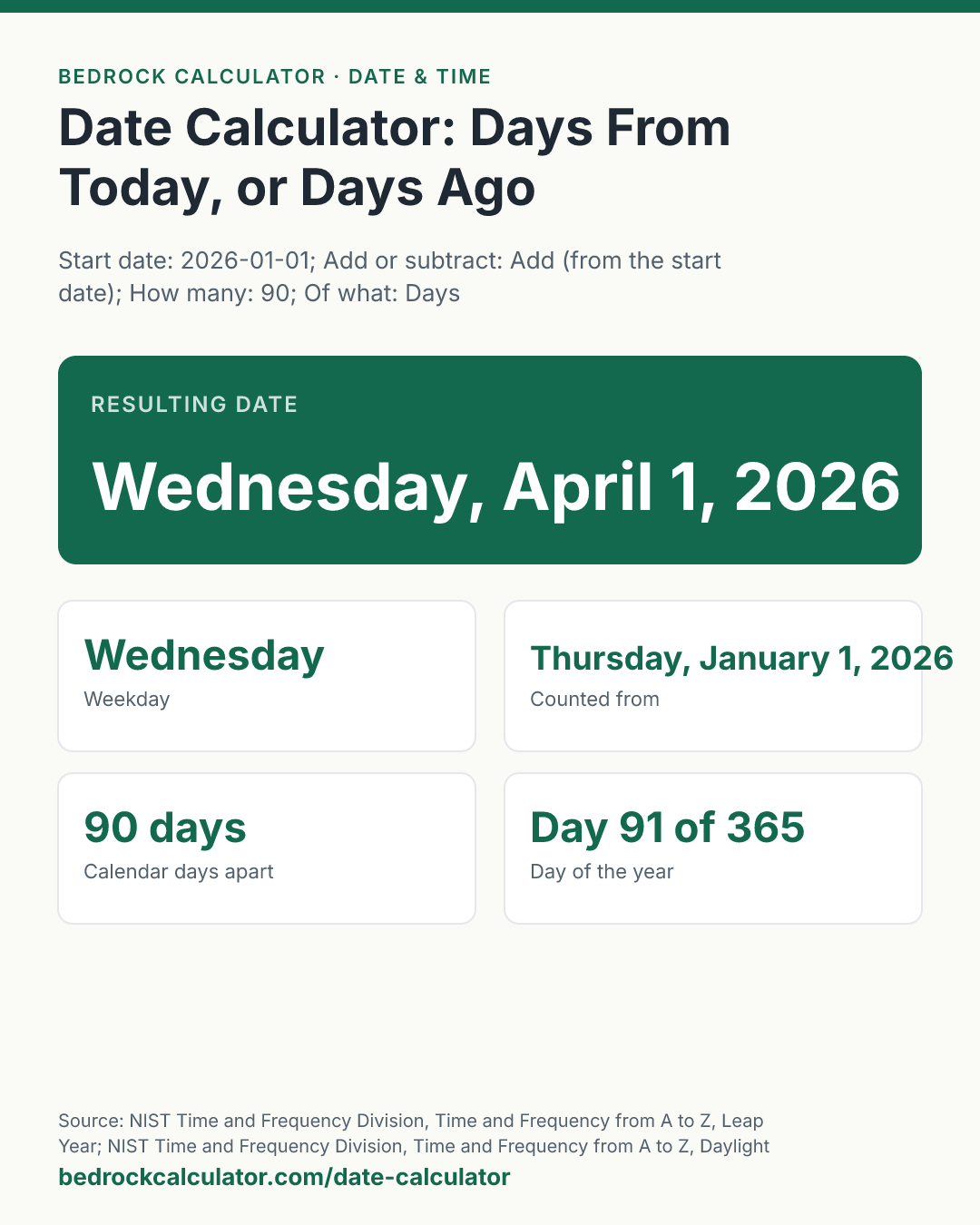

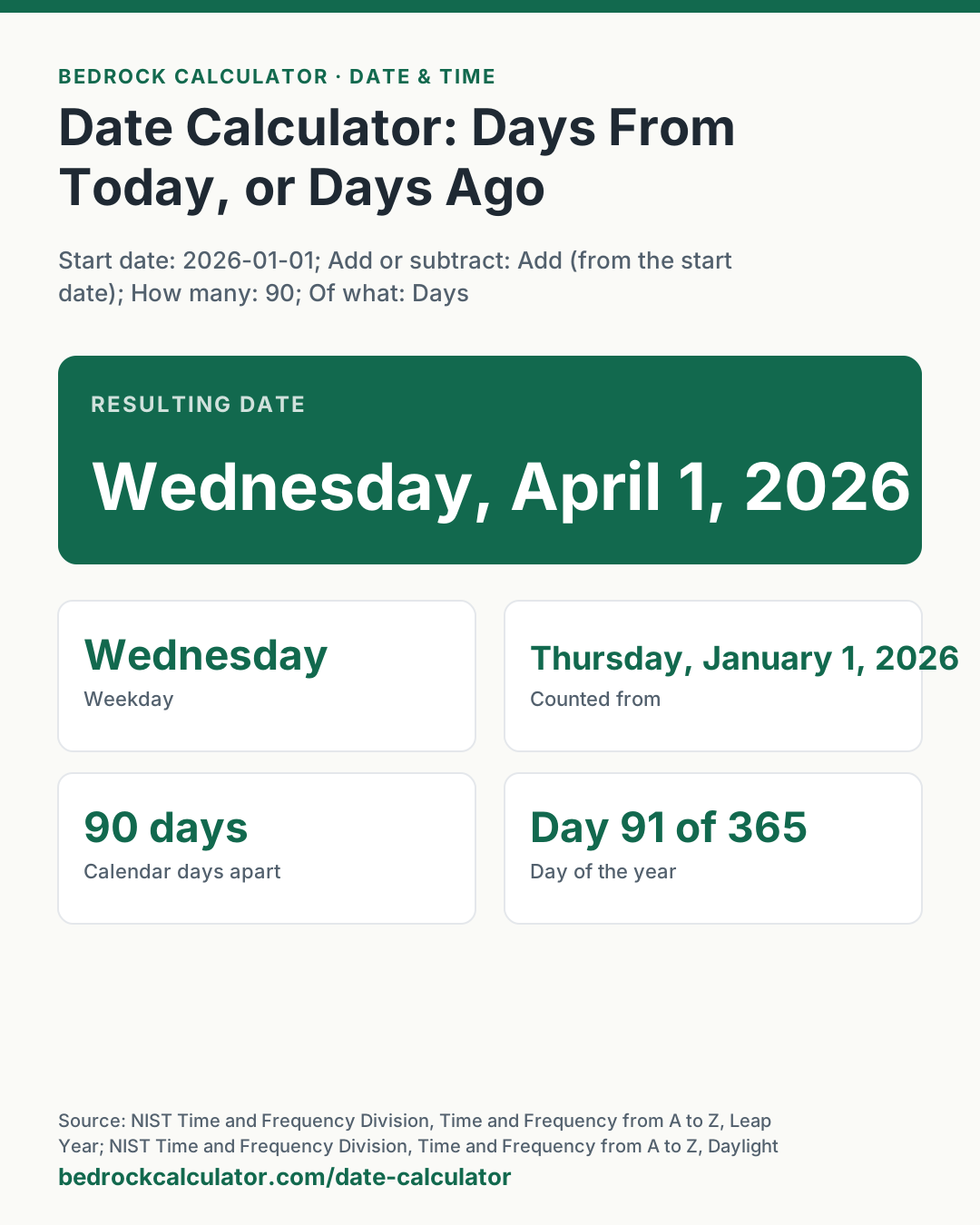
Quick Answer: Taking a fixed example date, 90 days from Thursday, January 1, 2026 is Wednesday, April 1, 2026. The calculator itself starts from today's date on your own device when you open it, and counts forward or back in days, weeks, months or years.
What does this calculator do?
This date calculator finds the date a number of days from today, or a number of days ago. It also adds or subtracts weeks, calendar months and calendar years, and for every answer it shows the weekday, how many calendar days apart the two dates are, the day of the year, and the date in the international year-month-day format.
The start date is today, read from the clock on your phone or computer when the page loads. The site is built ahead of time as static pages, so "today" cannot be fixed into the page; it has to come from your browser. The examples in this article use fixed start dates so they read correctly on any day, and the result card always names the date it counted from.
The convention is the one a calendar uses. The start date is day 0. One day from today is tomorrow, and 90 days from January 1 is the date you reach after turning 90 pages of a daily calendar. Months and years are calendar months and years, not fixed numbers of days, which matters more than people expect: 6 months is not 180 days.
Using the Date Calculator to Count Days From Today
- Leave Start date on today, or pick another date.
- Choose Add for a date in the future or Subtract for a date in the past.
- Type the number in How many, as a whole number.
- Choose Days, Weeks, Calendar months or Calendar years.
- Read the resulting date at the top, with its weekday and the other cards below.
The presets load four examples with fixed start dates: 90 days from January 1, 180 days before January 1, 6 months from October 17, and January 31 plus 1 month. A preset replaces the start date, so set it back to today afterwards if that is what you want.
How is this calculated?
- Read the start date. In the browser this is today's date on your device, in your local time zone. From then on the date is a plain calendar day with no clock time, so daylight saving changes cannot shift the result.
- Turn days and weeks into a day count. Days are used as entered and weeks are multiplied by 7. Each date is given a day number (the days since January 1, 1970, on the Gregorian calendar), the count is added or subtracted, and the day number is turned back into a date. Leap days are handled by the calendar rule itself: a year divisible by 4 has February 29, except century years not divisible by 400.
- Move whole calendar months or years. For months, the calculator moves the month forward or back and keeps the day of the month. A year is 12 months. If the day does not exist in the month you land in, the result is that month's last day. January 31 plus 1 month is February 28, or February 29 in a leap year. A birthday on February 29 plus one year is February 28.
day of month = min(start day, days in the month landed in)
- Describe the result. The weekday comes from the day number (January 1, 1970 was a Thursday). Calendar days apart is the difference between the two day numbers. The day of the year counts January 1 as day 1.
Worked Example
Starting from Thursday, January 1, 2026, add 90 days:
- January has 30 days left after the 1st, which brings you to January 31 (30 days).
- February 2026 has 28 days, bringing you to February 28 (58 days).
- March has 31, bringing you to March 31 (89 days).
- One more day is Wednesday, April 1, 2026, which is Day 91 of 365.
Going back instead, 180 days before January 1, 2026 is Saturday, July 5, 2025.
And in months: 6 months from October 17, 2026 is Saturday, April 17, 2027. That is 182 calendar days, not 180, because the months crossed have 31, 30, 31, 31, 28 and 31 days.
What Day Was It 180 Days Ago?
Choose Subtract, type 180, choose Days, and leave the start date on today. From January 1, 2026 the answer is Saturday, July 5, 2025. The day count is exact, so the answer for 180 days ago and for "half a year ago" can differ by a few days; use calendar months if you mean half a year.
What Date Is 6 Months From Today?
Choose Add, type 6, and choose Calendar months. The result lands on the same day of the month, six months on, unless that month is shorter. From August 31, for example, six months on is the last day of February. If a contract or policy says 180 days instead of 6 months, use Days, because the two give different dates.
What does this calculator not account for?
- Business days. The calculator counts every calendar day, weekends included. Deadlines counted in business days need a list of the holidays where you are, which this page does not assume.
- Time of day. Results are dates, not moments. Adding 1 day to 11 pm today gives tomorrow's date, not 11 pm tomorrow.
- Legal counting rules. Courts, contracts and agencies sometimes exclude the first day, include the last day, or move a deadline that falls on a weekend or holiday to the next working day. Read the rule that applies to you and adjust the count to match.
- Fractions. The number is a whole number. Half a month has no fixed length, so the calculator does not guess one.
- Dates before the Gregorian calendar. All dates are counted as if the Gregorian calendar always applied, which is not how most of history was written down before the 1580s, or in some countries before the 1900s.
What mistakes do people make with this?
- Treating months as 30 days. Six calendar months from October 17, 2026 is 182 days away. Six times 30 is 180, which lands two days earlier.
- Chaining month steps by hand. January 31 plus 1 month is February 28, and February 28 plus 1 month is March 28. But January 31 plus 2 months is March 31. The second table adds each number of months to January 31 directly, which is the right way.
- Off by one at the start. If day 1 of a 90-day period is today, the last day is 89 days from today, not 90. This calculator treats today as day 0, so check which way your rule counts.
- A device with the wrong date. The start date comes from your device. If its date or time zone is set wrongly, type the date you mean.
- Leap years in long spans. Adding 365 days is not always a year. From January 1, 2028, 365 days lands on December 31, 2028, because 2028 has February 29. Use Calendar years for anniversaries.
Frequently Asked Questions
What is 90 days from today?
What date is 180 days from today?
Does the calculator count today?
What is 31 January plus one month?
How many days is 3 months?
Is the date in the ISO format the same everywhere?
Sources
- NIST Time and Frequency Division, Time and Frequency from A to Z, Leap Year: the Gregorian leap year rule. nist.gov/pml/time-and-frequency-division/popular-links/time-frequency-z/time-and-frequency-z-l
- NIST Time and Frequency Division, Time and Frequency from A to Z, Daylight Saving Time: when US clocks change. nist.gov/pml/time-and-frequency-division/popular-links/time-frequency-z/time-and-frequency-z-d