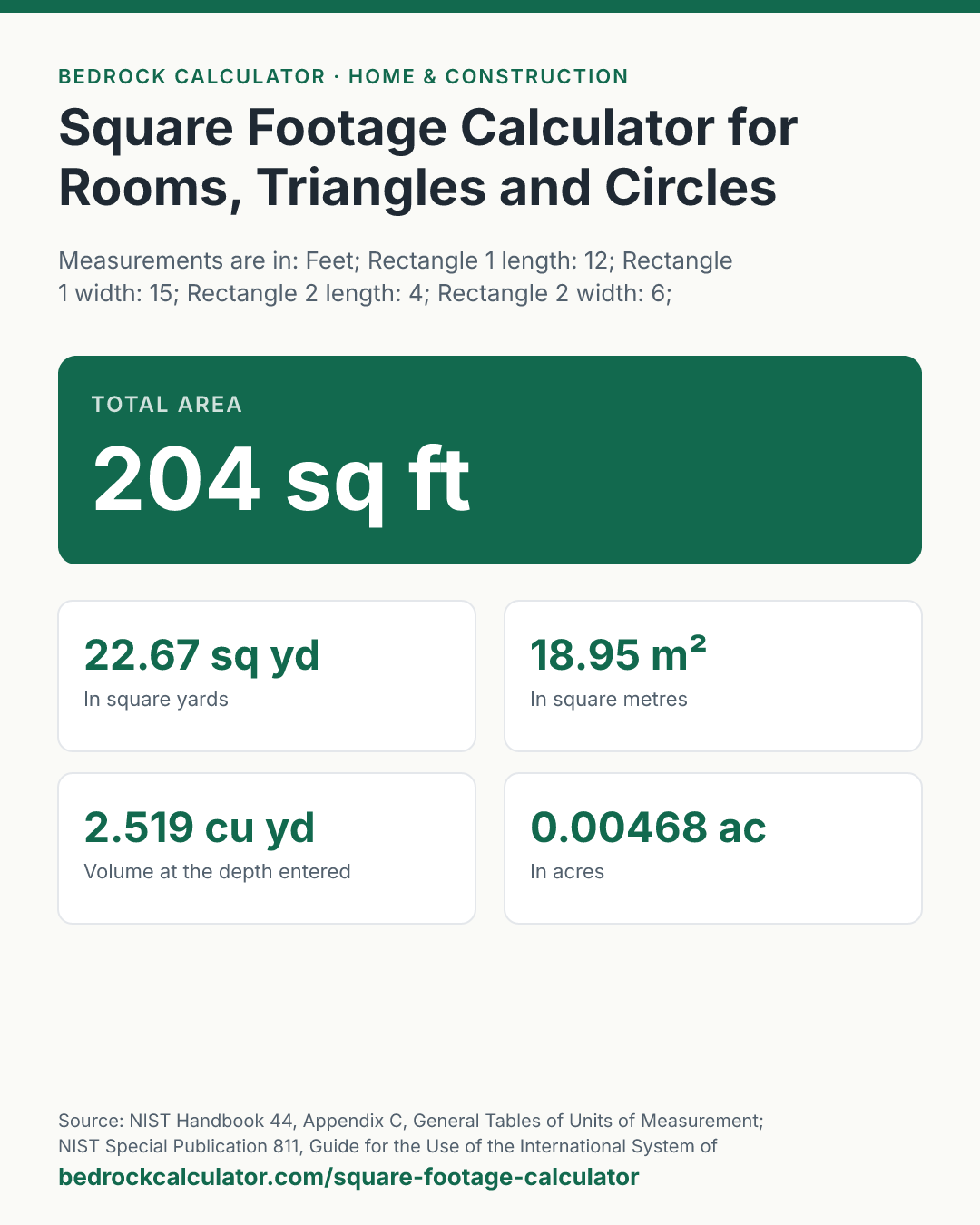
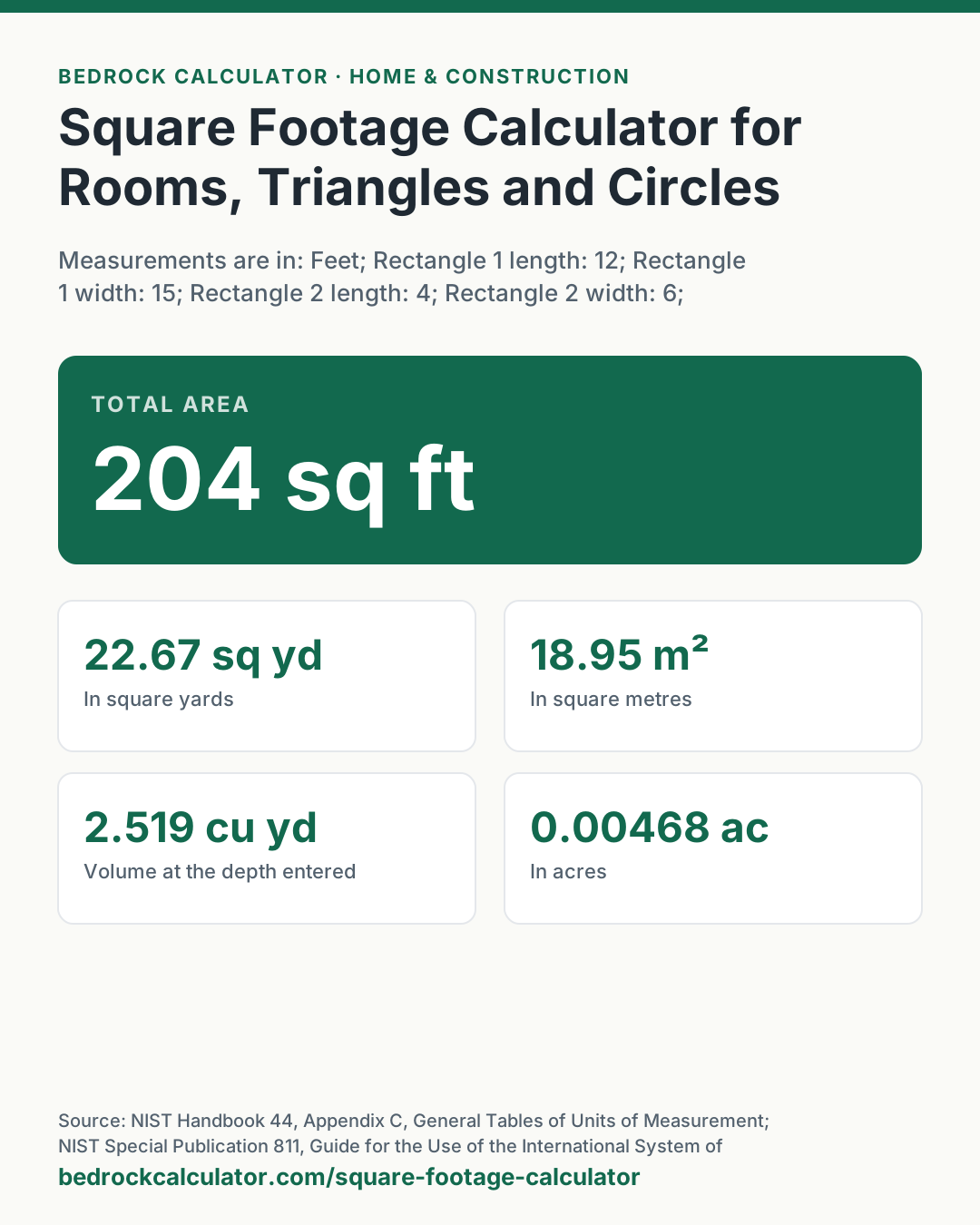
Quick Answer: A 12 by 15 foot room with a 4 by 6 foot alcove is 204 sq ft, or 22.67 square yards. Work out each rectangle as length times width, add any triangles and circles, and add the pieces together.
What does this calculator do?
This square footage calculator adds up the floor area of a space that is not a simple box. Most rooms are one rectangle, but plenty are not: an L-shaped living room, a bedroom with a closet, a deck with a clipped corner, a round patio.
Enter up to two rectangles, a triangle and a circle, and the calculator works out each one, converts it to square feet and adds them up.
You can measure in feet, inches, yards or metres. The total comes back in square feet, square yards, square metres and acres, and if you give a depth it also turns the area into cubic feet and cubic yards, which is how gravel, mulch, topsoil and concrete are sold.
Every conversion uses the international foot of exactly 0.3048 metres, so a square foot is exactly 0.09290304 square metres and a square yard is exactly 9 square feet. The only rounding is in the display.
Using the Square Footage Calculator
- Pick the unit you measured in. Every length on the form uses it.
- Enter the main rectangle's length and width. If the room is an L shape, split it into two rectangles and put the second one in Rectangle 2.
- Add a triangle for an angled wall or a corner bed, and a circle for a round area. Leave any section at zero to skip it.
- If you are ordering a bulk material, enter its depth in inches. Leave it at zero for flooring or paint.
- Read the total area at the top. The cards below repeat it in other units and show each section on its own, so you can check the pieces add up.
The preset buttons load a 12 by 12 bedroom, a 10 foot round patio and a room measured in metres. Under the calculator, two tables list the area of common room sizes and of circles from 3 to 30 feet across, and each can be downloaded as a CSV file.
How is this calculated?
- Work out each section in the unit you entered. A rectangle is length times width. A triangle is half its base times its height, where the height is measured square to the base. A circle is pi times the radius squared, with the radius taken as half the diameter you entered and pi carried to 34 digits.
A_rectangle = L × W; A_triangle = 1/2 b × h; A_circle = π(d/2)²
- Convert each area to square feet. Square inches, square yards and square metres are converted through their exact sizes: 144 square inches, 1/9 square yard or 0.09290304 square metres to the square foot. A section with any dimension at zero contributes nothing.
- Add the sections. The total is the sum of the two rectangles, the triangle and the circle in square feet.
- Convert the total. Square yards are square feet divided by 9. Square metres use the exact factor above. Acres divide by 43,560, the number of square feet in an acre.
- Turn area into volume if a depth is given. The depth is converted from inches to feet and multiplied by the total area to give cubic feet. Cubic yards are cubic feet divided by 27.
V_(cu yd) = (A_(sq ft) × (depth in inches)/12)/27
- Round for display. Areas show two decimal places, cubic yards three, and acres five. The arithmetic itself is carried at full precision, so rounding never stacks up between steps.
Worked Example
The default is a 12 by 15 foot room with a 4 by 6 foot alcove, and a depth of 4 inches to show the volume:
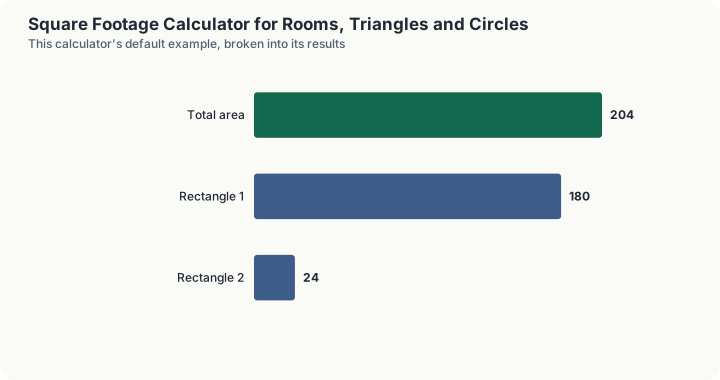
- Rectangle 1: 12 × 15 = 180 sq ft.
- Rectangle 2: 4 × 6 = 24 sq ft.
- Total: 180 + 24 = 204 sq ft.
- Square yards: 204 ÷ 9 = 22.67 sq yd. Square metres: 18.95 m².
- At 4 inches deep: 204 × 4 ÷ 12 = 68 cubic feet, and 68 ÷ 27 = 2.519 cubic yards.
A 10 foot round patio works the same way. The radius is 5 feet, so the area is pi × 25 = 78.54 sq ft, or 8.73 square yards. At 4 inches deep it holds 26.18 cubic feet, which is 0.97 cubic yards of base material.
A room measured as 4 by 5 metres is 20 square metres. Converted, that is 215.28 sq ft or 23.92 square yards.
How Do You Calculate Square Yards?
Find the area in square feet and divide by 9. A yard is 3 feet, so a square yard is a 3 by 3 foot square, which holds 9 square feet. A 12 by 12 room is 144 square feet, which is exactly 16 square yards.
Carpet and some sod and turf are priced by the square yard, so this is the figure to compare against a quote. If you measured in yards to begin with, choose yards as the unit and the calculator reports square feet and square yards together.
How Do You Find the Square Footage of a Circle?
Measure straight across the circle through its centre to get the diameter, halve it for the radius, and multiply pi by the radius squared. Enter the diameter in the Circle field and the calculator does the rest.
A 10 foot circle covers 78.54 square feet and a 20 foot circle covers 314.16, four times as much, because doubling the width quadruples the area. The circle table below the calculator lists sizes from 3 to 30 feet across.
How Do You Convert Square Feet to Cubic Yards?
Square feet alone cannot become cubic yards; a volume needs a depth. Multiply the area by the depth in feet to get cubic feet, then divide by 27. Enter the depth in inches and the calculator does both steps. For the default 204 square feet at 4 inches that is 2.519 cubic yards.
Going the other way, from cubic yards back to the square feet a load will cover, divide the cubic yards by the depth in feet and multiply by 27; for the full calculation with a compaction allowance and a weight, use the gravel calculator.
What does this calculator not account for?
- Walls and ceilings. This measures floor area only. Paint, drywall and wallpaper need wall area, which depends on ceiling height and openings.
- Irregular curves. Sections must be rectangles, triangles or full circles. A half circle or a curved bed can be approximated by entering a circle and halving the result yourself, or by splitting it into triangles.
- Overlap between sections. The sections are added, not merged. If two sections share floor, measure them so they meet edge to edge rather than overlap.
- Waste. The area here is the measured area. Flooring, tile and sod need an allowance for cutting, which the flooring and sod calculators add as a separate line.
- Wall thickness and how a listing measures a home. Real estate square footage follows its own conventions about which spaces count. This calculator measures whatever you enter, nothing more.
What mistakes do people make with this?
- Mixing feet and inches. A room of 12 feet 6 inches is 12.5 feet, not 12.6. Convert inches by dividing by 12, or measure everything in inches and choose inches as the unit.
- Measuring the slope instead of the height of a triangle. The height runs square to the base. Using the length of the sloped side overstates the area.
- Using the radius as the diameter. Entering the radius in the diameter field gives a quarter of the true area.
- Forgetting to divide by 9 or 27. Square feet to square yards is ÷ 9; cubic feet to cubic yards is ÷ 27. Dividing cubic feet by 9 gives a number three times too big.
- Mixing metric and imperial. A room measured partly in metres and partly in feet needs every length converted to one unit before it goes in.
Frequently Asked Questions
How do I calculate the square footage of a room?
How many square feet are in a square yard?
How many square feet does a cubic yard cover?
Is a square foot the same as a foot squared?
Can I enter measurements in metres?
How do I measure a room that is not a rectangle?
Should I measure to the wall or to the baseboard?
Sources
- NIST Handbook 44, Appendix C, General Tables of Units of Measurement: the square foot, square yard and acre. nist.gov/pml/owm/nist-handbook-44-current-edition
- NIST Special Publication 811, Guide for the Use of the International System of Units, Appendix B: conversion factors from square feet and cubic yards to SI. nist.gov/pml/special-publication-811
- National Bureau of Standards Miscellaneous Publication 233, Units of Weight and Measure: the 1959 international yard of 0.9144 metre. nvlpubs.nist.gov/nistpubs/Legacy/MP/nbsmiscellaneouspub233.pdf