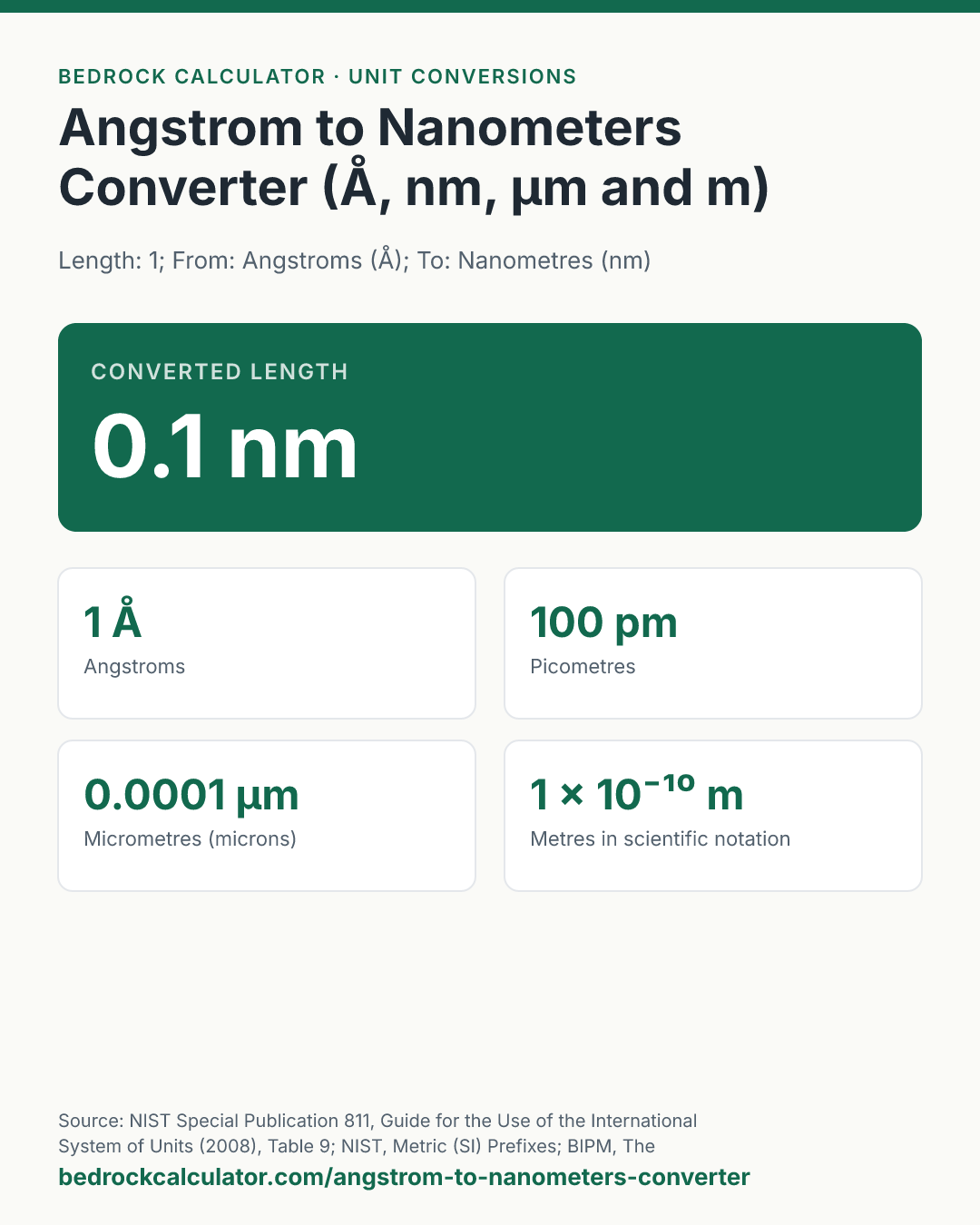
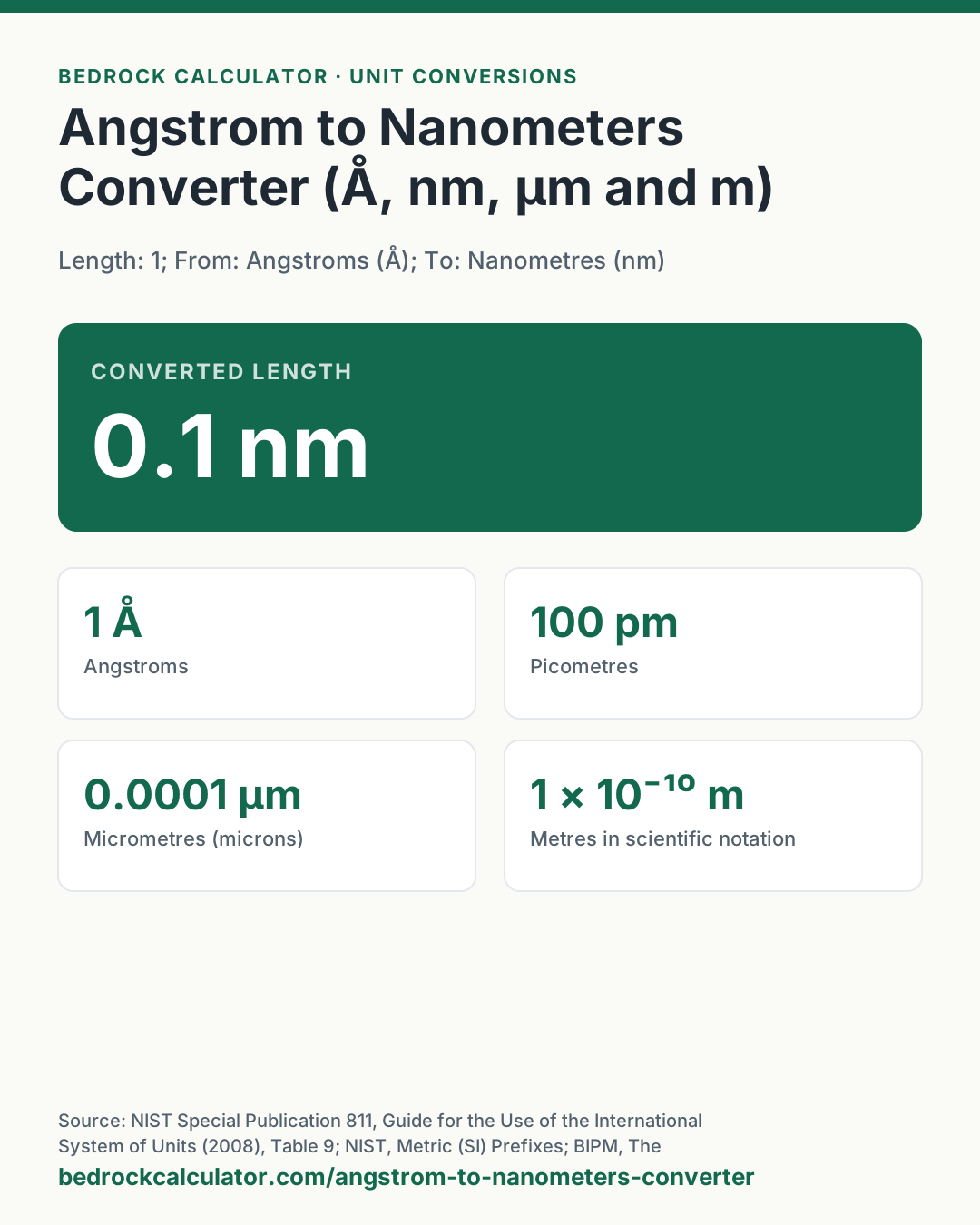
Quick Answer: 1 Å is 0.1 nm, which is 100 picometres or 1 × 10⁻¹⁰ m. One nanometre is 0.000000001 m (1 × 10⁻⁹ m), and 550 nm is 0.55 µm.
What does this calculator do?
This angstrom to nanometers converter moves a very small length between picometres, angstroms, nanometres, micrometres, millimetres and metres, in any direction. It is for the lengths of chemistry, physics and optics: bond lengths, crystal spacings, X-ray and light wavelengths, film thicknesses and chip features.
The angstrom (Å) is not an SI unit, but it is exactly one tenth of a nanometre, 10⁻¹⁰ metre, and NIST lists it among the units accepted for use with the SI. It survives because it is a convenient size for atoms: most bond lengths come out between about 1 and 3 Å. The nanometre has taken over in most other fields, and the two are related by a factor of exactly 10.
Every conversion here is a power of ten, so every result is exact. The one presentation problem is that the metre figures get very long, so the converter also writes the metre value in scientific notation.
Using the Angstrom to Nanometers Converter
- Type the length.
- Choose its unit in From and the unit you want in To.
- Read the result at the top. The cards list nanometres, angstroms, picometres, micrometres, millimetres, metres, and metres in scientific notation.
The presets load one nanometre in metres, an X-ray wavelength of 1.5406 Å, green light at 550 nm, and a carbon to carbon bond of 154 pm.
How is this calculated?
- Choose the units. A negative length is read as zero.
- Convert through the metre. Each unit is stored as its exact size in metres: the picometre as 10⁻¹², the angstrom as 10⁻¹⁰, the nanometre as 10⁻⁹, the micrometre as 10⁻⁶ and the millimetre as 10⁻³. The converter multiplies your number by the size of the unit you started in and divides by the size of the unit you want.
nm = (A × 10⁻¹⁰)/10⁻⁹ = A/10; pm = A × 100
m = nm × 10⁻⁹
- Write the metres in scientific notation. The metre figure is rounded to ten significant figures and written as a number between 1 and 10 times a power of ten.
- Round for display only. Picometres are shown to four decimal places, angstroms and nanometres to six, micrometres to nine, millimetres to twelve and metres to fifteen, so even one picometre still shows up in metres. Trailing zeros are dropped.
Worked Example
The default, 1 angstrom to nanometres:
- Nanometres: 1 ÷ 10 = 0.1 nm.
- Picometres: 1 × 100 = 100 pm.
- Metres: 0.0000000001 m, written 1 × 10⁻¹⁰ m.
1 nanometre in metres: 0.000000001 m, or 1 × 10⁻⁹ m. It is also 10 Å and 1,000 pm.
An X-ray wavelength of 1.5406 Å: 0.15406 nm, or 154.06 pm.
Green light at 550 nm: 0.55 µm, or 5,500 Å, which is 5.5 × 10⁻⁷ m.
A 154 pm bond: 1.54 Å, or 0.154 nm.
Angstroms to Nanometres: Common Values
| Angstroms | Nanometres | Picometres |
|---|---|---|
| 0.5 | 0.05 | 50 |
| 0.74 | 0.074 | 74 |
| 1 | 0.1 | 100 |
| 1.54 | 0.154 | 154 |
| 2 | 0.2 | 200 |
| 3.4 | 0.34 | 340 |
| 10 | 1 | 1,000 |
| 100 | 10 | 10,000 |
| 1,000 | 100 | 100,000 |
| 3,800 | 380 | 380,000 |
| 7,000 | 700 | 700,000 |
Bond lengths and crystal spacings mostly fall in the first rows of this table. The 3,800 and 7,000 Å rows are the ends of the visible range as NASA gives it, 380 to 700 nm.
Nanometres to Metres Conversion
| Nanometres | Micrometres | Metres |
|---|---|---|
| 1 | 0.001 | 1 × 10⁻⁹ |
| 10 | 0.01 | 1 × 10⁻⁸ |
| 100 | 0.1 | 1 × 10⁻⁷ |
| 380 | 0.38 | 3.8 × 10⁻⁷ |
| 500 | 0.5 | 5 × 10⁻⁷ |
| 700 | 0.7 | 7 × 10⁻⁷ |
| 1,000 | 1 | 1 × 10⁻⁶ |
| 1,550 | 1.55 | 1.55 × 10⁻⁶ |
| 1,000,000 | 1,000 | 1 × 10⁻³ |
1,550 nm lies in the infrared, beyond the visible range.
How Many Metres Is 1 nm?
One nanometre is one billionth of a metre: 0.000000001 m, or 1 × 10⁻⁹ m. Going the other way, a metre is 1,000,000,000 nanometres. The prefix nano means 10⁻⁹ by definition of the SI, so the conversion is exact.
What does this calculator not account for?
- Frequency or energy. A wavelength can be turned into a frequency or a photon energy, but that needs the speed of light and the Planck constant. This page converts lengths only.
- Wavelength in a medium. Light is slower in glass or water, so its wavelength there is shorter than in a vacuum. Quoted wavelengths are usually vacuum or air values.
- Larger units. For centimetres and above, the cm to meters converter is simpler to read.
- Non-SI units other than the angstrom. The micron is the old name for the micrometre and is shown as such; the fermi and the mil are not included.
What mistakes do people make with this?
- Moving the decimal point the wrong way. An angstrom is smaller than a nanometre, so the angstrom number is always ten times the nanometre number.
- Confusing nm with nmi. nm is the nanometre. The nautical mile is nmi, or NM in aviation.
- Losing zeros in metres. Long decimals are easy to miscount. Use the scientific notation card when writing a value in metres.
- Writing Å as A. The symbol is the capital A with a ring. Plain A is the ampere.
Frequently Asked Questions
How many nanometres is one angstrom?
How many angstroms are in a nanometre?
What is 1 nm in metres?
How do I convert nanometres to metres?
How many picometres are in an angstrom?
Is the angstrom an SI unit?
How many nanometres are in a micrometre?
How do I convert angstroms to metres?
Sources
- NIST Special Publication 811, Guide for the Use of the International System of Units (2008), Table 9: the ångström, 1 Å = 0.1 nm = 10⁻¹⁰ m. nist.gov/pml/special-publication-811
- NIST, Metric (SI) Prefixes: pico, nano, micro and milli. nist.gov/pml/owm/metric-si-prefixes
- BIPM, The International System of Units (SI Brochure, 9th edition, 2019): the metre and the SI prefixes. bipm.org/en/publications/si-brochure
- NASA Science, Visible Light: the visible range of 380 to 700 nanometres. science.nasa.gov/ems/09_visiblelight