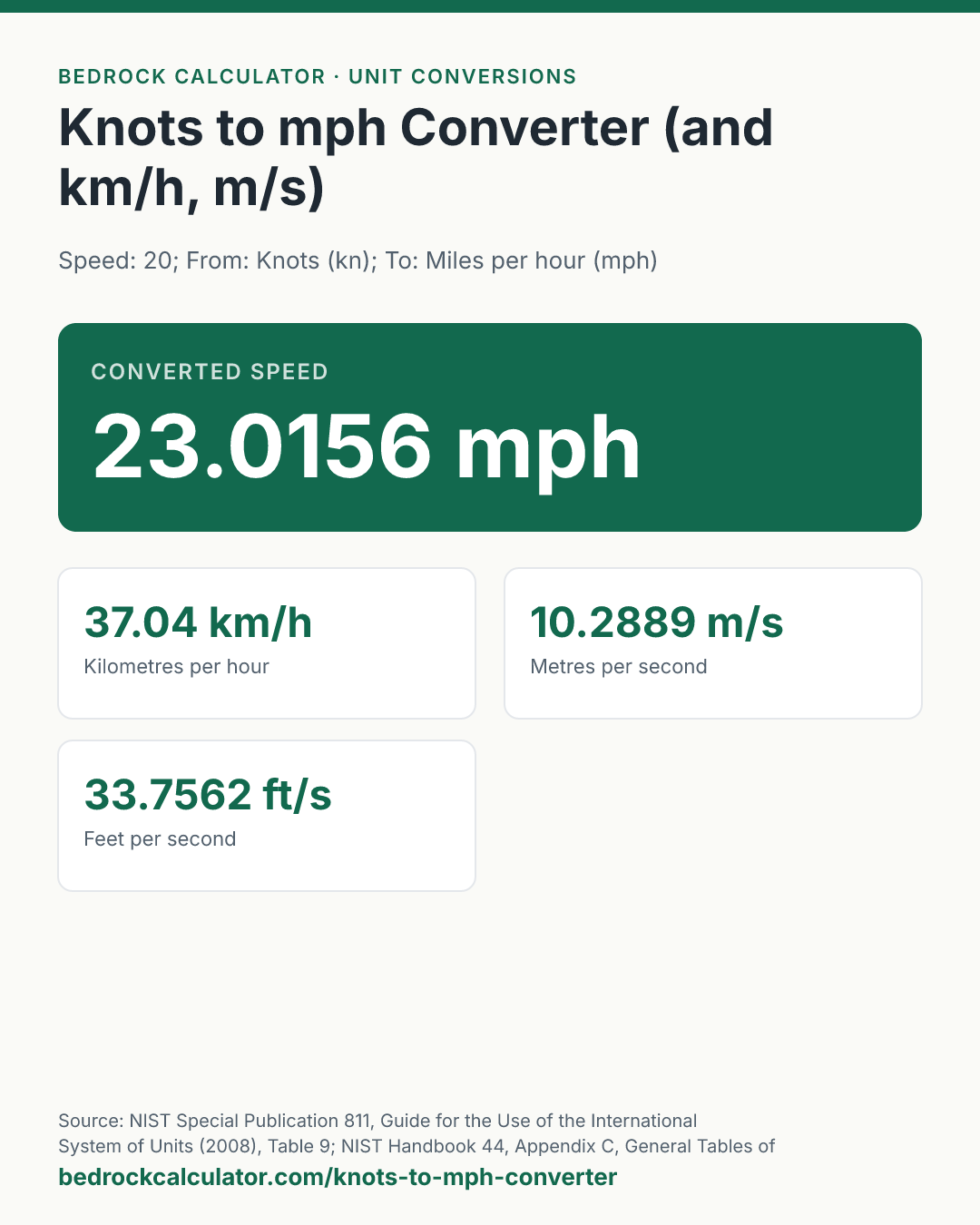

Quick Answer: 20 knots is 23.0156 mph. 35 knots is 40.2773 mph, 50 knots is 57.539 mph, and 60 mph is 52.1386 knots.
What does this calculator do?
This knots to mph converter changes a speed between knots, miles per hour, kilometres per hour, metres per second and feet per second, in any direction. Marine forecasts, aviation and hurricane advisories give speeds in knots, while US road signs and most weather apps use miles per hour.
That makes this the conversion sailors, pilots, anglers and storm watchers keep doing.
A knot is one nautical mile per hour, and the nautical mile is exactly 1,852 metres. The statute mile on a road sign is exactly 1,609.344 metres. So a knot is 1,852 ÷ 1,609.344 miles per hour, which is 1.15 mph to two decimal places, and exactly 1.852 kilometres per hour. The converter divides the exact lengths rather than multiplying by a rounded 1.15, so wind speeds near a warning threshold land on the right side of it.
Using the Knots to mph Converter
- Type the speed.
- Choose its unit in From and the unit you want in To.
- Read the converted speed at the top. The cards list miles per hour, kilometres per hour, metres per second, knots and feet per second.
The presets load a 50 knot gust, 35 knots, 60 mph in knots, and 100 km/h in mph. The tables below cover knots to mph from light air to hurricane force, and road speeds in mph to knots.
How is this calculated?
- Choose the units. A negative speed is read as zero.
- Convert through metres per second. Each unit is stored as its exact size in metres per second: the knot as 1,852/3,600, the mile per hour as 1,609.344/3,600, the kilometre per hour as 1,000/3,600, and the foot per second as 0.3048. The converter multiplies your number by the size of the unit you started in and divides by the size of the unit you want.
mph = knots × 1852/1609.344; km/h = knots × 1.852
knots = mph × 1609.344/1852
- Round for display only. Every unit is shown to four decimal places, rounded half up with trailing zeros dropped. Kilometres per hour from whole knots are exact.
Worked Example
The default, 20 knots to mph:
- mph: 20 × 1,852 ÷ 1,609.344 = 23.01561..., shown as 23.0156 mph.
- km/h: 20 × 1.852 = 37.04 km/h, exactly.
- m/s: 10.2889 m/s. ft/s: 33.7562 ft/s.
50 knots: 57.539 mph, or 92.6 km/h.
35 knots: 40.2773 mph, or 64.82 km/h.
60 mph to knots: 60 × 1,609.344 ÷ 1,852 = 52.1386 kn. That is also exactly 88 ft/s.
100 km/h to mph: 62.1371 mph, or 53.9957 kn.
Knots to mph: Wind and Storm Thresholds
| Knots | mph | km/h | What it marks |
|---|---|---|---|
| 10 | 11.51 | 18.52 | Steady sailing breeze |
| 34 | 39.13 | 62.968 | Bottom of the gale warning range |
| 47 | 54.09 | 87.044 | Top of the gale warning range |
| 64 | 73.65 | 118.528 | Category 1 hurricane |
| 83 | 95.51 | 153.716 | Category 2 hurricane |
| 96 | 110.47 | 177.792 | Category 3 hurricane |
| 113 | 130.04 | 209.276 | Category 4 hurricane |
| 137 | 157.66 | 253.724 | Category 5 hurricane |
The National Hurricane Center sets its categories in knots and publishes the mph and km/h figures rounded to whole numbers, which is why a 64 knot Category 1 threshold appears in advisories as 74 mph.
Common Speeds in Both Directions
| Knots | mph |
|---|---|
| 5 | 5.75 |
| 15 | 17.26 |
| 25 | 28.77 |
| 30 | 34.52 |
| 40 | 46.03 |
| 100 | 115.08 |
| 250 | 287.69 |
| 450 | 517.85 |
| mph | Knots |
|---|---|
| 10 | 8.69 |
| 30 | 26.07 |
| 55 | 47.79 |
| 65 | 56.48 |
| 70 | 60.83 |
| 100 | 86.9 |
450 knots is a typical airliner cruising speed through the air.
Why Do Ships and Planes Use Knots?
The nautical mile was based on one minute of latitude, so a navigator working on a chart can turn distance into degrees and minutes directly. A speed in nautical miles per hour, a knot, fits that system: at 20 knots a ship covers 20 minutes of latitude in an hour.
The international nautical mile was later fixed at exactly 1,852 m, which is close to, but no longer defined by, a minute of latitude. Aviation inherited the same units, and weather services use knots for marine and aviation forecasts.
What does this calculator not account for?
- Ground speed versus airspeed. An aircraft's airspeed in knots is relative to the air. Wind changes its speed over the ground; the converter changes units only.
- Current and leeway at sea. A boat's speed through the water and its speed over the ground differ by the current.
- Gusts and averages. Wind thresholds refer to sustained winds averaged over a set period. A gust figure converts the same way but means something different.
- Mach number. The speed of sound depends on air temperature, so Mach is not a fixed unit and is not offered.
What mistakes do people make with this?
- Treating a knot as a mile per hour. A knot is faster, so a 50 knot wind is 57.539 mph, not 50.
- Writing "knots per hour". A knot is already a speed. "Knots per hour" would be an acceleration.
- Rounding near a threshold. Rounding with 1.15 can push a speed over or under a warning limit. Use the exact figure.
- Mixing nautical and statute miles. Distances on charts are in nautical miles. Divide a distance in nautical miles by a speed in knots to get hours.
Frequently Asked Questions
How fast is 20 knots in mph?
How many mph is 50 knots?
What is 35 knots in mph?
How many knots is 60 mph?
How many km/h is one knot?
Is a knot faster than a mile per hour?
How many mph is a Category 1 hurricane?
Sources
- NIST Special Publication 811, Guide for the Use of the International System of Units (2008), Table 9: the nautical mile (1,852 m) and the knot (1,852/3,600 m/s), and Appendix B: the mile per hour. nist.gov/pml/special-publication-811
- NIST Handbook 44, Appendix C, General Tables of Units of Measurement: the statute mile and the international nautical mile. nist.gov/pml/owm/nist-handbook-44-current-edition
- NOAA National Hurricane Center, The Saffir-Simpson Hurricane Wind Scale: category thresholds in knots, mph and km/h. nhc.noaa.gov/aboutsshws.php
- NOAA National Weather Service, Glossary: gale warning (sustained winds or frequent gusts of 34 to 47 knots). forecast.weather.gov/glossary.php