How much do a new baby and a wedding cost in the US?
There's no official figure for what a baby or a wedding costs in the US. What you can pin down is how the bill is built, and that's where the surprises are.
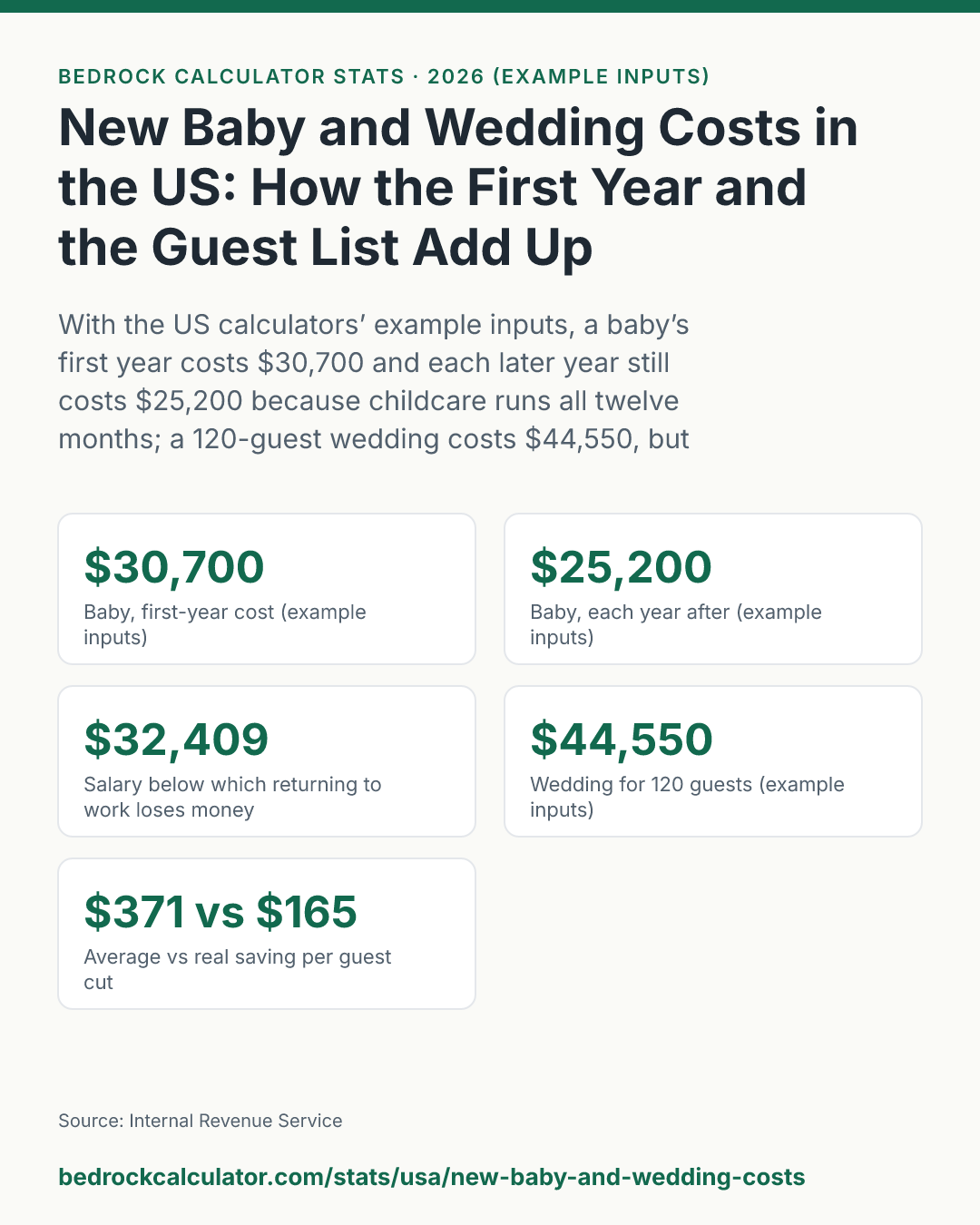
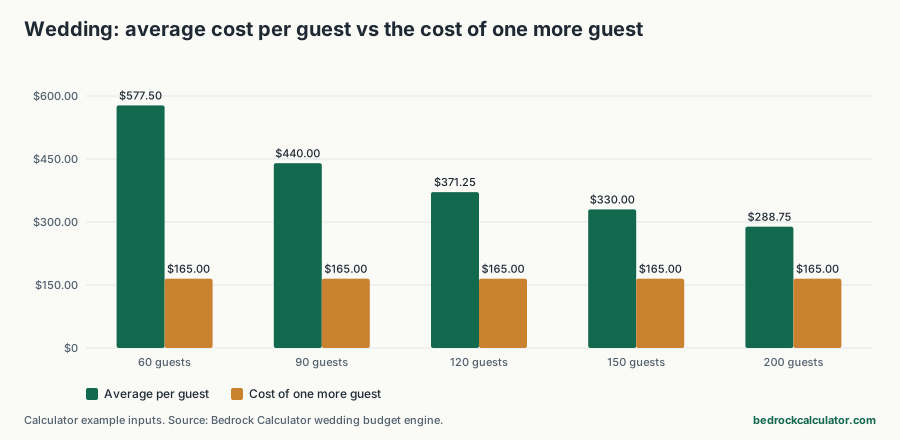
Using the example inputs in our calculators, a baby's first year costs $30,700. The years after that still cost $25,200 each, because childcare runs all twelve months instead of six. A 120-guest wedding with the example prices comes to $44,550, but cutting one guest saves only $165, not the $371 average.
How we worked out these numbers, and why they're examples
Both sets of figures come from the site's own calculators: the new baby cost calculator and the wedding budget calculator. We ran each one with its default inputs, then changed one thing at a time.
Those defaults are placeholders, not national averages. No US government agency publishes what a wedding costs, and the widely quoted averages come from surveys of people using wedding marketplace sites. Baby costs vary just as widely, above all childcare, which depends on where you live and who provides it. So read every dollar figure here as a worked example. The patterns hold whatever your prices are, and those are what this page is about.
The baby example inputs are:
- $3,000 out of pocket for the birth after insurance
- $2,500 of one-off purchases: crib, stroller, car seat
- $300 a month for diapers, formula, clothes and medical costs
- $1,600 a month of childcare, starting halfway through the first year (6 months)
- 8 weeks of unpaid leave at $1,200 a week
- $2,400 a year more in health insurance premiums for adding a dependent
The calculator adds these up. It doesn't model the child tax credit, a dependent care FSA, any state paid leave program or the federal child and dependent care credit. You can enter a credit or subsidy as a single yearly amount, and the example uses $1,200.
How much a baby costs in the first year
With the example inputs, the first year comes to $30,700, or about $2,558 a month. Two items make up most of it: $9,600 of childcare and $9,600 of pay lost during unpaid leave.
Year one costs only $5,500 more than a later year. The birth, the gear and the unpaid leave happen once, but the first year also has six fewer months of childcare, which cancels out most of them.
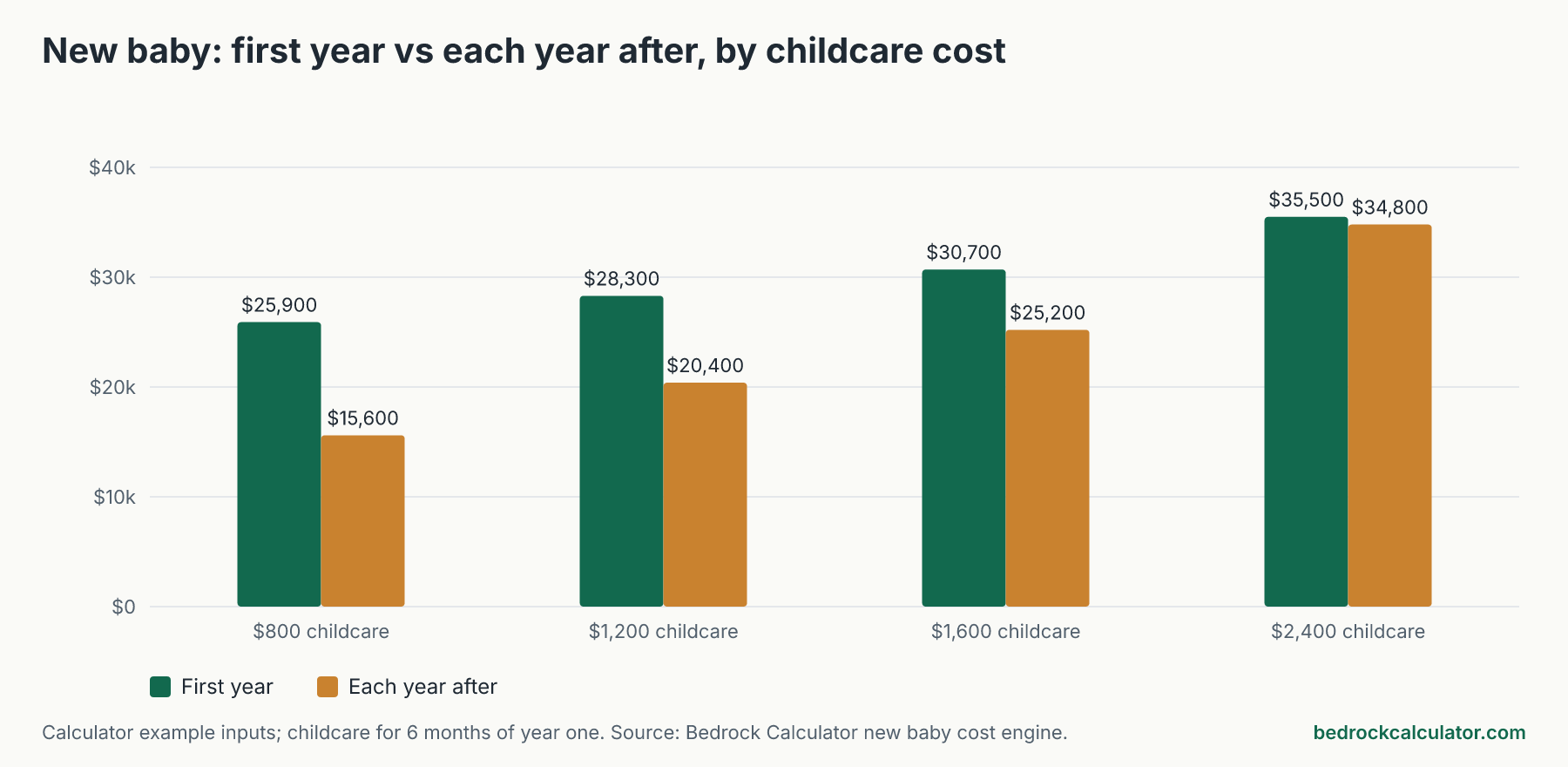
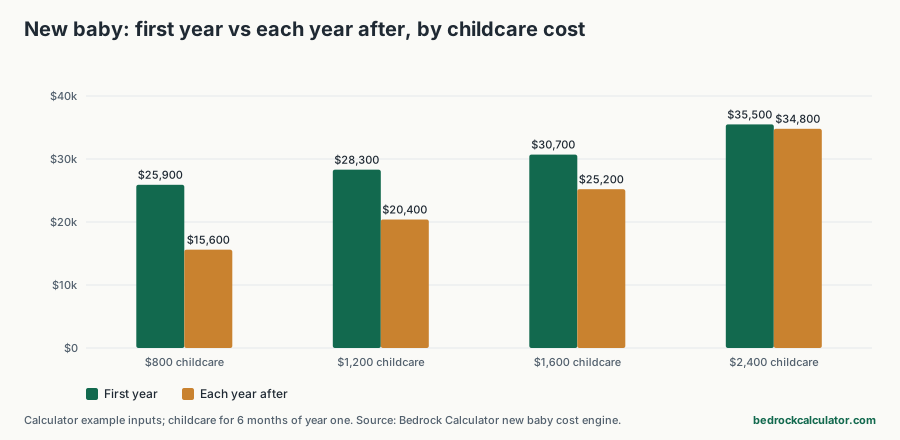
New baby costs by monthly childcare cost (other example inputs unchanged)
Download CSVChildcare for 6 of the first 12 months; all other inputs are the calculator’s example defaults. Breakeven is the returning earner’s salary at which take-home pay just covers childcare and work costs.
| $800 | $25,900 | $15,600 | $18,763 | $18,458 |
| $1,200 | $28,300 | $20,400 | $25,586 | $13,658 |
| $1,600 | $30,700 | $25,200 | $32,409 | $8,858 |
| $2,400 | $35,500 | $34,800 | $46,055 | -$743 |
Why year two can cost nearly as much as year one
People tend to think of the first year as the expensive one. But the birth and the gear happen once, while childcare goes from six months to twelve. With childcare at $1,600 a month, later years cost $25,200. At $2,400 a month, the first year is $35,500 and each later year is $34,800, nearly the same.
If childcare starts right away instead of halfway through, the first year rises to $40,300 with the other example inputs unchanged.
The childcare cliff: when going back to work costs money
A parent returning to work doesn't gain their whole salary. They gain take-home pay, minus childcare, minus the costs of working, such as commuting. Because childcare is paid from after-tax money, there's a salary below which the job loses money. The calculator calls this the childcare cliff.
With the example inputs, a 22% income tax rate, 7.65% payroll tax and $400 a month of work costs, the cliff sits at $32,409. A $45,000 job clears it and adds $8,858 a year to the household. At $800 a month of childcare the cliff is $18,763. At $2,400 it's $46,055, and the same $45,000 job loses $743 a year.
The calculator applies one flat tax rate to the whole salary. In real US tax brackets the first dollars are taxed at lower rates, so the true cliff is somewhat lower than shown. Losing money for a year or two can also be worth it for the career and retirement savings it protects, which the calculator doesn't value.
How a wedding budget breaks down
The wedding example uses $95 a guest for catering, $35 for the bar and $20 for rentals and stationery. Fixed costs, such as the $6,000 venue fee, photography, attire, flowers, music and rings, add up to $22,500. A 10% contingency reserve goes on top of everything.
For 120 guests the total is $44,550, including $4,050 of contingency. Fixed costs are 55.6% of the itemized bill.
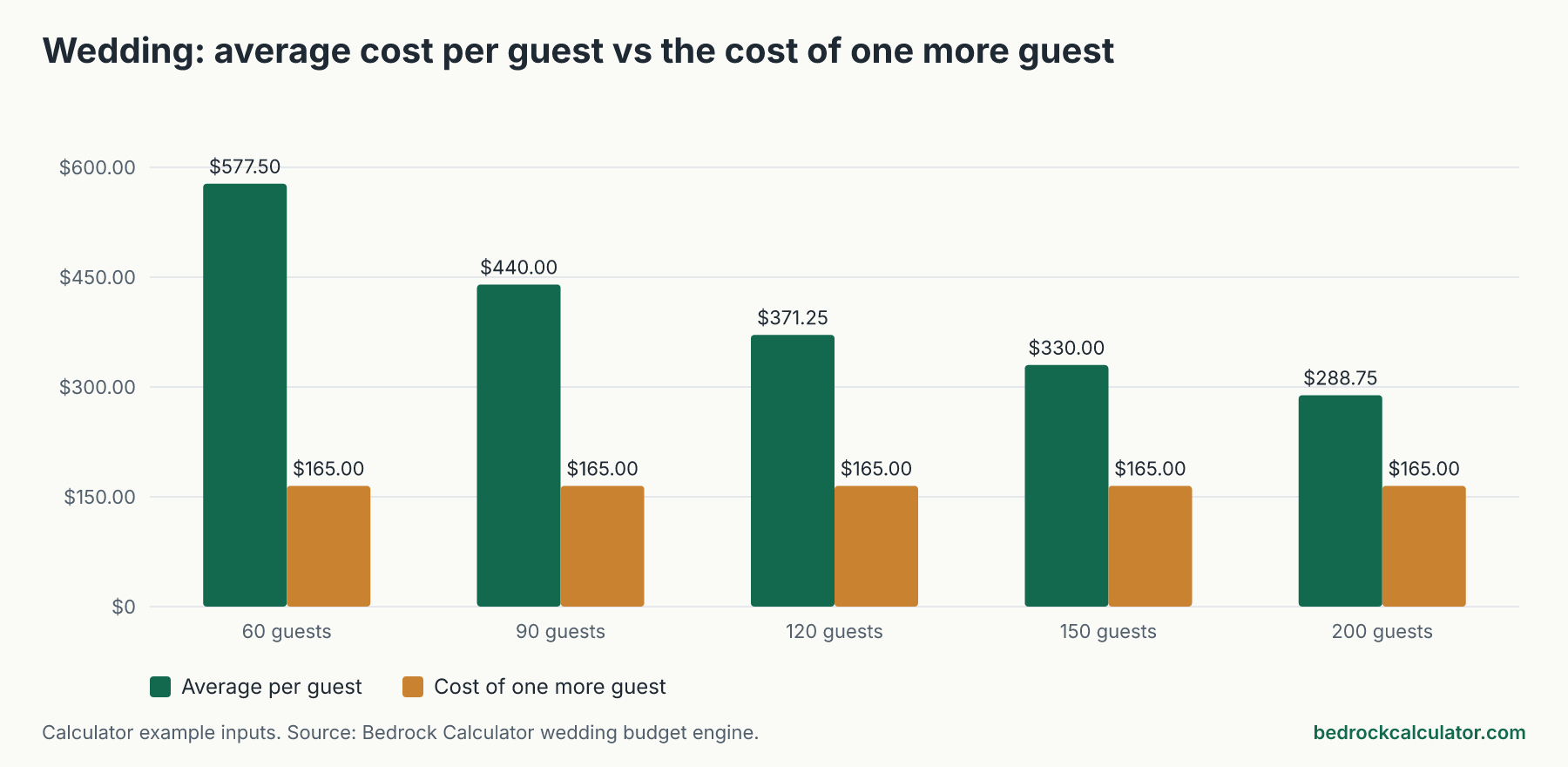
Wedding cost by guest count (example inputs)
Download CSVCalculator example prices: $95 catering, $35 bar and $20 rentals per guest; $22,500 of fixed costs; 10% contingency on everything.
| 60 | $34,650 | $578 | $165 | 71.4% |
| 90 | $39,600 | $440 | $165 | 62.5% |
| 120 | $44,550 | $371 | $165 | 55.6% |
| 150 | $49,500 | $330 | $165 | 50.0% |
| 200 | $57,750 | $289 | $165 | 42.9% |
The example budget is $35,000, which at these prices covers about 62 guests. That gap is common, and it's where the guest list usually gets cut.
Why cutting wedding guests saves less than you think
Divide the 120-guest total by 120 and you get $371 a guest. It's tempting to think cutting ten guests saves ten times that, or $3,713. It actually saves $1,650, because the venue, photographer and the rest don't get cheaper with fewer people. Each guest really costs only the per-head items plus their share of the contingency: $165.
The average falls as the list grows, from $578 at 60 guests to $289 at 200, but the cost of one more guest doesn't change. If you need to save real money, the fixed lines are where it is.
The calculator treats fixed costs as truly fixed. In reality some venues price by room size, so a big cut in guests can sometimes let you book a cheaper space. It also leaves out sales tax, service charges and tips, which can add a lot to catering bills.
Getting your own numbers
Replace every example input with a real quote or your own estimate:
- The new baby cost calculator for the first year, later years and the childcare cliff
- The wedding budget calculator for the total, the real cost per guest and how many guests your budget covers
- The paycheck calculator for actual take-home pay in your state, instead of a flat tax rate
- The emergency fund calculator to rebuild savings after either event