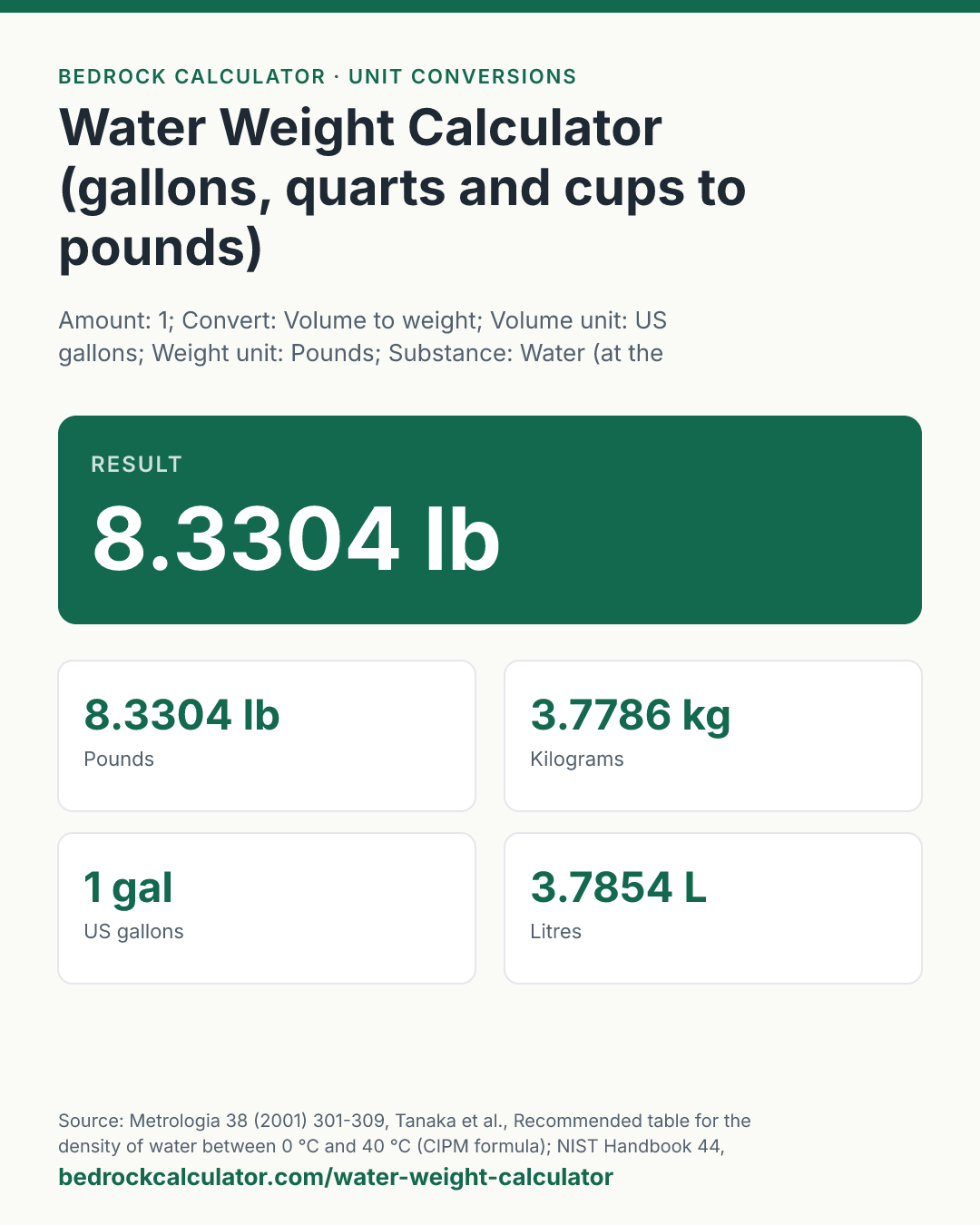
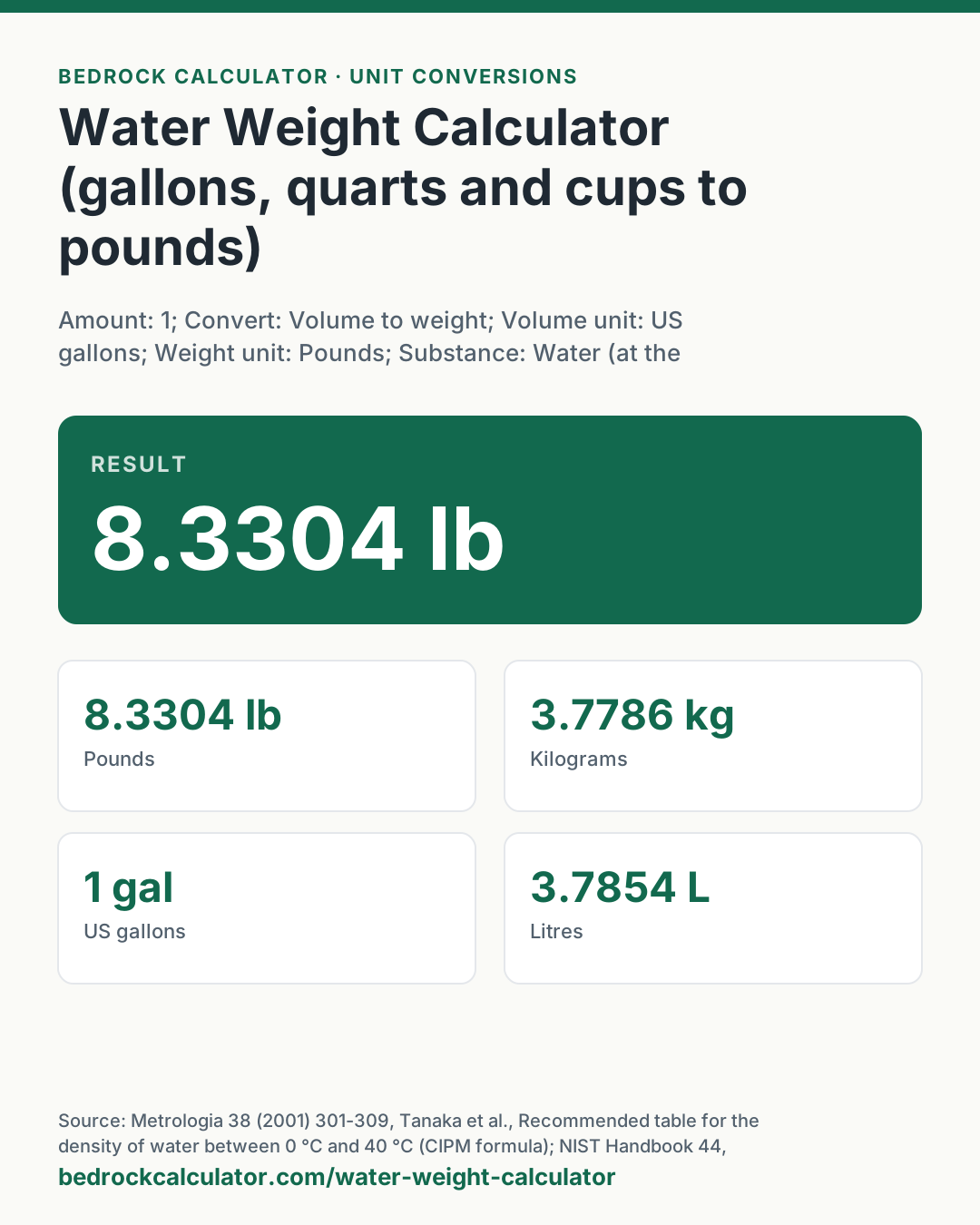
Quick Answer: A US gallon of pure water at 20 °C weighs 8.3304 lb (3.7786 kg), so a 5 gallon jug holds 41.6522 lb of water. A quart weighs 2.0826 lb and a litre 2.2007 lb.
What does this calculator do?
This water weight calculator gives the weight of a volume of water, and the volume that a weight of water fills. Enter gallons, quarts, pints, cups, fluid ounces, litres or millilitres and get pounds, kilograms and ounces; or go the other way from a weight to a volume.
It is about the weight of water as a substance, for jobs like loading a truck bed, sizing a shelf for an aquarium, filling a rain barrel or working out how many cups a pound of something fills. It is not a body weight or health tool.
Water's weight depends a little on temperature. The calculator uses the CIPM formula, the international reference for the density of pure water, at whatever temperature you enter from 0 to 40 °C, and starts at a room temperature of 20 °C. At that temperature water weighs 0.998207 grams per millilitre, which is why a litre weighs slightly less than a kilogram.
The same calculator works for fifteen common ingredients whose weights per cup are published by USDA FoodData Central, and for any substance whose density you know. That covers questions like how many cups are in a pound of flour, which have no single answer without saying what is being weighed.
Using the Water Weight Calculator
- Type the amount.
- Choose Volume to weight or Weight to volume.
- Choose the volume unit and the weight unit. Both are used: one for your input and one for the headline.
- Leave the substance on water and set the temperature, or pick an ingredient, or choose Other and type a density in grams per millilitre.
- Read the headline, then the cards for pounds, kilograms, ounces, gallons, quarts, cups, litres and the density used, with its source.
The presets load a 5 gallon jug, a quart of water and a pound of flour in cups. Below the calculator, one table gives the weight of common volumes of water, and another the cups and quarts in one pound of each listed substance. Both download as CSV.
How is this calculated?
- Pick the density. For water, the CIPM formula of Tanaka and others (Metrologia, 2001) is evaluated at your temperature; a temperature outside 0 to 40 °C is held at the nearest end and the source card says so. For a listed ingredient, the density is its USDA FoodData Central measure divided by that measure's volume, such as 125 g per US cup for all-purpose flour. For Other, it is your figure; zero or less is replaced by 1 g/mL, with a note.
- Convert volume to mass, or mass to volume. A volume is converted to cubic metres and multiplied by the density in kilograms per cubic metre to give kilograms. A weight is converted to kilograms and divided by the density to give cubic metres.
mass = volume × ρ; volume = mass/ρ
- Express the result in every unit. The mass is written in pounds (0.45359237 kg each), ounces and kilograms; the volume in US gallons (231 cubic inches), quarts, cups and litres.
- Round for display only. The arithmetic runs at 34 significant digits. Pounds, kilograms and ounces are shown to four places, gallons and quarts to six, cups and litres to four, and density to six.
Worked Example
The default, 1 US gallon of water at 20 °C:
- Volume: 1 gallon is 3.785411784 litres exactly.
- Density: 0.998207 g/mL.
- Mass: 3,785.411784 mL × 0.998207 g/mL = 3,778.62 g, which is 3.7786 kg or 8.3304 lb.
A 5 gallon jug: 41.6522 lb, or 18.8931 kg.
One quart: 2.0826 lb. One cup: 0.5207 lb, or 8.3304 ounces.
One pound of all-purpose flour in cups: USDA lists a cup at 125 g, so 453.59 g fills 3.6287 cups.
Weight of Water by Volume
| Volume | Pounds | Kilograms |
|---|---|---|
| 1 cup | 0.5207 | 0.2362 |
| 1 pint | 1.0413 | 0.4723 |
| 1 quart | 2.0826 | 0.9447 |
| 1 gallon | 8.3304 | 3.7786 |
| 5 gallons | 41.6522 | 18.8931 |
| 55 gallons | 458.1741 | 207.8243 |
| 1 litre | 2.2007 | 0.9982 |
| 20 litres | 44.0134 | 19.9641 |
All rows are water at 20 °C from the calculator's reference table, which lists more sizes.
How Much Does a Gallon of Water Weigh?
At 20 °C a US gallon of pure water weighs 8.3304 pounds. Colder water is a little heavier: near 4 °C, where water is densest, a quart weighs 2.0863 lb instead of 2.0826.
The old rhyme "a pint's a pound the world around" is close for a US pint, which weighs 1.0413 lb, but a British pint is larger and heavier.
Turned around, one pound of water fills 0.120042 gallons, 0.480167 quarts, 1.9207 cups or 454.41 mL.
How Many Cups Are in a Pound?
For water, 1.9207 cups. For anything else it depends on density, and the second reference table lists it for each USDA ingredient: a pound of all-purpose flour is 3.6287 cups, of granulated sugar 2.268 cups, of butter 1.9982 cups, of honey 1.338 cups.
Dry ingredients vary with how the cup is filled, so treat those as the USDA's measured figure, not a universal constant.
What does this calculator not account for?
- Impurities. The CIPM formula is for pure, air-free water. Tap water is very close; seawater is noticeably heavier.
- The container. The weight is the water alone. A full jug, tank or barrel also weighs whatever it is made of.
- Imperial gallons. Only the US gallon is offered. A British gallon is larger and holds more water.
- Packing of dry ingredients. USDA's cup of flour or sugar is one way of filling a cup; yours may differ.
- Temperatures outside 0 to 40 °C. Ice and hot water are outside the formula's range, and the calculator holds the temperature at the nearest end.
What mistakes do people make with this?
- Using 8 lb per gallon. It is a convenient round number, but it understates the weight, and the shortfall grows with the size of the tank.
- Mixing US and UK gallons. Water weights quoted from British sources use the imperial gallon and come out heavier.
- Forgetting the container and fittings when checking a floor, shelf or vehicle load.
- Assuming a pound of anything is two cups. That is roughly true for water and butter, but not for flour, cocoa or salt.
Frequently Asked Questions
How many pounds is 5 gallons of water?
How many pounds is a quart of water?
How many quarts are in a pound of water?
How many pounds are in a litre of water?
How many ml are in a pound of water?
How many cups is 1 lb?
Does hot water weigh less than cold water?
Sources
- Metrologia 38 (2001) 301-309, Tanaka et al., Recommended table for the density of water between 0 °C and 40 °C (CIPM formula). doi.org/10.1088/0026-1394/38/4/3
- NIST Handbook 44, Appendix C, General Tables of Units of Measurement: the US gallon, quart, pint and cup, and the avoirdupois pound. nist.gov/pml/owm/nist-handbook-44-current-edition
- USDA FoodData Central, SR Legacy 168894, Wheat flour, white, all-purpose, enriched, bleached: 1 cup = 125 g. fdc.nal.usda.gov/food-details/168894/nutrients
- USDA FoodData Central, SR Legacy 169655, Sugars, granulated: 1 cup = 200 g. fdc.nal.usda.gov/food-details/169655/nutrients
- NIST Special Publication 811, Guide for the Use of the International System of Units (2008), Appendix B: conversion factors to SI. nist.gov/pml/special-publication-811