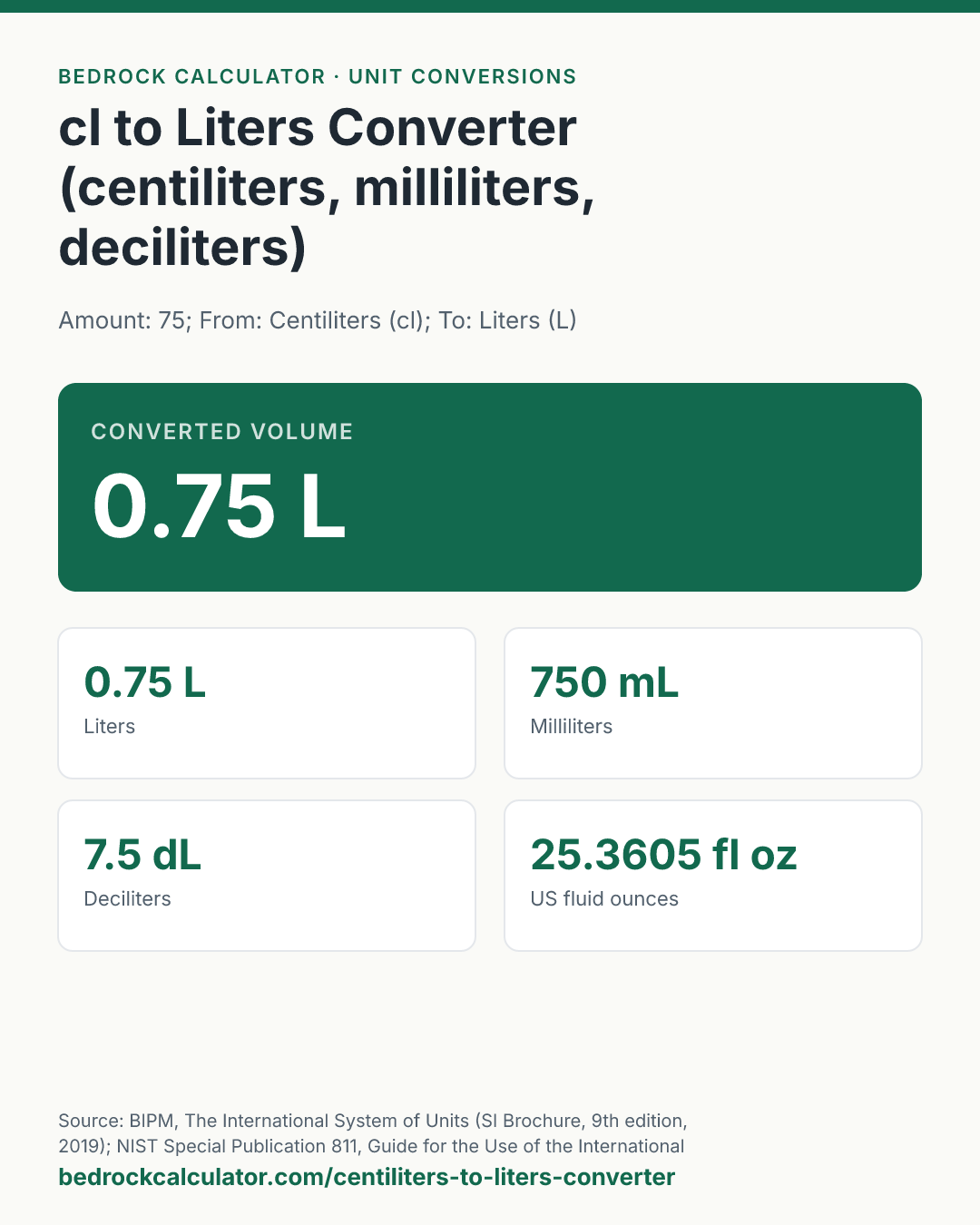
Quick Answer: 75 cl is 0.75 L, because there are 100 centiliters in a liter. A 33 cl can is 330 mL, and 1.5 L is 150 cl.
What does this calculator do?
This cl to liters converter moves between centiliters, milliliters, deciliters and liters, with US fluid ounces and US gallons alongside for anyone reading a European label in American units. Pick the unit you have and the unit you want, type the amount, and every unit appears at once on the cards.
Centiliters are common on drink labels in Europe: a standard wine bottle is marked 75 cl, a can 33 cl, a spirits bottle 70 cl. Deciliters show up in Scandinavian and Swiss recipes. All of them are the liter with an SI prefix: deci is a tenth, centi a hundredth, milli a thousandth. So the conversions between them are exact powers of ten, and the converter never rounds them for any amount with up to two decimal places, apart from very small milliliter figures turned into liters.
The symbol for the centiliter is cl or cL; both mean the same unit. The liter is written L or l, and the converter uses L. A liter is defined as exactly one cubic decimeter, which is also why one milliliter is one cubic centimeter.
Using the cl to Liters Converter
- Type the amount.
- Choose the unit you have under From: centiliters, milliliters, deciliters, liters, US fluid ounces or US gallons.
- Choose the unit you want under To. The default is centiliters to liters.
- Read the headline, then the cards for liters, deciliters, centiliters, milliliters, US fluid ounces and US gallons.
The presets load a 33 cl can in milliliters, a 1.5 L bottle in centiliters and a 70 cl bottle in US fluid ounces. Below the converter, one table runs from 1 cl to 200 cl and another from 0.1 L to 10 L. Both download as CSV.
How is this calculated?
- Read the units. From and To pick two of the six units. A negative amount is read as zero.
- Convert through the cubic meter. Each unit is stored as its exact size in cubic meters. The liter is a thousandth of a cubic meter; the deciliter, centiliter and milliliter are a tenth, a hundredth and a thousandth of a liter. The US gallon is 231 cubic inches at 2.54 cm to the inch, 3.785411784 L, and the US fluid ounce is a 128th of it. The converter multiplies by the size of the From unit and divides by the size of the To unit.
liters = centiliters/100; centiliters = liters × 100
1 L = 10 dL = 100 cl = 1,000 mL
- Fill in every unit. The same conversion runs for all six units shown on the cards.
- Round for display only. The arithmetic runs at 34 significant digits. Metric units and fluid ounces are shown to four decimal places and gallons to six, rounded half up with trailing zeros dropped.
Worked Example
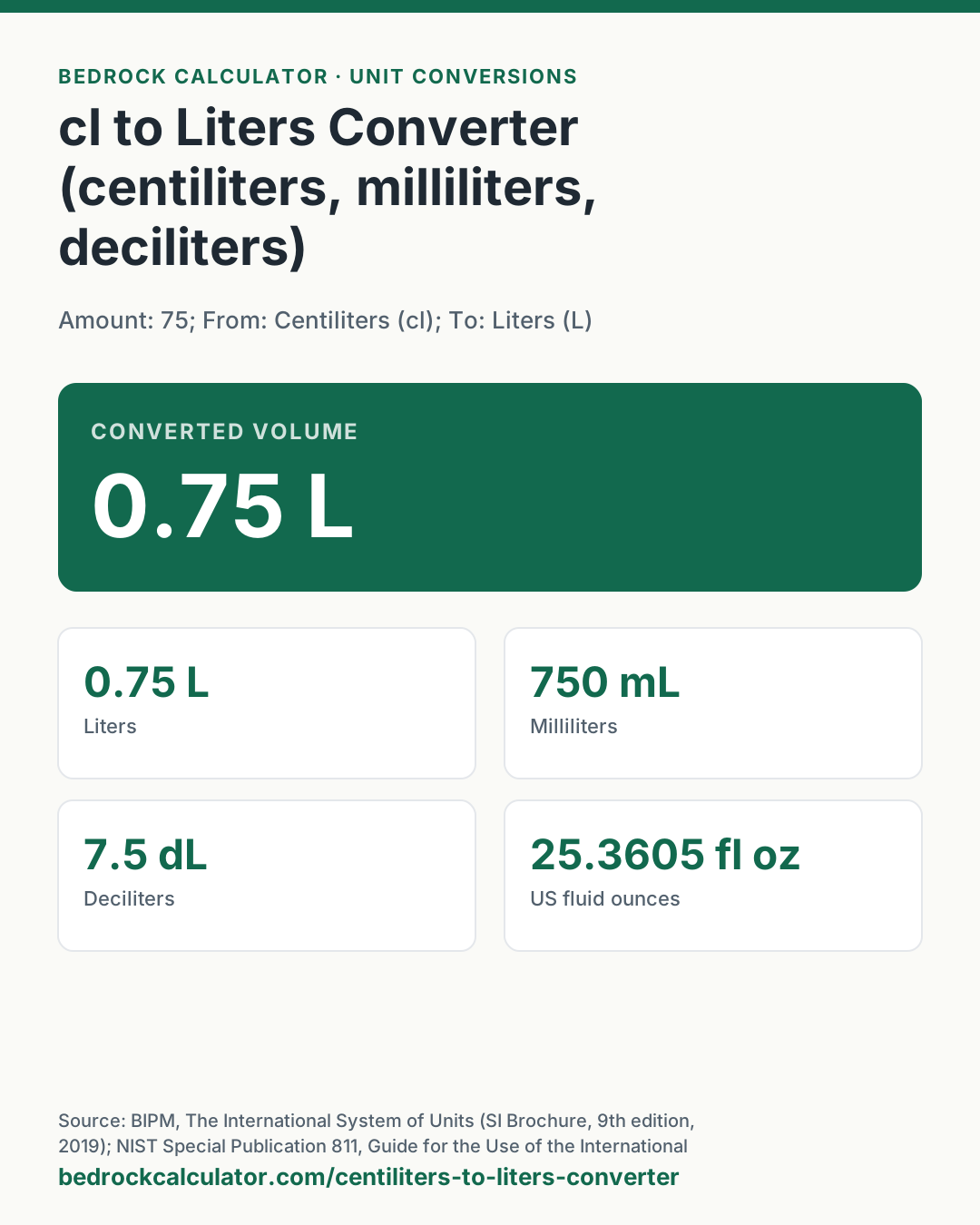
The default, 75 cl to liters:
- Liters: 75 ÷ 100 = 0.75 L.
- The cards: 7.5 dL, 750 mL, 25.3605 US fluid ounces and 0.198129 US gallons.
A 33 cl can: 33 × 10 = 330 mL, which is 11.1586 US fluid ounces.
A 1.5 L bottle: 1.5 × 100 = 150 cl, or 50.721 US fluid ounces.
A 70 cl bottle: 0.7 L, or 23.6698 US fluid ounces.
Centiliters and Liters at a Glance
| Centiliters | Liters | Milliliters | US fluid ounces |
|---|---|---|---|
| 5 | 0.05 | 50 | 1.6907 |
| 10 | 0.1 | 100 | 3.3814 |
| 25 | 0.25 | 250 | 8.4535 |
| 33 | 0.33 | 330 | 11.1586 |
| 50 | 0.5 | 500 | 16.907 |
| 70 | 0.7 | 700 | 23.6698 |
| 75 | 0.75 | 750 | 25.3605 |
| 100 | 1 | 1,000 | 33.814 |
These come from the converter's reference table, which also lists 1, 2, 4, 20, 35, 37.5, 150 and 200 cl.
How Many cl Are in a Liter?
There are exactly 100 centiliters in a liter, 10 in a deciliter and 1 cl is 10 mL. To go from centiliters to liters, divide by 100, or move the decimal point two places left: 75 cl becomes 0.75 L. To go from liters to centiliters, multiply by 100: 0.33 L becomes 33 cl.
Reading Labels and Recipes
European drink labels give centiliters, and American readers usually want fluid ounces. A 50 cl bottle is 16.907 US fluid ounces, a 70 cl bottle 23.6698 and a 75 cl bottle 25.3605. A full liter is 33.814 US fluid ounces, a little over a US quart. The US fluid ounce card does that step for any label.
Recipes from Sweden, Norway, Finland and Switzerland often measure liquids and even flour in deciliters, with a measuring jug marked in dL. One deciliter is 100 mL, so 2 dL of milk is 200 mL and 1.5 L of stock is 15 dL. If you only have American cups, convert to milliliters here and then use the ml to cups converter, which uses the US cup of 236.5882365 mL.
Milliliters, Centiliters and Grams
People converting milliliters often want grams next, but grams are a weight and milliliters a volume. The conversion between them depends on what is being measured. For water at room temperature a milliliter weighs very nearly a gram; for oil it weighs less and for honey more. The ml to grams converter on this site handles that with a stated density for water and for common ingredients.
What does this calculator not account for?
- Weight. Liters and centiliters are volumes. Use a density to turn them into grams or kilograms.
- Imperial units. The fluid ounce and gallon here are US customary. British fluid ounces and gallons are different sizes.
- Fill tolerance. A 75 cl bottle is filled within a tolerance, not to an exact 750 mL. The conversion is exact; the bottle is not.
- Very small amounts. A milliliter figure with two decimal places can need five decimal places in liters, and the display shows four.
What mistakes do people make with this?
- Moving the decimal the wrong way. Liters are the bigger unit, so the liter figure is always the smaller number.
- Reading cl as dl. A deciliter is ten times a centiliter. A recipe asking for 2 dL of milk wants 200 mL, not 20.
- Treating 75 cl as 75 fl oz. It is 25.3605 US fluid ounces.
Frequently Asked Questions
How many liters is 75 cl?
How many cl are in a liter?
How many ml is 33 cl?
How many cl is 1.5 liters?
How many ml are in a deciliter?
How many US fluid ounces is 70 cl?
How many cl are in a US gallon?
Sources
- BIPM, The International System of Units (SI Brochure, 9th edition, 2019): the litre and the SI prefixes deci, centi and milli. bipm.org/en/publications/si-brochure
- NIST Special Publication 811, Guide for the Use of the International System of Units (2008): the liter, its symbols L and l, and conversion factors. nist.gov/pml/special-publication-811
- NIST Handbook 44, Appendix C, General Tables of Units of Measurement: the US gallon and fluid ounce. nist.gov/pml/owm/nist-handbook-44-current-edition