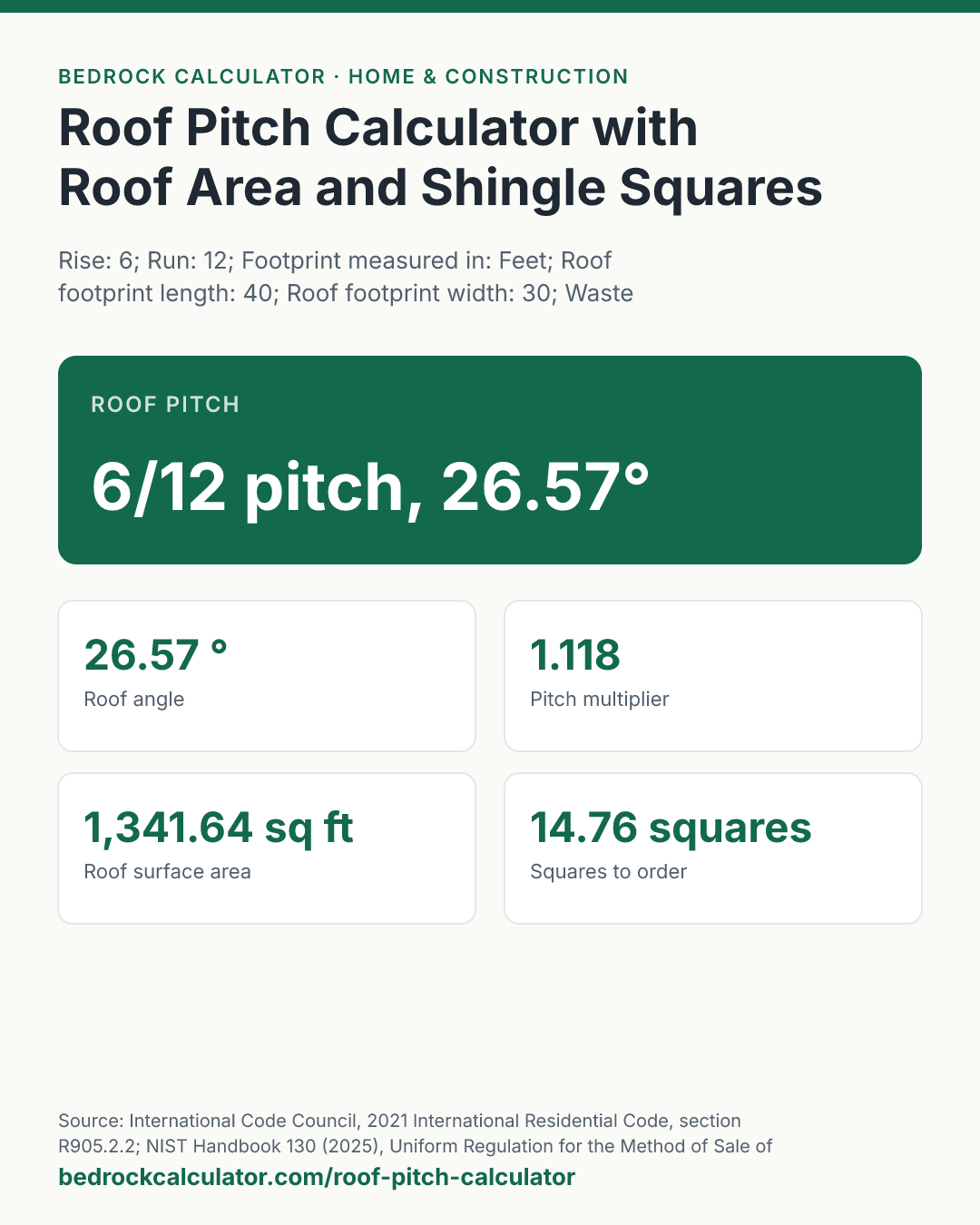
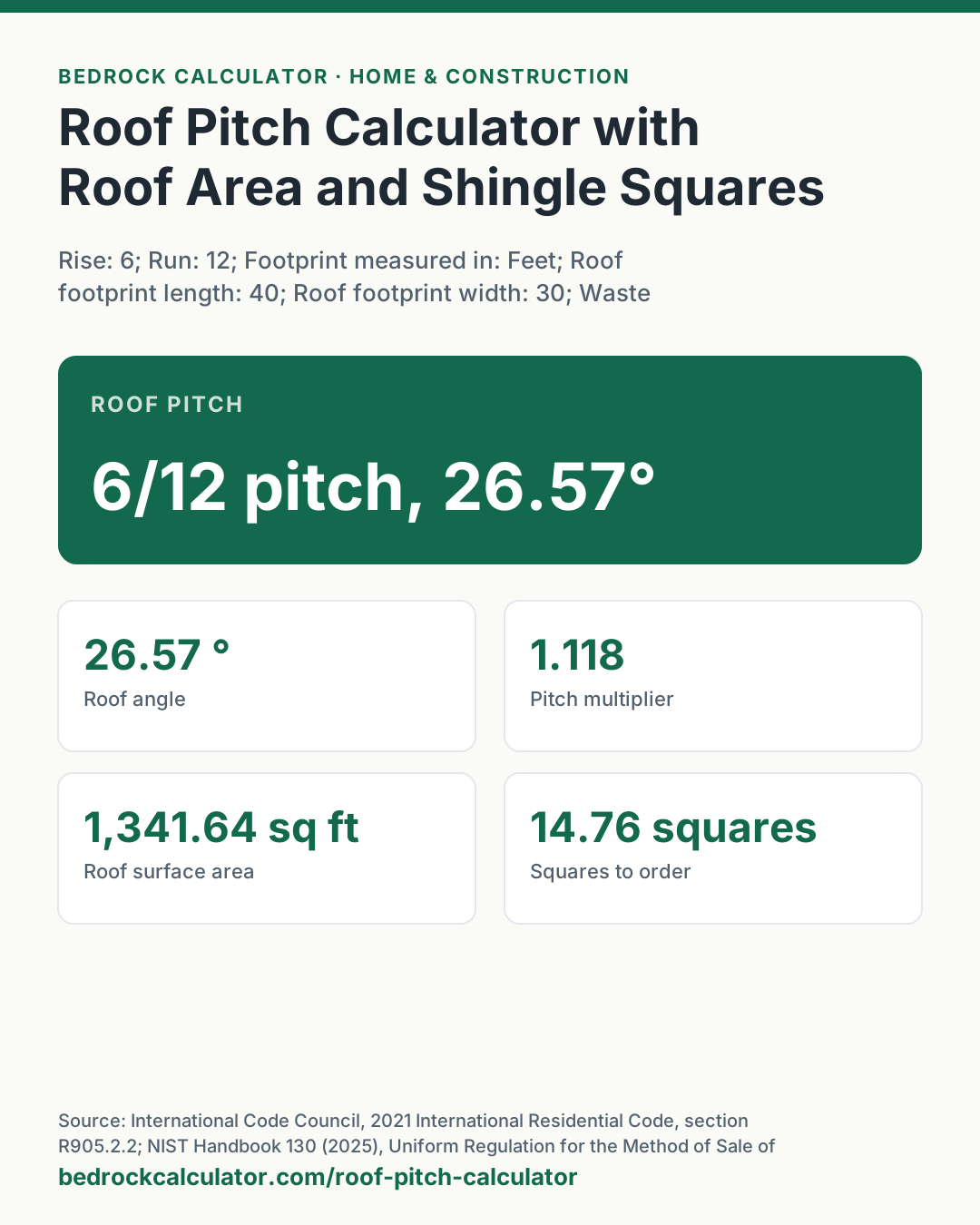
Quick Answer: A roof that rises 6 inches for every 12 inches of run has a 6/12 pitch, 26.57°. On a 40 by 30 foot footprint that is 1,341.64 square feet of roof, or 14.76 squares of shingles with a 10% waste allowance.
What does this calculator do?
This roof pitch calculator converts a rise and a run into the pitch roofers talk about (so many inches per foot, written 6/12), the angle in degrees, and the slope as a percentage.
It also does the job most people need the pitch for: turning the footprint of a roof into its true surface area, and that area into roofing squares and bundles of shingles.
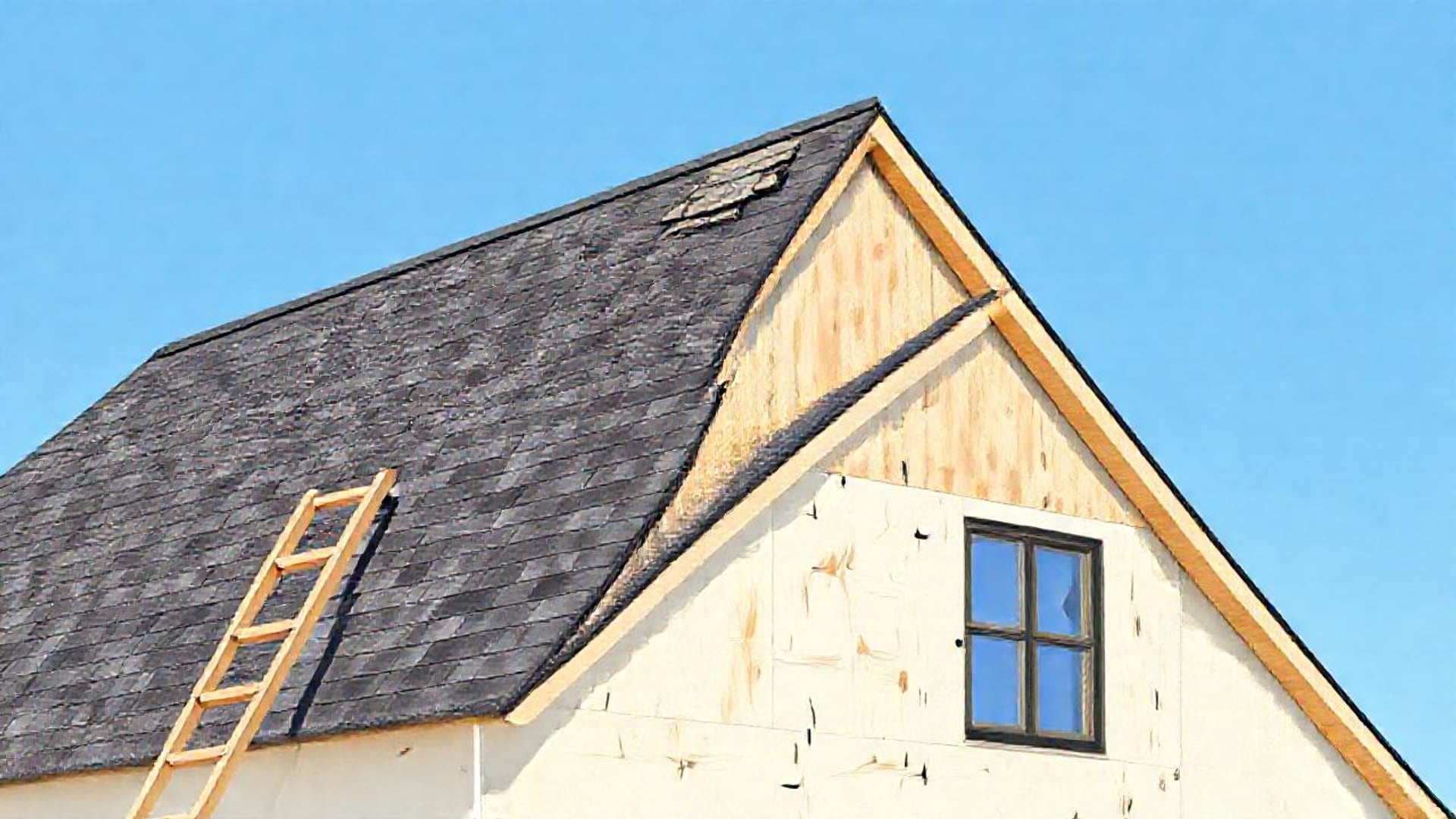
A pitched roof always has more surface than the ground it covers, because each plane is tilted. The steeper the pitch, the bigger the difference. The calculator handles that with the pitch multiplier, the sloped length of roof per foot of level run, so you can measure the roof from the ground or from a plan instead of climbing onto it.
The waste allowance for cutting at hips, valleys and edges is a separate line, so you can see the measured squares and the extra side by side.
Using the Roof Pitch Calculator
- Enter the rise and the run in the same unit. Roofers measure the rise over a 12 inch run, so a level held out 12 inches with 6 inches of drop to the roof is a 6/12 pitch. You can also enter any rise and run you measured, such as 30 inches over 72.
- To estimate shingles, enter the length and width of the roof's footprint seen from above, including the overhang at the eaves and gable ends.
- Set the waste allowance and the number of bundles per square printed on the shingle wrapper.
- Optionally enter a price per square from a quote.
- Read the pitch and angle at the top, the roof area and squares below.
The presets load a 4/12 roof, a 12/12 roof and an on-site measurement of 30 inches over 72 inches, all on the same footprint, so you can compare how the area grows with the pitch.
How is this calculated?
- Express the pitch per 12. Rise divided by run, times 12, gives the rise per foot of run. A 30 inch rise over a 72 inch run is 5/12.
- Find the angle. The roof angle is the arctangent of rise over run, converted from radians to degrees.
θ = arctan(rise/run)
- Find the slope percentage. Rise over run, times 100. A 6/12 roof is a 50% slope.
- Find the pitch multiplier. By Pythagoras, a level run of 1 has a sloped length of the square root of 1 plus the slope squared. This is the factor between a horizontal measurement and the length along the roof.
m = √(1 + (rise/run)²)
- Turn the footprint into roof area. The footprint (length times width, converted to square feet if you measured in metres) is multiplied by the pitch multiplier. Every plane of a gable or hip roof is tilted at the same angle, so each plane's area is its footprint times the same multiplier, and the total follows.
- Convert to squares, add waste, count bundles. A roofing square is 100 square feet. The waste allowance is the roof area times your percentage, shown on its own. Squares to order are the roof area plus waste, divided by 100. Bundles are squares to order times bundles per square, rounded up.
- Price it if asked. Squares to order times your price per square.
Worked Example
The default is a 6/12 pitch on a 40 by 30 foot footprint:
- Pitch: 6 ÷ 12 × 12 = 6/12. Angle: arctan(0.5) = 26.57°. Slope: 50%.
- Multiplier: √(1 + 0.25) = 1.118 (to four places, 1.1180).
- Footprint: 40 × 30 = 1,200 sq ft. Roof area: 1,200 × 1.118 = 1,341.64 sq ft.
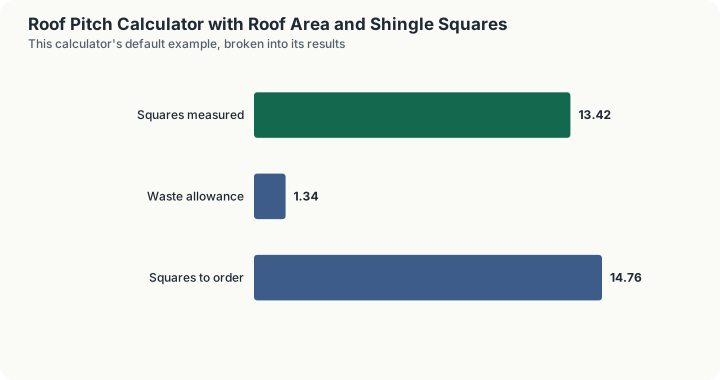
- Squares: 13.42 measured, plus 1.34 for waste, makes 14.76 squares.
- At 3 bundles per square: 14.76 × 3, rounded up to whole bundles, is 45 bundles.
The same footprint at 4/12 has 1,264.91 square feet of roof (13.91 squares to order), and at 12/12 it has 1,697.06 square feet (18.67 squares). A rise of 30 inches over 72 inches works out to a 5/12 pitch at 22.62°, with exactly 1,300 square feet of roof.
How Do You Calculate Roof Pitch?
Measure how far the roof rises over a known horizontal distance and scale it to 12. With a level and a tape, hold the level flat against the underside of a rafter or on the roof surface, mark 12 inches along it, and measure straight down (or up) to the roof: that measurement is the rise per 12.
If you only have a longer measurement, such as a rise of 30 inches over 72 inches of run, enter both and the calculator scales it. The pitch chart below the calculator lists every common pitch from 1/12 to 24/12 with its angle and multiplier.
How Many Squares of Shingles Do I Need?
Find the roof area and divide by 100, then add your waste allowance. NIST Handbook 130 defines a square of roofing as the quantity that covers 100 square feet when applied as the maker directs.
Most asphalt shingles are packaged so that three bundles make a square, but heavier products may take four or more, so read the coverage on the wrapper and enter bundles per square to match. Hips and ridges need cap shingles, and the first course needs starter strip; the waste allowance is where those go unless you order them separately.
What does this calculator not account for?
- Roofs with more than one pitch. The multiplier assumes every plane has the same slope. A roof with a steep main section and a shallow porch needs each part run separately.
- Dormers, valleys and complex shapes. A dormer adds roof that a rectangular footprint does not show. Measure dormers on their own and add them.
- Non-rectangular footprints. Split an L-shaped house into rectangles, or get the footprint area from the square footage calculator and enter it as a length with a width of 1.
- Underlayment, flashing and fasteners. Only shingle squares and bundles are counted.
- Safety and code rules beyond slope. The calculator says nothing about whether a roof is safe to walk on or what fall protection a job needs; that is for the roofer and local rules.
What mistakes do people make with this?
- Measuring rise and run in different units. A rise of 6 inches over a run of 1 foot is 6/12, not 6/1. Use the same unit for both.
- Using the house footprint without overhangs. Eaves and rakes are roofed too. Measure to the drip edge.
- Confusing pitch with angle. A 12/12 pitch is 45°, but a 6/12 pitch is not 22.5°; the relationship is an arctangent, not a straight line.
- Ordering squares without waste. Every cut at a hip or valley loses material, and the starter and ridge courses use extra.
- Assuming three bundles to a square. Check the wrapper.
Frequently Asked Questions
What is a 6/12 roof pitch in degrees?
What is the minimum pitch for asphalt shingles?
What is a roof pitch multiplier?
How do I convert a roof angle to a pitch?
What is a 12/12 pitch?
Does a steeper roof need more shingles?
Sources
- International Code Council, 2021 International Residential Code, section R905.2.2: minimum slope for asphalt shingles and double underlayment from 2/12 to 4/12. codes.iccsafe.org/content/IRC2021P2/chapter-9-roof-assemblies
- NIST Handbook 130 (2025), Uniform Regulation for the Method of Sale of Commodities, section 2.7: roofing sold by the square of 100 square feet. doi.org/10.6028/NIST.HB.130-2025
- NIST Special Publication 811, Guide for the Use of the International System of Units: the degree and the conversion of square feet to square metres. nist.gov/pml/special-publication-811