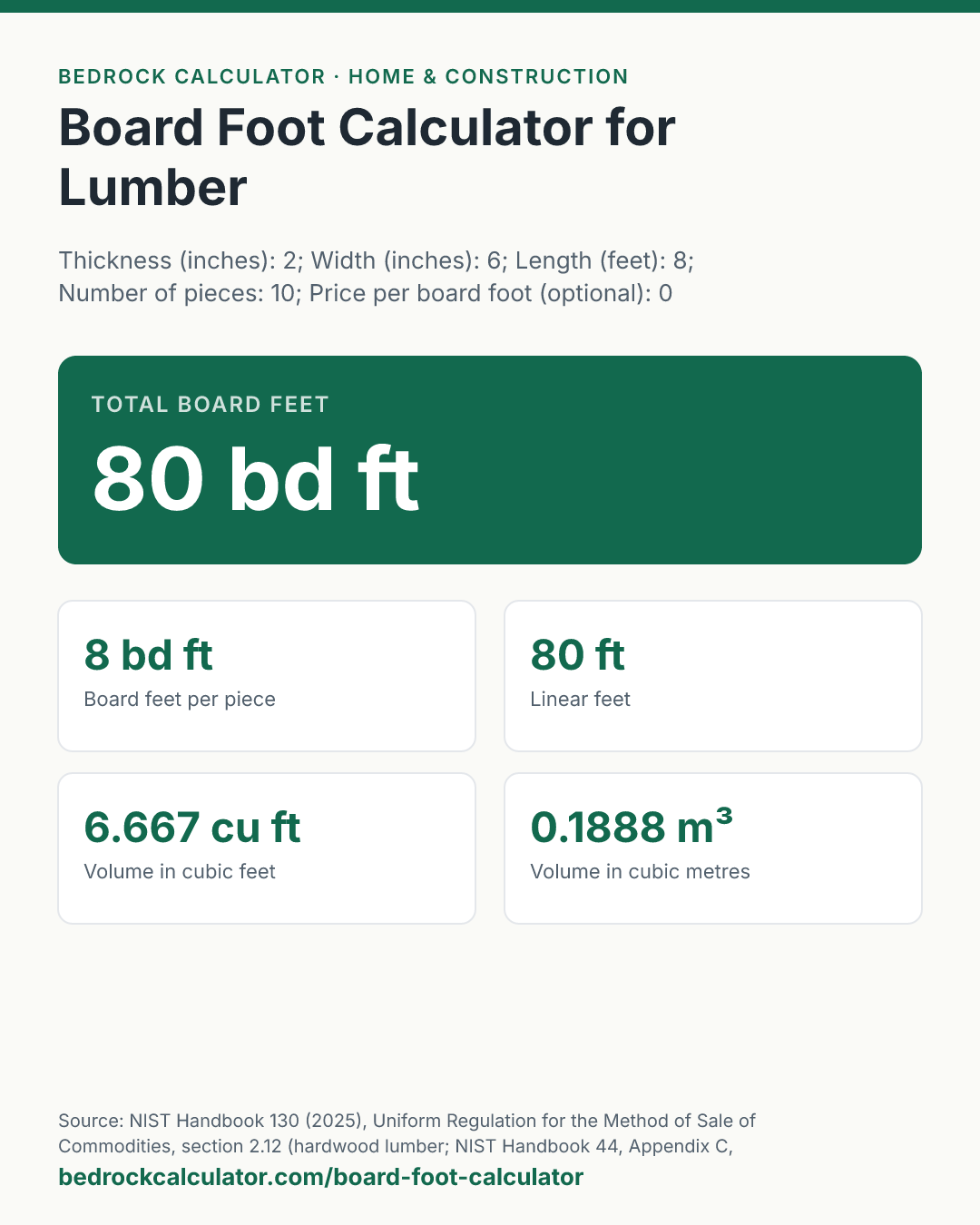
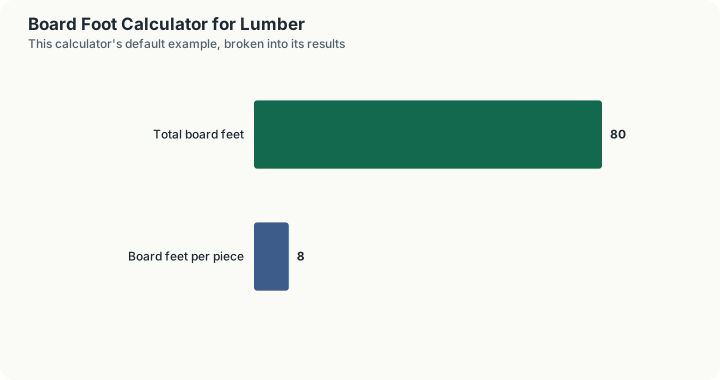
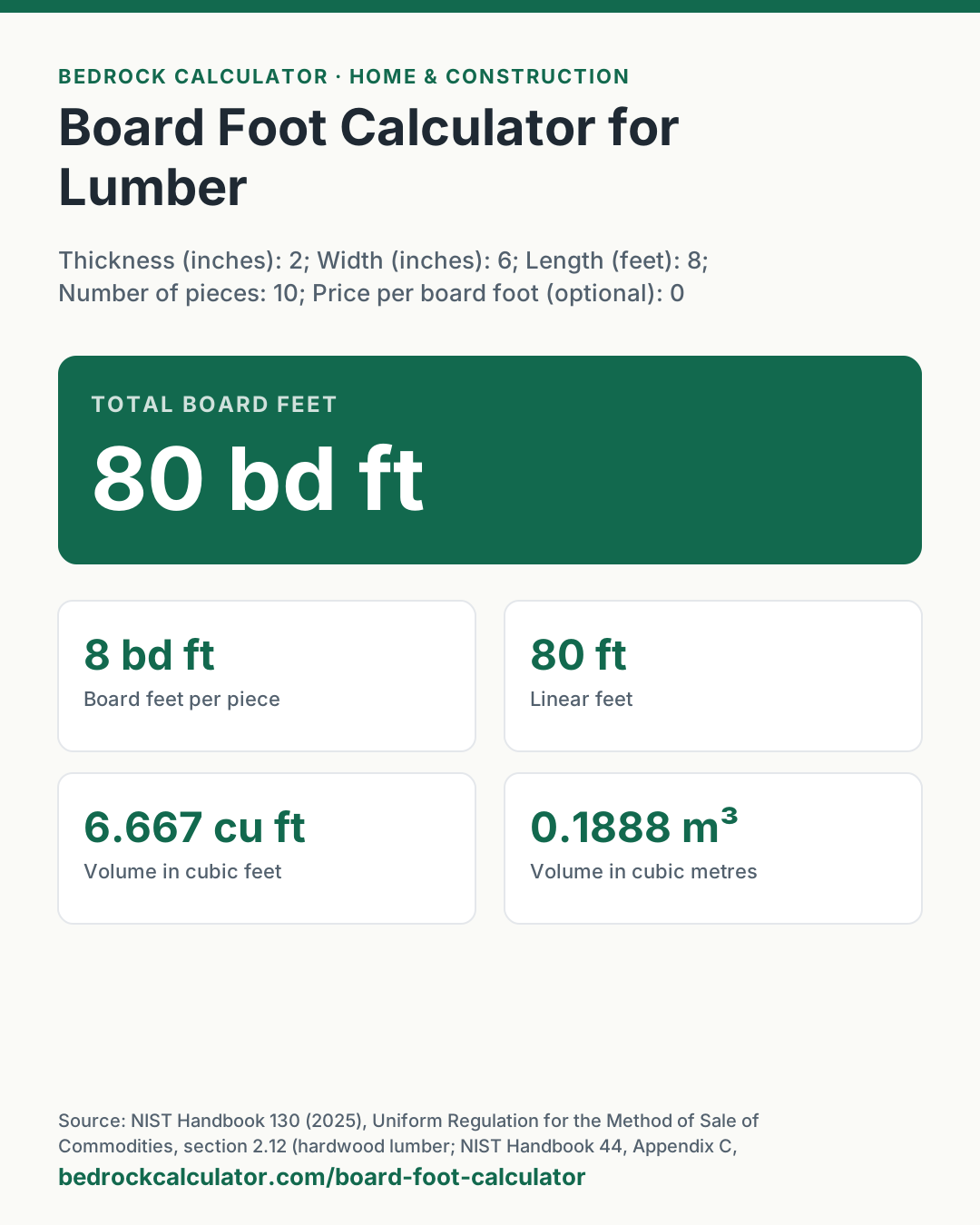
Quick Answer: Ten boards 2 inches thick, 6 inches wide and 8 feet long come to 80 bd ft, 8 board feet each. For any board, multiply thickness in inches by width in inches by length in feet and divide by 12.
What does this calculator do?
This board foot calculator works out how much lumber you are buying in the unit hardwood is priced by. A board foot is a volume: the wood in a board 1 foot long, 1 foot wide and 1 inch thick, which is 144 cubic inches.
NIST Handbook 130, the model regulation most US states adopt for how goods are sold, defines it exactly that way for hardwood lumber.
Enter the thickness and width in inches, the length in feet and the number of pieces. The calculator gives the board feet per piece and in total, the linear feet, the same volume in cubic feet and cubic metres, and a cost if you enter the yard's price per board foot.
The page also answers the question that trips most people up at the lumberyard: whether to use the nominal size of a board or its actual size. The arithmetic is the same either way, but the two give different answers, so the presets show both for a 2x4.
Using the Board Foot Calculator
- Enter the thickness in inches. Hardwood is sold in quarters: 4/4 (say "four quarter") is 1 inch, 5/4 is 1.25, 6/4 is 1.5 and 8/4 is 2.
- Enter the width in inches and the length in feet. For random-width hardwood, measure each board or use the average width of the stack.
- Enter the number of pieces of that size.
- Optionally enter the price per board foot from your supplier.
- Read the total board feet at the top, and the per-piece figure, linear feet, volume and cost below.
The presets load one board foot, five 4/4 boards 8 inches wide and 10 feet long, and an 8 foot 2x4 measured two ways.
How is this calculated?
- Find the volume of one piece in cubic inches. Thickness times width times length, with the length converted from feet to inches by multiplying by 12.
- Divide by 144. A board foot is 144 cubic inches, so the cubic inches divided by 144 is the board feet. The 12 in the length and the 144 cancel to the familiar shortcut:
board feet per piece = (T_in × W_in × L_ft)/12
- Multiply by the number of pieces. The per-piece figure times the count is the total.
- Convert the same volume. Cubic feet are the cubic inches divided by 1,728, so 12 board feet make one cubic foot. Cubic metres use the exact inch of 2.54 centimetres. Linear feet are the length times the number of pieces.
- Price it. The total board feet times your price per board foot. With no price entered the cost is zero; the calculator has no prices of its own.
- Round for display. Board feet and cubic feet show three decimal places, cubic metres four.
Worked Example
The default is ten pieces 2 inches by 6 inches by 8 feet:
- One piece: 2 × 6 × 8 ÷ 12 = 8 board feet.
- Ten pieces: 8 × 10 = 80 board feet.
- Linear feet: 8 × 10 = 80 feet.
- Volume: 80 ÷ 12 = 6.667 cubic feet, or 0.1888 cubic metres.
Five boards of 4/4 hardwood, 8 inches wide and 10 feet long: each is 1 × 8 × 10 ÷ 12 = 6.667 board feet, and the five come to 33.333 board feet over 50 linear feet.
An 8 foot 2x4. Measured by its nominal size, 2 × 4 × 8 ÷ 12 = 5.333 board feet. Measured at its actual dry size of 1½ by 3½ inches, 1.5 × 3.5 × 8 ÷ 12 = 3.5 board feet. The same stick of wood gives two different answers, which is why it matters which size your seller uses.
What Is a Board Foot?
A board foot is a unit of lumber volume equal to 144 cubic inches. Picture a board 12 inches wide, 12 inches long and 1 inch thick. A board 6 inches wide, 24 inches long and 1 inch thick is also one board foot, and so is one 2 inches thick, 6 inches wide and 12 inches long.
It is written bd ft, BF or FBM (foot, board measure). Twelve board feet fill one cubic foot.
How Do You Measure Board Feet?
Measure the thickness and width in inches and the length in feet, multiply the three and divide by 12. For rough hardwood, measure the thickness before planing, because that is what you pay for: a 4/4 board planed to 13/16 of an inch is still sold as 4/4.
The NIST rule for random-width hardwood bases the sale on the net board footage after kiln drying, with nothing added for shrinkage. For a stack of mixed widths, add the widths of all the boards of one length and thickness and enter that sum as the width with one piece.
Nominal or Actual Size?
Softwood dimension lumber is named by a nominal size that is larger than the board. Under the American Softwood Lumber Standard, which NIST Handbook 130 quotes, a dry 2x4 is dressed to 1½ by 3½ inches. Sellers who quote nominal sizes must also show the actual ones. Most retail softwood is sold by the piece or the linear foot anyway.
Hardwood is different: it is sold by the board foot on its rough thickness in quarters and its measured width. Before comparing prices, ask which dimensions the seller's board footage is based on, and enter those.
What does this calculator not account for?
- Waste and defects. The board feet are of the boards you enter. Knots, checks, end splits and the kerf of every cut reduce what you can use. Add an allowance by entering extra pieces.
- Surface measure. NIST Handbook 130 also describes surface measure for hardwood, a rounded square foot figure; this calculator works the exact board feet instead.
- Standard lengths and rounding. Lumber yards round fractional lengths down to a standard length (a 6 ft 8 in board is tallied as 6 ft under the NIST rule). The calculator uses the length you type.
- Moisture. Green lumber shrinks as it dries. The board feet are of the size you enter at the time you measure.
- Sheet goods. Plywood and other panels are sold by the sheet, not by the board foot.
What mistakes do people make with this?
- Entering the length in inches. The length box is in feet. An 8 foot board is 8, not 96.
- Mixing nominal and actual sizes. Using the actual size when the seller uses nominal makes the lumber look cheaper per board foot than it is.
- Forgetting the quarters. 8/4 is 2 inches, not 8.
- Treating linear feet as board feet. They match only for a board 1 inch thick and 12 inches wide. A 2x6 has 1 board foot per linear foot; a 1x4 has a third of one.
- Dividing by 144 with the length in feet. Use ÷ 12 when length is in feet and ÷ 144 when all three dimensions are in inches.
Frequently Asked Questions
How many board feet are in a 2x4x8?
How many board feet are in a cubic foot?
Is a board foot the same as a square foot?
How do I calculate the cost of lumber by the board foot?
What does 4/4 mean in lumber?
How do I work out board feet for a log?
Sources
- NIST Handbook 130 (2025), Uniform Regulation for the Method of Sale of Commodities, section 2.12 (hardwood lumber: the board foot, surface measure, standard lengths) and section 2.10 (softwood lumber and minimum dressed sizes). doi.org/10.6028/NIST.HB.130-2025
- NIST Handbook 44, Appendix C, General Tables of Units of Measurement: the inch, foot and cubic foot. nist.gov/pml/owm/nist-handbook-44-current-edition