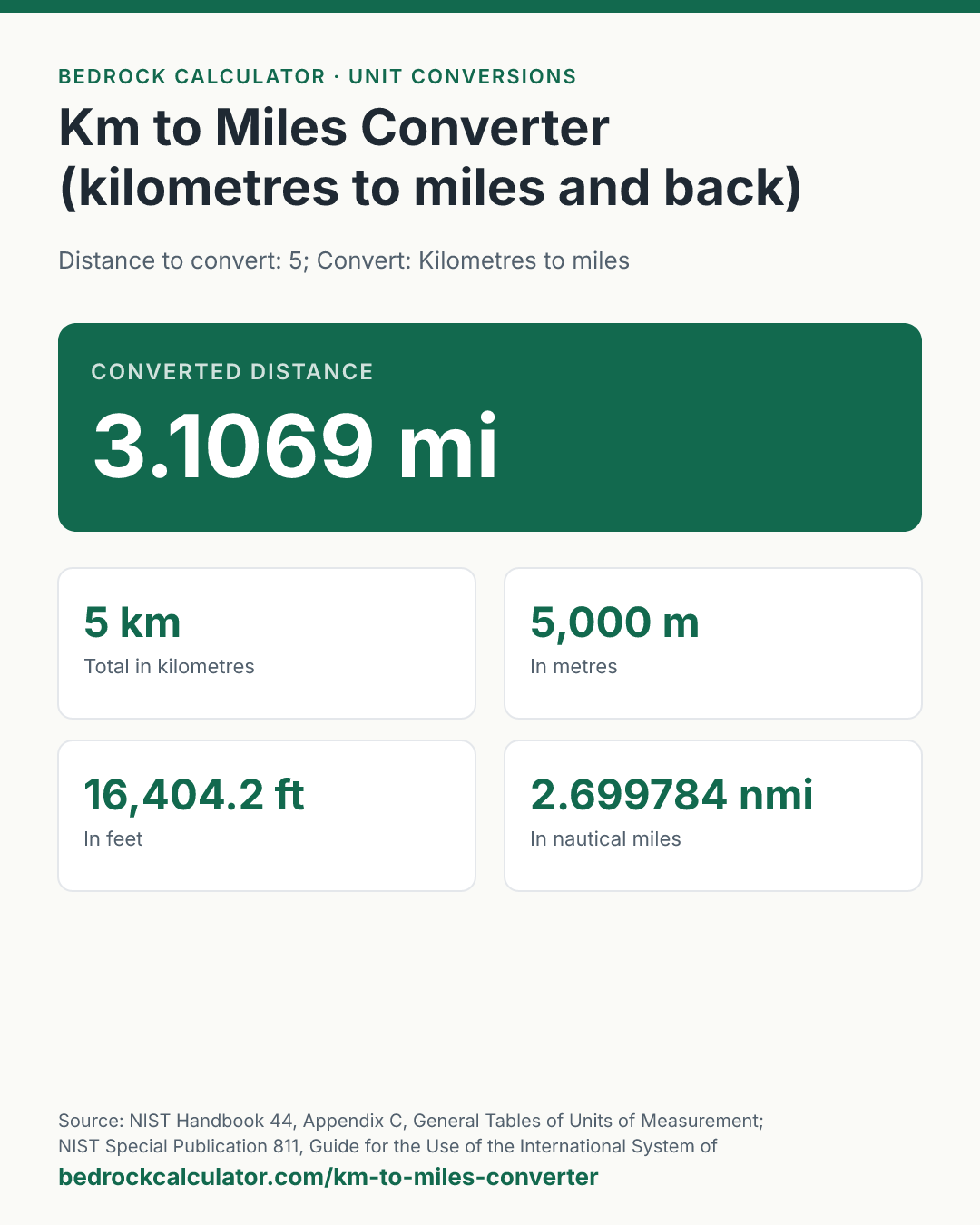

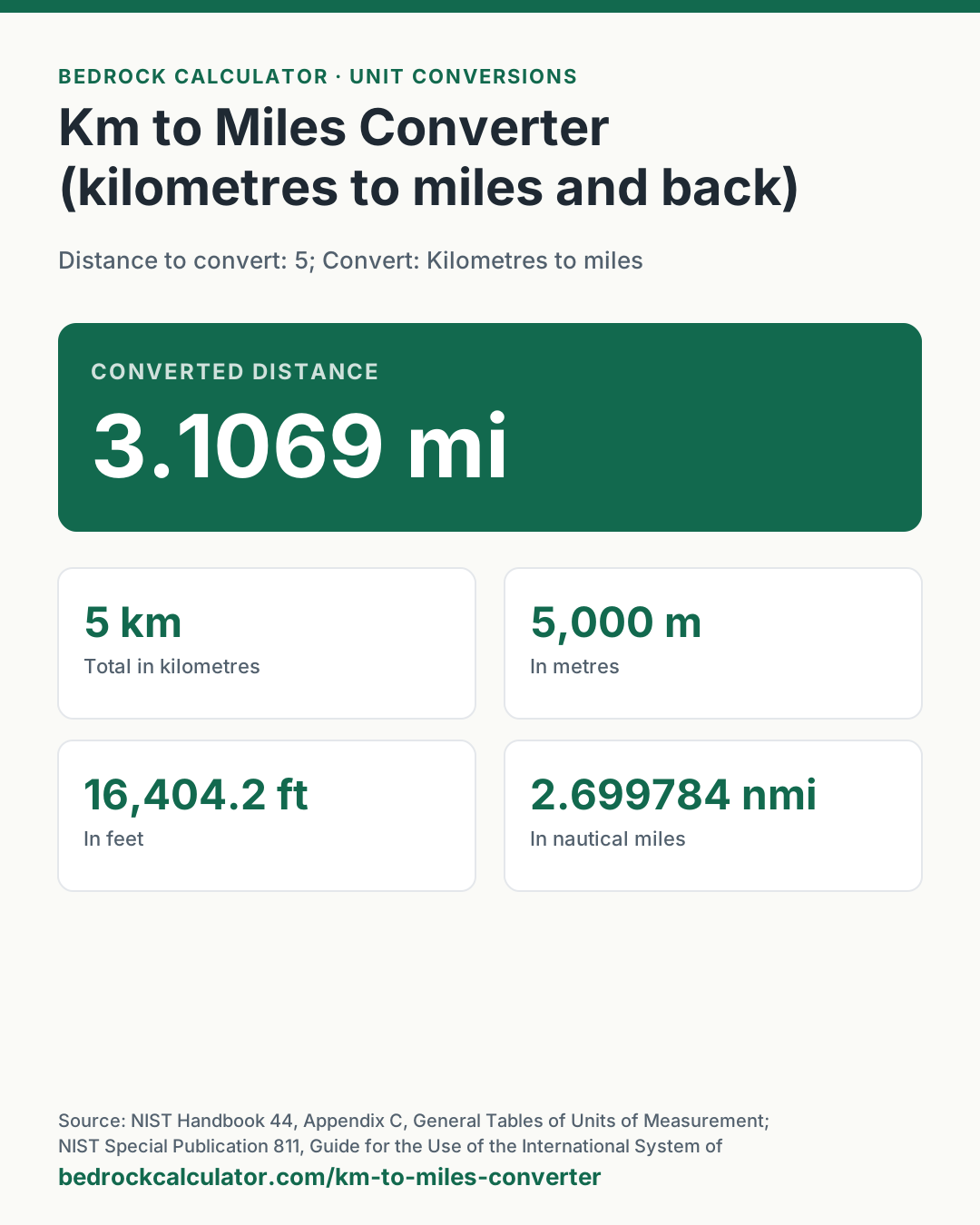
Quick Answer: 5 km is 3.1069 mi, 10 km is 6.2137 miles and a 42.195 km marathon is 26.2188 miles. To go from km to miles, divide by 1.609344; to go from miles to km, multiply by 1.609344.
What does this calculator do?
This km to miles converter works both ways. Enter a distance, choose kilometres to miles or miles to kilometres, and it gives the converted distance along with the same distance in metres, feet and nautical miles.
The factor it uses is exact. The international mile is 5,280 feet, and since 1959 the foot has been exactly 0.3048 metres, so a mile is exactly 1,609.344 metres, or 1.609344 kilometres. Going the other way, a kilometre is 1 divided by 1.609344 miles, which is a never-ending decimal that starts 0.621371. The converter divides by the exact figure rather than multiplying by a rounded one, so a long distance does not drift.
The default is 5 km because that is the distance people ask about most: the parkrun and charity 5K. The preset buttons add a 10K, a marathon, 100 miles and a 20,000 km odometer reading.
Using the Km to Miles Converter
- Type the distance. Decimals are fine, so 42.195 or 13.1 both work.
- Choose Kilometres to miles if your number is in kilometres, or Miles to kilometres if it is in miles.
- Read the converted distance at the top. The cards below repeat it in miles and kilometres to six decimal places, and give metres, feet and nautical miles.
Below the converter are two tables, one for each direction, covering race distances, speed-limit sized numbers and odometer readings. Each can be downloaded as a CSV file.
How is this calculated?
- Choose the starting unit. The direction tells the converter whether your number is in kilometres or miles. A negative number is read as zero.
- Convert through the metre. The kilometre is stored as 1,000 m and the mile as 5,280 × 0.3048 = 1,609.344 m, both exact. The converter multiplies your number by the size of the starting unit and divides by the size of the target unit.
miles = (km × 1000)/1609.344 = km/1.609344
km = miles × 1.609344
- Add the other units. The same distance is converted to metres, to feet (0.3048 m each) and to nautical miles (exactly 1,852 m each) through the same exact sizes.
- Round for display only. The arithmetic runs at 34 significant digits. The headline is rounded half up to four decimal places; the miles and kilometres cards to six, metres to three and feet to two, with trailing zeros dropped. Kilometres worked out from miles with up to three decimal places need no rounding at all.
Worked Example
The default, 5 km to miles:
- Miles: 5 ÷ 1.609344 = 3.10685596..., shown as 3.1069 mi in the headline and 3.106856 mi on the card.
- Metres: 5,000 m. Feet: 16,404.2 ft.
- Nautical miles: 2.699784 nmi.
A 10K: 10 ÷ 1.609344 = 6.2137 mi.
A marathon of 42.195 km: 42.195 ÷ 1.609344 = 26.2188 mi. That is where the familiar "26.2 miles" comes from.
Going the other way, 100 miles: 100 × 1.609344 = 160.9344 km exactly, or 160,934.4 m.
And an odometer reading of 20,000 km is 12,427.4238 mi.
Common Distances in Kilometres and Miles
| Kilometres | Miles | Where you meet it |
|---|---|---|
| 1 | 0.6214 | One kilometre |
| 5 | 3.1069 | 5K race |
| 10 | 6.2137 | 10K race |
| 21.0975 | 13.1094 | Half marathon |
| 42.195 | 26.2188 | Marathon |
| 100 | 62.1371 | Ultra distance |
| 1,000 | 621.3712 | Long road trip |
| 20,000 | 12,427.4238 | A year of driving |
| 50,000 | 31,068.5596 | Service interval |
| Miles | Kilometres |
|---|---|
| 1 | 1.6093 |
| 26.2 | 42.1648 |
| 55 | 88.5139 |
| 65 | 104.6074 |
| 70 | 112.6541 |
| 100 | 160.9344 |
How Do You Calculate Kilometres to Miles?
Divide the kilometres by 1.609344. If you are doing it in your head, multiplying by 0.6 gets you close and multiplying by 5 then dividing by 8 gets you closer, because 8 km is very nearly 5 miles (the table shows 8 km is 4.971 mi).
The kilometres to miles formula the converter uses is the exact division, so its answer does not depend on a shortcut.
To turn miles into kilometres, multiply by 1.609344. The 5 for 8 rule works backwards too: 5 miles is just over 8 km (8.0467 km in the table).
Kilometres to Metres
A kilometre is exactly 1,000 metres, so a kilometre to metre conversion is just a shift of the decimal point three places to the right: 5 km is 5,000 m and 42.195 km is 42,195 m. The Metres card shows this for every distance you enter.
What does this calculator not account for?
- Nautical miles as the input. The converter shows nautical miles as an output only. Boats and aircraft use the nautical mile of exactly 1,852 m, which is longer than the statute mile of 1,609.344 m.
- The old US survey mile. Land surveys in the United States once used a survey mile a few millimetres longer than the international mile. NIST retired the survey foot at the end of 2022, and this converter uses the international mile.
- Route length. A map distance and a measured road or race course are different things. Certified race courses are measured along the shortest legal path, and a GPS watch usually reads a little long.
- Speed. This page converts distances. For km/h and mph, use the speed converter, which handles knots too.
What mistakes do people make with this?
- Multiplying when you should divide. A mile is longer than a kilometre, so the mile figure is always the smaller one. If 10 km came out as 16 miles, the conversion went the wrong way.
- Using 0.6 for long distances. The shortcut always undercounts, and the error grows with the distance. 1,000 km is 621.3712 miles, and the shortcut lands well short of that.
- Writing 26.2 miles as exactly 42.2 km. 26.2 miles is 42.1648 km. The marathon is defined in kilometres, 42.195, and 26.2 miles is a rounded version of it.
- Confusing km with nautical miles. On a nautical chart, distances are in nautical miles, not kilometres or statute miles.
Frequently Asked Questions
How many miles is 5 km?
How many miles is 10 km?
How many kilometres are in a mile?
How many miles is 20,000 kilometres?
How many miles is 300,000 km?
Is a kilometre longer than a mile?
What is the kilometres to miles formula?
Sources
- NIST Handbook 44, Appendix C, General Tables of Units of Measurement: the mile as 5,280 feet and the international foot. nist.gov/pml/owm/nist-handbook-44-current-edition
- NIST Special Publication 811, Guide for the Use of the International System of Units (2008), Table 9 and Appendix B: the nautical mile of 1,852 m and conversion factors to SI. nist.gov/pml/special-publication-811
- National Bureau of Standards Miscellaneous Publication 233, Units of Weight and Measure (revised to the 1959 refinement of the yard and the pound announced in the Federal Register, 24 FR 5348). nvlpubs.nist.gov/nistpubs/Legacy/MP/nbsmiscellaneouspub233.pdf
- NIST, The US Survey Foot: retirement of the survey foot at the end of 2022. nist.gov/pml/us-surveyfoot