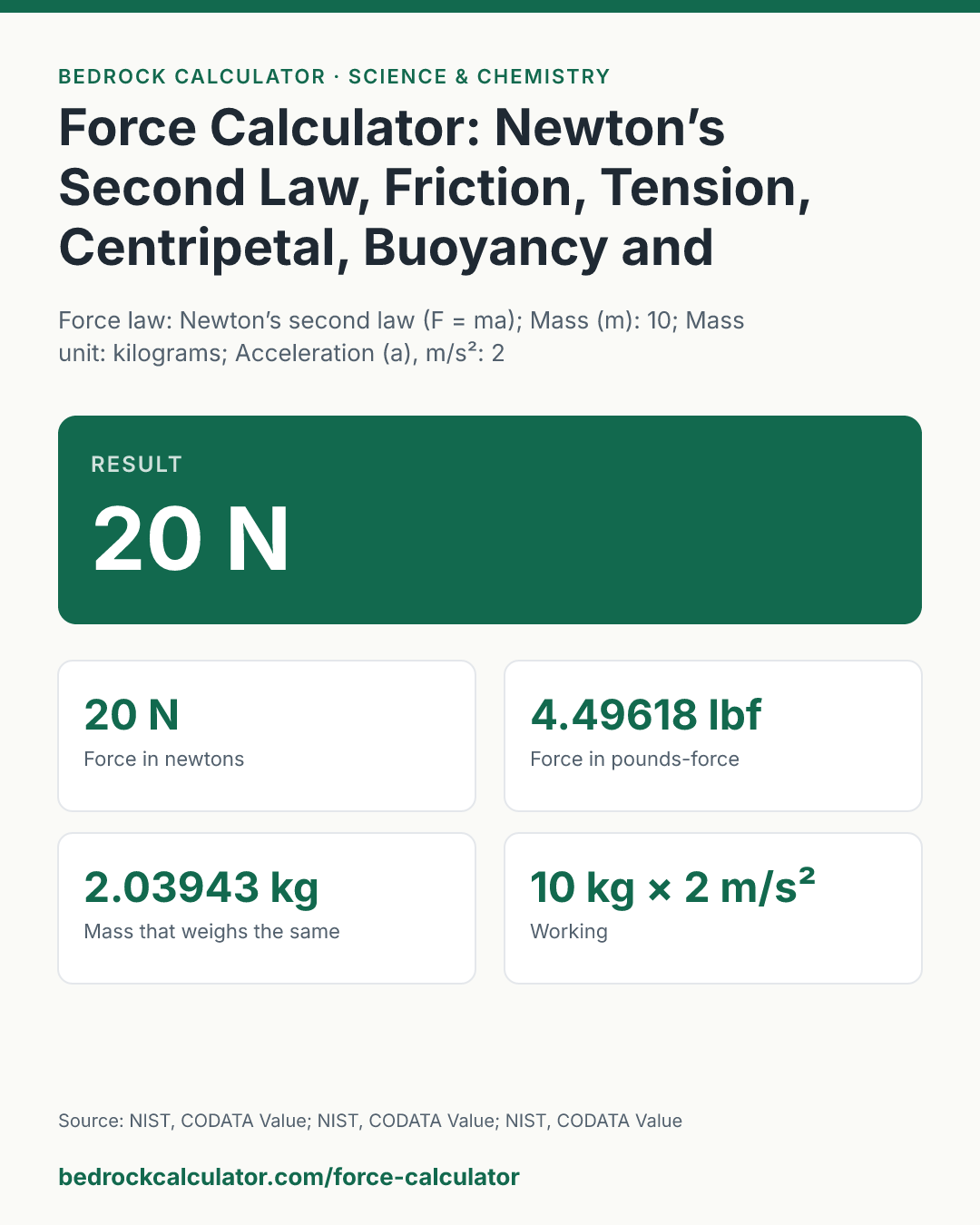

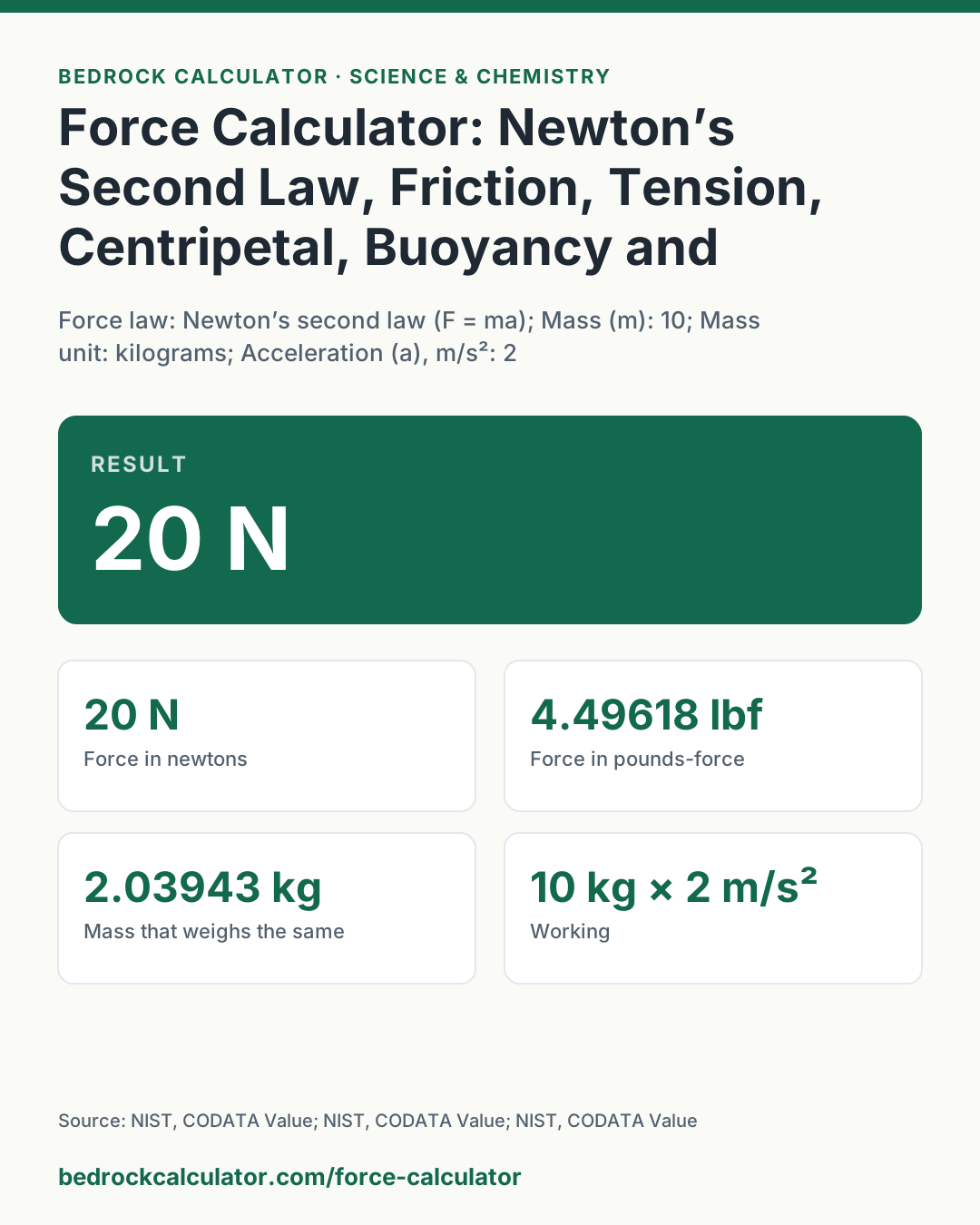
Quick Answer: By Newton’s second law, a 10 kg mass accelerating at 2 m/s² needs a net force of 20 N (4.49618 lbf). Choose another force law to get friction, rope tension, centripetal force, buoyancy or the Coulomb force between two charges.
What does this calculator do?
This force calculator puts the force laws of an introductory physics course in one place. Pick a law, fill in the boxes it uses, and it returns the force in newtons and pounds-force.
It also gives the mass that would weigh the same, and the intermediate figure the law depends on, such as the normal force for friction or the centripetal acceleration on a curve.
The laws covered are Newton’s second law (F = ma), weight (F = mg), kinetic friction (F = μN) and the coefficient of friction from a measured force, the tension in a rope holding a hanging mass, centripetal force (F = mv²/r), the buoyant force of Archimedes’ principle (F = ρVg) and Coulomb’s law for two point charges (F = kq₁q₂/r²). In Coulomb mode it also reports the electric field and electric potential of the first charge at the same distance.
Two constants carry the numbers. Standard gravity is g = 9.80665 m/s², exact by definition and listed by NIST in the CODATA tables. The Coulomb constant k = 1/(4πε₀) is computed from the vacuum electric permittivity ε₀ = 8.8541878188 × 10⁻¹² F/m, the 2022 CODATA value NIST publishes. That gives k = 8.987551786 × 10⁹ N·m²/C², the figure shown in the working line. Masses, volumes, charges and distances are converted to SI units before any formula runs.
Using the Force Calculator
- Choose the force law from the first menu.
- Fill in the boxes that law reads. Only the boxes that law uses are shown; switch laws and the others come back with the values you left in them.
- Pick units where a menu is offered: kilograms, grams or pounds for mass; litres, millilitres, cubic metres, cubic feet or US gallons for volume; coulombs down to picocoulombs or elementary charges for charge; metres down to ångströms for the distance between charges.
- Read the force at the top. The cards below give it in newtons and pounds-force, the equivalent mass, and the working.
The six preset buttons load one example of each common law, from a cart being pushed to two charges 10 cm apart.
How is this calculated?
- Convert to SI. Mass goes to kilograms, volume to cubic metres, charge to coulombs and distance to metres, using exact unit definitions (1 lb is 0.45359237 kg, 1 US gallon is 231 cubic inches, one elementary charge is 1.602176634 × 10⁻¹⁹ C).
- Apply the chosen law. Each mode is one formula, with g = 9.80665 m/s²:
F = ma; F_weight = mg
F_friction = μN, N = mg; μ = F/N
T = m (g + a); F_c = mv²/r
F_b = ρ_fluid V g; F = k q₁q₂/r², k = 1/4πε₀
- Friction uses a level surface. The normal force N is taken as the weight, m × g, which is true when the surface is flat and nothing else presses down. The coefficient mode divides the force you measured by that same normal force.
- Tension takes upward as positive. A load being lifted and speeding up has a positive acceleration and the rope pulls harder than the weight. A load being lowered and speeding up has a negative one. If the downward acceleration is larger than g, a rope would have to push, so the calculator says so instead of returning a negative tension.
- Buoyancy reads the fluid density. Fresh water is pure water at 20 °C, 998.2067 kg/m³, from the CIPM formula for the density of water. For any other fluid, the density you type is used.
- Coulomb’s law keeps the sign. A positive product of charges means repulsion and a negative one attraction. The headline shows the size of the force and names its direction. The field and potential of q₁ at the same distance use the same constant:
E = k q₁/r²; V = k q₁/r
- Convert back and round. The force is converted to pounds-force (1 lbf is 4.4482216152605 N) and divided by g for the equivalent mass. Results are rounded half up to six significant figures; the coefficient of friction is shown to four.
Worked Example
The default inputs push a 10 kg cart with a net acceleration of 2 m/s²:
- F = m × a = 10 × 2 = 20 N.
- In pounds-force: 20 ÷ 4.4482216152605 = 4.49618 lbf.
- Equivalent mass: 20 ÷ 9.80665 = 2.03943 kg, so the push equals the weight of about two kilograms.
The other presets work the same way:
- Friction: a 10 kg crate on a level floor has a normal force of 98.0665 N. With μ = 0.3, the force to keep it sliding is 29.42 N.
- Tension: hoisting 50 kg while speeding up at 2 m/s² puts 590.333 N in the rope, made of the 490.333 N weight plus 100 N to accelerate it.
- Centripetal: a 1,200 kg car at 20 m/s on a 50 m radius bend needs 9,600 N of sideways grip, a centripetal acceleration of 8 m/s².
- Buoyancy: a 2 litre object fully under fresh water is pushed up with 19.5781 N.
- Coulomb: two +1 µC charges 10 cm apart repel with 0.898755 N.
Coulomb’s Law Formula
Coulomb’s law gives the electric force between two point charges: F = k q₁ q₂ / r². The force grows with each charge and falls with the square of the distance, so doubling the gap cuts the force to a quarter. The reference table on this page shows it for two 1 µC charges: 89.8755 N at 1 cm, 22.4689 N at 2 cm and 0.898755 N at 10 cm.
The electric force formula is often written with ε₀ instead of k: F = q₁q₂ / (4πε₀r²). The two are the same thing. Since the 2019 redefinition of the SI, ε₀ is a measured quantity rather than an exact one, which is why k is quoted to ten significant figures here and not as a closed number.
Electric Potential Formulas
Two formulas cover most course problems. The potential of a single point charge at distance r is V = kq / r, measured from zero at infinity, and the potential energy of a pair of charges is U = kq₁q₂ / r. The calculator gives the first one for q₁ in Coulomb mode: a 1 µC charge produces 89,875.5 V at 10 cm. Multiply that potential by the second charge to get the pair’s potential energy in joules.
What Is the Formula for Tension in Physics?
For a single rope holding a mass that moves straight up or down, T = m(g + a), with a positive when the acceleration is upward. At rest or at a steady speed, the tension is just the weight.
Pulleys, ropes at angles and two-body problems such as an Atwood machine need the same idea applied to each body in turn, which this calculator does not set up for you.
What does this calculator not account for?
- Inclines and angled pulls. Friction mode assumes a level surface, so the normal force is the full weight. On a slope of angle θ the normal force is mg cos θ.
- Static friction. The friction mode is kinetic friction, for a surface already sliding. The force to start an object moving is usually higher.
- Multiple forces at once. Each mode is one law. Net force problems with several forces need them added as vectors first, then F = ma.
- Partly submerged objects. Buoyancy uses the volume you enter as the displaced volume. For a floating object, enter only the part below the surface.
- Charges that are not points. Coulomb’s law here is for point charges or spheres measured centre to centre, in a vacuum. In water or another medium the force is smaller by the material’s relative permittivity.
- Local gravity. Standard gravity is a defined value; real gravity varies by a few parts in a thousand across the Earth.
What mistakes do people make with this?
- Using grams in F = ma. A newton is a kilogram metre per second squared. Entering 500 for half a kilogram gives a force 1,000 times too large unless the mass unit is set to grams.
- Forgetting the micro. Course problems give charges in microcoulombs or nanocoulombs. Typing 1 with the unit left on coulombs makes the force a trillion times too big for two charges.
- Using diameter as the radius. Centripetal force divides by the radius of the circle.
- Confusing mass and weight. Mass is in kilograms; weight is a force in newtons. A 10 kg mass weighs 98.0665 N.
- Squaring the wrong thing. In Coulomb’s law only the distance is squared; in centripetal force only the speed is.
Frequently Asked Questions
How do I calculate the coefficient of friction?
How do you calculate centripetal force?
What is the buoyancy force formula?
Why does the calculator show an equivalent mass?
Is the Coulomb constant exactly 9 × 10⁹?
Does the calculator handle negative charges?
Sources
- NIST, CODATA Value: vacuum electric permittivity, ε₀ = 8.8541878188(14) × 10⁻¹² F/m (2022 CODATA). physics.nist.gov/cgi-bin/cuu/Value
- NIST, CODATA Value: standard acceleration of gravity, g_n = 9.80665 m/s² (exact). physics.nist.gov/cgi-bin/cuu/Value
- NIST, CODATA Value: elementary charge, e = 1.602176634 × 10⁻¹⁹ C (exact). physics.nist.gov/cgi-bin/cuu/Value
- Tanaka, Girard, Davis, Peuto and Bignell, Recommended table for the density of water between 0 °C and 40 °C based on recent experimental reports, Metrologia 38 (2001) 301 (CIPM formula). doi.org/10.1088/0026-1394/38/4/3
- NIST Special Publication 811, Guide for the Use of the International System of Units, Appendix B: the pound-force and other conversion factors. nist.gov/pml/special-publication-811