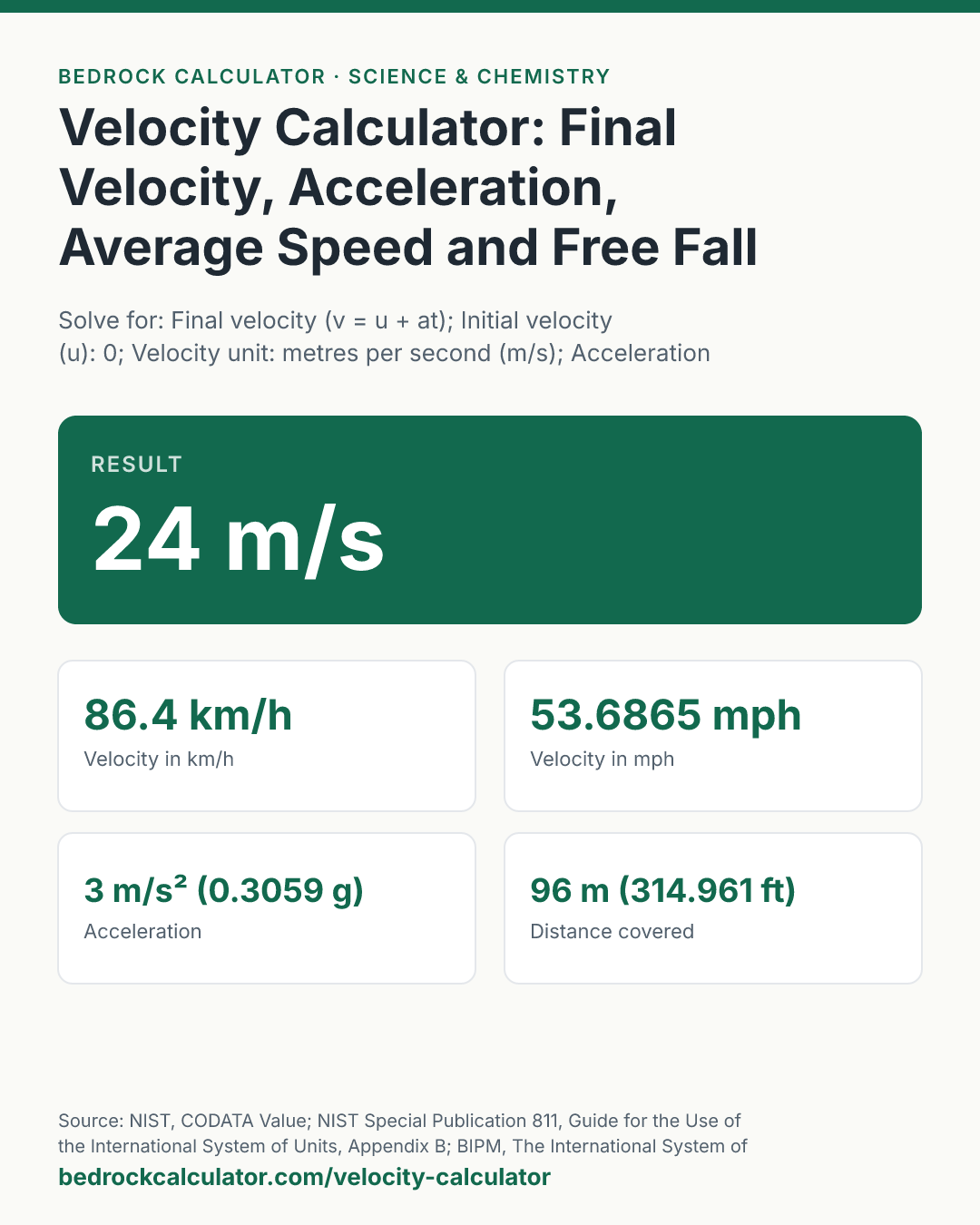

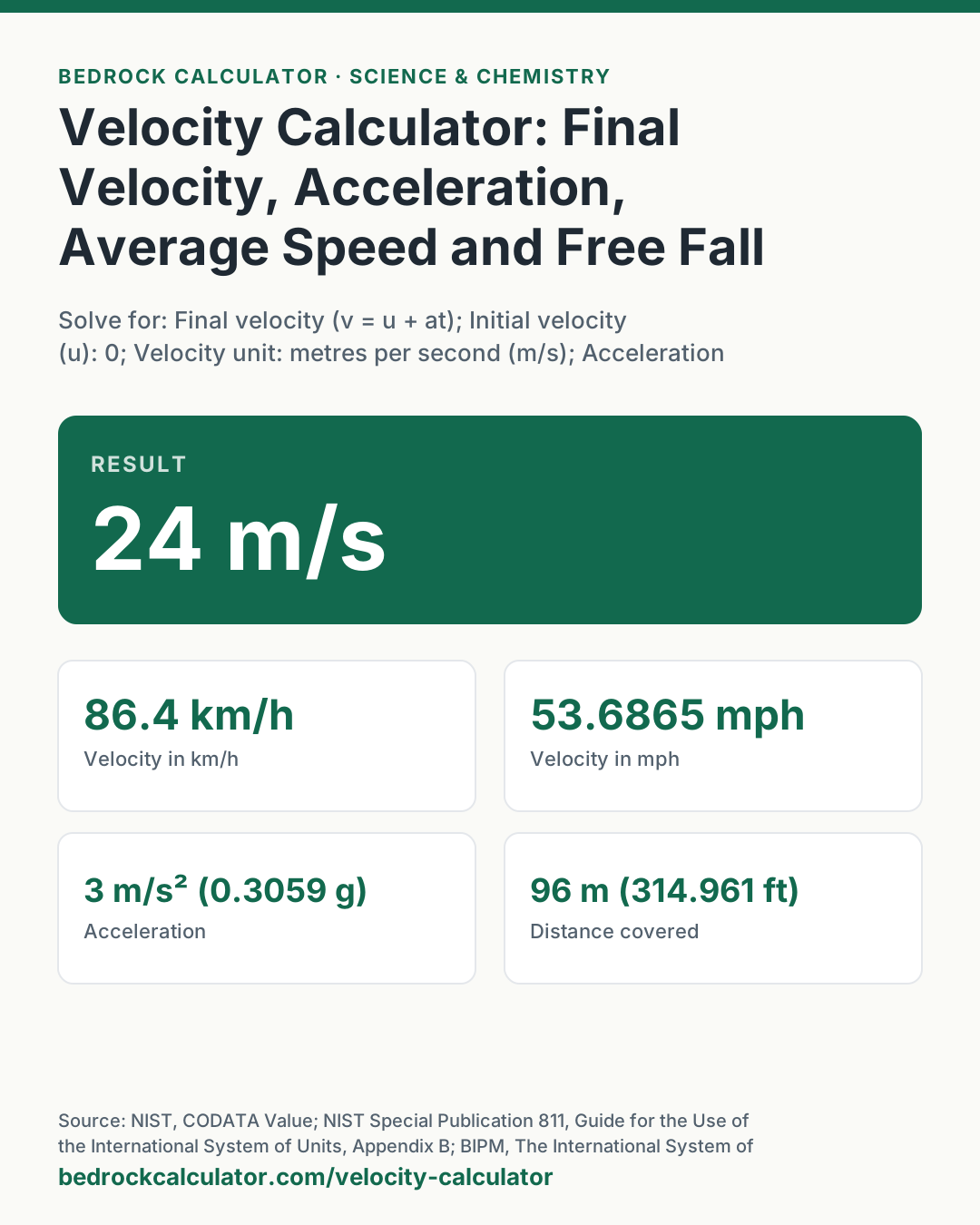
Quick Answer: Starting from rest and accelerating at 3 m/s² for 8 seconds, an object reaches 24 m/s (86.4 km/h) and covers 96 m. The formula is v = u + at: final velocity equals initial velocity plus acceleration times time.
What does this calculator do?
This velocity calculator works the four questions students and drivers ask most about straight-line motion. It finds the final velocity after a period of steady acceleration, the acceleration needed to change from one velocity to another, the average velocity over a distance and a time, and the time and impact speed of an object dropped from a height.
Every calculation uses the constant-acceleration equations from introductory mechanics. Inputs can be typed in metres per second, kilometres per hour, miles per hour or feet per second, with times in seconds, minutes or hours and distances in metres, kilometres, feet or miles. The calculator turns everything into SI units (metres, seconds, metres per second) before any formula runs, then converts the answer back to the unit you chose. That order matters: mixing kilometres per hour with seconds is the most common reason a hand calculation comes out 3.6 times too big or too small.
Free fall uses standard gravity, g = 9.80665 m/s². That figure is exact by definition (it was fixed by the General Conference on Weights and Measures in 1901) and is the value NIST lists in the CODATA tables. Real gravity varies by a fraction of a percent with latitude and altitude, which the free fall section below discusses.
Using the Velocity Calculator
- Pick what to solve for: final velocity, acceleration, average velocity, or free fall.
- Fill in the boxes that mode uses. Only the boxes that mode uses are shown.
- Choose units for velocity, acceleration, time and distance. The velocity unit also sets the unit of the headline answer.
- Read the result at the top. The cards below repeat the velocity in m/s, km/h and mph, and give the acceleration, the distance covered and the time.
The preset buttons load four common cases: a car accelerating from rest, a car braking to a stop, a 100 m sprint, and a ball dropped from 20 m.
How is this calculated?
- Convert to SI. Velocities are converted to metres per second, accelerations to metres per second squared, times to seconds and distances to metres, using exact unit definitions (1 km/h is 1/3.6 m/s, 1 mile is 1,609.344 m, 1 ft/s² is 0.3048 m/s², 1 g is 9.80665 m/s²).
- Final velocity mode. The final velocity is the starting velocity plus the change that the acceleration produces over the time. The distance covered comes from the second constant-acceleration equation.
v = u + at; s = ut + 1/2at²
- Acceleration mode. The acceleration is the change in velocity divided by the time taken. The distance covered is the average of the two velocities times the time, which holds whenever acceleration is constant.
a = (v − u)/t; s = ((u + v) t)/2
- Average velocity mode. The distance is divided by the time. No acceleration is assumed or reported, because an average says nothing about how the speed changed along the way.
v̄ = d/t
- Free fall mode. The object starts from rest and falls through the height h with nothing slowing it. The fall time and the impact speed both follow from the constant-acceleration equations with a = g.
t = √(2h/g); v = √2gh; g = 9.80665 m/s²
- Round for display. The arithmetic runs at 34 significant digits. Results are converted back to your units and rounded half up to six significant figures, with trailing zeros dropped. A time of zero or less is refused, since every formula above except free fall divides by it or needs it to be positive.
Worked Example
The default inputs describe a car pulling away from a standstill at 3 m/s² for 8 seconds:
- Initial velocity u = 0, acceleration a = 3 m/s², time t = 8 s.
- Final velocity: v = 0 + 3 × 8 = 24 m/s, which is 86.4 km/h or 53.6865 mph.
- Distance covered: s = 0 × 8 + ½ × 3 × 8² = 96 m.
Braking is the same equation with the sign flipped. A car doing 20 m/s that stops in 4 seconds has an acceleration of (0 − 20) ÷ 4 = −5 m/s², about half of standard gravity, and travels (20 + 0) × 4 ÷ 2 = 40 m while stopping.
For an average, the 100 m world record of 9.58 seconds works out to 100 ÷ 9.58 = 10.4384 m/s, or 37.5783 km/h. The top speed during that run was higher, because the sprinter started from rest.
A stone dropped from 20 m takes 2.01962 s to fall and hits the ground at 19.8057 m/s (71.3005 km/h), ignoring air resistance.
What Is the Formula for Velocity?
There are two everyday formulas, and which one you need depends on what you know. If you know a distance and a time, velocity is distance divided by time, v = d / t, and the answer is the average velocity over that stretch.
If you know a starting velocity, a steady acceleration and a time, the velocity at the end is v = u + at. The calculator's average and final velocity modes are these two formulas.
Velocity and speed are not quite the same. Velocity has a direction, so a car reversing at 5 m/s has a velocity of −5 m/s if forward is positive. Speed is the size of the velocity without the direction. On a straight line with no reversing, the two numbers match, which is the situation this calculator models.
How Do You Find Acceleration?
Subtract the starting velocity from the final velocity and divide by the time it took: a = (v − u) / t. Going from 0 to 100 km/h in 10 seconds comes out at 2.77778 m/s² when you enter the speeds in km/h. A negative answer means the object slowed down.
Free Fall Formula and Common Drop Heights
The free fall equations are t = √(2h/g) for the time and v = √(2gh) for the impact speed. They assume the object starts at rest and that air does nothing to it. The reference table on this page runs the calculator at a range of heights, and can be downloaded as a CSV file.
What does this calculator not account for?
- Air resistance. Free fall here is a fall in a vacuum. A real object reaches a terminal velocity where drag balances its weight, and a skydiver tops out far below the speeds the table shows for 500 m and 1,000 m.
- Changing acceleration. Every mode assumes acceleration is constant over the interval. A car's acceleration falls as its speed rises, so the final velocity mode gives the result for an average acceleration, not a real launch curve.
- Local gravity. Standard gravity is a defined value. Measured gravity is a little lower at the equator and a little higher near the poles, which changes free fall times in the fourth significant figure.
- Direction in two or three dimensions. Velocities are along one line. Projectile motion, where horizontal and vertical motion are separate, is not modelled.
- Relativity. At speeds that are a sizeable fraction of the speed of light, these equations stop holding. Nothing in everyday life gets close.
What mistakes do people make with this?
- Mixing km/h with seconds. 100 km/h in 10 s is not an acceleration of 10. Divide km/h by 3.6 to get m/s first, or let the calculator do it by setting the velocity unit.
- Dropping the sign. Deceleration is negative acceleration. If you enter a braking problem with a positive acceleration, the formula speeds the car up.
- Treating average velocity as top speed. The sprint example averages 10.4384 m/s, but the runner was faster than that near the finish.
- Using 10 m/s² for g. It is a fine mental shortcut, but it makes fall times about 1% short. The calculator uses 9.80665 m/s².
- Doubling the height to double the speed. Impact speed grows with the square root of height. Going from 5 m to 20 m only doubles the speed, from 9.90285 m/s to 19.8057 m/s, as the table shows.
Frequently Asked Questions
How do you calculate velocity from distance and time?
How do I work out velocity with acceleration and time?
What is the formula of acceleration?
What is the terminal velocity formula?
How is angular velocity related to velocity?
Why does the free fall answer not depend on mass?
Can velocity be negative?
Sources
- NIST, CODATA Value: standard acceleration of gravity, g_n = 9.80665 m/s² (exact). physics.nist.gov/cgi-bin/cuu/Value
- NIST Special Publication 811, Guide for the Use of the International System of Units, Appendix B: conversion factors for the mile, foot and kilometre per hour. nist.gov/pml/special-publication-811
- BIPM, The International System of Units (SI Brochure, 9th edition): the metre, the second and derived units such as m/s². bipm.org/en/publications/si-brochure