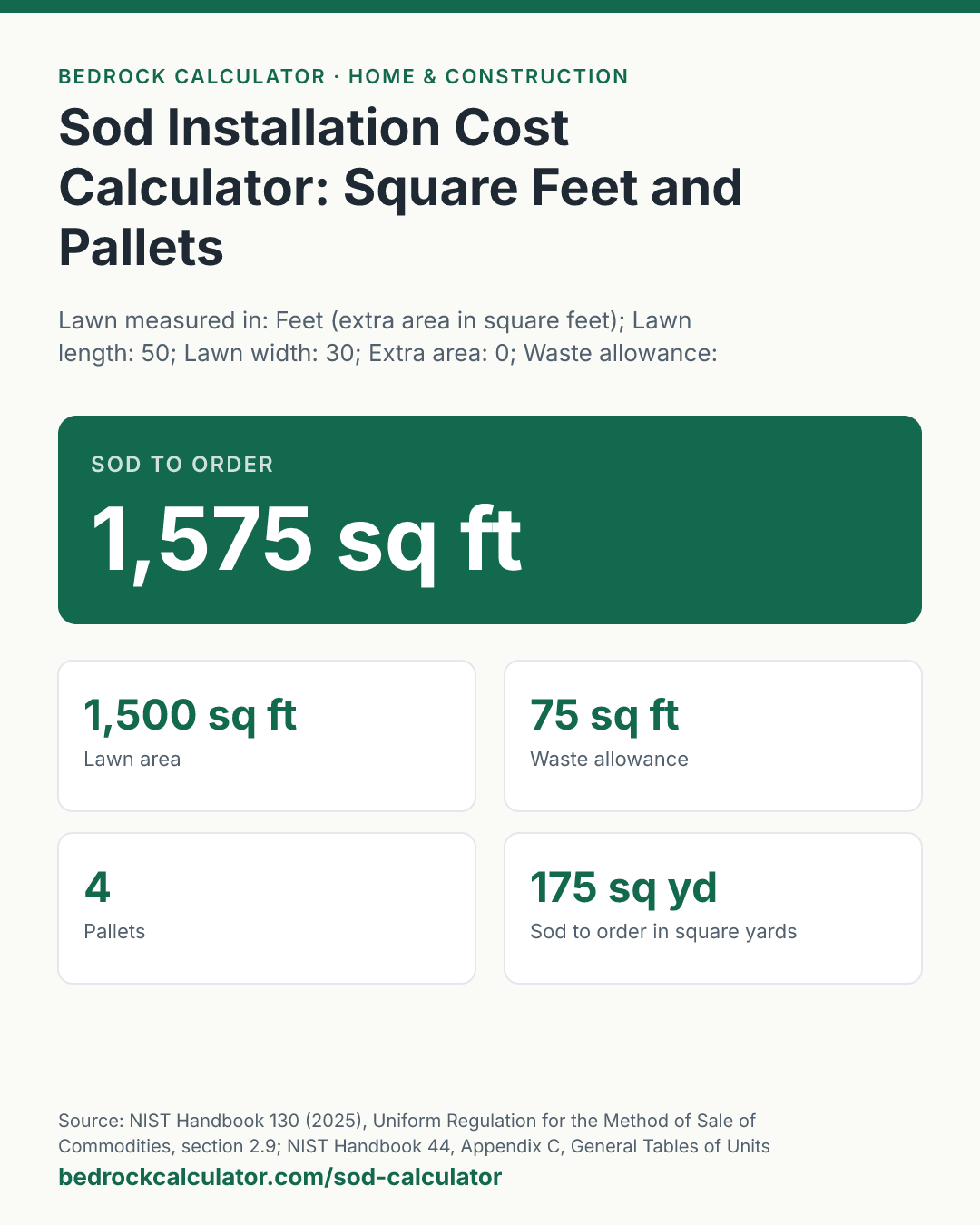
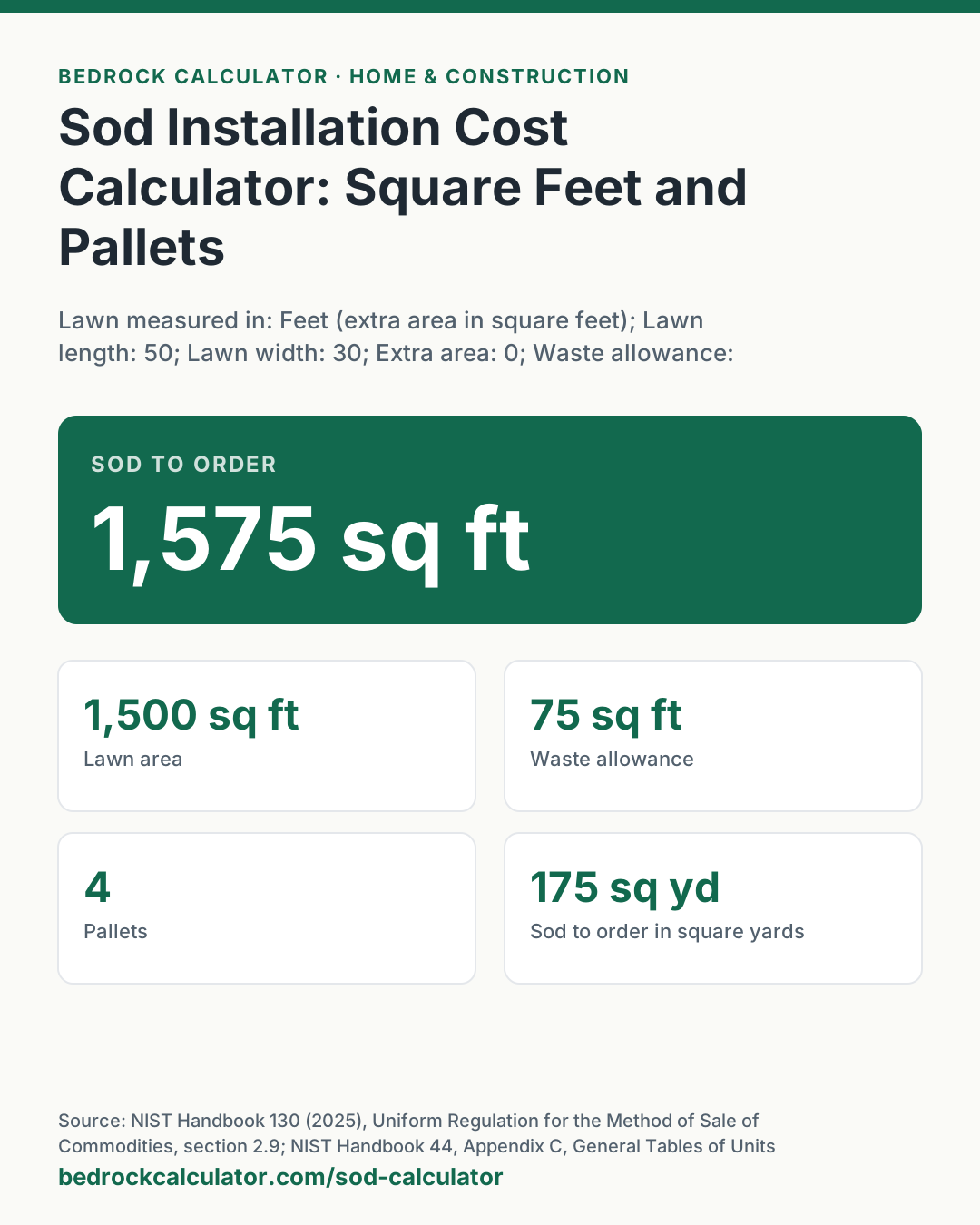
Quick Answer: A 50 by 30 foot lawn is 1,500 square feet. With a 5% waste allowance, order 1,575 sq ft of sod, which is 175 square yards or 4 pallets of 450 square feet. Enter your own prices to see the installed cost.
What does this calculator do?
This sod installation cost calculator works out how much sod a lawn needs and, with the prices from your supplier and installer, what the job will cost. It measures the lawn, adds a waste allowance and counts pallets at the coverage your sod farm quotes.
It also converts the order to square yards and square metres and adds up the cost of the sod, the labour to lay it and any delivery charge.
There are no prices built in. Sod prices vary with the grass, the season, the region and the size of the order, and installation prices vary even more, so any figure the calculator made up would mislead you. Enter the quotes you have and it does the arithmetic. One preset uses deliberately round, made-up prices of 1.00 a square foot so you can see how the cost lines add up; they are not market rates.
Pallet size is an input for the same reason: growers stack different amounts on a pallet, and the figure on the form is a placeholder until you replace it with your supplier's.
Using the Sod Installation Cost Calculator
- Choose feet or metres and enter the length and width of the lawn.
- Add any extra patches as an area.
- Set the waste allowance for cutting around beds, paths and curves.
- Enter the coverage per pallet from your supplier.
- Enter the sod price per square foot, the installation price per square foot, and the delivery fee, if you have them.
- Read the sod to order at the top and the pallets and costs below.
The presets show a 40 by 25 foot front yard with a side strip, the default lawn with made-up prices, and a lawn measured in metres.
How is this calculated?
- Find the lawn area. Length times width, plus any extra area, converted to square feet if you measured in metres.
- Add the waste allowance as its own line. The lawn area times your percentage is the allowance; together they are the sod to order.
A_order = A_lawn × (1 + waste)
- Convert. Square yards are square feet divided by 9; square metres use the exact factor of 0.09290304. Sod is sold by any of the three.
- Count pallets. Sod to order divided by the coverage per pallet, rounded up.
- Add up the cost. The sod cost is the sod to order times your price per square foot. Installation is charged on the lawn area, since you pay for the ground covered, not the offcuts. The total adds the delivery fee.
total = A_order × p_sod + A_lawn × p_install + delivery
Worked Example
The default is a 50 by 30 foot lawn with a 5% waste allowance and 450 square foot pallets:
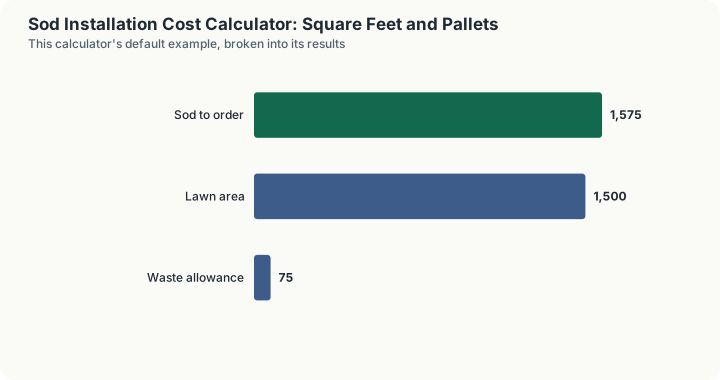
- Lawn area: 50 × 30 = 1,500 sq ft.
- Waste: 75 sq ft. Sod to order: 1,575 sq ft, or 175 square yards (146.3 m²).
- Pallets: 1,575 ÷ 450, rounded up, is 4 pallets.
With the made-up prices of 1.00 per square foot for sod, 1.00 per square foot for laying it and 100 for delivery, the sod costs 1,575, the installation 1,500, and the total is 3,175. Replace those numbers with your quotes.
A 40 by 25 foot front yard plus a 120 square foot strip is 1,120 square feet of lawn and 1,176 square feet of sod to order, 3 pallets.
A lawn 12 by 8 metres is 1,033.3 square feet; with waste, order 1,085 square feet.
How Much Sod Do I Need?
Measure the lawn, multiply length by width, and add a few percent for cutting. For curved beds and many obstacles, use a larger allowance. The calculator keeps the allowance separate so you can see exactly how much extra you are ordering. The table below lists sod and pallets for common lawn sizes.
For an irregular yard, get the area from the square footage calculator and enter it as extra area.
How Do You Estimate the Cost to Install Sod?
Get three numbers: the sod price per square foot (or per pallet, divided by the pallet's coverage), the installer's price per square foot, and the delivery fee. The total is the sod you order times its price, plus the lawn area times the installation price, plus delivery.
Ask whether the installation price includes removing the old lawn, grading and soil preparation, which are often quoted separately.
How Do You Measure a Yard for Sod?
Measure the lawn in straight sections. Most yards break into a few rectangles: the main lawn, a strip along the drive, a patch between the house and a path. Run the largest one as the length and width, add the others up and enter them as extra area. Leave out patios, paths, planting beds and the footprint of sheds.
For curved beds, measure to the outer edge of the curve and let the waste allowance absorb the trimming. Write the measurements down before you call for quotes so every supplier prices the same area.
What does this calculator not account for?
- Site preparation. Removing old turf, grading, topsoil and starter fertiliser are not included.
- Irrigation. New sod needs regular watering; sprinkler work is extra.
- Price breaks. Many suppliers charge less per square foot for full pallets or large orders.
- Slopes and curves. The area is measured flat. Steep slopes and tight curves need more sod and more labour.
- Taxes and minimum charges. Add them from your quote.
What mistakes do people make with this?
- Ordering by pallet without checking coverage. A pallet from one farm can cover a different area from another.
- Laying sod days after delivery. Sod is perishable; schedule delivery for the day you lay it.
- Forgetting paths and beds. Take hard surfaces and planting beds out of the area before you order.
- Comparing quotes on different units. Convert price per square yard to price per square foot by dividing by 9.
Frequently Asked Questions
How many square feet of sod are on a pallet?
How much sod do I need for a 50 by 30 foot yard?
How many square yards of sod do I need?
Should I pay for installation on the waste?
Is sod sold by the square foot or the square yard?
Sources
- NIST Handbook 130 (2025), Uniform Regulation for the Method of Sale of Commodities, section 2.9: turf sod sold by the square metre, square foot or square yard. doi.org/10.6028/NIST.HB.130-2025
- NIST Handbook 44, Appendix C, General Tables of Units of Measurement: the square foot, square yard and square metre. nist.gov/pml/owm/nist-handbook-44-current-edition