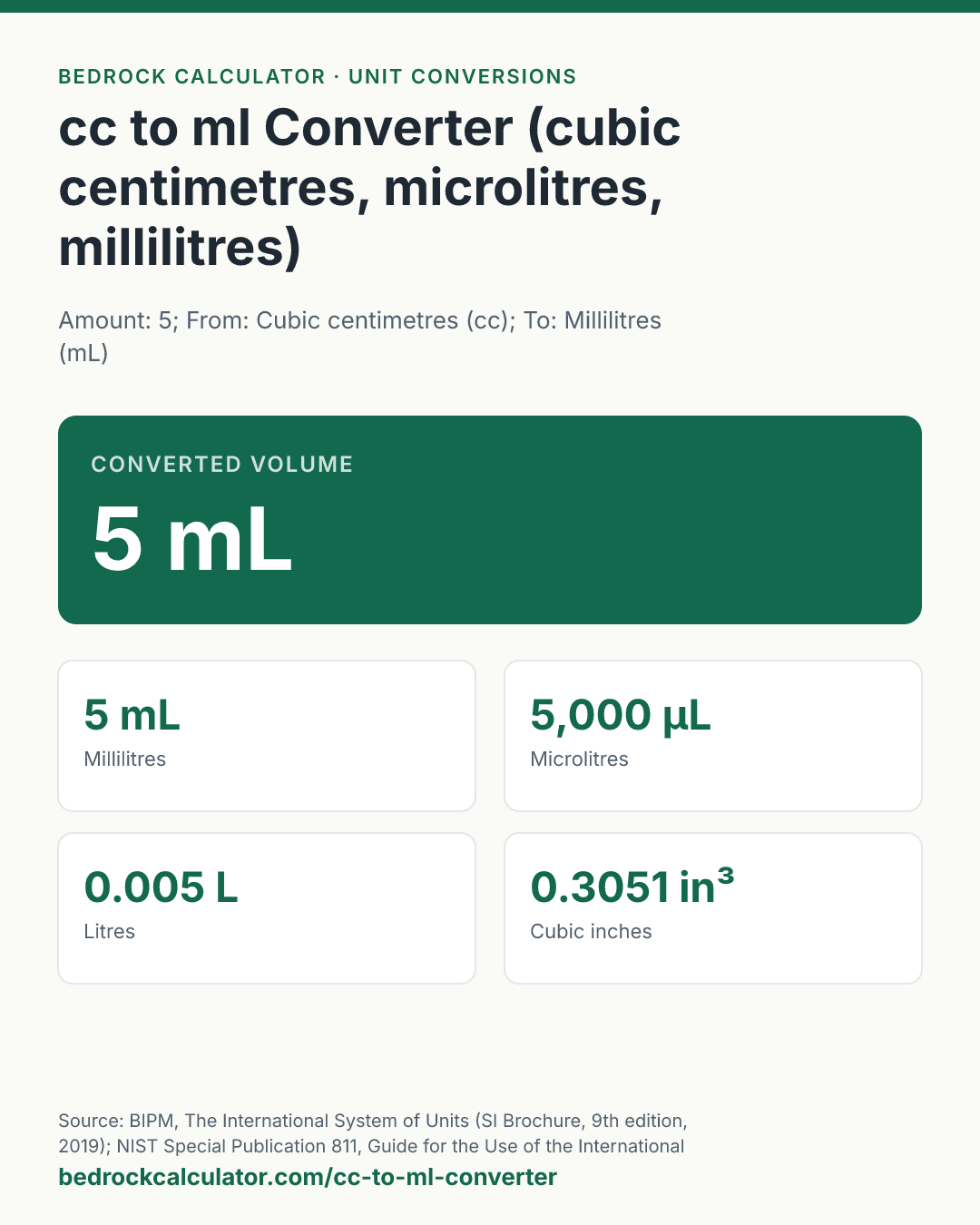

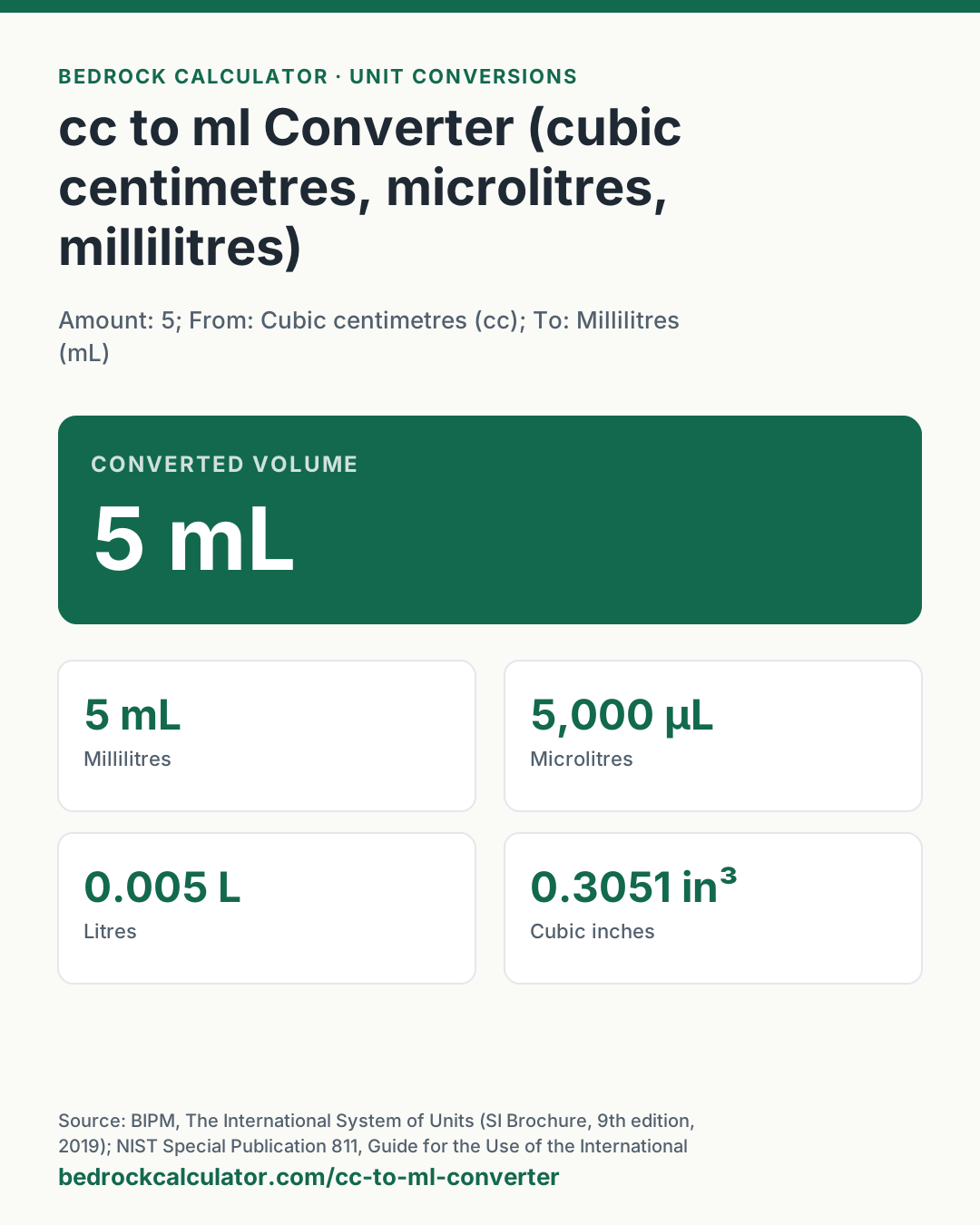
Quick Answer: One cc is exactly one millilitre, so 5 cc is 5 mL. A millilitre is 1,000 microlitres, so 250 µL is 0.25 mL, and a 1,600 cc engine is 97.638 cubic inches.
What does this calculator do?
This cc to ml converter handles the small metric volumes used in labs, workshops and engine specifications: cubic centimetres (cc), millilitres (mL), microlitres (µL) and litres, with cubic inches and US fluid ounces for comparison. Choose the unit you have and the one you want; every unit is shown at once on the cards.
The first conversion is the simplest one on this site. A litre is defined as exactly one cubic decimetre, a cube 10 cm on a side. Divide it into a thousand parts and each part is both one millilitre and one cubic centimetre. So 1 cc and 1 mL are two names for the same volume, with no rounding and no conversion factor. The name you see depends mostly on the field: medicine and engines have long used cc, while chemistry and food labelling use mL.
The microlitre is a thousandth of a millilitre, the volume a laboratory pipette handles. Going the other way, cubic inches come from the inch of exactly 2.54 cm, so a cubic inch is exactly 16.387064 cc. That is the conversion behind engine sizes given in both cc and cubic inches.
Using the cc to ml Converter
- Type the amount.
- Choose the unit you have under From: cc, mL, µL, litres, cubic inches or US fluid ounces.
- Choose the unit you want under To. The default is cc to millilitres.
- Read the headline, then the cards for millilitres, cubic centimetres, microlitres, litres, cubic inches and US fluid ounces.
The presets load 250 µL to millilitres, a 1,600 cc engine to cubic inches and half a millilitre to microlitres. Below the converter, one table runs from 1 µL to 5,000 µL and another from 1 cc to 5,000 cc in cubic inches, fluid ounces and litres. Both download as CSV.
How is this calculated?
- Read the units. From and To pick two of the six units. A negative amount is read as zero.
- Convert through the cubic metre. Each unit is stored as its exact size in cubic metres: the millilitre and the cubic centimetre are both one millionth of a cubic metre, the microlitre one billionth, the litre one thousandth. A cubic inch is 0.0254 m cubed. The US fluid ounce is one 128th of the US gallon of 231 cubic inches. The converter multiplies by the size of the From unit and divides by the size of the To unit.
1 cc = 1 cm³ = 1 mL = 1,000 μ L
cubic inches = cc/16.387064
- Fill in every unit. The same conversion runs for all six units on the cards.
- Round for display only. The arithmetic runs at 34 significant digits. Millilitres, cc, microlitres, cubic inches and fluid ounces are shown to four decimal places and litres to six, rounded half up with trailing zeros dropped.
Worked Example
The default, 5 cc to millilitres:
- Millilitres: 5 mL, the same number.
- Microlitres: 5,000 µL. Litres: 0.005 L.
- Cubic inches: 5 ÷ 16.387064 = 0.3051 in³. US fluid ounces: 0.1691.
250 µL to millilitres: 250 ÷ 1,000 = 0.25 mL.
Half a millilitre to microlitres: 0.5 × 1,000 = 500 µL.
A 1,600 cc engine: 1,600 ÷ 16.387064 = 97.638 in³, or 1.6 L. That is why the same engine is described as 1.6 litres, 1,600 cc or about 98 cubic inches.
cc, ml and Microlitres at a Glance
| Microlitres | Millilitres | cc |
|---|---|---|
| 1 | 0.001 | 0.001 |
| 10 | 0.01 | 0.01 |
| 100 | 0.1 | 0.1 |
| 250 | 0.25 | 0.25 |
| 1,000 | 1 | 1 |
| 5,000 | 5 | 5 |
| cc | Cubic inches | Litres |
|---|---|---|
| 50 | 3.0512 | 0.05 |
| 125 | 7.628 | 0.125 |
| 250 | 15.2559 | 0.25 |
| 1,000 | 61.0237 | 1 |
| 1,600 | 97.638 | 1.6 |
| 2,000 | 122.0475 | 2 |
These rows are taken from the converter's reference tables.
How Many cc Are in a Milliliter?
Exactly one. A cubic centimetre and a millilitre are the same volume by definition, so any figure in one unit is the same figure in the other. A 3 cc syringe holds 3 mL; a 10 mL vial holds 10 cc. Nothing is rounded.
How Many Microlitres Are in a Millilitre?
One thousand. The prefix micro means a millionth, so a microlitre is a millionth of a litre and a thousandth of a millilitre. Pipettes are commonly sold in ranges such as 2 to 20 µL or 100 to 1,000 µL; the top of the second range is exactly 1 mL.
The symbol µL is sometimes typed as uL when the µ character is not available; it is the same unit.
What does this calculator not account for?
- Weight. A cc or millilitre is a volume. Its weight depends on the substance; for water and common ingredients, use the ml to grams converter.
- Measuring accuracy. Syringes, pipettes and graduated cylinders each have their own tolerance. The conversion is exact; the instrument reading is not.
- Engine displacement conventions. Manufacturers often round a displacement to a marketing figure, such as 1.6 L for an engine slightly over or under 1,600 cc.
- Imperial fluid ounces. Only the US fluid ounce is offered.
- Dosing. This converter changes units. It is not a guide to medicine doses; follow the instructions that come with a medicine and the measuring device supplied.
What mistakes do people make with this?
- Thinking cc and mL differ. They do not. Any conversion between them that is not 1 to 1 is wrong.
- Mixing mL and µL by a factor of 1,000. A 50 µL sample is 0.05 mL, not 0.5.
- Confusing cm with cc. A centimetre is a length; a cubic centimetre is a volume.
- Using 16.4 for a cubic inch. It is close; 16.387064 cc is exact.
Frequently Asked Questions
How many ml is 1 cc?
How many microliters are in a ml?
How many ml is 250 microliters?
How many cc is a cubic inch?
How many cubic inches is 1,600 cc?
How many cc are in a US fluid ounce?
Is mil the same as ml?
Sources
- BIPM, The International System of Units (SI Brochure, 9th edition, 2019): the litre as a cubic decimetre and the SI prefixes milli and micro. bipm.org/en/publications/si-brochure
- NIST Special Publication 811, Guide for the Use of the International System of Units (2008), Appendix B: the cubic inch and the litre. nist.gov/pml/special-publication-811
- NIST Handbook 44, Appendix C, General Tables of Units of Measurement: the inch and the US fluid ounce. nist.gov/pml/owm/nist-handbook-44-current-edition