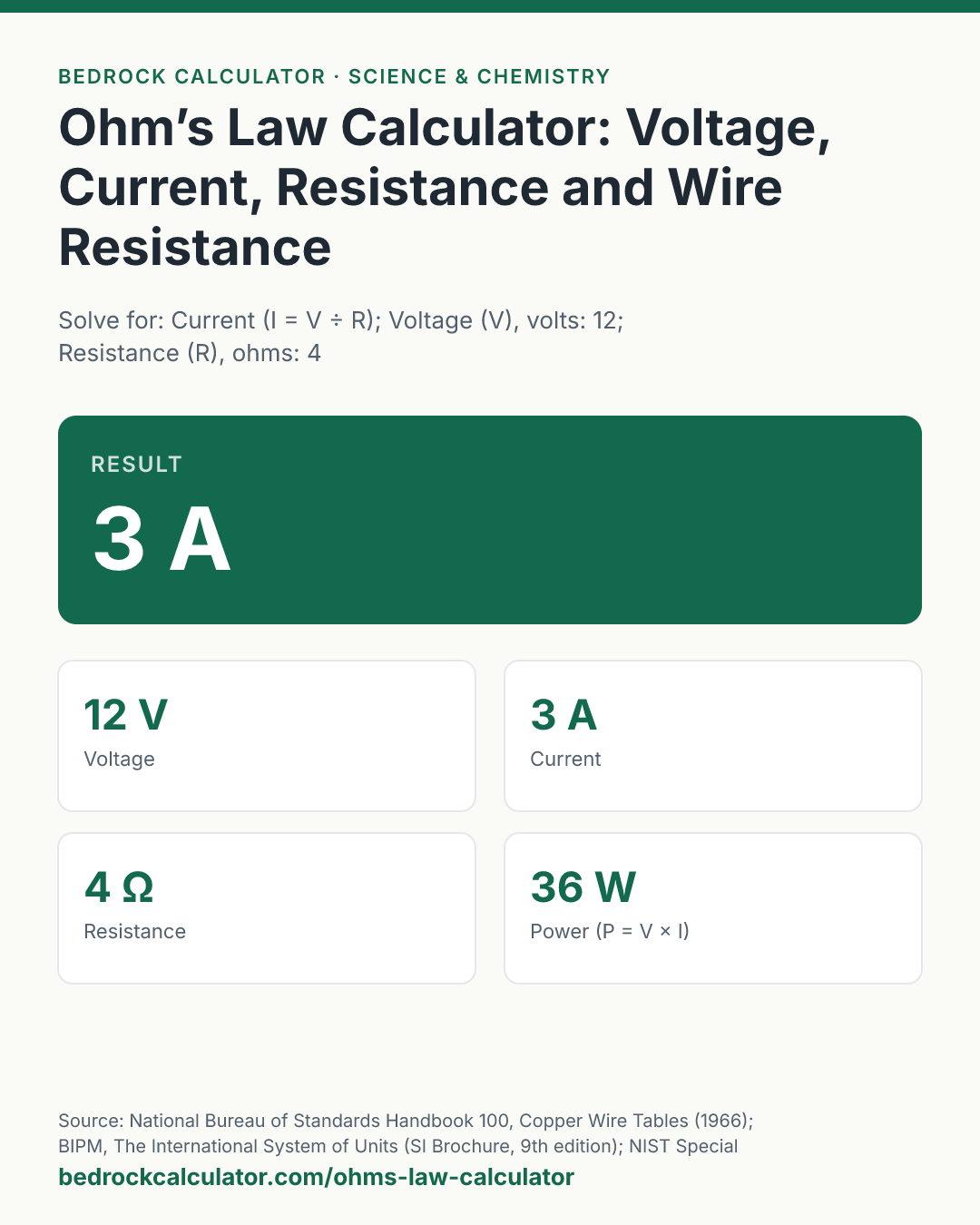

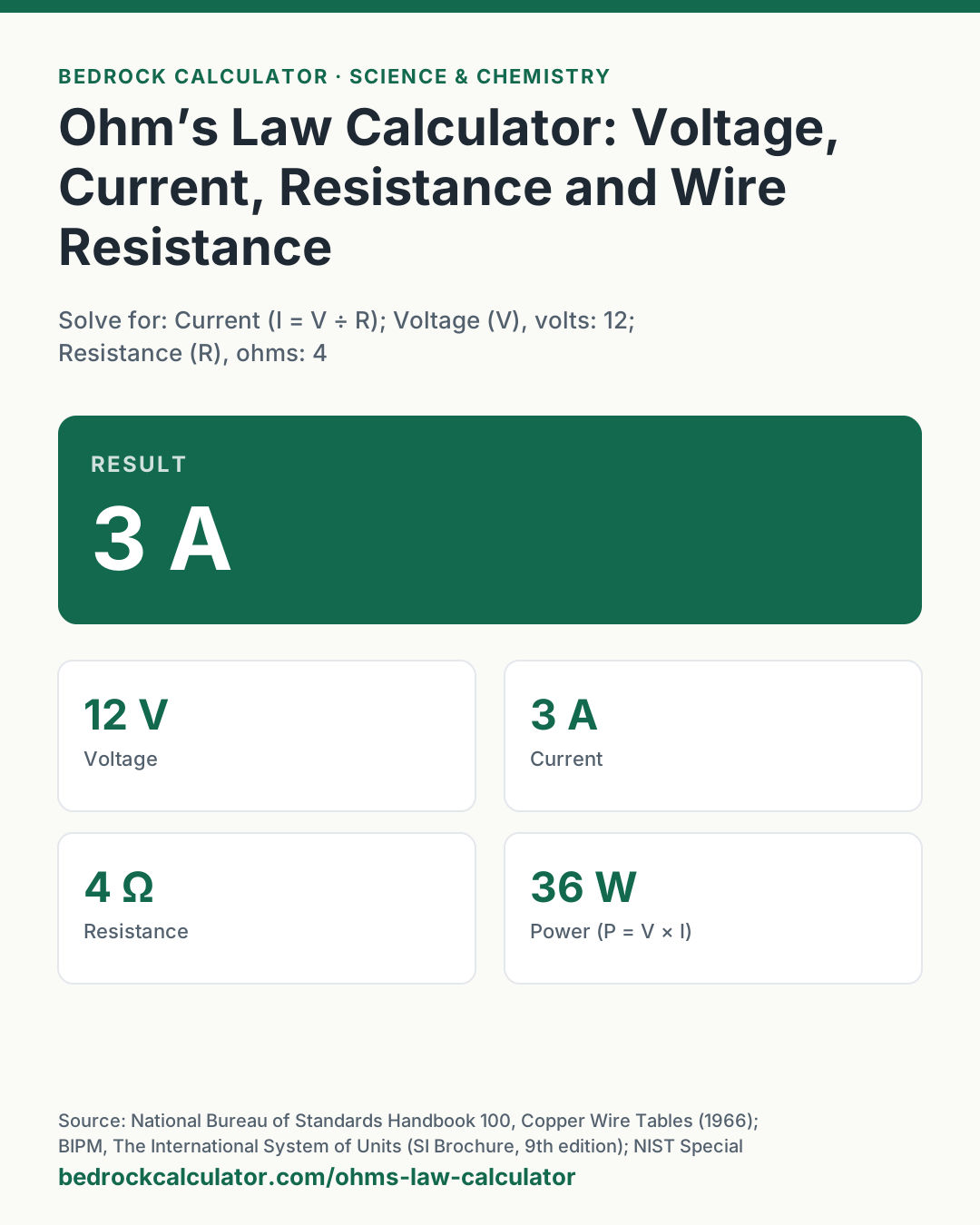
Quick Answer: 12 volts across a 4 ohm resistor drives a current of 3 A, because Ohm’s law says current equals voltage divided by resistance (I = V/R). The resistor turns 36 W into heat.
What does this calculator do?
This Ohm’s law calculator solves V = IR for whichever of the three you need: the current that flows when a voltage is applied across a resistance, the voltage needed to push a current through a resistance, or the resistance that a measured voltage and current imply. Every answer comes with the power the resistance dissipates and its conductance.
A fourth mode answers a question Ohm’s law alone cannot: what is the resistance of a length of wire? Resistance depends on the material, the length and the thickness. Give the calculator a conductivity (or choose copper), a length and a diameter, and it works out the resistance and the voltage lost along the wire at the current you enter.
The copper option is the International Annealed Copper Standard: a conductivity of 58 megasiemens per metre at 20 °C, which is a resistivity of exactly 1/58 ohm square millimetre per metre. That definition is the basis of copper wire tables, and the source here is the National Bureau of Standards (now NIST) Handbook 100, Copper Wire Tables.
Using the Ohm’s Law Calculator
- Choose what to solve for: current, voltage, resistance or wire resistance.
- Enter the two known values in volts, amps or ohms. The box that matches the answer is hidden.
- For a wire, pick copper or enter a conductivity in MS/m, then the length (metres, kilometres, feet or yards) and the bare conductor diameter (millimetres, centimetres or inches). The current box sets the current for the voltage drop.
- Read the answer at the top. The cards repeat voltage, current and resistance together, with power, conductance and the working.
How is this calculated?
- Apply Ohm’s law to the two values you gave. Each mode is the same law rearranged:
I = V/R; V = IR; R = V/I
- Wire resistance. The diameter is converted to metres and turned into a cross-sectional area. The resistance is the length divided by the conductivity times that area. Resistivity, ρ, is the reciprocal of conductivity, so the same formula is often written R = ρL/A.
A = πd²/4; R = L/σA = ρL/A
- Voltage drop along the wire. In wire mode the voltage shown is the drop along the wire at the current you entered, V = IR.
- Power and conductance. Power is voltage times current. Conductance, in siemens, is the reciprocal of resistance.
P = VI; G = 1/R
- Round for display. Results are rounded half up to six significant figures. A resistance of zero (when solving for current), a current of zero (when solving for resistance) and a wire with no diameter or conductivity are refused, since each would divide by zero.
Worked Example
The default inputs are 12 V across 4 Ω:
- Current: I = 12 ÷ 4 = 3 A.
- Power: P = 12 × 3 = 36 W.
- Conductance: G = 1 ÷ 4 = 0.25 S.
Sizing a resistor for an LED: a 5 V supply and an LED that drops 2 V leave 3 V for the resistor. At 20 mA (0.02 A), R = 3 ÷ 0.02 = 150 Ω, and the resistor dissipates 0.06 W, well within a common quarter watt part.
The voltage across a 220 Ω resistor carrying 0.5 A is 0.5 × 220 = 110 V, and it would have to shed 55 W, far more than a small resistor can.
For a wire, take 10 m of copper with a 1.5 mm diameter:
- Cross-section: π × 1.5² ÷ 4 = 1.76715 mm².
- Resistance: 10 ÷ (58 × 1.76715) = 0.0975662 Ω.
- At 3 A, the voltage drop is 0.292699 V, and the wire gives off 0.878096 W as heat.
How Is Resistance Calculated?
There are two ways, and which applies depends on what you have. If a component is in a circuit and you can measure the voltage across it and the current through it, divide one by the other: R = V/I.
If you have a piece of material, use its conductivity or resistivity and its shape: R = L/(σA) for a uniform wire or bar. The second explains why long, thin wires have more resistance than short, thick ones. The reference table shows it for 100 m of copper: 2.19524 Ω at 1 mm diameter, but only 0.54881 Ω at 2 mm, a quarter as much, because the area grows with the square of the diameter.
Conductivity to Resistance
Conductivity, σ, is how well a material carries current, in siemens per metre. To turn it into the resistance of a wire, divide the length by conductivity times cross-sectional area. Be careful with the units: conductivity is often quoted in MS/m (millions of siemens per metre) or as a percentage of the copper standard (% IACS), and the area must be in square metres if the conductivity is in S/m. The calculator takes MS/m and does the conversions. A material at 35 MS/m in the same 10 m, 1.5 mm wire gives 0.161681 Ω.
What does this calculator not account for?
- Temperature. Resistance rises with temperature. The copper value is at 20 °C; a warm cable has noticeably more resistance, and the calculator does not correct for it.
- AC effects. At high frequencies current crowds to the surface of a conductor (the skin effect) and resistance rises. The wire mode is for direct current or low-frequency AC.
- Components that are not ohmic. Ohm’s law with a fixed R applies to resistors and wires. Diodes, LEDs, bulbs and batteries do not have a constant resistance, which is why the LED example applies the law only to the resistor.
- Stranded wire and gauge tables. A stranded conductor has slightly less copper than a solid wire of the same outer diameter. Enter the effective diameter if you know it.
- Safety. Choosing a cable for a real installation follows electrical codes on current capacity and voltage drop. This page is arithmetic, not a wiring design.
What mistakes do people make with this?
- Milliamps entered as amps. 20 mA is 0.02 A. Entering 20 makes the resistor a thousand times too small.
- Counting the wire once. Current flows out and back, so a device 10 m away needs 20 m of wire in the calculation.
- Using the insulated diameter. Measure the bare conductor.
- Forgetting the power rating. A resistor of the right value can still burn out if P = VI exceeds its rating.
- Mixing up conductivity and resistivity. They are reciprocals. Copper is 58 MS/m, or 1.72414 × 10⁻⁸ Ω·m.
Frequently Asked Questions
What is Ohm’s law?
How do I find current from voltage and resistance?
How much resistance does copper wire have?
What is conductance?
Does Ohm’s law work for AC?
Why does a long cable lose voltage?
Sources
- National Bureau of Standards Handbook 100, Copper Wire Tables (1966): the International Annealed Copper Standard, 58 m/(Ω·mm²) at 20 °C, a resistivity of 1/58 Ω·mm²/m. nvlpubs.nist.gov/nistpubs/Legacy/hb/nbshandbook100.pdf
- BIPM, The International System of Units (SI Brochure, 9th edition): the volt, ampere, ohm, siemens and watt. bipm.org/en/publications/si-brochure
- NIST Special Publication 811, Guide for the Use of the International System of Units, Appendix B: conversion factors for length. nist.gov/pml/special-publication-811