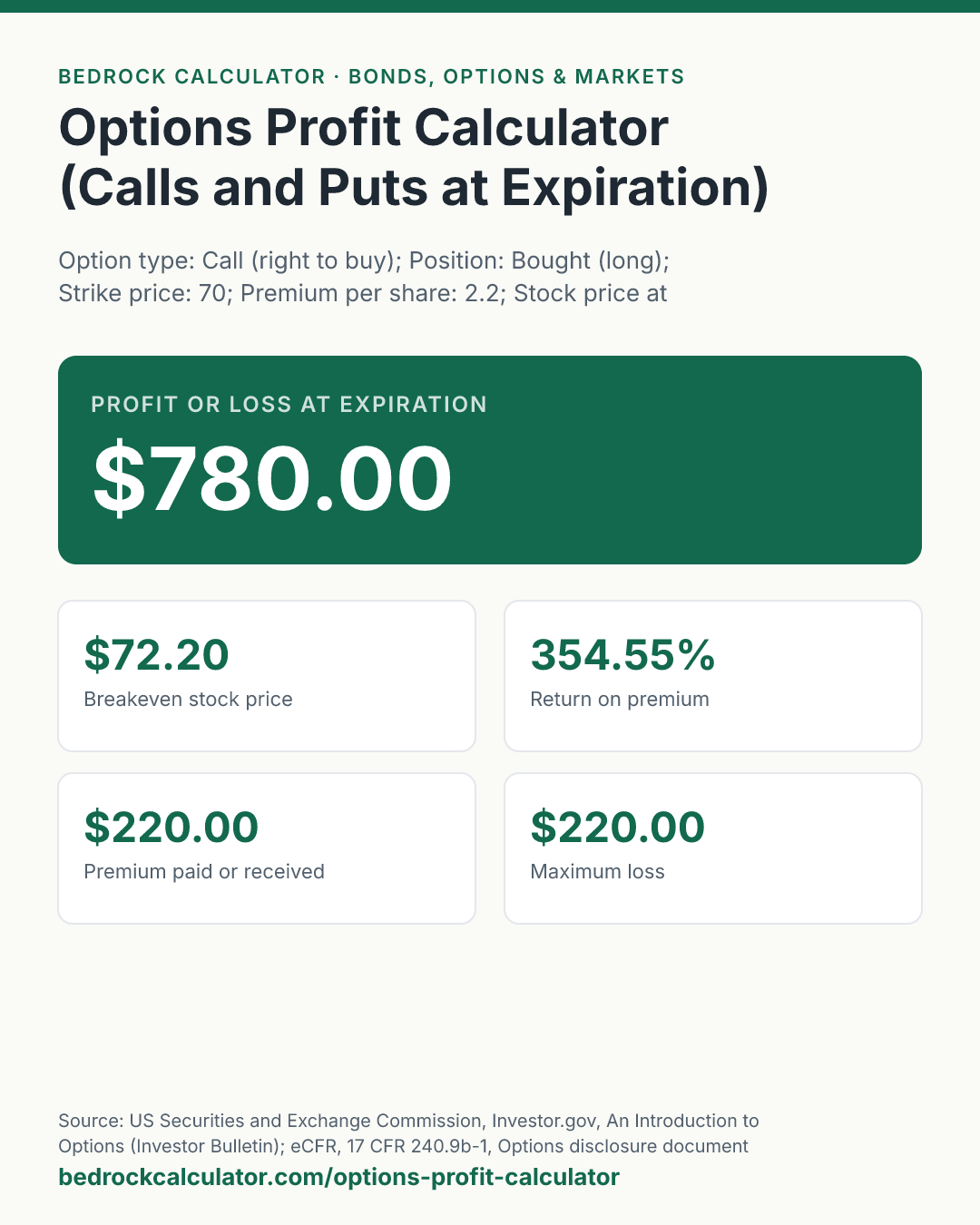

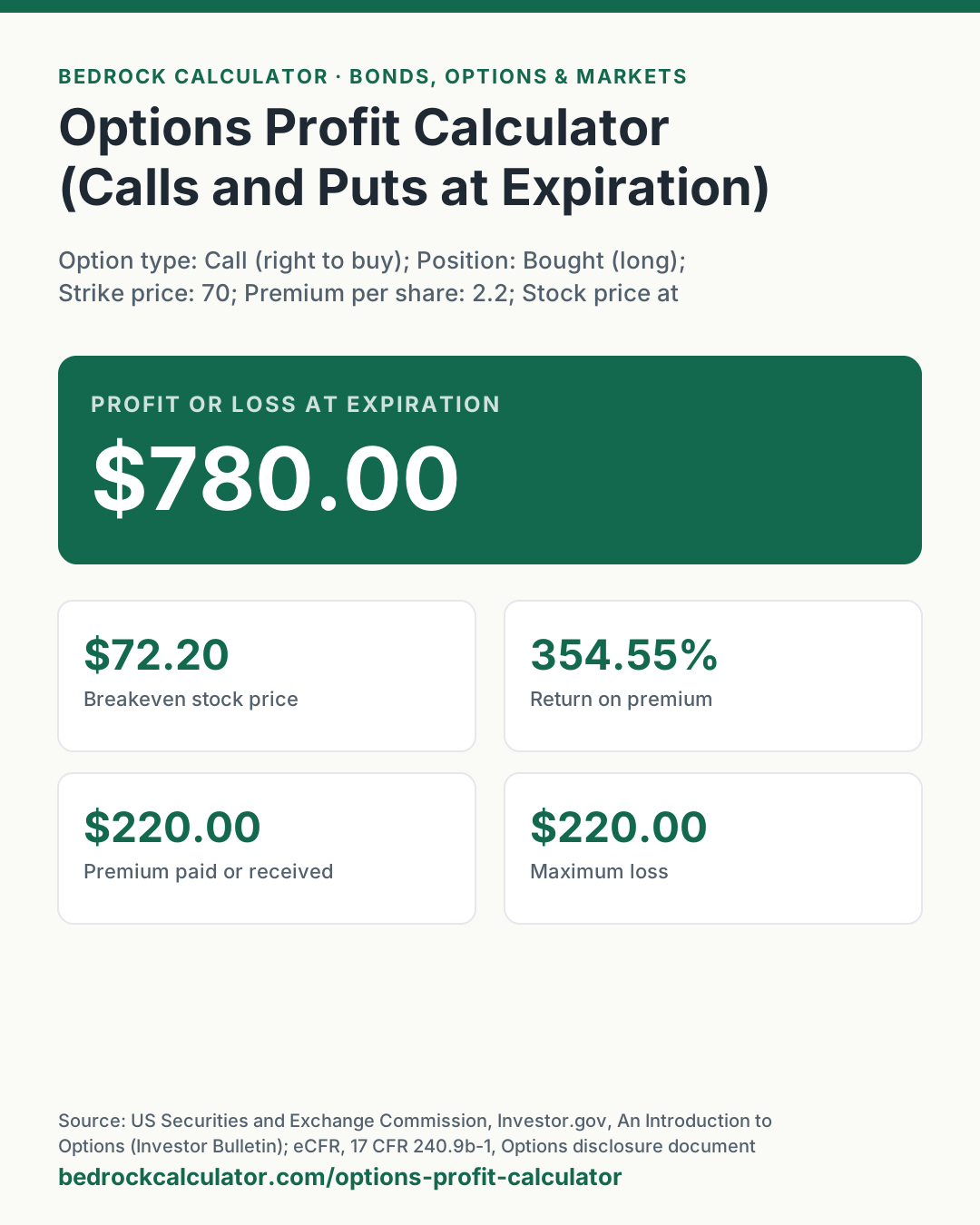
Quick Answer: One 70 call bought at $2.20 a share, held to expiration with the stock at $80, makes $780.00: the option is worth $10 a share across 100 shares, less the $220 premium. It breaks even at $72.20.
What does this calculator do?
This options profit calculator works out what a single call or put is worth at expiration, and what you made or lost on it, whether you bought the option or wrote (sold) it. Enter the strike, the premium, the number of contracts and a stock price at expiration, and it returns the profit or loss in dollars, the return on the premium, the breakeven stock price, and the most you could make or lose on the position.
The defaults are the example the SEC uses in its investor bulletin on options: an ABC December 70 call quoted at $2.20, bought when the stock is near $68. The bulletin works out the same breakeven of $72.20 and the same $220 loss if the stock finishes at $65.
The calculation rests on one assumption, stated plainly: the position is held until expiration. At that moment an option has no time value left; it is worth exactly what exercising it would gain, or nothing. Before expiration an option's market price also reflects time and volatility, which this calculator does not model. For a value before expiration, use a pricing model such as Black-Scholes.
How to Use the Options Profit Calculator
- Choose a call or a put.
- Choose whether you bought it (long) or sold it to open (short, or written).
- Enter the strike price and the premium per share as quoted.
- Enter a stock price at expiration to test. The result is for that one price.
- Enter the number of contracts. Shares per contract is 100 for standard US stock options.
- Add your total commissions and fees if you want them included.
Try several stock prices to see the range of outcomes, or read the two tables below the calculator, which run the default call and the matching put across a range of expiration prices. The presets show the call expiring worthless, the 70 put with the stock at $60, a written call with the stock finishing just above the strike, and the default call at five contracts with fees.
How is this calculated?
- Value the option at expiration. A call is worth the amount the stock finishes above the strike, and a put the amount it finishes below, never less than zero. This is the intrinsic value.
call value = max(S − K, 0); put value = max(K − S, 0)
where S is the stock price at expiration and K the strike.
- Subtract the premium for a buyer. The buyer's profit per share is that value minus the premium paid. The writer's profit per share is the exact opposite: the premium received minus the value.
buyer profit per share = value − premium; writer profit per share = premium − value
- Scale to the position. The profit per share is multiplied by the shares per contract and the number of contracts, and the total fees are subtracted.
total profit = profit per share × shares per contract × contracts − fees
- Find the breakeven. A call breaks even when the stock finishes at the strike plus the premium; a put at the strike minus the premium. Fees are not included in the breakeven.
- Find the limits. A bought call can lose at most its premium and has no ceiling on profit. A bought put can lose at most its premium and gains most if the stock goes to zero: (strike − premium) per share. A written option has the mirror image: the premium is the most it can make, and a written call's loss has no ceiling. Any fees you enter come off every outcome, so they are added to the maximum loss and taken off the maximum profit: five bought calls with $6.50 of fees can lose $1,106.50, not just the $1,100 premium.
- Work out the return. The return on premium is the total profit divided by the total premium, times 100.
Worked Example
With the default inputs, one bought 70 call at $2.20, stock at $80 at expiration:
- Premium paid: $2.20 × 100 shares = $220.00.
- Value at expiration: $80 − $70 = $10.00 a share, or $1,000 for the contract.
- Profit: $1,000 − $220 = $780.00, a return of 354.55% on the premium.
- Breakeven: $70 + $2.20 = $72.20.
If the stock instead finishes at $65, below the strike, the call expires worthless and the whole $220 premium is lost, a return of −100%.
The matching 70 put bought at $2.20 with the stock at $60 is worth $10 a share at expiration, so it also makes $780.00, and it breaks even at $67.80. Its best case, if the stock went to zero, is $6,780.00.
Writing the 70 call instead, and seeing the stock finish at $72, the writer keeps the $220 premium but owes the $2-a-share value: a profit of $20.00. Above $72.20 the writer starts to lose, with no upper limit.
Reading the Payoff Tables
The first table shows the bought call across stock prices. Everything at or below the $70 strike is the same $220 loss, because the option expires worthless however far the stock falls. Above the strike, every dollar the stock rises adds $100 to the result, crossing zero at $72.20. The second table shows the put, which mirrors it: flat losses above the strike, and gains of $100 for each dollar the stock falls below $67.80.
What does this calculator not account for?
- Time value and volatility. Before expiration an option trades above its intrinsic value. Selling the option early can make more or less than the expiration figure here.
- Early exercise and assignment. US stock options can usually be exercised before expiration, and a writer can be assigned at any time. The calculator looks only at expiration.
- Dividends. A dividend lowers the stock price on the ex-date and affects early exercise decisions. Enter the stock price you expect after any dividend.
- What happens after exercise. Exercising a call buys 100 shares per contract and exercising a put sells them. The calculator values that at the expiration price; holding or selling the shares afterwards is a separate result.
- Margin. Writing options requires margin, and an uncovered written call can require much more as the stock rises. Margin costs are not included.
- Taxes. Gains and losses on options are taxable and the treatment depends on the position. Nothing here is a tax figure.
- Multi-leg strategies. Spreads, straddles and covered calls combine positions. This calculator handles one option position at a time; for a covered call use the covered call calculator.
What mistakes do people make with this?
- Forgetting the multiplier. A $2.20 premium is $220 per contract, not $2.20. Profit figures quoted per share are a hundredth of the dollar result.
- Confusing in the money with profitable. A call is in the money as soon as the stock passes the strike, but it is not profitable until the stock passes the breakeven. Between $70 and $72.20, the default call is in the money and still losing.
- Ignoring the written side's risk. The SEC bulletin warns that some written options carry unlimited potential losses. A written call's premium is small next to what a sharp rise in the stock can cost.
- Testing one price. The result is for the stock price you enter. Run a few, or read the tables, before you decide.
- Leaving out fees. On small positions, commissions and exchange fees can be a large share of the premium.
Frequently Asked Questions
How do I calculate profit on a call option?
What is the breakeven on a put option?
What is the most I can lose buying an option?
Can I lose more than I invested selling options?
Why does the calculator not show my option's current value?
What happens if I hold an in-the-money option to expiration?
Sources
- US Securities and Exchange Commission, Investor.gov, An Introduction to Options (Investor Bulletin): calls, puts, 100-share contracts, the ABC December 70 example and its $72.20 and $67.80 breakevens. investor.gov/additional-resources/news-alerts/alerts-bulletins/investor-bulletin-introduction-options
- eCFR, 17 CFR 240.9b-1, Options disclosure document: the definition of standardized options and the disclosure document brokers must deliver. ecfr.gov/current/title-17/section-240.9b-1