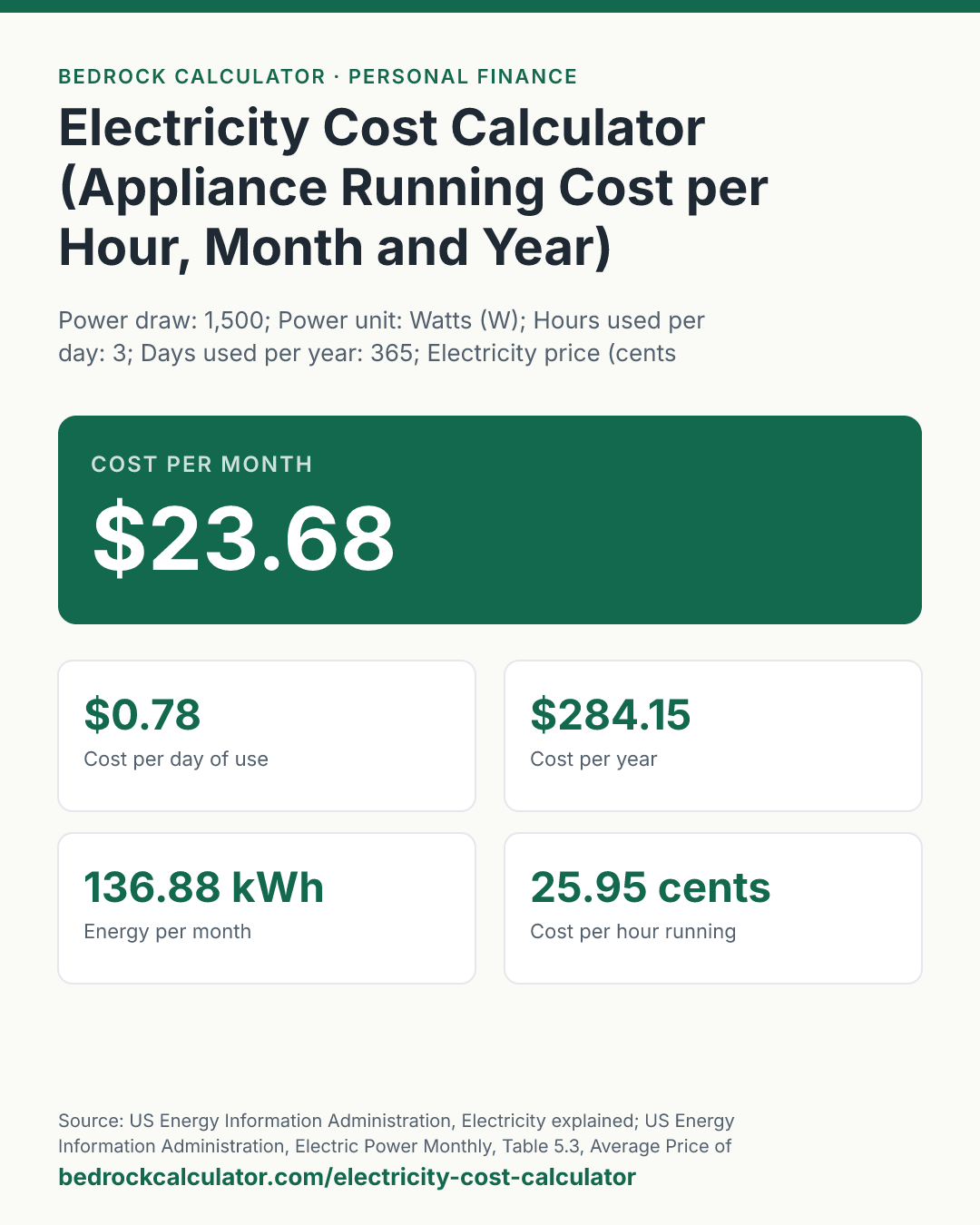

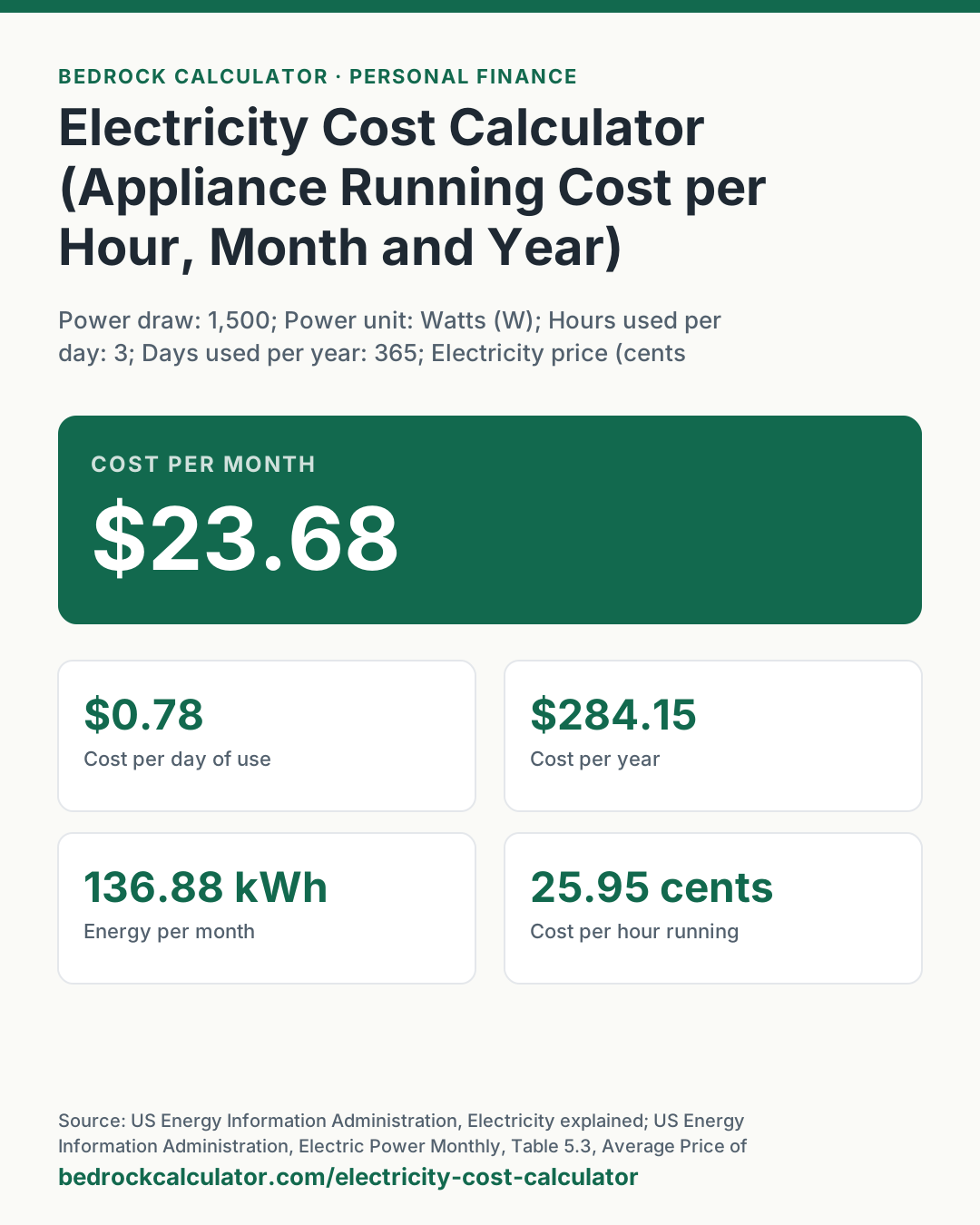
Quick Answer: A 1,500 W heater used 3 hours a day uses 4.5 kWh a day and costs about $23.68 a month at 17.30 cents per kWh. Multiply the kilowatts by the hours to get kWh, then multiply by your price per kWh.
What does this calculator do?
This electricity cost calculator works out what an appliance or device costs to run. Enter its power in watts or kilowatts, how many hours a day you use it, how many days a year, and your electricity price in cents per kilowatt hour. It returns the cost per hour of running, per day of use, per month and per year, and the energy in kilowatt hours behind each figure.
The method is the one the US Energy Information Administration uses to explain electricity use: energy is power times time. A 40-watt bulb running for five hours uses 200 watt hours, or 0.2 kWh, and your utility bills you for kilowatt hours. Multiply the kWh by the price and you have the cost.
The default price, 17.30 cents per kWh, is the average US residential price for 2025 in the EIA's Electric Power Monthly, a preliminary figure. Your own rate may be well above or below it, so for a real answer use the price from your bill. Dividing the total of your bill by the kWh it charges for gives an all-in rate that includes delivery charges and fees.
How to Use the Electricity Cost Calculator
- Find the device's power. It is usually on a label on the back or underside, or in the manual, in watts (W) or kilowatts (kW).
- Enter the hours you run it on a typical day of use.
- Enter how many days a year you use it. Leave it at 365 for something used every day, or lower it for a seasonal device such as a space heater or a window air conditioner.
- Enter your electricity price in cents per kWh.
- Read the monthly cost at the top, and the hourly, daily and yearly figures below it.
The presets cover an LED bulb, the default heater used only in winter, a home electric car charger and a desktop computer used on working days. Two tables below the calculator list the cost of common wattages for one hour a day, and the default heater at different electricity prices.
How is this calculated?
- Convert to kilowatts. A power in watts is divided by 1,000. One kilowatt is 1,000 watts.
- Energy per day. The kilowatts times the hours used per day gives kilowatt hours per day.
kWh per day = kW × hours per day
- Energy per year and per month. The daily kWh times the days used per year gives the yearly figure. The monthly figure is one twelfth of the year, so twelve months add up to the year exactly, and a seasonal device's use is spread evenly across the year.
kWh per year = kWh per day × days per year; kWh per month = (kWh per year)/12
- Cost. Each energy figure is multiplied by the price. The price in cents per kWh is divided by 100 to give dollars.
cost = kWh × (cents per kWh)/100
- Cost per hour. One hour of running costs the kilowatts times the price in cents.
- Round for display. Dollar amounts are rounded to the cent, and cents and kWh to two decimal places, only when shown.
Worked Example
With the default inputs, a 1,500 W heater, 3 hours a day, every day, at 17.30 cents per kWh:
- Power: 1,500 W is 1.5 kW.
- Energy per day: 1.5 × 3 = 4.5 kWh.
- Cost per hour of running: 1.5 × 17.30 = 25.95 cents.
- Cost per day: 4.5 × $0.173 = $0.78.
- Energy per year: 4.5 × 365 = 1,642.5 kWh, costing $284.15.
- Per month: one twelfth of that, 136.88 kWh and $23.68.
Used only 90 days a year, the same heater costs $70.07 a year. Its monthly figure of $5.84 is the yearly cost spread over twelve months; in the months you run it, the bill rises by more.
A 10 W LED bulb on for 5 hours a day costs $3.16 a year. A 7.2 kW car charger running 2 hours a day uses 14.4 kWh a day and costs about $75.77 a month.
How Do You Calculate Electricity Cost?
Find the kilowatt hours, then multiply by the price. Kilowatt hours are the power in kilowatts times the hours of use. A 200 W computer used 8 hours a day draws 0.2 kW for 8 hours, which is 1.6 kWh a day. At 17.30 cents that is about 28 cents a day, and over 250 working days the computer costs $69.20 a year.
The first table below the calculator is a quick reference: every 1,000 W used for one hour costs 17.3 cents at the default price, and a 100 W device used for an hour a day all year costs $6.31.
What Changes the Cost Most
Price matters as much as power. The second table shows the default heater costing $13.69 a month at 10 cents per kWh and $54.75 at 40 cents. Residential prices vary widely between states and utilities, so the same appliance can cost several times more to run in one place than another.
Hours matter too. Cutting the heater's use from 3 hours a day to 1.5 halves every figure, because energy is directly proportional to time.
What does this calculator not account for?
- Devices that cycle. Refrigerators, freezers, air conditioners and heaters with thermostats switch on and off, so they draw their rated power only part of the time. Entering the label wattage with all the hours they are plugged in overstates the cost. Estimate the hours they actually run.
- Variable power. Many devices draw less than their maximum most of the time. A label wattage is usually the maximum.
- Standby power. Devices left plugged in can draw a little power while off. Enter those hours separately if you want to include them.
- Time-of-use rates and tiers. Some utilities charge more at peak hours or above a monthly usage threshold. The calculator uses one flat price.
- Fixed charges. Monthly customer or connection charges on your bill do not depend on any one appliance and are not included, unless you use an all-in rate that already spreads them.
- Calendar months. A month here is one twelfth of a year. A 31-day month of daily use costs a little more than the figure shown, and a 28-day month a little less.
What mistakes do people make with this?
- Confusing watts with watt hours. Watts are a rate of power; watt hours and kilowatt hours are the amount of energy used over time. Your bill charges for energy.
- Mixing dollars and cents. Prices are in cents per kWh. Entering 0.173 instead of 17.30 makes everything a hundred times too small.
- Using the label wattage for a fridge. See the note on cycling above.
- Forgetting seasonal use. A heater used three months a year costs a quarter of the all-year figure.
- Using an old price. Electricity prices change. Check a recent bill.
Frequently Asked Questions
How much does it cost to run a 1,500 watt heater?
How do I calculate the cost of electricity per kWh?
How many kWh does a 1,000 watt appliance use?
How much does it cost to charge an electric car at home?
What is the average price of electricity in the US?
Why is my bill higher than the calculator says?
Sources
- US Energy Information Administration, Electricity explained: measuring electricity: watts, kilowatts and kilowatt hours, and the 40 W bulb example. eia.gov/energyexplained/electricity/measuring-electricity.php
- US Energy Information Administration, Electric Power Monthly, Table 5.3, Average Price of Electricity to Ultimate Customers: the residential average of 17.30 cents per kWh for 2025 (preliminary). eia.gov/electricity/monthly/epm_table_grapher.php
- NIST Special Publication 811, Guide for the Use of the International System of Units: the watt and the kilowatt hour of 3.6 MJ. nist.gov/pml/special-publication-811