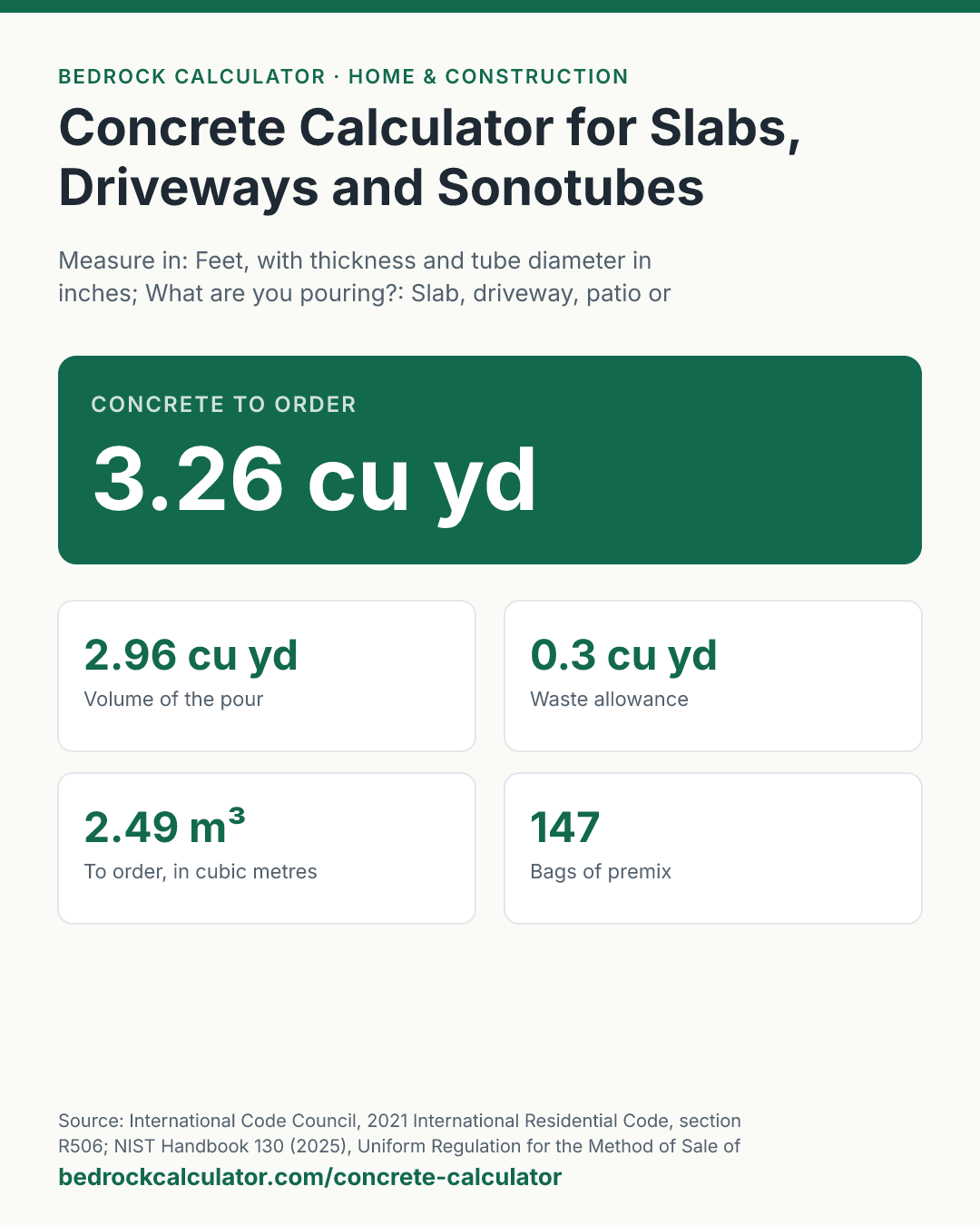
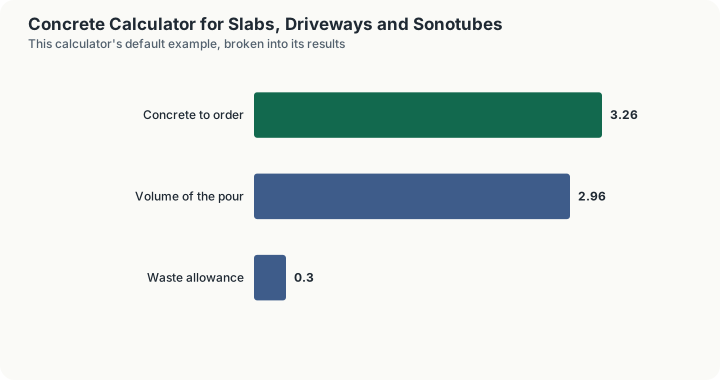
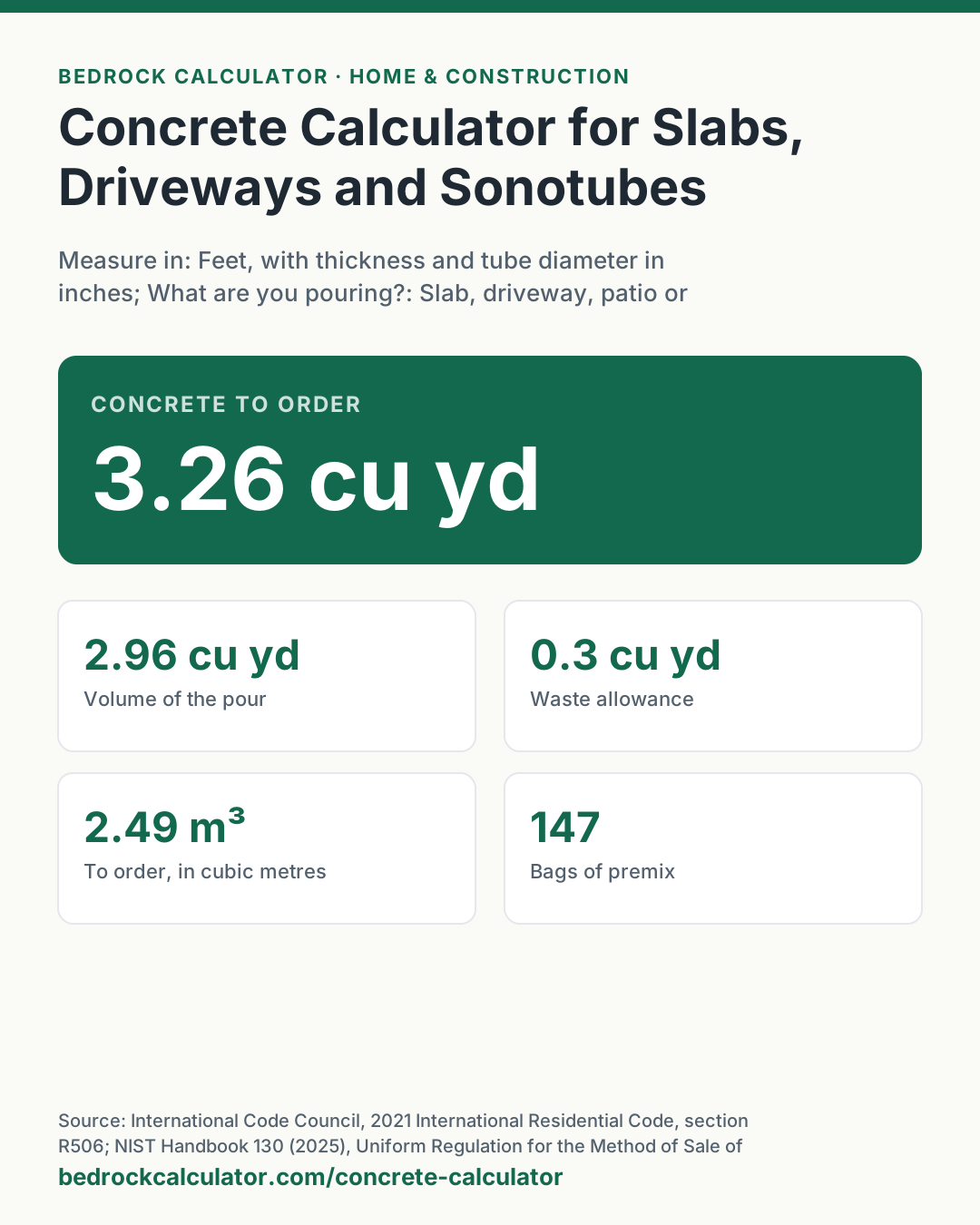
Quick Answer: A slab 20 feet long, 12 feet wide and 4 inches thick takes 2.96 cubic yards of concrete. With a 10% waste allowance, order 3.26 cu yd, or about 147 bags at 0.6 cubic feet per bag.
What does this calculator do?
This concrete calculator works out how much concrete a pour needs, in the cubic yards ready-mix is ordered by, and in bags for smaller jobs you mix yourself.
It handles the two shapes most home projects use: flat slabs (patios, shed bases, driveways, sidewalks and footings) and round columns cast in cardboard tube forms, often called sonotubes, for deck and porch footings.
The volume is plain geometry. A slab is a box; a tube is a cylinder, and several tubes are added together. What the geometry cannot know is how much extra you will need for ground that is not quite level, forms that bulge a little and concrete left in the chute, so the waste allowance is a separate line that you set.
The bag count uses the yield printed on the bag, because premixed concrete comes in several bag sizes. If you enter a price per cubic yard from your ready-mix supplier, the calculator gives the cost; driveway quotes are usually built up the same way, plus labour and finishing.
Using the Concrete Calculator
- Choose feet and inches or metres and centimetres.
- Choose a slab or round tube forms.
- For a slab, enter the length, width and thickness. For tubes, enter the inside diameter, the depth of concrete in each and the number of tubes.
- Set the waste allowance.
- Enter the yield per bag from the bag you plan to buy, and your price per cubic yard if you have a quote.
- Read the cubic yards to order at the top, with cubic feet, cubic metres, bags and cost below.
The presets show four 12 inch sonotubes 4 feet deep, a 40 by 12 foot driveway at 5 inches, and a metric shed base.
How is this calculated?
- Convert to feet. Lengths in metres and thicknesses or diameters in inches or centimetres are converted to feet exactly.
- Find the volume of the pour. A slab is length × width × thickness. A tube is π × radius² × depth, with the radius half the inside diameter, times the number of tubes.
V_slab = L × W × T; V_tubes = n × π(d/2)²h
- Convert to cubic yards. One cubic yard is 27 cubic feet.
- Add the waste allowance as its own line. The pour times your percentage is the allowance; together they are the concrete to order.
- Count bags. The concrete to order in cubic feet divided by the yield per bag, rounded up.
bags = ⌈(V_(order, cu ft))/(yield per bag)⌉
- Price it if asked. Cubic yards to order times your price per cubic yard.
Worked Example
The default is a 20 by 12 foot slab, 4 inches thick:
- Volume: 20 × 12 × (4 ÷ 12) = 80 cubic feet, which is 2.96 cubic yards.
- Waste at 10%: 0.3 cubic yards, for 3.26 cubic yards to order (88 cubic feet, 2.49 cubic metres).
- Bags at 0.6 cubic feet each: 88 ÷ 0.6, rounded up, is 147 bags, which is why a slab this size is usually ordered as ready-mix.
Four 12 inch sonotubes with 4 feet of concrete in each hold 0.47 cubic yards; with waste, order 0.51 cubic yards, or 24 bags.
A driveway 40 by 12 feet and 5 inches thick takes 7.41 cubic yards; with waste, 8.15 cubic yards.
A shed base 4 by 3 metres and 10 centimetres thick takes 1.73 cubic yards (1.32 cubic metres) with waste.
How Much Concrete Do I Need for a Sonotube?
Multiply π by the radius squared by the depth, all in feet. A 12 inch tube holds 0.79 cubic feet per foot of depth, and four of them 4 feet deep hold 0.47 cubic yards. Choose round tube forms, enter the diameter, depth and number of tubes, and the calculator adds them up.
The table below lists the concrete per foot of depth for tubes from 6 to 24 inches across. Footing size and depth are set by your local code and your deck plans, not by the calculator.
How Do You Estimate the Cost of a Concrete Driveway?
Work out the cubic yards, including waste, and multiply by the ready-mix price per cubic yard from your supplier. The calculator does both when you enter the price. A finished driveway quote also includes excavation, base gravel, forms, reinforcement, labour, finishing and sometimes a short-load fee for small orders; ask your contractor for those separately.
The gravel calculator works out the base course.
What does this calculator not account for?
- Thickened edges, footings under slabs and steps. Work each as its own slab and add them.
- Reinforcement. Rebar and mesh take up a tiny share of the volume and are ignored.
- Base course. The gravel under a slab is a separate material; the IRC calls for a 4 inch base under below-grade slabs.
- Bell-shaped footings. Tubes with flared bases hold more than a straight cylinder.
- Strength and mix. The calculator counts volume only. The concrete strength required depends on the use and the code.
What mistakes do people make with this?
- Entering the thickness in feet. Thickness is in inches (or centimetres). Four inches is 4, not 0.33.
- Dividing by 9 instead of 27. Cubic feet to cubic yards is ÷ 27.
- Ordering the exact volume. Ready-mix shortfalls are expensive. Keep a waste allowance.
- Using the outside diameter of a tube. The concrete fills the inside.
- Assuming one bag size. Bag yields differ; read the bag.
Frequently Asked Questions
How many cubic yards of concrete do I need for a 10 by 10 slab?
How thick should a concrete slab be?
How many bags of concrete make a cubic yard?
How much concrete is in a sonotube?
Can I measure in metres?
Sources
- International Code Council, 2021 International Residential Code, section R506: 3½ inch minimum slab thickness and the 4 inch base course. codes.iccsafe.org/content/IRC2021P2/chapter-5-floors
- NIST Handbook 130 (2025), Uniform Regulation for the Method of Sale of Commodities, section 2.29: sand, gravel and aggregate sold in bulk by the cubic yard, cubic metre or weight. doi.org/10.6028/NIST.HB.130-2025
- NIST Handbook 44, Appendix C, General Tables of Units of Measurement: the cubic foot and cubic yard. nist.gov/pml/owm/nist-handbook-44-current-edition