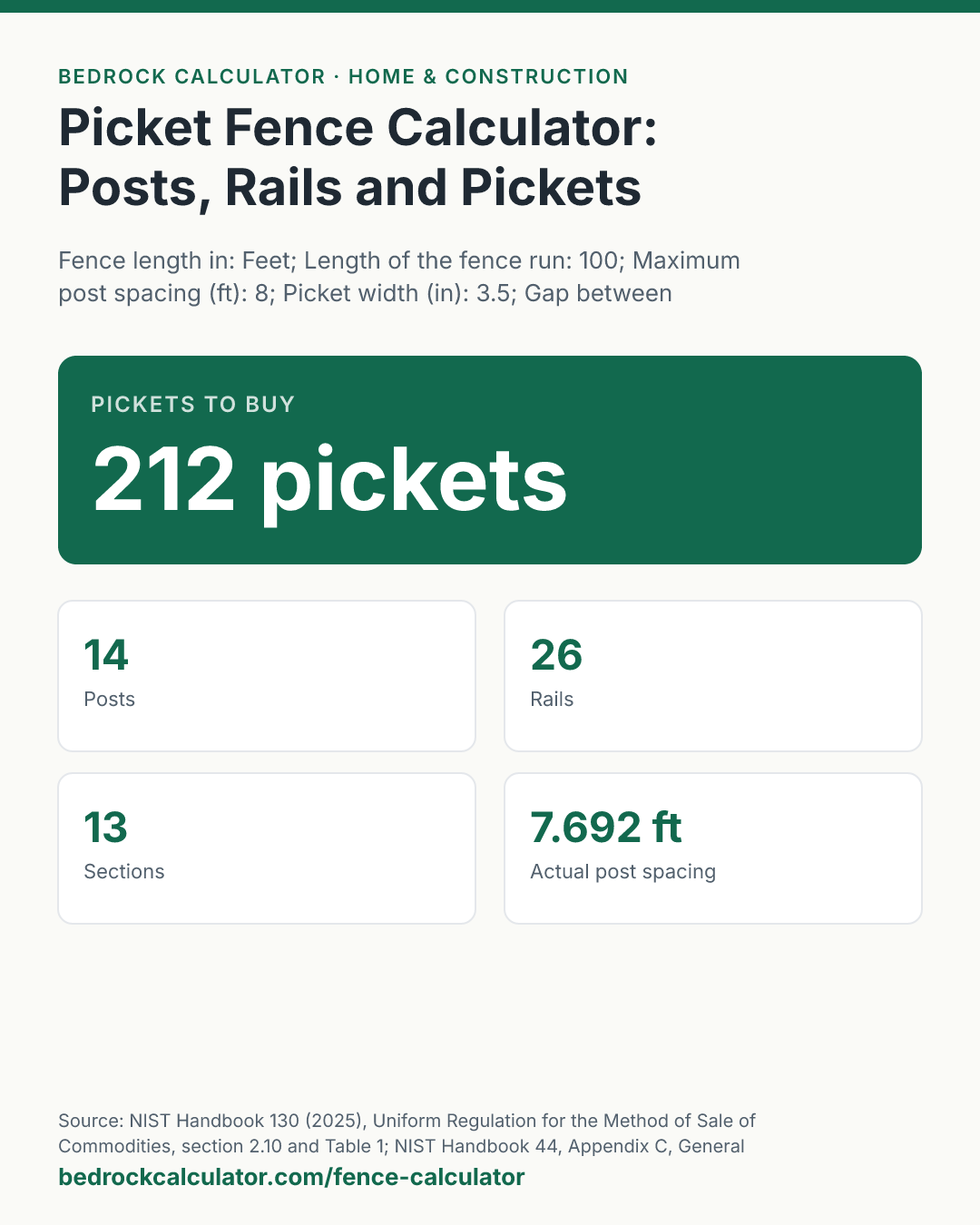

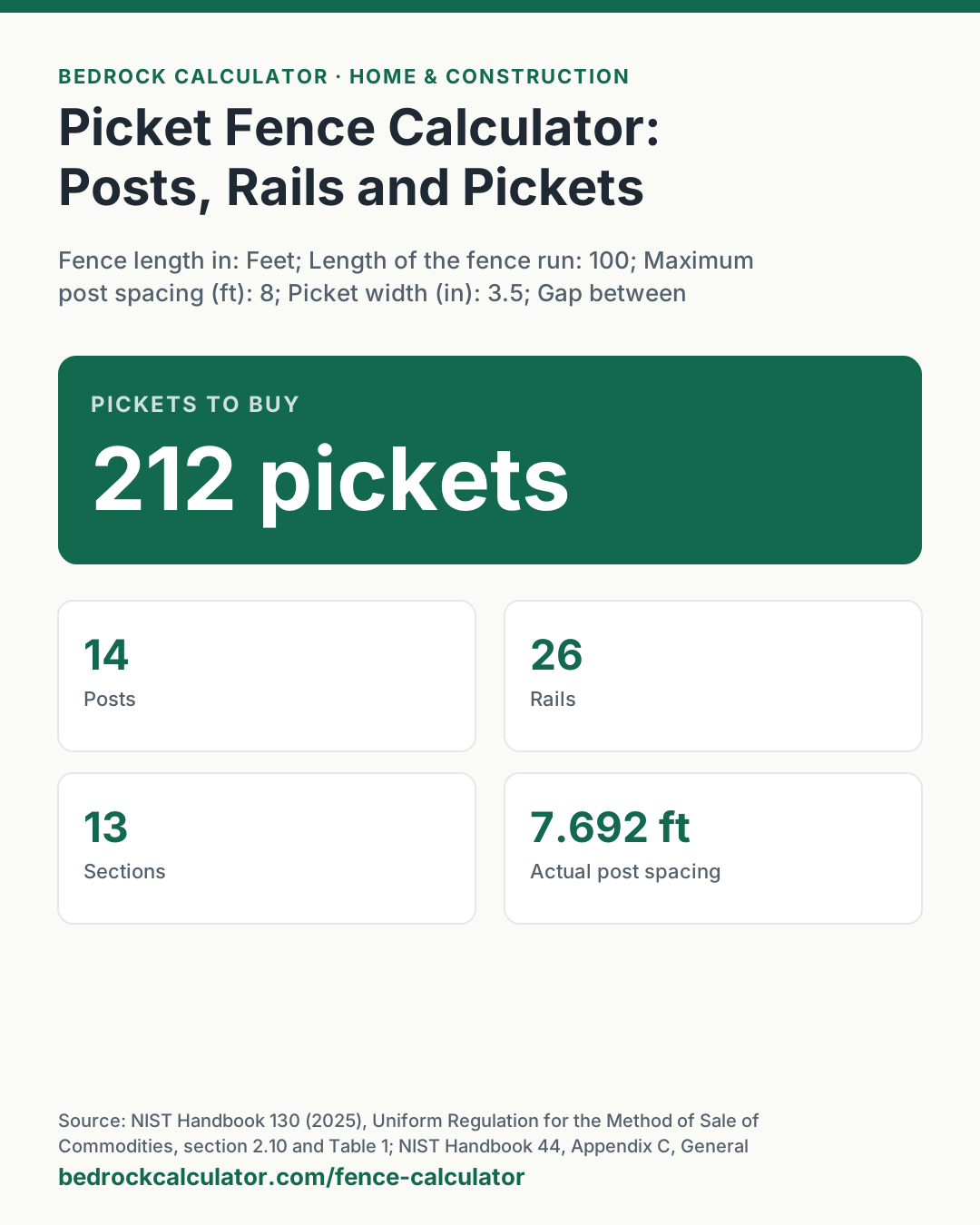
Quick Answer: A 100 foot picket fence with posts no more than 8 feet apart needs 14 posts and 26 rails. With 3.5 inch pickets and 2.5 inch gaps it takes 201 pickets; with 5% spares, buy 212 pickets.
What does this calculator do?
This picket fence calculator counts the posts, rails and pickets for a straight run of fence. Enter the length of the run, the farthest apart you want the posts, the width of your pickets and the gap between them, and it works out how many of each to buy.
The posts are spaced evenly. Rather than putting a post every 8 feet and leaving an odd short section at the end, the calculator splits the run into the fewest equal sections no longer than your maximum, so every section is the same length and the fence looks even. Rails go in every section. Pickets are counted along the whole run: the smallest number whose widths and gaps together cover it.
Picket width matters more than people expect. Lumber is sold by its nominal size, and a dry 1x4 is actually 3½ inches wide, a 1x6 is 5½ inches. The default uses the true width of a 1x4.
Using the Picket Fence Calculator
- Choose feet or metres and enter the length of one straight run.
- Enter the maximum post spacing in feet, usually set by the length of the rails you will buy.
- Enter the actual picket width and the gap you want between pickets. Use 0 for a privacy fence with no gaps.
- Choose two or three rails per section.
- Set the spare picket allowance and read the counts.
The presets show the same run as a privacy fence with 5½ inch boards and three rails, a 50 foot front fence, and a 30 metre run.
How is this calculated?
- Convert to inches. The run (in feet or metres) and the post spacing are converted to inches exactly.
- Split the run into equal sections. The run divided by the maximum post spacing, rounded up, is the number of sections. Each section is then the run divided by that number, which is never longer than your maximum.
sections = ⌈L/s_max⌉; posts = sections + 1
- Count posts and rails. A straight run with a post at each end has one more post than sections. Rails are sections times rails per section; rail material is rails times the section length.
- Count pickets. With n pickets of width w and n − 1 gaps of g, the fence covers n × w + (n − 1) × g. The smallest n that covers the run is:
n = ⌈(L + g)/(w + g)⌉
- Add spares as their own line, then round up. The picket count times your percentage is the spare allowance.
Worked Example
The default is a 100 foot run, posts at most 8 feet apart, 2 rails, 3.5 inch pickets and 2.5 inch gaps:
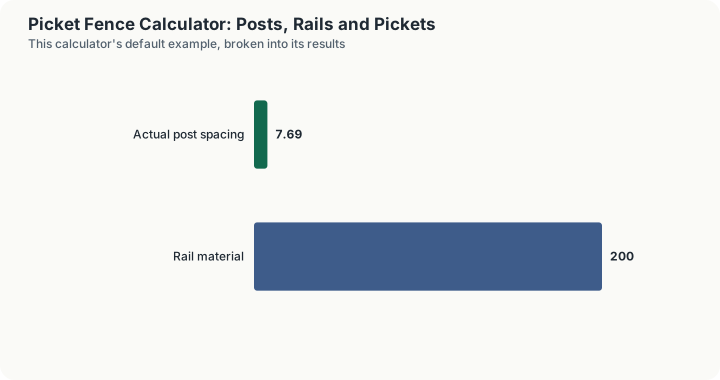
- Sections: 100 ÷ 8 = 12.5, rounded up to 13, each 7.692 feet long.
- Posts: 13 + 1 = 14. Rails: 13 × 2 = 26, or 200 feet of rail.
- Pickets: 1,200 inches of run plus one 2.5 inch gap, divided by 6 inches per picket and gap, rounded up, is 201 pickets.
- Spares at 5%: 10.1, so buy 212 pickets.
As a privacy fence with 5½ inch boards butted together and three rails, the same run takes 219 boards (230 with spares) and 39 rails.
A 50 foot front fence takes 8 posts, 14 rails and 101 pickets, 107 with spares. A 30 metre run takes 14 posts and 198 pickets.
How Many Pickets Do I Need?
Add the picket width to the gap, and divide that into the fence length plus one gap, rounding up. With 3½ inch pickets and 2½ inch gaps, each picket and its gap take 6 inches, so a fence needs about two pickets per foot. The table below lists posts, rails and pickets for runs from 16 to 200 feet.
How Far Apart Should Fence Posts Be?
No farther than your rails can span, and often closer. Rails are commonly sold in 8 foot lengths, which is why 8 feet is the starting maximum here. Taller or heavier fences, windy sites and local rules can call for closer spacing. The calculator spaces the posts evenly at or under the maximum you set.
How Do You Lay Out a Fence With Several Sides?
Measure each straight side separately, from corner post to corner post, and run the calculator once for each. Add up the pickets and rails. For posts, add up each side's posts and then subtract one for every corner where two sides meet, since that post is shared.
If a gate sits in a run, measure the run on each side of the gate as its own section, and leave the gate opening out of the picket count. Mark the post positions with stakes and a string line before you dig, so the even spacing the calculator gives you is what goes in the ground.
What does this calculator not account for?
- Corners and gates. Each run is counted on its own. Where two runs meet at a corner, they share a post; subtract one post for each shared corner. Gates need their own posts, hardware and framing.
- Post length and concrete. Posts must be set deep enough for your soil and frost line. Count concrete with the concrete calculator using the tube option, or ask your supplier.
- Slopes. On a slope the fence follows the ground, and stepped sections can need more pickets.
- Picket overhang at ends. The count covers the run exactly; how the end pickets sit on the posts is a building choice.
- Fasteners, caps and finish. Not included.
What mistakes do people make with this?
- Using the nominal picket width. A 1x4 is 3½ inches wide, not 4. Using 4 undercounts the pickets.
- Forgetting the end post. Posts are one more than sections.
- Spacing posts exactly 8 feet and leaving a stub. Equal sections look better and use the same number of posts.
- Counting each side of a corner separately. Shared corner posts are counted twice if you add two runs.
Frequently Asked Questions
How many pickets do I need for a 16 foot fence?
How many fence posts do I need for 100 feet?
How wide is a fence picket?
How many rails does a picket fence need?
Can I use metres?
Sources
- NIST Handbook 130 (2025), Uniform Regulation for the Method of Sale of Commodities, section 2.10 and Table 1: nominal and dressed sizes of softwood boards (a dry 1x4 is 3½ inches wide). doi.org/10.6028/NIST.HB.130-2025
- NIST Handbook 44, Appendix C, General Tables of Units of Measurement: the inch, foot and metre. nist.gov/pml/owm/nist-handbook-44-current-edition