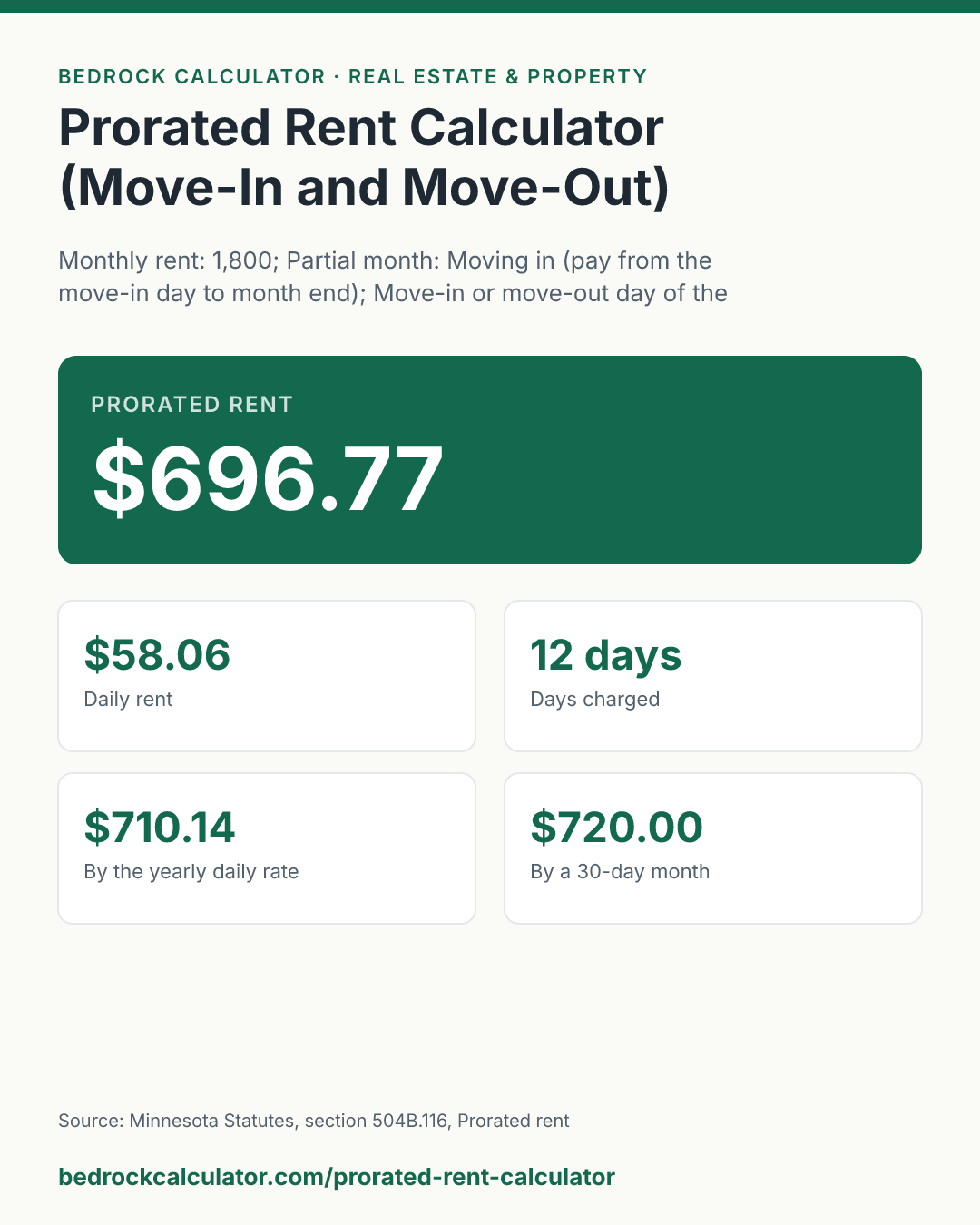

Quick Answer: At $1,800 a month, moving in on the 20th of a 31-day month means paying for 12 days, which is $696.77 at the actual-days rate. Divide the rent by the days in the month, then multiply by the days you occupy.
What does this calculator do?
This prorated rent calculator works out the rent for a partial month, at the start of a lease or at the end. Enter the monthly rent, the move-in or move-out day, and how many days the month has, and it returns the prorated amount along with the daily rate and the number of days charged.
There is no single national rule for prorating rent, and three methods are in common use. The calculator shows all three side by side so you can see which one your landlord used, or which one your lease or state law calls for:
- Actual days in the month: the rent divided by the days in that particular month. Minnesota requires this method when a lease ends partway through a month: its statute says proration must use the actual number of calendar days for the calendar month.
- Yearly daily rate: the rent times 12, divided by 365, which gives one daily rate for every month of the year.
- 30-day month: the rent divided by 30 whatever the month, sometimes called a banker's month.
The answers differ by tens of dollars on a typical rent, so it is worth knowing which applies before you sign or pay.
Using the Prorated Rent Calculator
- Enter the full monthly rent.
- Choose moving in or moving out. Moving in charges from the move-in day to the end of the month; moving out charges from the 1st to the move-out day.
- Enter the day of the month you move in or out.
- Choose how many days that month has. February is 28 days, or 29 in a leap year.
- Choose the daily rate method your lease uses. If you do not know, compare the three results shown below the main figure.
The presets cover a move-out on the 10th of a 30-day month, a February move-out, the default move-in at the 30-day rate, and a move-in on the 1st where the 30-day rate would exceed a full month's rent.
How is this calculated?
- Count the days charged. The move-in or move-out day itself counts as a day of rent. Moving in on day d of an n-day month pays for n − d + 1 days. Moving out on day d pays for d days.
- Find the daily rate. Under the method you choose:
actual = rent/(days in month); yearly = (rent × 12)/365; 30-day = rent/30
- Multiply. The prorated rent is the daily rate times the days charged.
prorated rent = daily rate × days charged
- Cap at a full month. A partial month never costs more than a whole one. If the daily rate times the days would exceed the monthly rent, which can happen with the 30-day or yearly rate in a 31-day month, the result is capped at the monthly rent.
- Round for display. The daily rate is carried at full precision and only rounded to the cent when shown, so the daily rate on screen times the days can differ from the total by a cent or two.
Worked Example
With the default inputs, $1,800 rent, moving in on the 20th of a 31-day month, actual days:
- Days charged: 31 − 20 + 1 = 12 days (the 20th through the 31st).
- Daily rate: $1,800 ÷ 31 = $58.06, shown to the cent.
- Prorated rent: the unrounded daily rate × 12 = $696.77.
- That is $1,103.23 less than a full month.
The same move-in under the other methods:
- Yearly rate: $1,800 × 12 ÷ 365 a day, so 12 days cost $710.14.
- 30-day month: $1,800 ÷ 30 = $60.00 a day, so 12 days cost $720.00.
Moving out of a $1,200 apartment on the 10th of a 30-day month costs $400.00 by actual days or by a 30-day month, since the month has 30 days, and $394.52 at the yearly rate.
Which Prorating Method Costs Less?
It depends on the month. In a 30-day month the actual-days and 30-day methods give the same answer. In a 31-day month the actual-days method is cheapest per day, and in February it is the most expensive per day, because the same rent is spread over fewer days.
The second table below the calculator shows this for a $1,500 rent and a move-in on the 15th. In February the tenant pays $750.00 by actual days but only $690.41 at the yearly rate. In a 31-day month it flips: $822.58 by actual days against $850.00 for a 30-day month.
The yearly rate gives the same daily figure all year, $49.32 a day at $1,500, which makes it the easiest to check. The actual-days rate is the one that matches the calendar exactly.
What does this calculator not account for?
- State and local law. Some states set a method for some situations, such as Minnesota for a lease ending mid-month. Many leave it to the lease. Check your lease and your state's landlord-tenant law.
- Lease terms. Many leases say whether rent is prorated at all, or require a full first month and prorate the second. The calculator assumes the partial month is prorated.
- Fees and deposits. Security deposits, pet rent, parking and utilities are not prorated here. Prorate them separately if your lease does.
- Notice periods. Moving out early does not always end the obligation to pay. A required notice period can extend the rent you owe beyond your move-out day.
- Mid-lease rent changes. One monthly rent is used for the whole calculation.
- Partial-day rules. The calculator counts the move-in and move-out day as a full day. Some leases do not charge for the move-out day.
What mistakes do people make with this?
- Off-by-one day counts. The 20th through the 31st is 12 days, not 11. Count both the first and the last day.
- Assuming every month has 30 days. Use the real month length unless your lease says 30.
- Mixing methods. Using a 30-day rate for the move-in month and actual days for the move-out month makes the two partial months add up to something other than one month's rent.
- Rounding the daily rate first. Rounding to the cent before multiplying can shift the total by a few cents. The calculator rounds once, at the end.
- Forgetting the leap year. February has 29 days in a leap year, which lowers the daily rate by actual days.
Frequently Asked Questions
How do I calculate prorated rent?
What is the prorated rent for moving out on the 10th?
Does the move-in day count toward prorated rent?
How is rent prorated in February?
Can a landlord charge a full month for a partial month?
What is a banker's month?
Sources
- Minnesota Statutes, section 504B.116, Prorated rent: proration at the average daily rate using the actual number of calendar days in the month. revisor.mn.gov/statutes/cite/504B.116