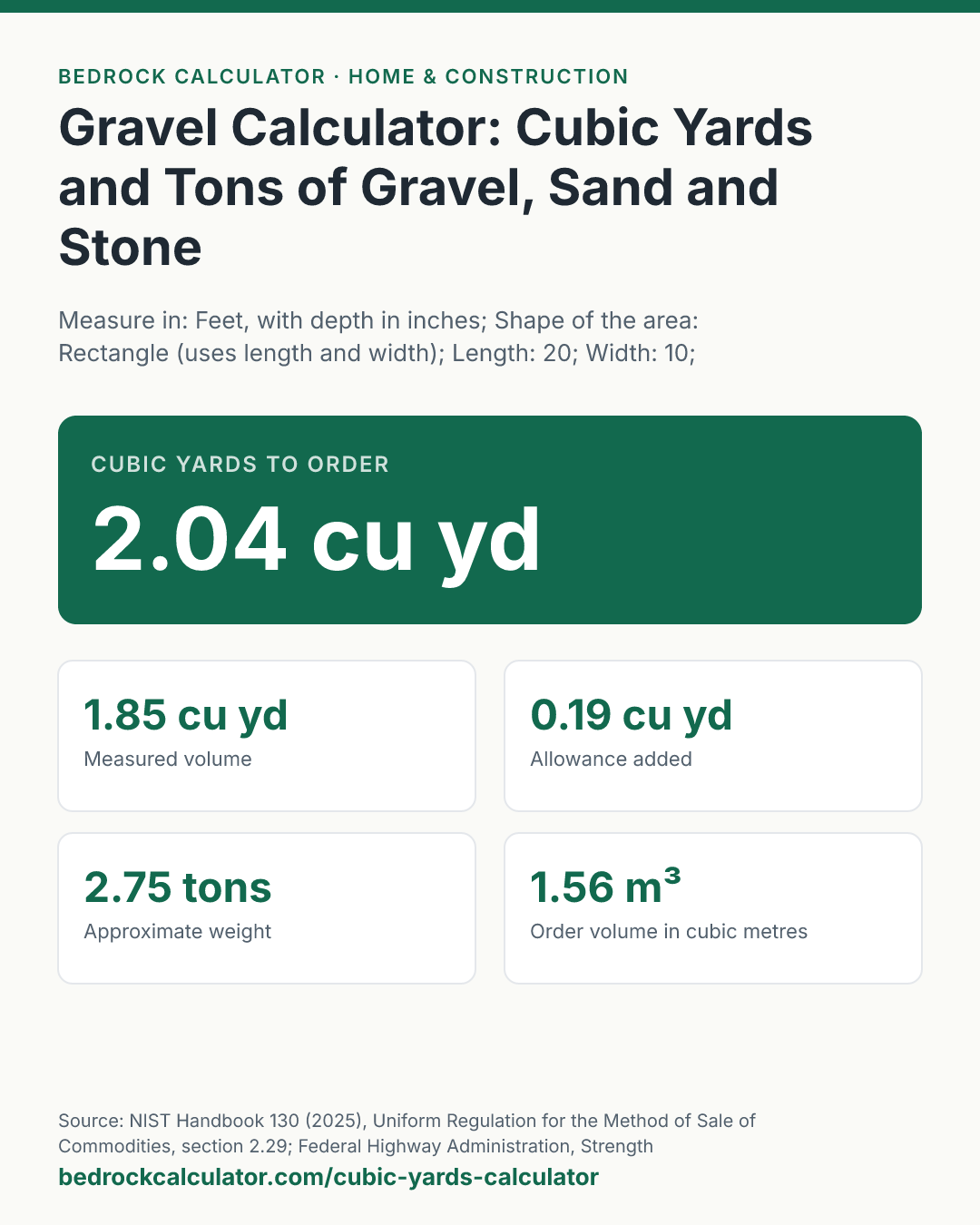
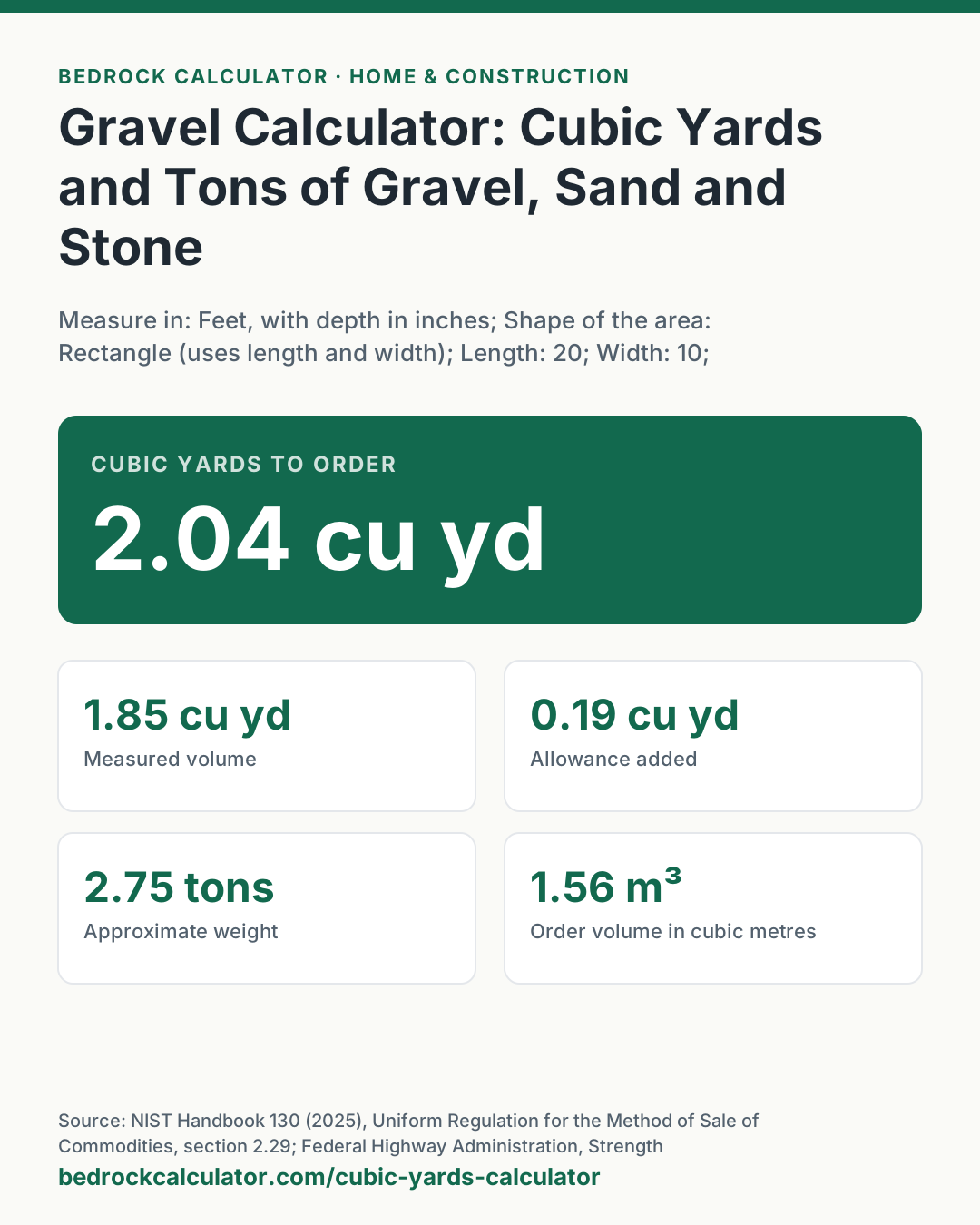
Quick Answer: A 20 by 10 foot area 3 inches deep holds 1.85 cubic yards of gravel. With a 10% allowance for compaction and spillage, order 2.04 cu yd, which weighs about 2.75 tons at 100 lb per cubic foot.
What does this calculator do?
This gravel calculator works out how many cubic yards of gravel, crushed stone, sand, topsoil or mulch you need to fill an area to a given depth, and roughly what that much material weighs.
Landscape suppliers sell bulk material by the cubic yard or by the ton, so it gives you both, along with cubic feet, cubic metres and a bag count for bagged products.
The calculation has two parts, and the page keeps them apart. The first is plain geometry: area times depth is the volume of the finished bed. The second is a judgement: loose stone packs down when it is compacted, and some always ends up outside the bed, so you order a little more. That allowance is a number you choose, and it shows up as its own line rather than being folded into the total.
The weight depends on the material. A cubic yard of dry crushed stone, damp sand and shredded bark weigh very different amounts, so the calculator asks for the bulk density instead of assuming one.
Using the Gravel Calculator
- Choose feet and inches or metres and centimetres.
- Pick a rectangle or a circle, and enter the length and width or the diameter. For an odd shape, use the square footage calculator to get the area and enter it here as a rectangle of that many square feet by 1 foot.
- Enter the depth of the finished layer.
- Set the allowance. Ten percent is the starting value; raise it for a base that will be compacted hard.
- Enter the bulk density your supplier sells by, if you want the weight to match their ticket.
- Optionally enter a bag size for bagged gravel, sand or potting mix, and a price from your quote.
The presets load a 50 by 12 foot gravel driveway at 4 inches, a paver sand bed under a 12 by 12 foot patio, and an 8 foot round bed.
How is this calculated?
- Find the area. A rectangle is length times width. A circle is pi times half the diameter squared. Metric measurements are converted to square feet through the exact foot of 0.3048 metres.
- Multiply by the depth. The depth is converted from inches (or centimetres) to feet and multiplied by the area, which gives the measured volume in cubic feet.
V_(cu ft) = A_(sq ft) × (depth in inches)/12
- Convert to cubic yards. A cubic yard is 3 by 3 by 3 feet, which is 27 cubic feet.
V_(cu yd) = (V_(cu ft))/27
- Add the allowance as its own line. The measured cubic yards times your allowance percentage is the allowance. Measured volume plus allowance is the volume to order.
- Estimate the weight from the bulk density. The order volume is converted to cubic metres, the density you entered in pounds per cubic foot is converted to kilograms per cubic metre, and the product is expressed in US short tons of 2,000 pounds and in metric tonnes.
tons = (V_(cu ft) × density (lb/ft³))/2000
- Count bags and price it. Bags are the order volume in cubic feet divided by the bag size, rounded up to a whole bag. The cost is the quantity in the unit your price is quoted in (cubic yards, tons, tonnes or cubic metres) times that price. With no price entered, the cost is zero.
Worked Example
The default is a 20 by 10 foot area, 3 inches deep:
- Area: 20 × 10 = 200 sq ft.
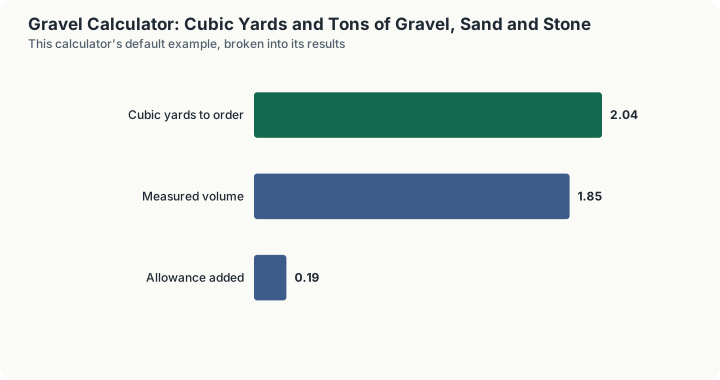
- Measured volume: 200 × 3 ÷ 12 = 50 cubic feet, and 50 ÷ 27 = 1.85 cubic yards.
- Allowance at 10%: 0.19 cubic yards.
- Order: 2.04 cubic yards, which is 55 cubic feet or 1.56 cubic metres.
- Weight at 100 lb per cubic foot: 55 × 100 = 5,500 lb, or 2.75 tons (2.49 tonnes).
- In half cubic foot bags: 110 bags.
A gravel driveway 50 feet long and 12 feet wide, topped with 4 inches of stone, is 600 square feet and 7.41 cubic yards measured. With the allowance, order 8.15 cubic yards, about 11 tons at the same density.
A paver sand bed 1 inch deep under a 12 by 12 foot patio needs only 0.44 cubic yards measured and 0.49 cubic yards with the allowance. That is 13.2 cubic feet, or 27 half cubic foot bags, which is why sand for a small patio is often cheaper bagged than delivered.
How Much Does a Cubic Yard of Gravel Weigh?
It depends on the stone, its size range and how wet it is. When the Federal Highway Administration tested 13 standard stone gradations for its report on open-graded aggregates, the loose unit weights ran from about 86 to 116 pounds per cubic foot, and the same stone packed to its maximum density weighed between 101 and 146.
At 100 pounds per cubic foot, one cubic yard weighs 1.35 tons; the table below shows the range from 80 to 120. Sand, topsoil and mulch fall outside the stone figures, so for those, use the density your supplier quotes or weigh a bucket of known volume.
How Much Paving Sand or Crushed Stone Does a Patio Need?
A paver patio usually has two layers: a compacted base of crushed stone and a thin bed of sand on top. Work each layer separately. Run the calculator once for the base at its depth, then again for the sand at its depth, with the same length and width.
Base layers are compacted, so they deserve a higher allowance than the sand. The coverage table below shows how many cubic yards 100 square feet takes at depths from 1 to 12 inches, which scales directly: 300 square feet needs three times as much.
What does this calculator not account for?
- Slopes and uneven ground. The depth is treated as even across the whole area. Where the ground dips, measure the depth at several points and use the average.
- Material-specific compaction. The allowance is one percentage you choose. The calculator does not know how much a particular stone settles.
- Moisture. Wet sand and soil weigh more than dry. The weight is only as good as the density you enter.
- Delivery minimums and truck sizes. Suppliers often round orders to a half or whole yard and may have a minimum. Round up yourself.
- Prices. None are built in. The cost line only multiplies your own quote.
What mistakes do people make with this?
- Entering the depth in feet. The depth box takes inches in US mode. Three inches is 3, not 0.25.
- Dividing by 9 instead of 27. Square feet to square yards is ÷ 9, but cubic feet to cubic yards is ÷ 27.
- Ordering the measured volume exactly. Loose stone shrinks when compacted. Without an allowance you will come up short.
- Assuming a ton and a cubic yard are the same. For most gravel a cubic yard weighs more than a ton. Check which unit your quote uses before comparing prices.
- Using a stone density for mulch or soil. Bark mulch is far lighter than gravel. Use the right density or ignore the weight.
Frequently Asked Questions
How many square feet does a cubic yard of gravel cover?
How deep should gravel be for a driveway?
Can I use this as a potting mix calculator?
How do I convert tons of gravel to cubic yards?
Why does the calculator ask for an allowance?
What if my area is not a rectangle or a circle?
Sources
- NIST Handbook 130 (2025), Uniform Regulation for the Method of Sale of Commodities, section 2.29: sand, rock, gravel and stone sold in bulk by the cubic yard, cubic metre or weight. doi.org/10.6028/NIST.HB.130-2025
- Federal Highway Administration, Strength Characterization of Open-Graded Aggregates for Structural Backfills, FHWA-HRT-15-034: minimum and maximum unit weights of 13 AASHTO gradations. fhwa.dot.gov/publications/research/infrastructure/structures/bridge/15034/006.cfm
- International Code Council, 2021 International Residential Code, section R506.2.2: 4 inch base course under slabs. codes.iccsafe.org/content/IRC2021P2/chapter-5-floors
- NIST Special Publication 811, Appendix B: conversion factors for cubic yards, pounds and tons. nist.gov/pml/special-publication-811