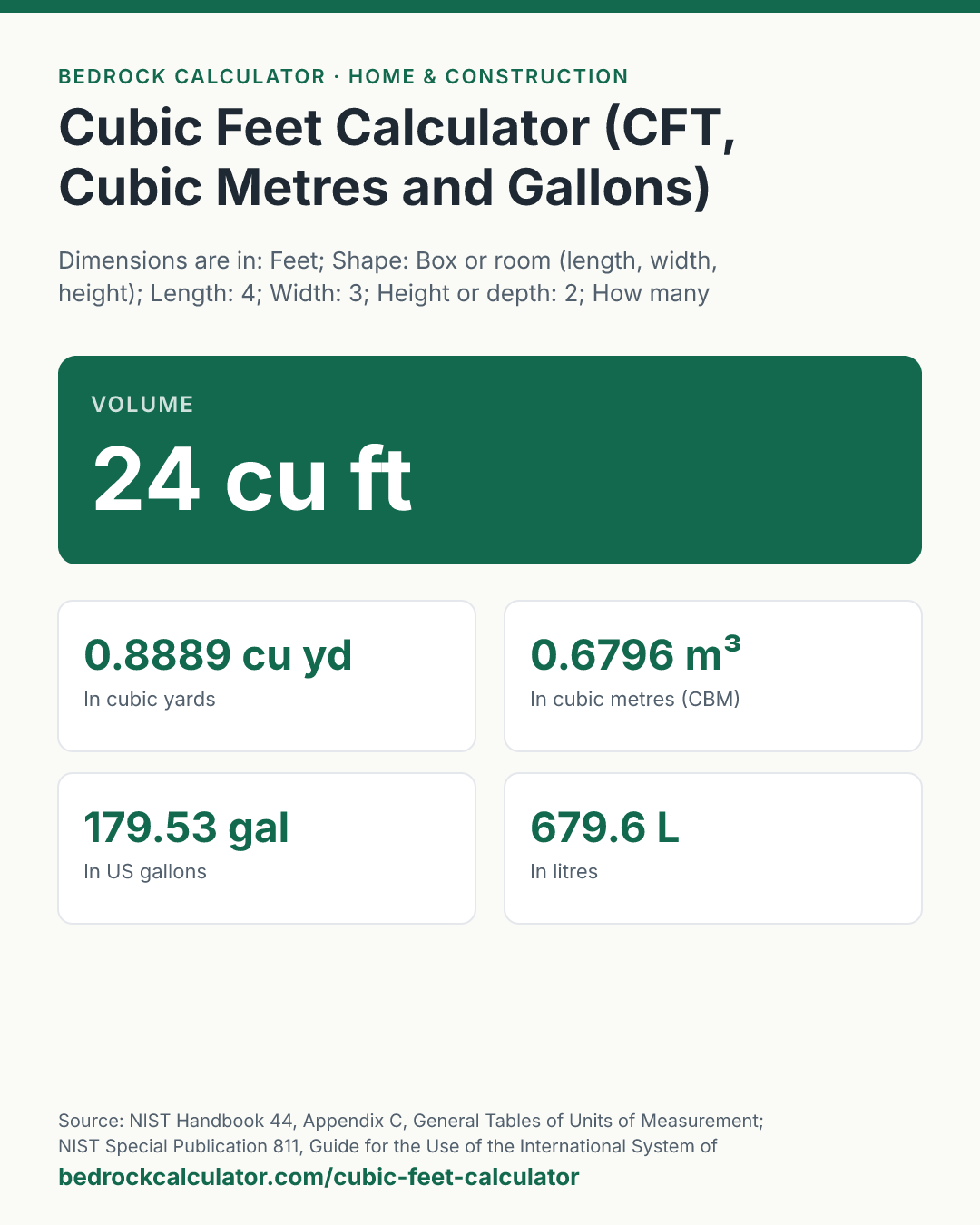
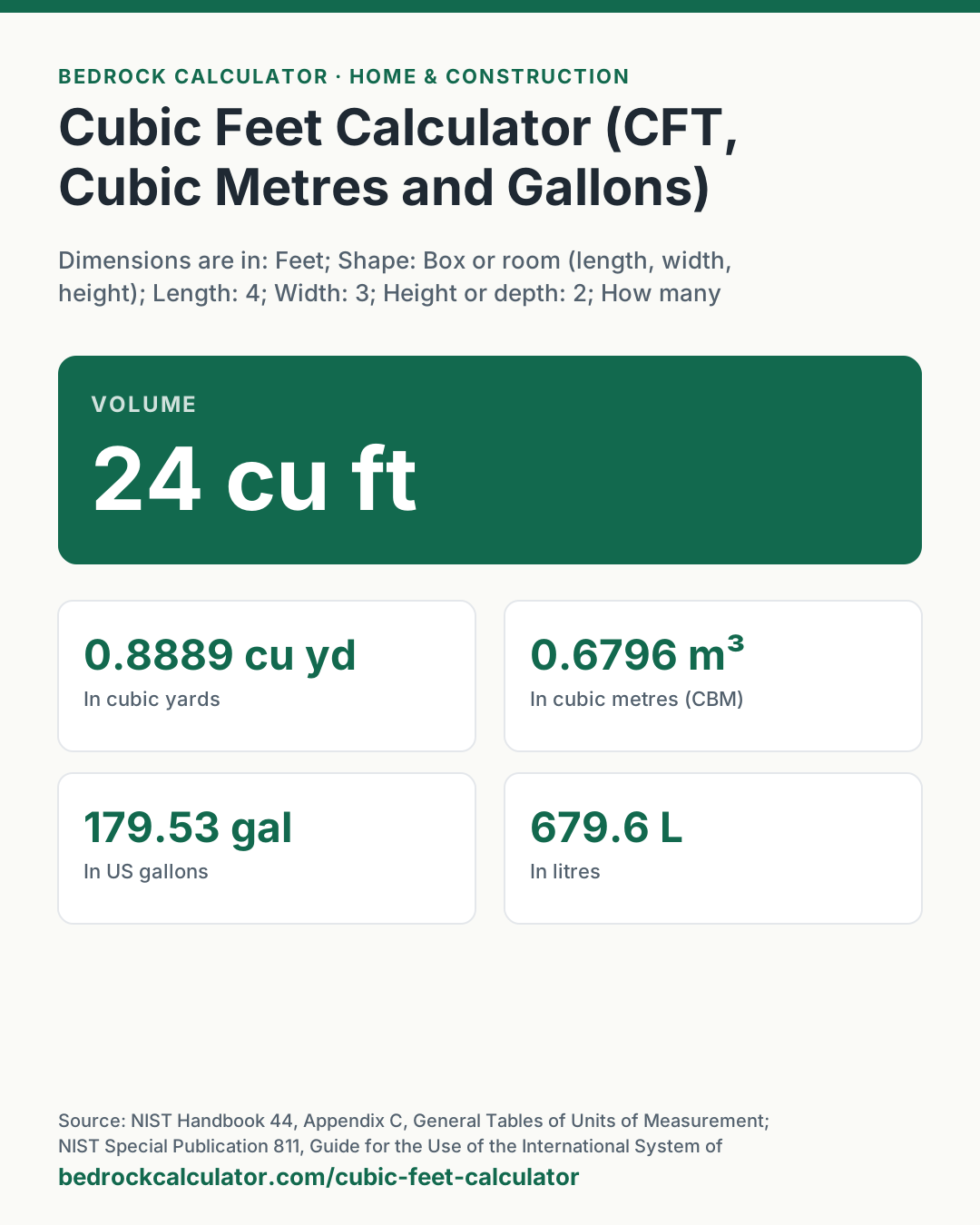
Quick Answer: A box 4 feet long, 3 feet wide and 2 feet high holds 24 cu ft, which is 0.8889 cubic yards, 0.6796 cubic metres or 179.53 US gallons. Multiply length by width by height in feet to get cubic feet.
What does this calculator do?
This cubic feet calculator finds the volume of a box, a room, a container or a round drum, and gives it in the units people actually buy and ship in: cubic feet (often written CFT or ft³), cubic yards, cubic metres (the CBM used for freight), cubic inches, US gallons and litres.
Measure in whatever unit is handy. Inches suit boxes and appliances, feet suit rooms and storage units, and metres or centimetres suit shipping crates. The calculator works the volume out in the unit you measured in, then converts it exactly. If you are pricing several identical boxes, enter how many and it multiplies for you.
Every conversion comes from the international inch of exactly 2.54 centimetres and the US gallon of exactly 231 cubic inches, so a cubic foot is exactly 1,728 cubic inches and 0.028316846592 cubic metres. Only the display is rounded.
Using the Cubic Feet Calculator
- Choose the unit your tape measure shows.
- Choose a box for anything with flat sides, or a cylinder for a drum, tank, tube or round planter.
- For a box, enter length, width and height. For a cylinder, enter the diameter and the height.
- If you have several of the same thing, enter the number.
- Read the volume in cubic feet at the top, and the other units below it.
The presets load a medium moving box measured in inches, ten shipping cartons measured in centimetres, a room and a round drum.
How is this calculated?
- Work out the volume in the unit you entered. A box is length × width × height. A cylinder is pi × radius² × height, with the radius taken as half the diameter and pi carried to 34 digits.
V_box = L × W × H; V_cylinder = π(d/2)²h
- Convert to cubic feet. The volume is converted through the exact size of each cubic unit. A cubic foot is 12 × 12 × 12 = 1,728 cubic inches, a cubic yard is 27 cubic feet, and a cubic metre is about 35.3 cubic feet.
cu ft = (cu in)/1728; cu ft = m³/0.028316846592
- Multiply by the count. For several identical items, the single volume is multiplied by how many there are.
- Convert to the other units. Cubic yards divide by 27. Cubic metres use the exact factor above. Gallons divide the cubic inches by 231, the definition of the US gallon, which works out to about 7.48 gallons per cubic foot. Litres are cubic metres times 1,000.
- Round for display. Cubic feet show up to three decimal places, cubic yards and cubic metres four, gallons and litres two.
Worked Example
The default is a box 4 feet by 3 feet by 2 feet:
- Volume: 4 × 3 × 2 = 24 cubic feet.
- Cubic yards: 24 ÷ 27 = 0.8889 cu yd.
- Cubic metres: 24 × 0.028316846592 = 0.6796 m³.
- Gallons: 24 cubic feet is 41,472 cubic inches, and 41,472 ÷ 231 = 179.53 gallons, or 679.6 litres.
A moving box 18 by 18 by 16 inches is 5,184 cubic inches. Divide by 1,728 and it is exactly 3 cubic feet, or 0.085 m³.
Ten cartons of 60 by 40 by 40 centimetres come to 0.96 m³, the CBM a freight forwarder would quote. In cubic feet that is 33.902 cu ft.
A round drum 22.5 inches across and 33.5 inches tall is pi × 11.25² × 33.5 = 13,319.9 cubic inches, which is 7.708 cubic feet or 57.66 gallons.
How Do You Calculate Cubic Feet?
Measure the length, width and height in feet and multiply them. If you measured in inches, multiply the three inch measurements and divide by 1,728, or choose inches as the unit and let the calculator do it.
The common slip is dividing inches by 12 only once: a box 24 by 24 by 24 inches is 2 × 2 × 2 = 8 cubic feet, not 24 × 24 × 24 ÷ 12.
How Many Gallons Are in a Cubic Foot?
About 7.48 US gallons. The exact figure is 1,728 ÷ 231, because a cubic foot holds 1,728 cubic inches and the US gallon is defined as 231 cubic inches. To convert cubic feet to gallons, multiply by 7.48; to go from gallons to cubic feet, divide by it.
The table below lists 0.5 to 100 cubic feet in gallons and litres. These are US liquid gallons; the imperial gallon used in the UK is larger and is not used here.
How Do You Work Out CBM for Shipping?
CBM is simply cubic metres. Measure the carton or crate in metres (or centimetres), multiply length by width by height, and multiply by the number of cartons. Choose metres or centimetres as the unit and read the cubic metres line. Ten cartons of 60 by 40 by 40 centimetres, the preset, come to 0.96 m³.
Freight lines often charge by the greater of CBM and weight, and their rounding rules are their own.
What does this calculator not account for?
- Wall thickness. The volume is of the outside dimensions you enter. For the capacity inside a container, measure the inside.
- Irregular shapes. Only boxes and cylinders are worked out. Split an L-shaped space into boxes and add them, or use the dedicated calculators for cones and spheres.
- Packing efficiency. A storage unit or truck of a given cubic footage never holds that much furniture, because things do not pack perfectly.
- Imperial gallons. Gallons here are US gallons of 231 cubic inches.
- Dimensional weight. Carriers convert volume to a billable weight with their own divisor, which this does not apply.
What mistakes do people make with this?
- Mixing units. A box 2 feet by 18 inches by 1 foot needs every length in one unit before multiplying: 2 × 1.5 × 1 = 3 cubic feet.
- Dividing cubic inches by 12 or 144. Cubic inches to cubic feet is ÷ 1,728. Dividing by 144 is square inches to square feet.
- Using the radius as the diameter for a drum. The diameter is the full width. Entering the radius as the diameter gives a quarter of the volume.
- Confusing cubic feet with square feet. Square feet measure a floor; cubic feet measure a space. Floor area times ceiling height gives the cubic feet of a room; the two numbers are not interchangeable.
Frequently Asked Questions
What is CFT?
How do I convert cubic feet to cubic metres?
How many cubic feet is a 12 inch cube?
How do I convert gallons to cubic feet?
How many cubic feet is a room?
What is the volume of a cylinder in cubic feet?
Sources
- NIST Handbook 44, Appendix C, General Tables of Units of Measurement: the cubic inch, cubic foot, cubic yard and the US gallon of 231 cubic inches. nist.gov/pml/owm/nist-handbook-44-current-edition
- NIST Special Publication 811, Guide for the Use of the International System of Units, Appendix B: conversion factors from cubic feet and gallons to cubic metres. nist.gov/pml/special-publication-811
- National Bureau of Standards Miscellaneous Publication 233, Units of Weight and Measure: the 1959 international yard and inch. nvlpubs.nist.gov/nistpubs/Legacy/MP/nbsmiscellaneouspub233.pdf