What do Division 293 tax and the First Home Super Saver Scheme cost or pay?
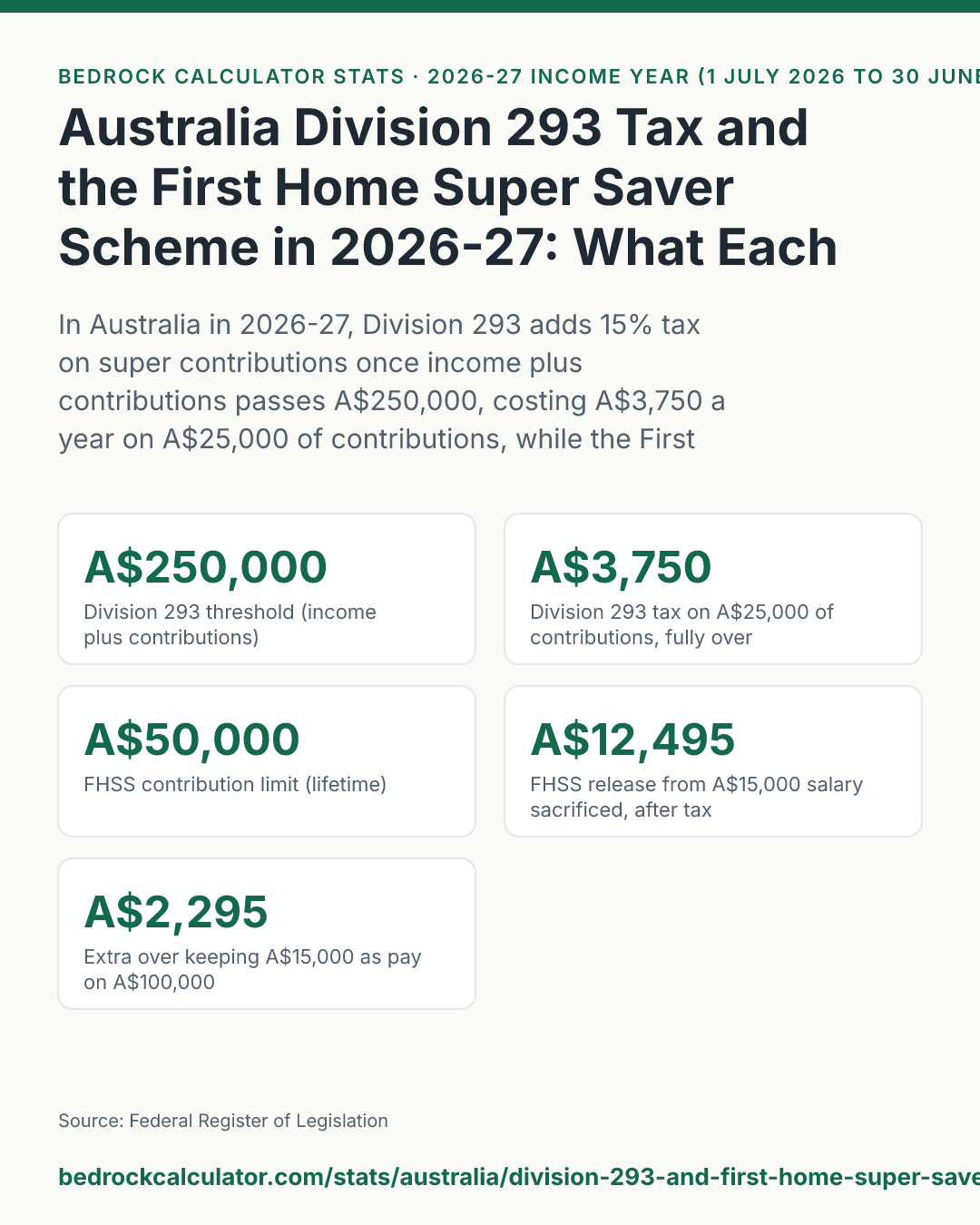
Two super rules matter most at opposite ends of a career in Australia. Division 293 is an extra 15% tax on the super contributions of high earners, and it starts once your income plus your concessional contributions passes A$250,000. On A$25,000 of contributions it costs A$3,750 a year once you're fully over the line.
The First Home Super Saver scheme (FHSS) works the other way. It lets you put voluntary contributions into super, where they're taxed lightly, and take them out later for a first home deposit. Up to A$50,000 of contributions can count, plus the earnings on them. A single A$15,000 salary sacrifice comes back as A$12,495 after tax, before earnings.
How Division 293 works
Concessional contributions, which are your employer's contributions plus any salary sacrifice or personal contributions you claim a deduction for, are normally taxed at 15% when they go into your fund. For someone on the top tax rates that's a big discount, and Division 293 claws part of it back.
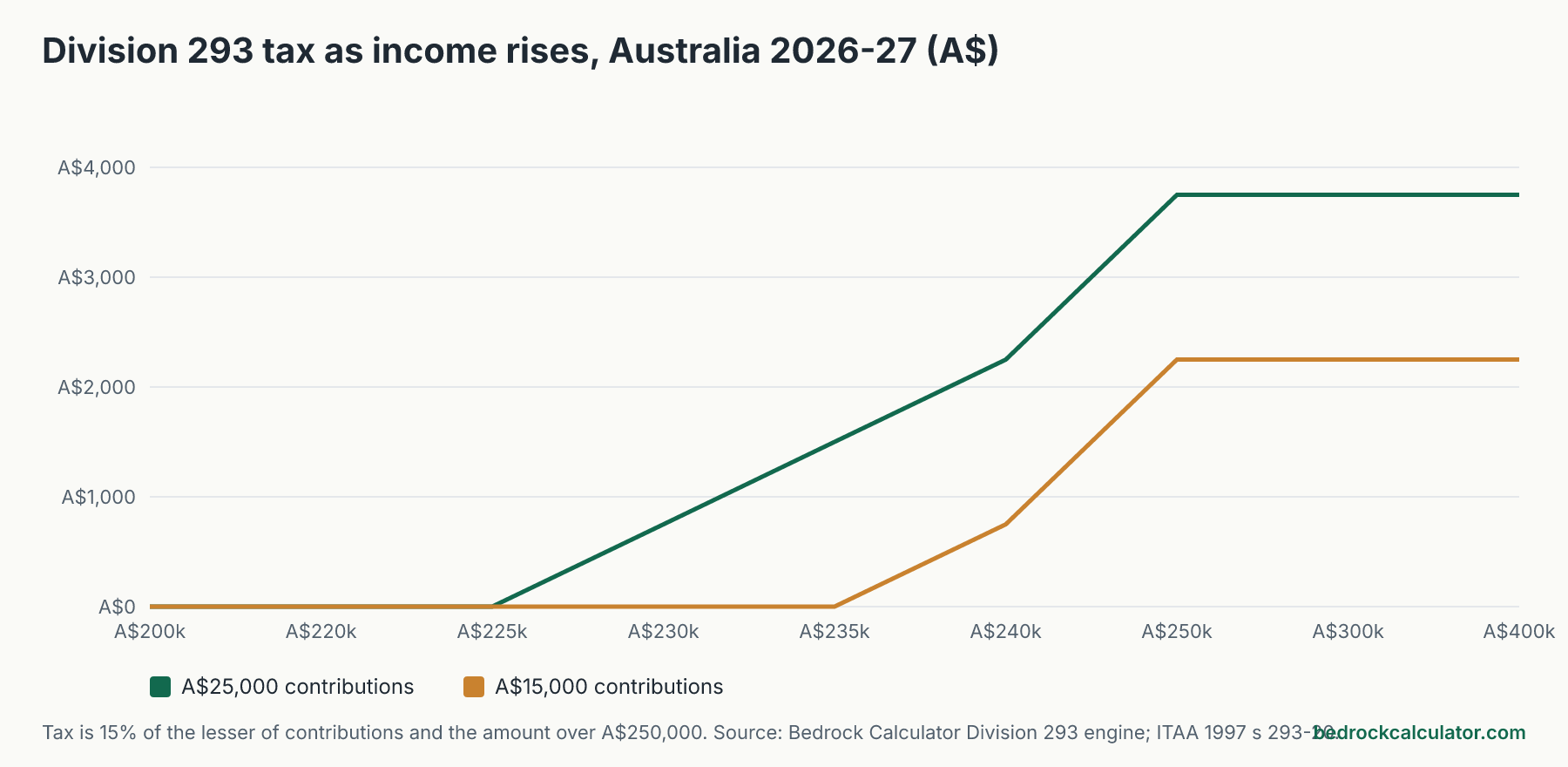
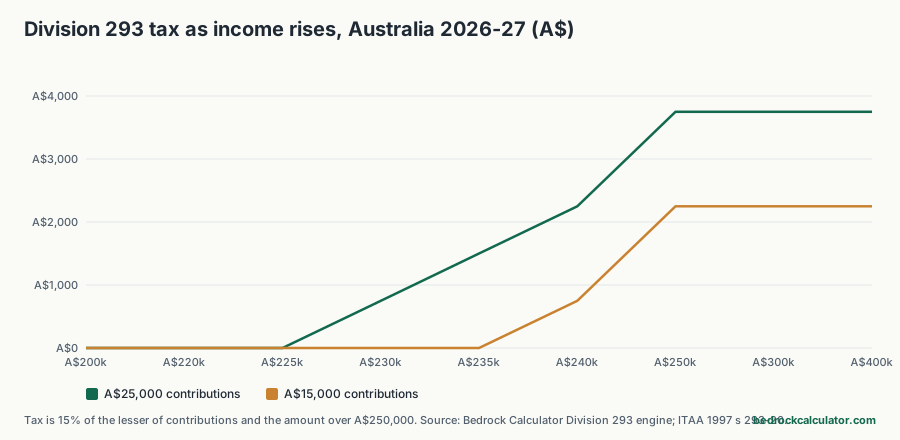
The test adds two things together: your income for surcharge purposes, leaving out the super contributions themselves, and your concessional contributions for the year. If the total is over A$250,000, you pay 15% on whichever is smaller: your contributions, or the amount you're over. That "smaller of" rule produces the ramp in the chart above.
Take someone on A$235,000 with A$25,000 of contributions. Their Division 293 income is A$260,000, which is A$10,000 over the line. Only that slice is taxed, so the bill is A$1,500. At A$250,000 the whole A$25,000 is over and the tax reaches A$3,750. After that it stops growing, however high income goes: it's still A$3,750 at A$400,000, because the tax can never exceed 15% of your contributions.
The threshold is written into the Income Tax Assessment Act 1997 as a fixed dollar amount, with no indexation. As wages rise, more people cross it.
Division 293 at every income
Division 293 tax by income, Australia 2026-27 (A$)
Download CSVIncome is income for surcharge purposes excluding super contributions. Contributions are concessional (employer, salary sacrifice and deductible personal contributions), all within the cap.
| A$200,000 | A$225,000 | A$0 | A$0 |
| A$220,000 | A$245,000 | A$0 | A$0 |
| A$225,000 | A$250,000 | A$0 | A$0 |
| A$230,000 | A$255,000 | A$750 | A$0 |
| A$235,000 | A$260,000 | A$1,500 | A$0 |
| A$240,000 | A$265,000 | A$2,250 | A$750 |
| A$250,000 | A$275,000 | A$3,750 | A$2,250 |
| A$300,000 | A$325,000 | A$3,750 | A$2,250 |
| A$400,000 | A$425,000 | A$3,750 | A$2,250 |
With A$15,000 of contributions the ramp starts later and tops out lower, at A$2,250. Contributions here are within the concessional cap. Amounts over the cap are taxed under different rules and aren't part of Division 293.
How the First Home Super Saver scheme works
If you've never owned property in Australia, you can ask the ATO to release voluntary contributions you've made to super, plus the earnings on them, to put toward a first home. Three rules shape what comes out:
- The limits. No more than A$15,000 of contributions from any one financial year can count, and no more than A$50,000 in total. Earnings are worked out on the contributions that count and are added on top of that limit.
- The 85% rule. Salary sacrificed and other concessional contributions come out at 85%, because 15% was taken as contributions tax when they went in. After-tax contributions come out in full.
- Tax on the way out. The concessional part and the earnings are added to your assessable income and taxed at your marginal rate, with a 30% tax offset. After-tax contributions aren't taxed again.
What different contribution histories release
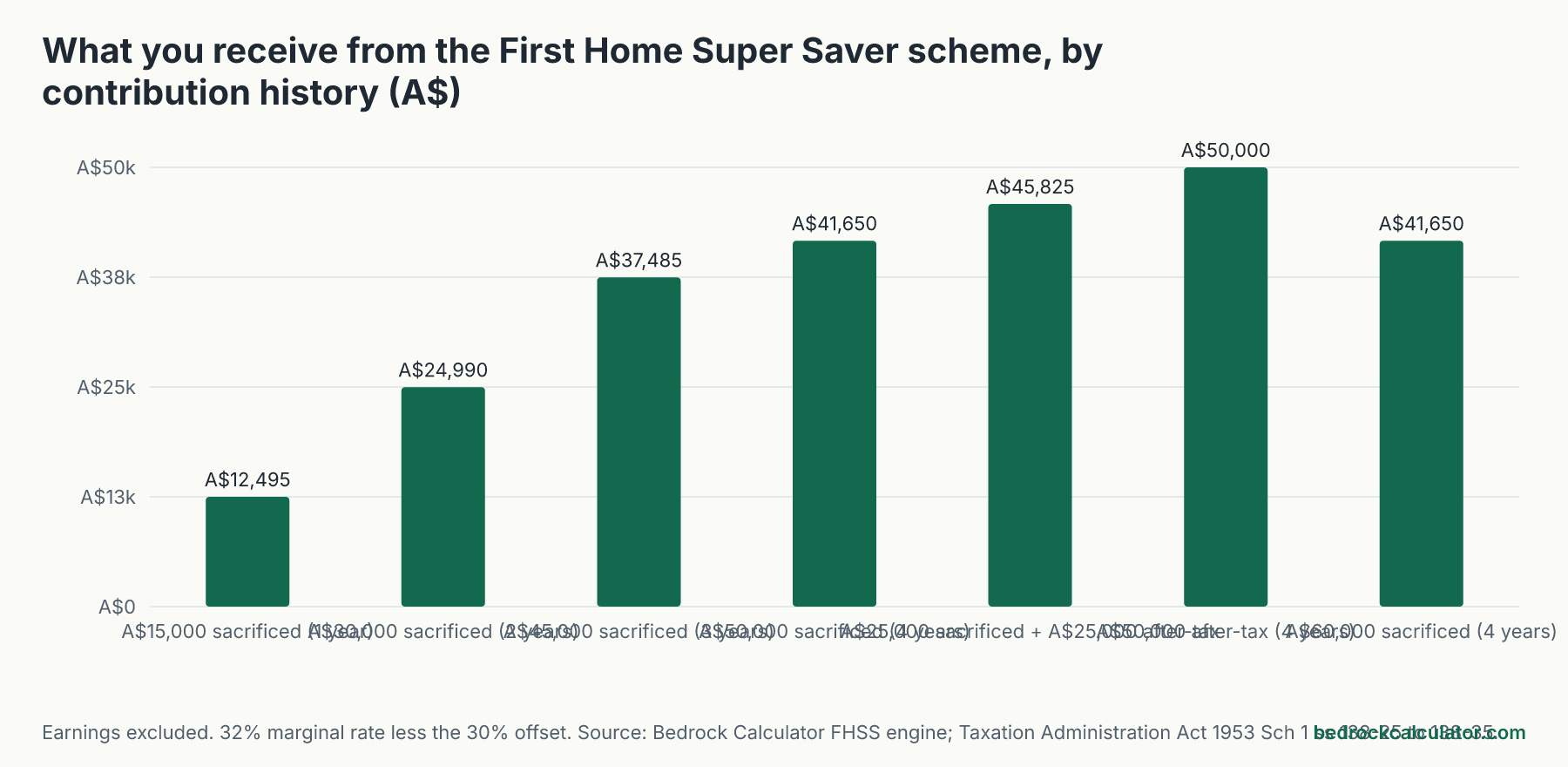
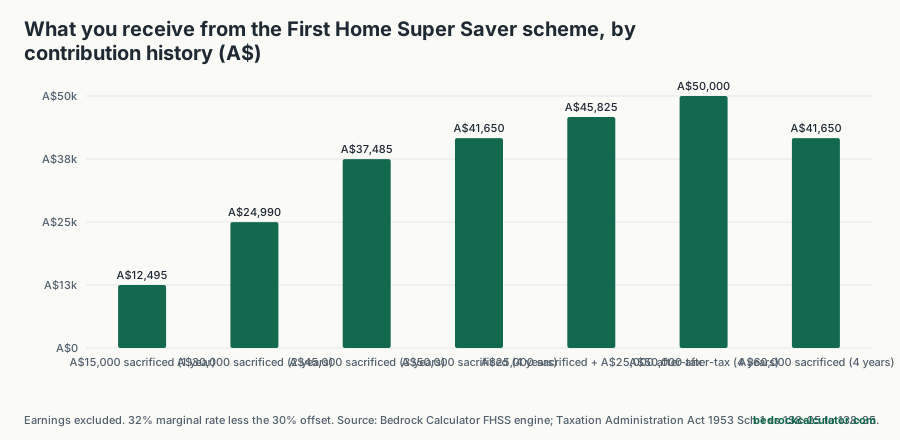
The table below runs seven histories through the calculator. Earnings are set to nil so you can see the contribution part clearly. Tax is estimated at a 32% marginal rate, the 30% bracket plus the Medicare levy, which leaves 2% once the offset is applied.
First Home Super Saver release by contribution history, Australia 2026-27 (A$, before earnings)
Download CSVAssociated earnings set to nil; they are added on top of each release and taxed. Tax is an estimate at a 32% marginal rate (30% bracket plus the 2% Medicare levy) less the 30% offset.
| A$15,000 salary sacrificed (1 year) | A$12,750 | A$12,750 | A$255 | A$12,495 |
| A$30,000 salary sacrificed (2 years) | A$25,500 | A$25,500 | A$510 | A$24,990 |
| A$45,000 salary sacrificed (3 years) | A$38,250 | A$38,250 | A$765 | A$37,485 |
| A$50,000 salary sacrificed (4 years) | A$42,500 | A$42,500 | A$850 | A$41,650 |
| A$60,000 salary sacrificed (4 years) | A$42,500 | A$42,500 | A$850 | A$41,650 |
| A$25,000 sacrificed + A$25,000 after-tax | A$46,250 | A$21,250 | A$425 | A$45,825 |
| A$50,000 after-tax (4 years) | A$50,000 | A$0 | A$0 | A$50,000 |
Two rows are worth a closer look. The mixed history, A$25,000 sacrificed and A$25,000 after tax, releases A$46,250, more than the A$50,000 sacrifice alone (A$42,500), because after-tax money isn't reduced by the 85% rule. And A$60,000 of salary sacrifice releases A$42,500, the same as A$50,000, because only A$50,000 of contributions can ever count.
Is it worth doing?
For a salary sacrifice, the comparison is with simply taking the money as pay. On a A$100,000 salary, sacrificing A$15,000 reduces take-home pay by A$10,200 for the year, as worked out by the take-home pay calculator. The FHSS release returns A$12,495 before earnings, A$2,295 more, and the earnings add to that.
The gap is bigger on higher salaries, where the tax saved going in is larger.
There are trade-offs. Salary sacrifice counts toward your concessional cap, so it competes with other contributions. The money is locked in super until the ATO releases it. And once it's released, you need to sign a contract to buy or build a home within the period the law sets and tell the ATO you have.
How we worked out these numbers
Every figure comes from the Division 293 and FHSS calculator on this site:
- Division 293 runs use income for surcharge purposes excluding super, with A$25,000 or A$15,000 of concessional contributions, all within the cap
- FHSS runs use the contribution totals shown, earnings set to nil, and a 32% marginal rate for the tax estimate
- The take-home pay comparison is a resident on A$100,000 in 2026-27 with hospital cover and no other deductions
When the contributions you've made add up to more than the limit, the law counts them in the order they were made. The calculator doesn't know that order, so it counts concessional and after-tax contributions in proportion to their totals.
What these numbers leave out
- Associated earnings. The ATO calculates them at the shortfall interest charge rate, which changes every quarter. They add to every release and are taxed. Enter your own figure in the calculator.
- Your actual marginal rate in the release year. The FHSS tax depends on your other income that year. The estimate uses one rate.
- Excess contributions over the concessional cap, and defined benefit funds, which follow different Division 293 rules.
- Eligibility. FHSS needs you to be 18 or over, never to have owned property in Australia, and not to have used the scheme before.
Run your own numbers
Use the Division 293 and FHSS calculator with your own income, contributions, earnings and marginal rate. The superannuation calculator shows how contributions grow to retirement, and the stamp duty calculator covers the other big cost of a first home.