How much tax does negative gearing save in Australia?
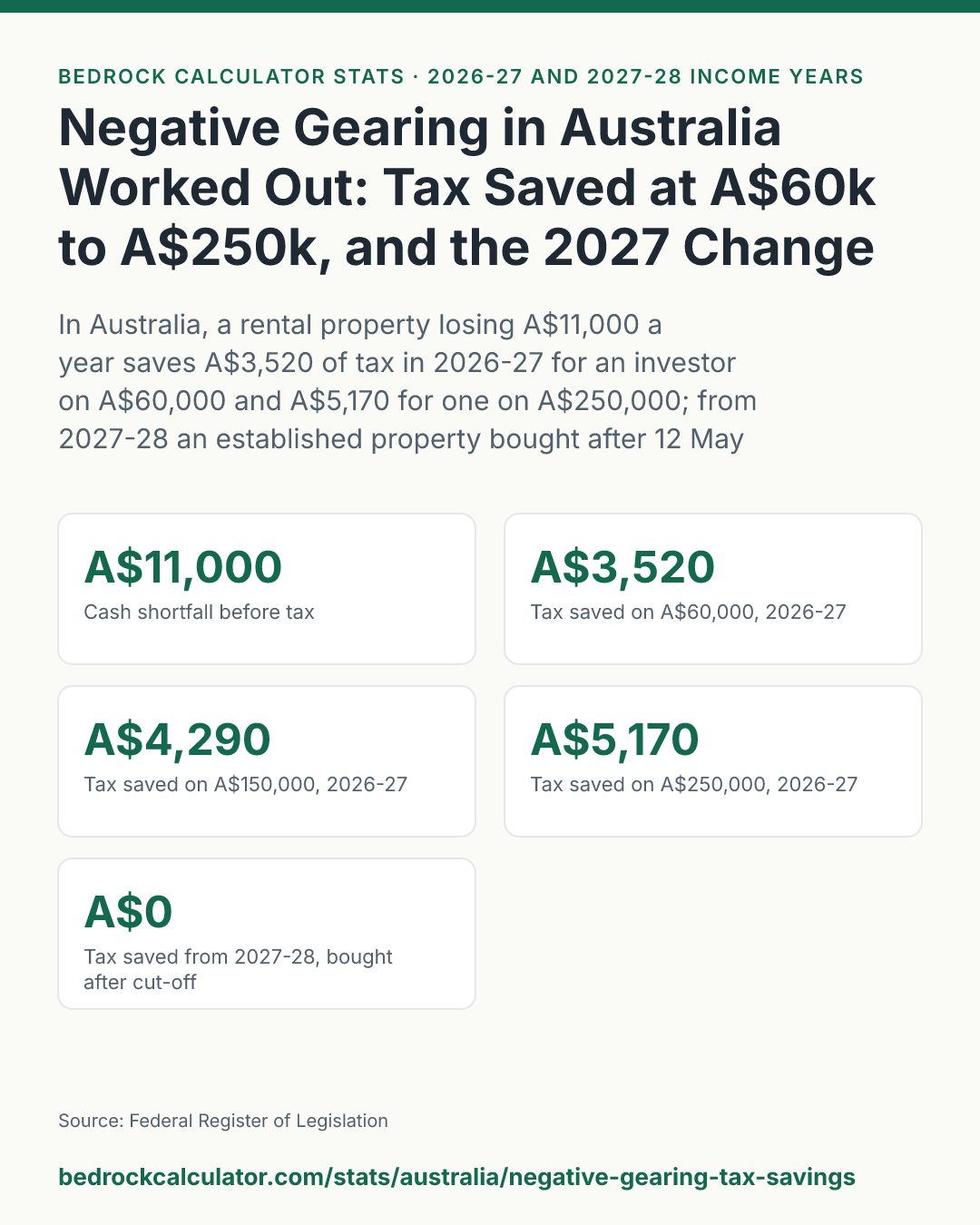
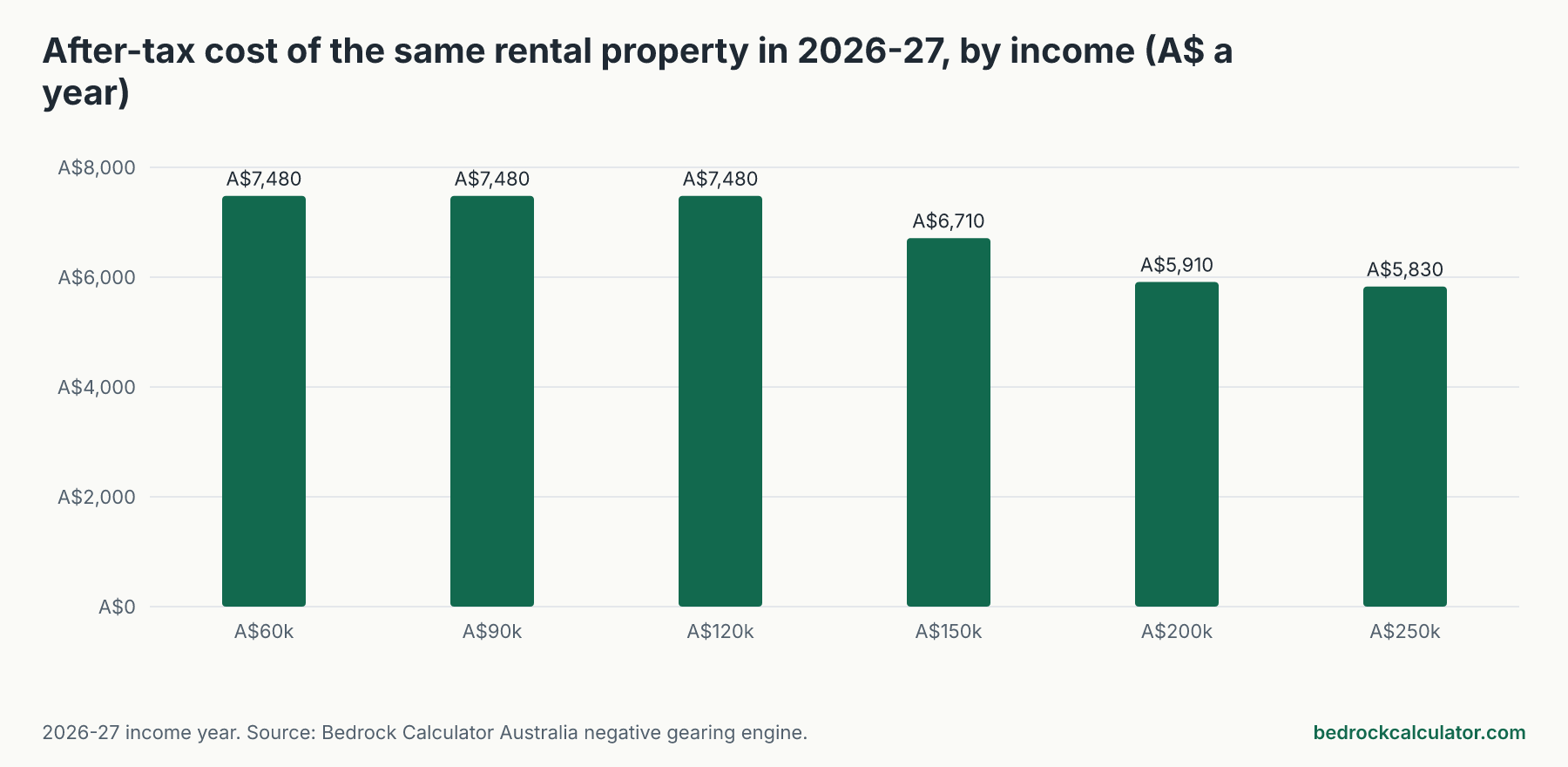
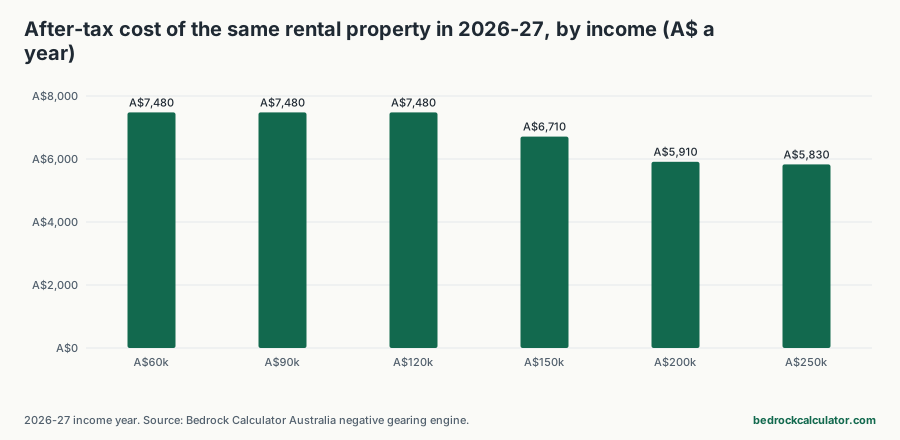
Take a rental property in Australia that costs A$11,000 a year more than it earns in rent. In the 2026-27 income year, an investor earning A$60,000 gets A$3,520 of that back in tax. An investor on A$250,000 gets A$5,170 back. The after-tax cost of holding the same property falls from A$7,480 to A$5,830 as income rises.
From 2027-28 the rules change. If the property is an established dwelling bought after 7.30pm on 12 May 2026, the loss can no longer be claimed against your salary at all. It's carried forward instead, so the tax saved that year is nil at every income.
How we worked out these numbers
We ran the Australia negative gearing calculator on this site for one example property at six levels of other taxable income, from A$60,000 to A$250,000. The property is the same in every run:
- Rent of A$32,000 a year
- Loan interest of A$34,000 a year
- Other deductible costs of A$9,000: rates, insurance, strata, agent fees, repairs and depreciation
That's A$43,000 of deductions against A$32,000 of rent, a cash shortfall of A$11,000, or about A$212 a week before tax.
The calculator subtracts the deductible loss from your other taxable income, works out income tax and the Medicare levy with and without it, and reports the difference as tax saved. We show three cases: the 2026-27 income year, and the 2027-28 income year for a property bought after the 12 May 2026 cut-off and one bought before it.
The numbers are year one only. The calculator doesn't apply tax offsets or the Medicare levy surcharge, and it takes the costs as entered without checking whether each one is deductible or how depreciation should be spread. It also leaves out the capital gain or loss when you eventually sell, which is where the investment is meant to pay off.
Negative gearing tax savings at every income
Click a column heading to sort.
Negative gearing in Australia: year-one tax saved and after-tax cost by income (A$)
Download CSVOne established residential property: A$32,000 rent, A$34,000 interest and A$9,000 of other deductible costs, a cash shortfall of A$11,000 before tax. Tax saved includes the Medicare levy. "Quarantined" is an established dwelling bought after 7.30pm (ACT legal time) on 12 May 2026; "grandfathered" was bought before.
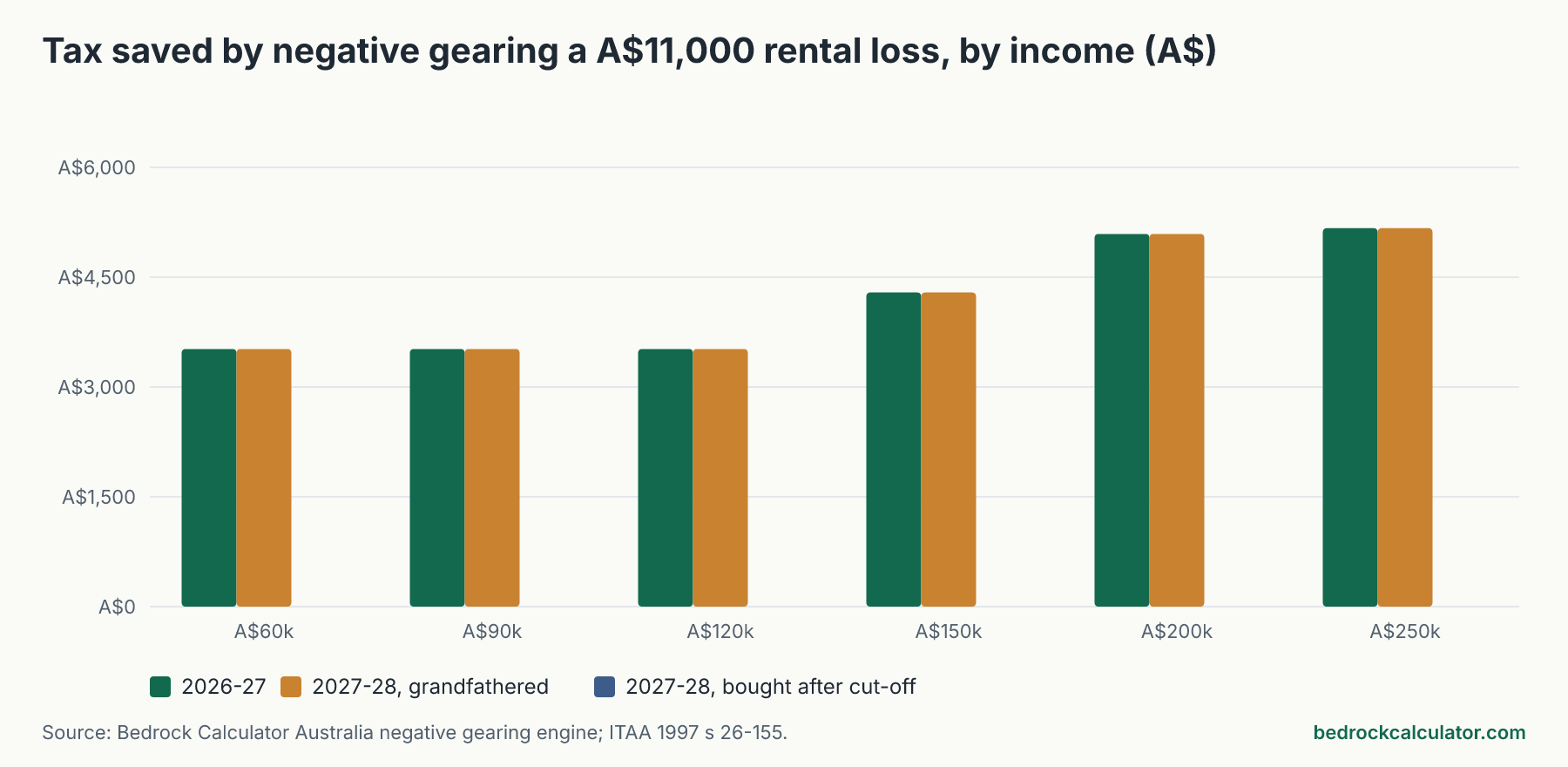
| A$60,000 | A$3,520 | A$7,480 | A$3,520 | A$0 | A$11,000 |
| A$90,000 | A$3,520 | A$7,480 | A$3,520 | A$0 | A$11,000 |
| A$120,000 | A$3,520 | A$7,480 | A$3,520 | A$0 | A$11,000 |
| A$150,000 | A$4,290 | A$6,710 | A$4,290 | A$0 | A$11,000 |
| A$200,000 | A$5,090 | A$5,910 | A$5,090 | A$0 | A$11,000 |
| A$250,000 | A$5,170 | A$5,830 | A$5,170 | A$0 | A$11,000 |
Why higher earners save more
The deduction saves tax at your marginal rate, plus the Medicare levy. Everyone from A$60,000 to A$120,000 in this example is in the same 30% tax bracket after the deduction, so each saves A$3,520: 32.0% of the loss.
At A$150,000 the whole loss comes off income taxed at 37%, so the saving rises to A$4,290. At A$200,000, where the loss straddles two brackets, it's A$5,090, and at A$250,000, where the whole loss comes off income taxed at 45%, it's A$5,170, or 47.0% of the loss. Same property, same cash shortfall, A$1,650 a year more back in tax for the highest earner.
That's why the after-tax cost varies so much:
At A$60,000 the property costs A$7,480 a year after tax, around A$144 a week. At A$250,000 it costs A$5,830, around A$112 a week.
What changes from 2027-28
Legislation passed in June 2026 adds a new section 26-155 to the tax law. From the 2027-28 income year, if your rental deductions on residential property exceed the rent, the excess is not deductible against other income such as salary. Three groups are exempt:
- Properties you last acquired before 7.30pm (ACT legal time) on 12 May 2026. The contract date is what counts, not settlement.
- New residential dwellings.
- Dwellings used for purposes the Minister sets out, limited to social and affordable housing and certain disadvantaged groups. The calculator doesn't model any of these determinations.
For a property in the first two groups, nothing changes. The table shows the 2027-28 tax saved on a grandfathered property is the same as in 2026-27 at every income in our example, from A$3,520 to A$5,170.
For an established property bought after the cut-off, the tax saved in 2027-28 is nil, and the after-tax cost at A$150,000 jumps to the full A$11,000, A$4,290 more than a grandfathered property costs the same investor.
Is the quarantined loss lost?
No, and this is the part that's often misunderstood. The quarantined amount can be used against a net capital gain in the same year. Whatever is left becomes a rental deduction in the next income year, so the loss is deferred rather than lost.
In our example the full A$11,000 rolls forward from 2027-28, and it can be used once the property's rent exceeds its costs or when you sell at a gain.
So the change is mainly about timing. You still get the deduction, but later, and only against rental profits or capital gains, not your wages. For someone holding a heavily geared property for years, that delay can be long.
Is negative gearing worth it?
A loss is still a loss. Even at A$250,000 you're out A$5,830 a year in cash after tax. Negative gearing only makes sense if the property's value grows by more than the after-tax losses, and after capital gains tax on the sale.
The same 2026 law withdraws the 50% CGT discount on established property for sales from 1 July 2027, which changes that sum too; see what the CGT discount is worth at each income.
Run your own numbers
Enter your rent, interest, costs and income in the Australia negative gearing calculator, and set the income year and purchase date. The capital gains tax calculator handles the sale. On the way in, compare stamp duty by state, and once you own the property, the Australia land tax calculator works out the yearly land tax on the published NSW, Victorian and Queensland schedules.