What is a fully franked dividend worth at each tax rate?
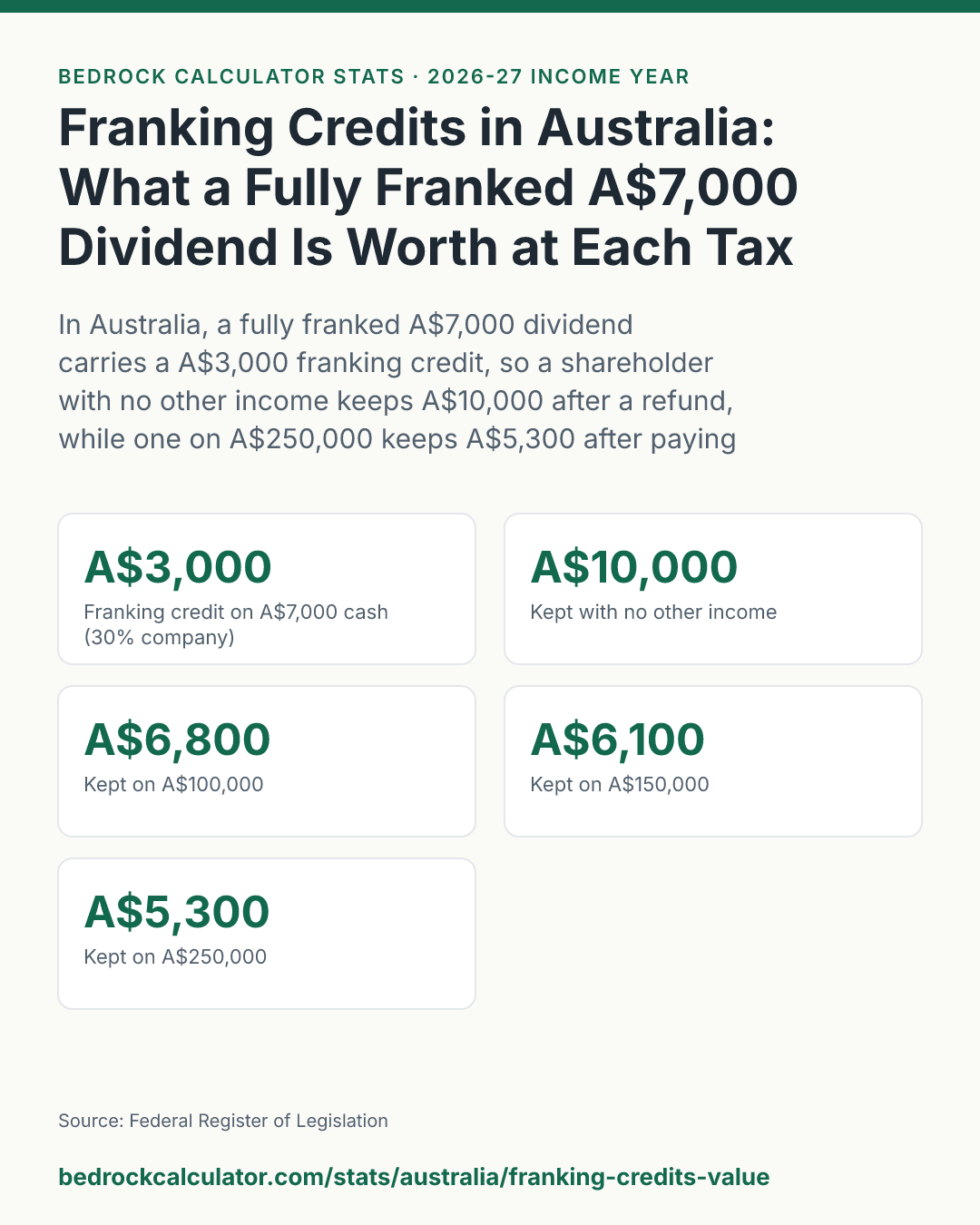
A fully franked dividend in Australia comes with a tax credit for the company tax already paid. On a A$7,000 cash dividend from a company paying 30% tax, that franking credit is A$3,000.
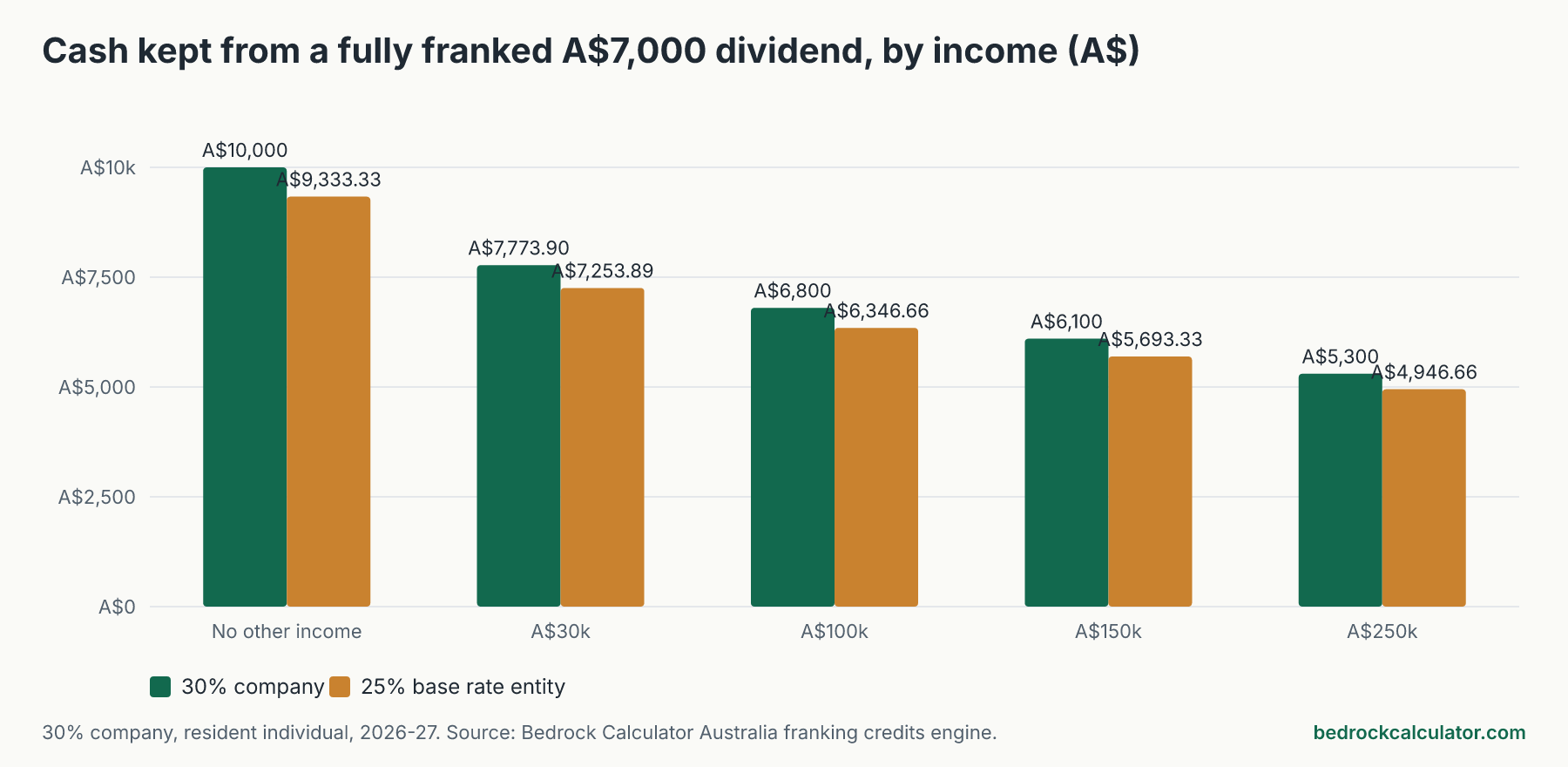
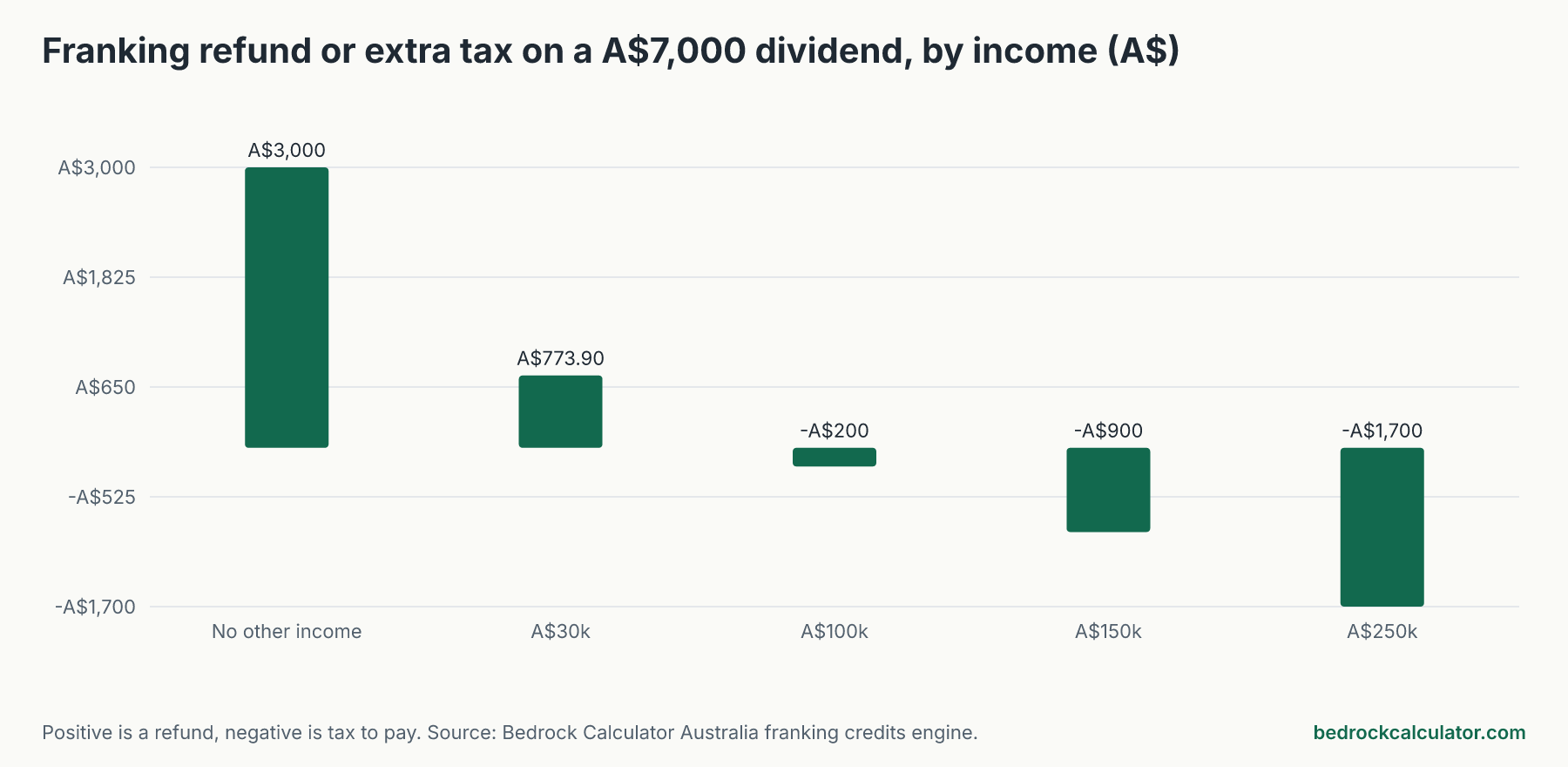
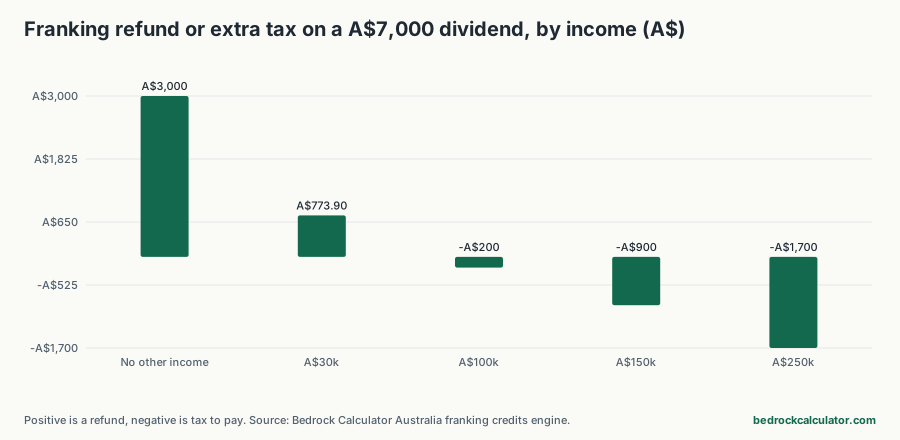
What it's worth to you depends on your tax rate. With no other income, you get the whole credit back as a refund and end up with A$10,000. On A$100,000 the credit almost exactly covers your tax and you keep A$6,800. On A$250,000 you pay A$1,700 on top and keep A$5,300.
How franking credits work
When an Australian company pays a dividend out of profits it has already paid tax on, it can attach a franking credit for that tax. A fully franked dividend carries the full credit.
You then do three things at tax time:
- Add the credit to the cash dividend. Your A$7,000 becomes a "grossed-up" dividend of A$10,000 in your assessable income.
- Work out tax on your income including that grossed-up amount.
- Subtract the A$3,000 franking credit from your tax as an offset.
If your tax rate is lower than the company's, the credit is more than the tax on the dividend, and the excess is refunded to resident individuals. If your rate is higher, you pay the difference.
How we worked out these numbers
We ran the Australia franking credits calculator on this site for a A$7,000 fully franked dividend at five levels of other taxable income, chosen so the grossed-up dividend falls in each of the 2026-27 tax brackets: no other income, A$30,000, A$100,000, A$150,000 and A$250,000. Each run assumes an Australian resident individual, includes the Medicare levy, and treats the franking offset as refundable.
We ran every income twice: once for a company paying the standard 30% rate, and once for a smaller base rate entity paying 25%, which attaches a smaller credit of A$2,333 and grosses the dividend up to A$9,333.
The calculator applies the low income tax offset before the franking offset, which matters at A$30,000, but not the seniors and pensioners tax offset, so an eligible retiree's refund would be a little larger than shown. It also doesn't apply the holding period rule (you generally need to hold shares at risk for 45 days to use the credit, unless your credits are small), the Medicare levy surcharge, or the different rules for super funds, companies and trusts.
What a franked dividend is worth at each income
Click a column heading to sort. A positive figure in the refund column is money back; a negative one is extra tax to pay.
What a fully franked A$7,000 dividend is worth at each income, Australia 2026-27 (A$)
Download CSVResident individual, franking offset refundable, Medicare levy included. Company pays 30% tax unless shown as a 25% base rate entity. Low income tax offset applied; seniors and pensioners tax offset not applied.
| A$100k | A$3,200 | -A$200 | A$6,800 | A$6,346.66 |
| A$150k | A$3,900 | -A$900 | A$6,100 | A$5,693.33 |
| A$250k | A$4,700 | -A$1,700 | A$5,300 | A$4,946.66 |
| A$30k | A$2,226.10 | A$773.90 | A$7,773.90 | A$7,253.89 |
| No other income | A$0 | A$3,000 | A$10,000 | A$9,333.33 |
Who gets a refund of franking credits
Anyone whose tax on the grossed-up dividend is less than the credit. With no other income, the A$10,000 sits below the tax-free threshold and the Medicare levy threshold, so there's no tax at all and the whole A$3,000 comes back. That's why franking refunds matter so much to retirees with low taxable income and to people in the pension phase of super.
At A$30,000 the tax on the dividend is A$2,226, an effective 22.3% of the grossed-up amount, so you still get A$774 back.
Franked dividends in the middle tax bracket
At A$100,000 your marginal rate including the Medicare levy is 32.00%. That's just above the company's 30%, so the credit covers nearly everything and you pay only A$200 more. You keep A$6,800 of the A$7,000 cash dividend.
Franked dividends for high earners
Above the middle bracket you pay extra. At A$150,000 the marginal rate is 39.00% and the top-up is A$900. At A$250,000 it's 47.00%, the top-up is A$1,700, and you keep A$5,300. That's 53.0% of the grossed-up dividend, against 100.0% for someone with no other income.
Franking doesn't make dividends tax-free for high earners. What it does is stop the same profit being taxed twice: the company's 30% counts toward your tax, and you pay only the gap to your own rate.
Dividends from a base rate entity
Smaller companies with turnover under the base rate entity threshold pay 25% company tax, so their dividends carry a smaller credit. With no other income you'd keep A$9,333 from the same A$7,000 cash dividend, rather than A$10,000. At A$250,000 you'd keep A$4,947 after paying A$2,053 more tax.
The final column of the table shows the base rate entity figure at every income. In every case it's lower, because less company tax was paid and less credit comes with the dividend.
Work out your own franking credits
Enter your cash dividend, franking percentage and other income in the Australia franking credits calculator. The distribution statement from the company shows the franking percentage and whether it franks at 30% or 25%. For the rest of your tax, the Australia income tax calculator covers your salary, and if you sell the shares, the capital gains tax calculator works out the tax on the gain. Our article on tax on a share or property gain at each income shows how that changes from 1 July 2027.