How much tax is due on a capital gain in Australia after the CGT discount?
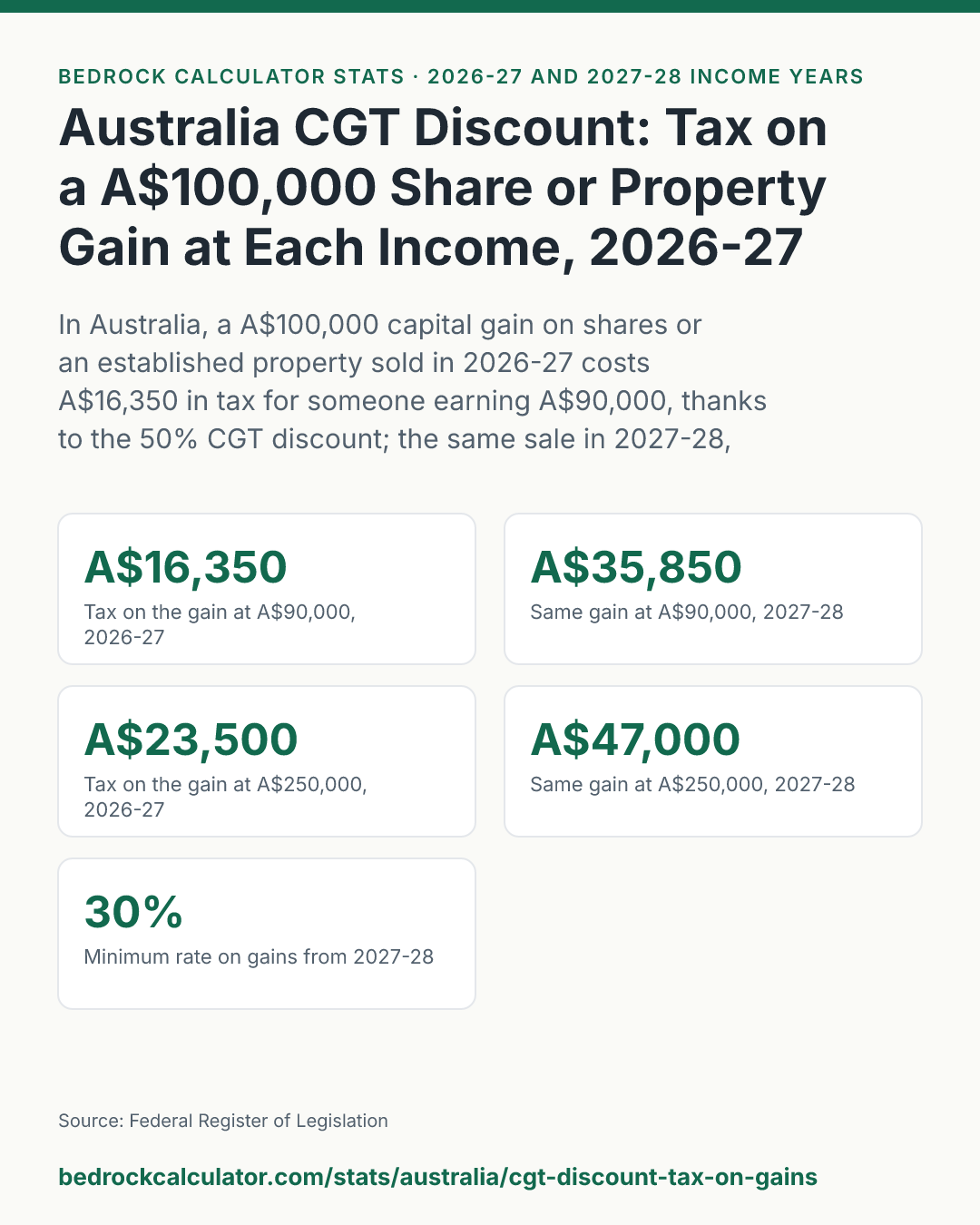
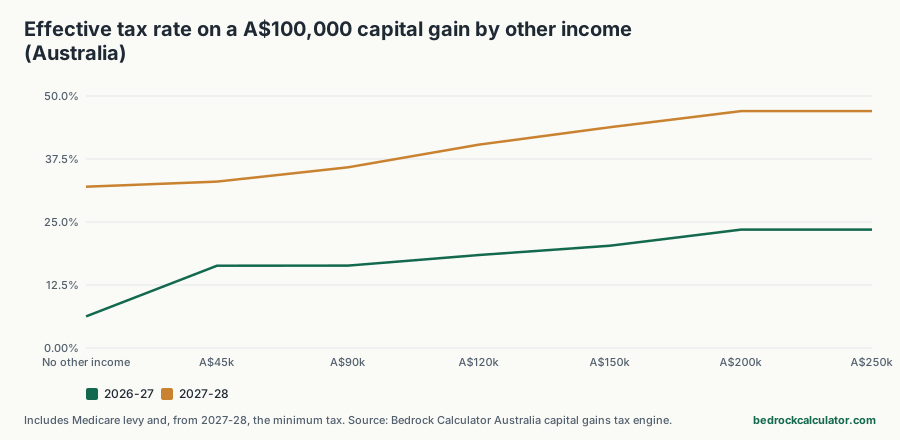
Sell shares or an established investment property in Australia for a A$100,000 gain in the 2026-27 income year, and the 50% CGT discount means only half the gain is taxed. Someone with A$90,000 of other income pays A$16,350. Someone on A$250,000 pays A$23,500.
Make the same sale in 2027-28 and the bill roughly doubles, because the discount is withdrawn for most assets from 1 July 2027 and a new 30% minimum tax on gains starts. At A$90,000 the tax rises to A$35,850; at A$250,000 it rises to A$47,000.
How we worked out these numbers
We ran the Australia capital gains tax calculator on this site for one gain at seven levels of other taxable income, from nothing up to A$250,000. The asset was bought for A$500,000 and sold for A$600,000, a gain of A$100,000. It was held for more than 12 months, the seller is an Australian resident individual, and there are no capital losses.
For each income we ran three cases:
- A sale in 2026-27: the 50% discount applies, so A$50,000 of the gain is added to taxable income
- A sale in 2027-28 of shares or an established property: no discount, and the new Division 119 minimum tax applies
- A sale in 2027-28 of a new residential dwelling, which keeps the discount under the 2026 law
The calculator adds the taxable part of the gain to your other income, works out the extra income tax and Medicare levy, and from 2027-28 adds any minimum tax top-up. The tax shown is the extra tax caused by the gain, not your whole tax bill.
It leaves some things out. It applies the low income tax offset but no other offset, such as the seniors and pensioners tax offset, and it doesn't apply the Medicare levy surcharge. It doesn't apportion a gain on a property that changed use after 1 July 2027, a rule the 2026 law also adds. And the main residence exemption, small business concessions and rollovers aren't modelled. The cost base is taken as entered.
Tax on a capital gain at every income
Click a column heading to sort. The rate columns show the tax as a share of the whole A$100,000 gain.
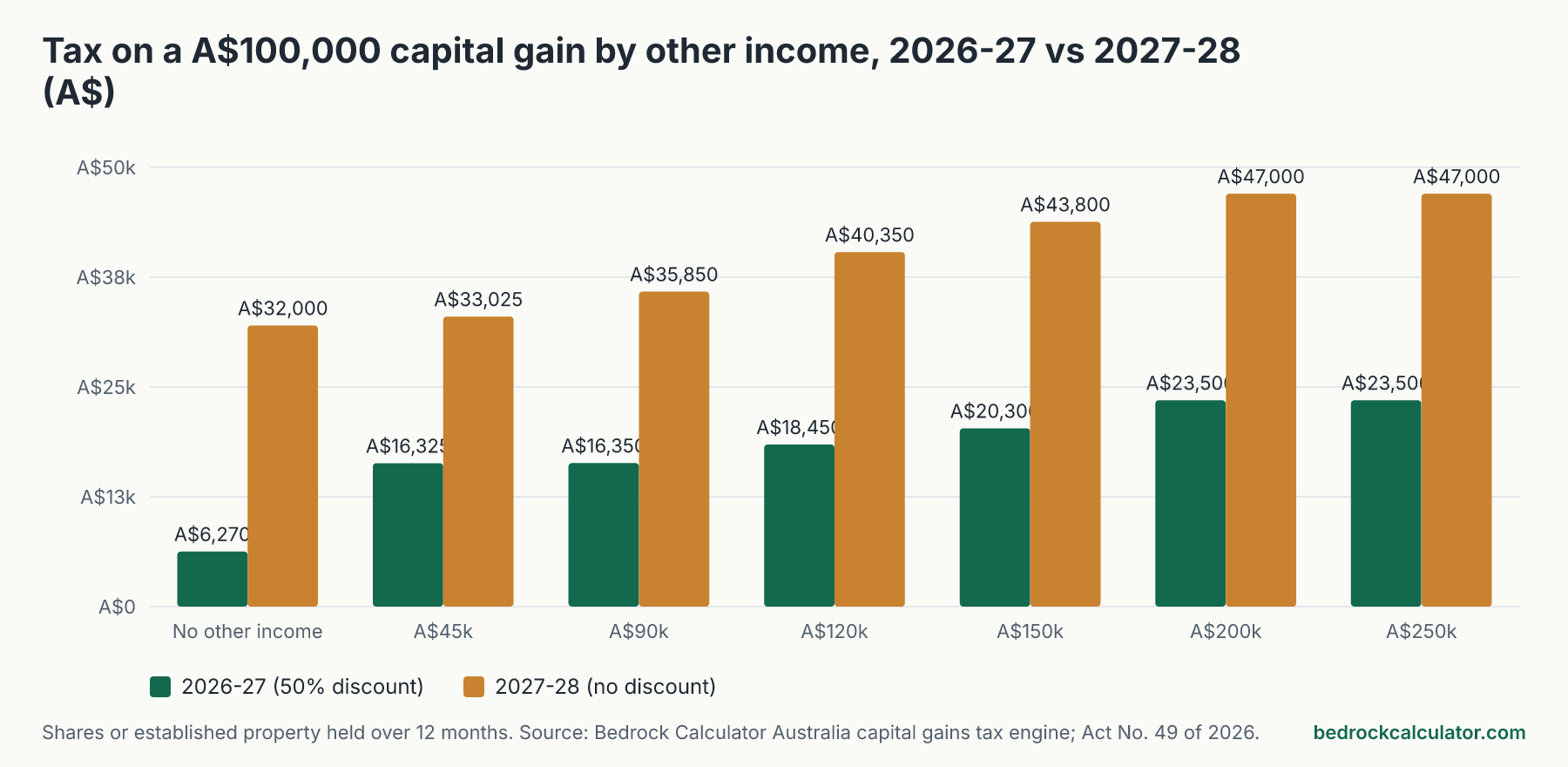
Tax on a A$100,000 capital gain in Australia by other income: 2026-27 vs 2027-28 (A$)
Download CSVResident individual, asset held over 12 months, no capital losses. Tax includes income tax, the Medicare levy and, from 2027-28, the Division 119 minimum tax. "New dwelling" is a sale in 2027-28 of a new residential dwelling, which keeps the discount.
| A$0 | A$6,270 | 6.3% | A$32,000 | 32.0% | A$6,002 |
| A$45,000 | A$16,325 | 16.3% | A$33,025 | 33.0% | A$16,325 |
| A$90,000 | A$16,350 | 16.4% | A$35,850 | 35.9% | A$16,350 |
| A$120,000 | A$18,450 | 18.4% | A$40,350 | 40.4% | A$18,450 |
| A$150,000 | A$20,300 | 20.3% | A$43,800 | 43.8% | A$20,300 |
| A$200,000 | A$23,500 | 23.5% | A$47,000 | 47.0% | A$23,500 |
| A$250,000 | A$23,500 | 23.5% | A$47,000 | 47.0% | A$23,500 |
How the 50% CGT discount works
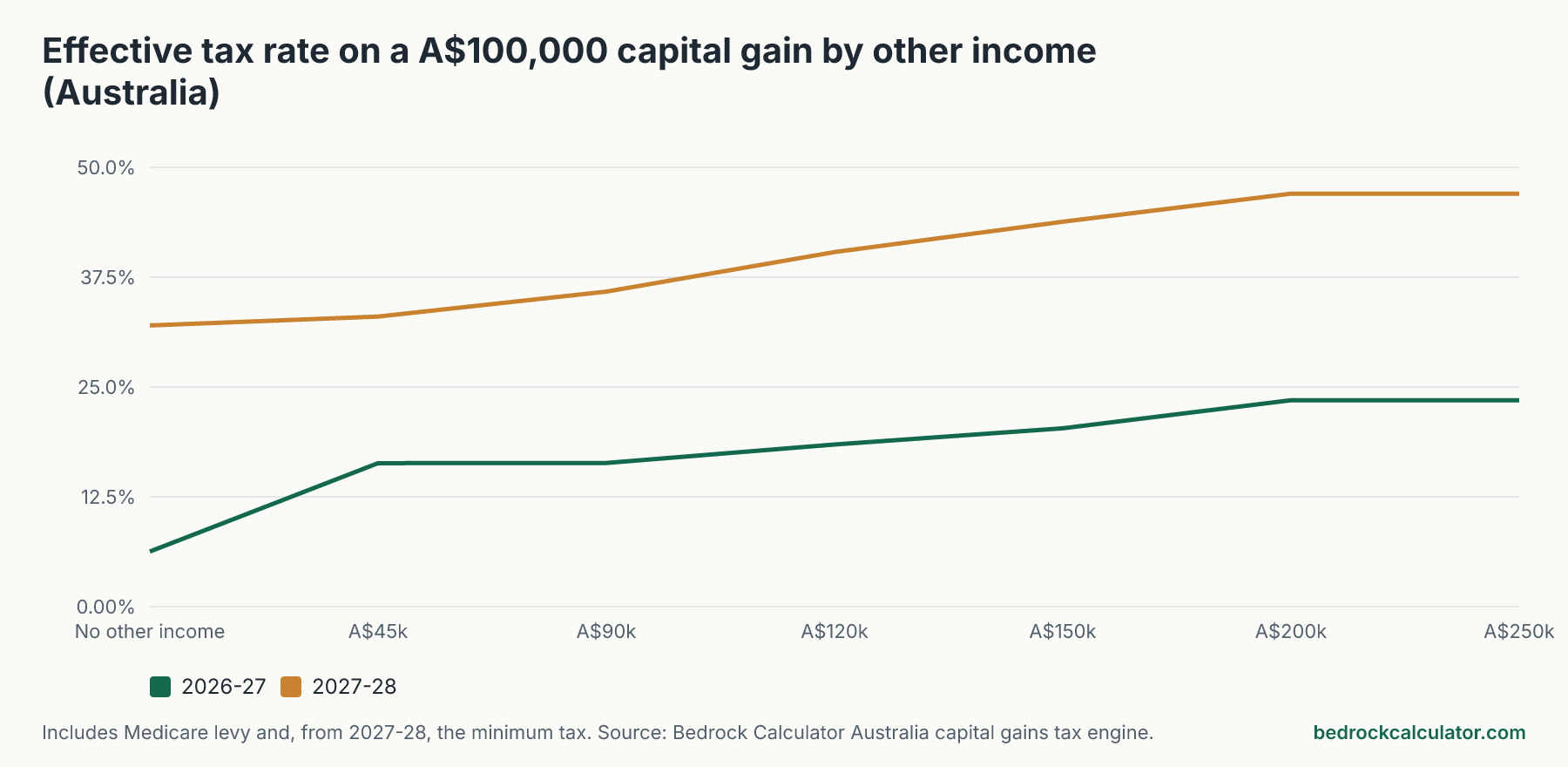
Under the discount, only half the gain counts as income. That half is then taxed at your marginal rate plus the Medicare levy. So in 2026-27 the effective rate on the whole gain is roughly half your top marginal rate.
With no other income, the taxable half of the gain mostly falls in the low brackets and the effective rate is 6.3%, a bill of A$6,270. At A$90,000 it's 16.4%. At A$250,000, where all of it is taxed at the top rate, it's 23.5%.
What changes from 1 July 2027
Legislation passed in June 2026 rewrites the discount. For a CGT event on or after 1 July 2027, an individual's discount is nil unless the gain is on a new residential dwelling or affordable housing. The whole gain is taxed as income.
It also adds a floor. Division 119 says the tax on a capital gain must be at least 30% of the gain before offsets. If your ordinary tax on the gain comes in below that, you pay the difference as a minimum tax top-up.
You can see both effects in the table. With no other income, the whole A$100,000 is now taxed, but the brackets alone would still leave the rate below 30%, so the minimum tax adds A$9,748. The total, including the Medicare levy, is A$32,000, against A$6,270 a year earlier: an extra A$25,730, the largest jump of any income we tested.
At A$90,000 and above, the gain is already taxed above the floor, so the minimum tax adds A$0. The bill rises because the discount is gone: from A$16,350 to A$35,850 at A$90,000, and from A$23,500 to A$47,000 at A$250,000, an extra A$23,500. In 2027-28 the effective rate at A$250,000 is 47.0%.
New residential dwellings keep the discount. Sold in 2027-28, the same gain on a new dwelling costs A$16,350 at A$90,000 and A$23,500 at A$250,000, the same as in 2026-27.
Should you sell before 1 July 2027?
On these numbers a sale in 2026-27 always costs less tax than the same sale a year later. On a A$100,000 gain the difference is A$19,500 at A$90,000 and A$23,500 at A$250,000.
That doesn't make selling right for everyone. Selling means transaction costs, possibly stamp duty to buy back in, and giving up an asset you may want to hold. For property, you'd also need a buyer and a settlement date that fits. And the law can change again. But if you were planning to sell in the next year or two anyway, the timing is worth a careful look with your accountant.
Working out your own capital gains tax
Enter your sale price, cost base, other income and the income year in the Australia capital gains tax calculator. If the asset is a rental property, the negative gearing calculator shows what it costs to hold, and our article on negative gearing worked out at several incomes covers the 2027 change to rental losses. To see how Australia's tax on gains compares with other countries, see capital gains tax by country.